Language


 No results found
Driving in Sri Lanka: Tips and requirements
Would you like to know the requirements for driving in Sri Lanka? Here is a comprehensive guide. Keep reading!

If you’re planning on driving in Sri Lanka and want to explore the country at your own pace, we’ve put together a guide to help you understand all the requirements and documents you’ll need.
We’ve also included sections with key information, such as the traffic rules that differ in Sri Lanka, fuel and toll costs, and the approximate hourly rates for street parking.
Stay with us, and you’ll get a full guide to visiting this Asian island and driving smoothly, with all the essential dos and don’ts for getting around safely.
Driving licenses valid in Sri Lanka
First off, you should know that in Sri Lanka, having just an International Driving Permit or your home country’s license isn’t enough. There’s an extra step you need to take to be able to drive legally in the country.
There are three licenses you’ll theoretically need to drive on the island. The two we mentioned earlier are part of the process you must complete before arriving in Sri Lanka, after which you can obtain a locally issued driving permit.
Your country’s license
No matter your nationality, you must have a valid driver’s license issued by your home country. It also needs to be current and remain valid for the entire duration of your stay in Sri Lanka.
International Driving Permit
You need to arrange this permit from your home country through the local agency that handles international driving licenses. To apply, you must have your national driver’s license, which is usually required to be at least one year old.
Sri Lankan driver’s license
This is the only license that allows you to drive legally in Sri Lanka, so you’ll need to obtain it upon arrival, regardless of your immigration status. Make sure to check the specific documentation required for your situation.
Requirements and documentation for driving in Sri Lanka
Here’s what you need to know about getting a temporary driving permit in Sri Lanka, including the documents required. There are three different ways to obtain it, so which option you choose will depend on how much time and effort you’re willing to put in once you arrive.
From Bandaranaike International Airport
The easiest way to get your temporary driving permit in Sri Lanka is at Bandaranaike International Airport. You can start the process and receive the permit the same day by providing the required documents and meeting the necessary requirements.
Original documents and copies:
- Valid passport in perfect condition.
- Valid visa.
- Driver’s license from your country (translated).
- International Driving Permit, which usually translates your national license into English (recommended).
- Completed driver’s license application form.
- Two passport-size photos.
- Payment of the application fee, which is 2,000 Sri Lankan rupees (approximately $6.50).
Requirements:
- Minimum age to drive: 18 years old, while rental agencies require you to be at least 21 years old.
- Insurance valid for Sri Lanka with coverage for driving and third-party protection.
- Licenses that are more than 2 years old (recommended by car rental agencies).
From the Automobile Association of Ceylon (AAC) in Colombo
This motor vehicle organization can help you process your driving permit and is located at 40 Sir Mohomad Macan Markar Mawatha, Colombo 00300, Sri Lanka. The process here may take longer and be slightly more expensive than doing it at the airport. Here’s what you’ll need to provide:
Original documents and copies:
- International Driving Permit
- Valid passport
- Sri Lankan visa.
- One or two passport-size photographs.
- Completed driving license application form.
- Payment of application fees, which can be up to 8,000 Sri Lankan rupees (approx. $26).
Requirements:
- You must be over 18 years old to drive a regular car. If you are renting a car, the minimum age is 21.
- Valid insurance with coverage for drivers and third-party damage.
- National driver’s license valid for more than 2 years.
3. Through a car rental agency
This is a way to get a head start on your temporary driving permit in Sri Lanka. You can reach out to a local car rental company and ask them to begin the process for you.
Remember, this option comes with an extra fee on top of the car rental, but it allows you to start driving right when you arrive. The documents and requirements are the same as before, so be sure to submit everything needed to make the process faster.
Travel tip
When you arrive in Sri Lanka and start driving, you’ll need internet access to use GPS, stay in touch with friends and family, and share data with other passengers so they can check plans or help navigate using apps like Waze.
We recommend Holafly’s monthly plans, which provide 25 GB or unlimited data that you can share with the devices of your travel companions.
They’re also global, so if you’re traveling to other countries after Sri Lanka, you won’t need to switch plans or SIM cards, as coverage extends to over 160 countries. You can also take advantage of the unlimited data eSIM for Sri Lanka for just the days you need.
Important: If you are a frequent traveler and want to stay connected without worrying about expensive roaming or looking for a new SIM at every destination, Holafly’s subscription plans are for you. With a single eSIM, enjoy internet in more than 160 countries for a fixed price and no surprises on your bill. Travel without limits and connect easily and securely! 🚀🌍

Traffic rules in Sri Lanka and signage
In Sri Lanka, traffic and transportation rules are governed by the Motor Traffic Act, established by the Ministry of Transport and Highways along with the Road Development Authority.
You’ll find that many traffic rules are similar to those in other countries, but with a few local twists to match driving conditions in Sri Lanka. Here are some key ones to keep in mind to avoid fines:
- Speed limit: The speed limit on urban roads is 50 km/h, while on highways and motorways it is between 70 and 100 km/h.
- Direction of traffic: In Sri Lanka, they drive on the left, with the steering wheel on the right.
- Alcohol and drug restrictions: It is prohibited to drive under the influence of any substance that impairs the senses.
- Seat belts: Mandatory for front seat passengers.
- Overtaking on the road: The proper way to overtake is on the right, and you should use your turn signal to indicate the lane change. Larger vehicles generally have the right of way.
- Motorcycle traffic: Motorcycles are prohibited from driving on highways.
- Motorcycle clothing: Helmets are mandatory for both motorcycle passengers.
- Traffic lights: Traffic lights generally work like in other countries, but some may show red and yellow together, which means get ready to move. Others might have a flashing yellow light, signaling you to slow down and proceed with caution.
- Cell phone use: You may only answer calls using hands-free devices. Using your cell phone while driving is prohibited.
The most common traffic fines in Sri Lanka
Some mistakes made by foreign drivers in Sri Lanka can lead to fines, and in serious cases, even jail time. That’s why we’ve listed the most common traffic violations and their penalties for driving in the country:
| Offense | Fine |
| Driving without a valid license | LKR 25,000 ($82) |
| Driving under the influence of alcohol or drugs | LKR 25,000 ($82) |
| Speeding | Between 2,000 and 25,000 LKR ($7-82) depending on the speed recorded by the authorities |
| Traffic violations | Between 2,000 and 25,000 LKR ($7-82) |
Tolls and refueling
Toll fees in Sri Lanka vary depending on how far you travel and the type of vehicle you’re driving, so costs can differ. One useful reference for estimating toll expenses by distance is the route from Colombo to Kandy.
The two cities are about 117 km apart, and according to the Highway Toll Calculator, the fee is roughly $2 to $3 for small cars and around $4 to $5 for buses. Sri Lanka is also expanding its payment options, and some toll points now accept debit and credit cards.
When it comes to refueling, most vehicles in Sri Lanka run on gasoline or diesel. Major providers like Shell and Lanka IOC are widely available, with gasoline priced at around $4.13 per gallon and diesel at about $3.93 per gallon, according to Global Petrol Prices.
Parking in Sri Lanka
Parking in Sri Lanka can take a bit of patience, but it’s manageable if you plan ahead and follow traffic rules. In larger cities and popular tourist areas, parking tends to be more limited due to the high number of vehicles.
Public street parking is usually regulated by local authorities, though it may also be managed by parking attendants who charge hourly fees ranging from about $0.15 to $0.45.
In tourist areas, parking is usually available at hotels, restaurants, and shopping centers. Fees vary by location, but hotel parking is often free, while other private parking rates typically range from about $0.30 to $0.75.
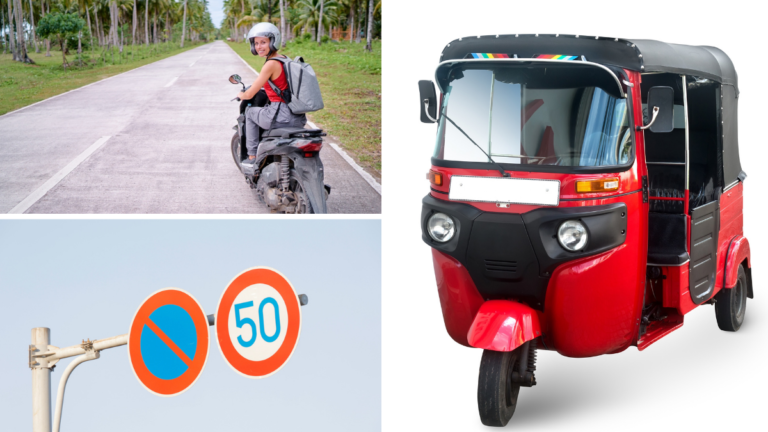
There are also areas where parking is strictly prohibited under any circumstances. These include intersections and places marked with circular signs featuring a red border and a diagonal line or an “X.”
Parking is also not allowed on streets with double yellow lines, on sidewalks, at crosswalks, or in bus-only lanes, which is especially common in Colombo.
Options for renting a car in Sri Lanka
Car rentals are common in Sri Lanka among tourists and foreigners staying in the country for a while. There’s a wide range of options available to suit different travel styles and driving needs.
Some services even offer car rentals with a local driver included. This is popular because city traffic can be quite chaotic, and a local driver who knows the streets and driving habits can handle the busiest times more easily.
Types of cars commonly rented in Sri Lanka
Local car rental agencies in Sri Lanka offer a wide range of vehicles. You can choose anything from small standard cars to 4×4 SUVs, depending on your travel needs and budget.
You’ll find SUVs from brands like Toyota or Mitsubishi, ideal for mountainous or challenging roads, as well as smaller cars like the Toyota Premio or Honda City, which are more fuel-efficient and cost less to run. Here’s a list of approximate daily rental rates by vehicle type:
| Vehicle | Price per day | Price per week | Price per month |
| Compact cars (for two to four passengers) | Between 6,000 and 9,000 LKR (approximately $20 to $30) | Between 40,000 and 60,000 LKR (between $130 and $200) | Between 120,000 and 180,000 LKR (between $400 and $600) |
| 4×4 trucks | 15,000–25,000 LKR ($50–80) | 100,000–160,000 LKR ($330–530) | 300,000–480,000 LKR ($1,000–1,600) |
| Tuk Tuk | 3,000-5,000 LKR ($10-16) | 20,000–35,000 LKR ($65–115) | 60,000–100,000 LKR ($200–330) |
Tips for driving in Sri Lanka as a foreigner
Here are some tips for driving in Sri Lanka. Since it’s different from what you might be used to, staying alert and aware of local traffic behavior is key to avoiding accidents and traffic violations.
1. Documentation
Make sure you have all the necessary documents to drive in Sri Lanka: your local driving permit, passport, visa, and travel insurance that covers drivers.
Also, familiarize yourself with the key vehicle documents you may need to show to authorities while driving on highways or city streets.
2. Study Sri Lanka’s specific traffic regulations
Most traffic rules in Sri Lanka are similar to those used around the world. However, there are a few local quirks you should be aware of to avoid accidents or fines.
For example, knowing the driving direction, how certain traffic lights work, where parking is allowed, and the proper way to overtake are all details that can make a big difference when driving on the island.
3. Study the routes you will be taking
Familiarizing yourself with your routes is essential to understand where you’re starting from, the roads you’ll take, and the distance to your destination. This will help you estimate travel time and also locate gas stations, restaurants, hospitals, and accommodations along the way.
This way, you can travel more relaxed, getting a feel for the country’s geography and spotting key tourist spots where you can stop for photos along the way.
4. Confirm that your travel insurance is valid in Sri Lanka
This is an important point because you might purchase travel insurance that isn’t valid in Sri Lanka, doesn’t cover your travel needs, or doesn’t meet the requirements set by local traffic authorities.
That’s why it’s important to make sure your travel insurance covers damage to other people or their property, any damage to the car you’re driving, and includes medical assistance for yourself or others in case of an accident.
5. Avoid driving at night
If you’re not familiar with the roads, it’s best to drive only during the day, as you won’t know the condition of some stretches. Many roads in Sri Lanka also have poor lighting, which can make driving at night riskier.
6. Don’t get cut off
Be sure to get either Holafly’s monthly subscription plans or the eSIM for Sri Lanka. Both options let you check travel information, use GPS, and stay in touch with friends, family, or your insurance in case of an emergency.
Frequently asked questions about driving in Sri Lanka
Even if you meet most of the requirements and have the necessary documents, rental agencies will likely not let you rent a car, as their policy is to only serve customers over 21 years old.
No, the application fee must be paid in cash using Sri Lankan rupees, so it’s a good idea to exchange your currency beforehand to make the process smoother.
It really depends on where you’re going and the kind of trip you’re taking. If you’re traveling between cities, a car is more comfortable, practical, and faster. But if you’ll be staying in a big city, using public transportation is usually a better choice, since traffic can be overwhelming for some drivers.
Yes, but it’s still a growing niche. Both the number of users and the infrastructure are expanding, and charging stations aren’t yet as widespread or convenient as regular gas stations.
Plans that may interest you


Hi! I'm a Spanish-English translator working with Holafly, helping bring travel content to life for curious travelers. As a digital nomad with a passion for exploring, I'm always adding new spots to my bucket list. If you love to travel like me, stick around because you're in the right place to find inspiration for your next trip! ✈️🌍