Language


 No results found
Driving in Spain: Tips and requirements
Will you be driving in Spain? Be sure to read this comprehensive guide to stay up to date with the regulations and have a smooth trip.

Driving in Spain can be a pleasant experience if you’re familiar with the rules, the required paperwork, and the local driving style. Roads are generally in excellent condition, with modern highways, and cities blend historic districts with wide, well-marked avenues. For that reason, whether you’re visiting as a tourist or planning a longer stay, it’s worth understanding how driving works in the country before getting behind the wheel.
There are a few driving quirks in Spain that are good to be aware of. Some highways charge tolls, traffic laws are strictly enforced, speed cameras are common, and city driving can be hectic, particularly in places like Madrid and Barcelona. You’ll also find that driving styles differ from one region to another: the north is generally more laid-back, while the south tends to be livelier.
This guide covers everything you need to know to drive in Spain easily and without stress. We explain the requirements for foreign drivers, which licenses are accepted, and how toll roads and parking work. Whether you are planning a trip or preparing for a move, you are in the right place. Let’s get started!
Which driver’s licenses are valid in Spain?
If you are a foreigner planning to drive in Spain, the first thing to check is whether your current license is valid or if you need an additional permit. The rules depend on your country of origin and on how long you plan to stay in Spain. In most cases, driving is straightforward for short visits, but if you remain in the country for more than six months, you will likely need to obtain a Spanish driving license.
Spain allows several types of driving licenses, including foreign licenses, those issued in the EU and the European Economic Area, the International Driving Permit, and in some cases licenses from non EU countries that have specific agreements in place. Each option comes with its own requirements, so it is best to review them individually.
Licenses from the European Union and the European Economic Area
If your driving license was issued by a country in the EU or the EEA, such as Iceland, Liechtenstein, or Norway, you can drive in Spain without any extra paperwork. There is no need for an international permit or additional validation. As long as your license is valid, in good condition, and not expired, you can use it without issue.
If you stay in Spain for more than six months, the Spanish traffic authority will ask you to register in the national drivers database. It is a straightforward process with no tests involved and simply confirms your residency status. You may also choose to exchange your license for a Spanish one, although this is optional.
Licenses from third countries with agreements
Spain has agreements with several countries that allow their citizens to drive and later exchange their license for a Spanish one without taking a practical test. These countries include Argentina, Chile, Colombia, Peru, Ecuador, Uruguay, Brazil, Venezuela, Panama, and the Dominican Republic, among others.
With a valid license from any of these countries, you can drive in Spain for the first six months after becoming a resident. If you are just visiting as a tourist, you can use your license for the entire stay, as long as it’s temporary and doesn’t exceed six months.
If you stay longer and become a resident, you will need to exchange your license through the Spanish traffic authority. The process involves submitting your valid license, a medical fitness certificate, an ID, and a document proving your Spanish residency.
In most cases, you will not have to take a practical or theoretical exam. The new Spanish license will be of the same category as your original license.
Licenses from countries without agreements
If your country isn’t on the agreement list, you can drive in Spain with your foreign license for up to six months from your arrival, whether you’re visiting as a tourist or starting your residency.
Once that time is up, you’ll have to start the process of getting a Spanish license, which includes taking a required theory course, passing a written test at the traffic office, and completing a practical driving exam.
This is commonly the case for countries such as the United States, Mexico, Australia, the United Kingdom (after Brexit), Japan, and Canada, among others.
International Driving Permit (IDP)
The International Driving Permit is an additional document that translates your license into several languages. It does not replace your regular license and is only meant to be used alongside it. In Spain it is required in two specific situations:
- If your license is not written in the Latin alphabet.
- If you come from a country without an agreement and are traveling only as a tourist.
You can get it in your home country before traveling, usually through the official traffic authority. It is typically valid for one year.
Where can these licenses be obtained or processed in Spain?
The Spanish traffic authority handles all license-related procedures, from registering a European license to exchanging a non-EU license or applying for a new Spanish one. You can begin the process online or make an appointment to do it in person at any local office.
What other requirements and documents are necessary to drive in Spain?
Having a valid license is only part of what’s needed to drive in Spain. You also need to meet certain personal requirements, carry the proper documents, and make sure your vehicle meets local regulations. The good news is that most of these rules are straightforward and easy to follow if you check them before your trip.
Below, I will detail everything you need to drive without any problems.
Minimum and maximum age for driving
The minimum age for driving in Spain depends on the type of vehicle:
- 18 years old for cars (B license).
- 16 years old for mopeds.
- 21 years old for professional or larger vehicles.
There is no general maximum age for driving. However, the Spanish traffic authority requires more frequent license renewals once you turn 65. This includes regular medical check-ups to make sure you are still fit to drive.
Physical conditions and disabilities
Spain allows people with certain disabilities to drive, as long as their vehicle has the necessary adaptations and they have passed the required medical exams. In these cases, the license may include codes specifying the mandatory modifications, such as automatic transmission, hand controls, or special mirrors.
Required documentation for driving
Whether you are driving your own car or renting one, you must always carry:
- A valid driver’s license (and International Driving Permit, if applicable).
- Identity card or passport.
- Rental agreement, if the car is not yours.
- Vehicle registration certificate.
- ITV (Vehicle Technical Inspection) card, physical or digital.
- Valid insurance policy.
Most rental companies provide all the vehicle documentation, so you just need to check that it is complete before picking it up.
Compulsory insurance
All vehicles in Spain are required to have liability insurance, which covers any damage you might cause to others. Rental cars typically include this basic coverage, but you can opt for additional protection if you want extra peace of mind while driving.
Driving without insurance is a serious offense, with heavy fines and even immobilization of the vehicle.
ITV: Vehicle Technical Inspection
The ITV is a mandatory technical inspection that ensures that the car is fit to drive. How often it is required depends on the age of the vehicle:
- Less than 4 years old: No ITV required.
- From 4 to 10 years: Inspection every 2 years.
- Over 10 years: Annual inspection.
If you are traveling in a rental car, you won’t have to worry about this, as the company always takes care of it before delivering each vehicle.
Environmental labeling
Many Spanish cities, including Madrid and Barcelona, have Low Emission Zones where only vehicles with an environmental badge are allowed. These badges classify cars based on their emission levels: B, C, ECO, or ZERO.
If you rent a car, it will usually already have the required badge. If you bring your own foreign vehicle, you’ll need to get the appropriate badge or check whether your car is allowed in these zones. Failing to follow the rules can result in hefty fines.
Mandatory items inside the car
To drive in Spain, the vehicle must carry:
- Reflective vest.
- Two emergency triangles or an approved V16 light.
- Spare tire or puncture repair kit.
- Basic tools depending on the vehicle.
If you rent a car, check before leaving the agency that everything is included in the trunk. If not, ask them to equip the vehicle with everything you need.
Stay connected when driving in Spain
While Spanish roads are usually easy to navigate, having a stable internet connection can be a big help for GPS, checking traffic, finding alternate routes, or getting assistance if something goes wrong. If you’re traveling with others, an eSIM lets you keep several devices connected in the car without needing external WiFi.
This is where Holafly’s monthly plans come in. With a global eSIM, you can enjoy unlimited data or 25 GB to get around Spain without any hassle. You can even drive into France or Portugal and stay connected, since Holafly covers more than 160 countries. All of this comes with no roaming fees and an easy setup.
Important: If you are a frequent traveler and want to stay connected without worrying about expensive roaming or looking for a new SIM at every destination, Holafly’s subscription plans are for you. With a single eSIM, enjoy internet in more than 160 countries for a fixed price and no surprises on your bill. Travel without limits and connect easily and securely! 🚀🌍

What are the traffic rules and road signs in Spain?
Driving in Spain is straightforward if you are familiar with the basic rules of the road. Most of them are similar to those in other European countries, but there are a few local specifics worth keeping in mind before you head out. Knowing these in advance will help you drive more safely, avoid fines, and enjoy a smoother experience behind the wheel.
Direction of traffic and right of way
In Spain, traffic keeps to the right and overtaking is done on the left. Roundabouts are very common, especially in cities. Vehicles already inside the roundabout have the right of way, so you need to wait for a safe gap before entering.
Pedestrians have the right of way at crosswalks. If you’re coming from a country where this isn’t common, it’s something to watch out for so it doesn’t catch you off guard.
Speed limits in Spain
Speed limits vary depending on the type of road, but in general they are as follows:
- Highways and expressways: 120 km/h.
- Conventional roads: 90 km/h.
- Urban roads: 50 km/h (although many single-lane streets are now limited to 30 km/h).
- School zones or residential areas: Lower speed limits, signposted.
Be aware that both fixed and mobile speed cameras are widespread, especially on high risk stretches of road. Speeding is one of the most common violations and also one of the most expensive. If you are visiting as a tourist and plan to rent a car, this is particularly important to keep in mind, as a fine can quickly impact your travel budget.
Use of cell phones and electronic devices
As in most countries, using your phone while driving is illegal in Spain, even if you are stopped at a traffic light. To stay on the safe side, you will need a hands free system or a fixed phone mount.
Do not underestimate this rule, as the penalties for this offense are high and often include loss of points on the license for residents.
Alcohol allowed while driving
Spain is strict about alcohol consumption. The permitted limits are:
- 0.5 g/l in blood (0.25 mg/l in breath) for most drivers.
- 0.3 g/l in blood (0.15 mg/l in breath) for new and professional drivers.
Keep this in mind, as alcohol and drug checks are common, especially on main roads and during weekends. Fines can be steep, and in some cases the penalties may even involve criminal charges.
Mandatory lights for driving in Spain
Low-beam headlights are required at night, in tunnels, and in conditions like fog, heavy rain, or poor visibility, as well as on poorly lit roads. In fact, many drivers choose to keep their lights on during the day when driving outside urban areas for added safety.
Use of seat belts and child restraint systems
Here’s another rule that applies almost everywhere: seat belts are mandatory for all passengers, in every seat and at all times. That means whether you are driving on highways, secondary roads, or city streets, and even on short trips or at low speeds.
Be especially careful in urban areas, as this is one of the most common fines. You can be penalized even if the car only moves a short distance, such as when changing parking spots or driving a few meters down a small city street.
Minors, meanwhile, must always travel in child restraint systems appropriate for their age and size.
Signage in Spain
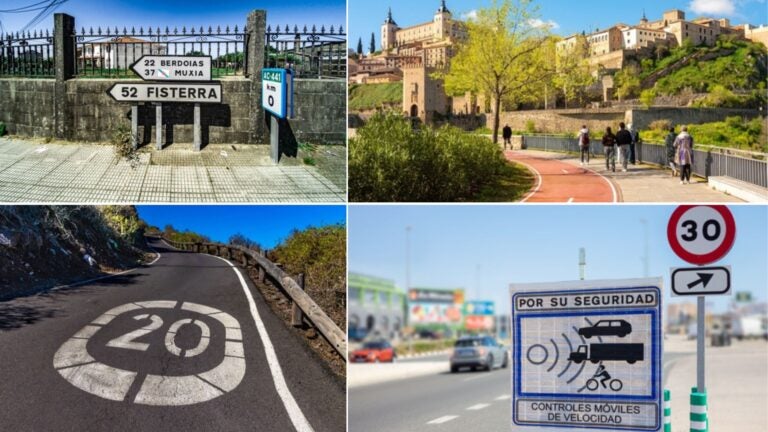
Another area that often leads to fines is road signage. You don’t need to be overly worried, but it’s wise to pay attention. Most signs are similar to those in other European countries, though there are a few local details worth noting.
As for colors, they tend to follow the European pattern:
- Blue: Mandatory lanes or expressways.
- Red: Prohibitions.
- Yellow: Temporary restrictions or warnings.
- Green: Highways and freeways.
Temporary yellow signs for roadworks take precedence over permanent ones. Lane directions can change throughout the day on some roads, and in certain cities you’ll come across signs for Low Emission Zones, which might be a new concept if you’re visiting from Latin America.
If you are traveling from countries outside Europe, you will notice that the signs are very visual, which makes driving easier for tourists.
Penalties and driving regulations in Spain
Spain has a detailed system of fines aimed at reducing accidents and improving road safety. While penalties vary depending on the severity of the offense, there are common violations you’ll want to avoid. Below is a table with approximate amounts for the most frequent fines.
| Violation | Description | Fine |
| Speeding | Exceeding the speed limit on urban or interurban roads | $120 to $700 depending on the excess |
| Using a cell phone while driving | Holding or handling a phone while driving | $230 |
| Driving under the influence of alcohol | Exceeding the legal limit (0.5 g/l in blood or 0.25 mg/l in breath) | $600-1,170 |
| Not wearing a seat belt | Driver or passengers not wearing seat belts on any type of road | $230 |
| Running a red light | Failing to stop at a red light | $230 |
| Driving without compulsory insurance | Vehicle without civil liability insurance | High fine + vehicle immobilization (variable, normally $700-3,500) |
| Entering Low Emission Zones without authorization | Entering restricted areas with an unauthorized vehicle | $230 (depending on the municipality) |
| Lack of mandatory items (vest, triangles/V16 light) | Not carrying the required safety equipment | $230 |
| Driving under the influence of drugs | Presence of substances in the body (regardless of quantity) | $1,170 |
| Refusing to take an alcohol or drug test | Refusing to comply with police checks | $1,170 + criminal offense |
How do tolls and fuel charges work in Spain?
Besides traffic signs and regulations, another important aspect of driving in Spain is knowing how tolls work and what options you have for refueling along the way. Whether you’re planning a short trip or a longer journey, understanding these details will help you better manage your budget and travel time.
Tolls in Spain: How they work and how much they cost
Spain has two main types of major roads: freeways and toll highways. Freeways are free to use, while some highways charge tolls, which can vary depending on the section, location, and traffic.
In general, tolls in Spain work in two ways. There are the traditional booths where you pay with cash or card, and the electronic toll system, called Via-T, which charges your account automatically through a device in your car so you don’t have to stop.
If you rent a car, many companies offer Via-T as an optional service. It lets you use the fast lanes and can save you time, especially during peak travel periods.
Approximate toll prices
Prices may vary, but these are approximate ranges for cars:
- Short distances: $3 to $10.
- Medium distances: $10 to $17.
- Long distances or popular tourist routes: $17 to $40.
A typical example is the route from Barcelona to Girona or Málaga to Estepona, where tolls usually range between $6 and $13. On longer routes, such as in some northern regions, prices can be higher.
How to pay tolls?
In Spain, tolls can be paid in three ways: cash, bank card, or through the electronic toll system. Cash is the least used option, though booths still accept it. Paying by card is the most common, while Via-T lets you go through without stopping, which is especially convenient for long or frequent trips.
If you are using a rental car, check whether the company includes the Via-T device and what additional cost this entails.
How to refuel in Spain?
Spain has an extensive network of service stations, so refueling is easy both in cities and along the roads. Some stations are large, with shops and restrooms, while others are smaller and found in towns or on secondary routes.
The most common types of fuel are:
- Gasoline 95 (Unleaded 95): The most widely used and economical for standard cars (between $1.80 and $2.05 per liter)
- Gasoline 98 (Unleaded 98): Higher octane; recommended for high-end vehicles (between $1.99 and $2.29 per liter).
- Diesel: Very common in rental cars and larger vehicles (between $1.80 and $2.05 per liter).
- Electric: Charging stations are available in cities and on some highways (between $0.35 and $0.70 per kWh, depending on the operator).
If you’re used to buying fuel by the gallon, remember that in Spain it’s sold by the liter. The numbers may seem smaller, but a gallon is roughly 3.78 liters, so keep that in mind when comparing prices.
Refueling in Spain is straightforward. You just pull up to the pump, choose the type of fuel, fill up, and then pay inside. Many stations also let you pay directly at the pump with a card, which is handy if you’re traveling outside regular business hours. On highways, all stations accept card payments without any issues.
Tip: If you are renting a car, check what type of fuel it uses. Refueling with the wrong type can result in additional charges.
How does parking work in Spain?
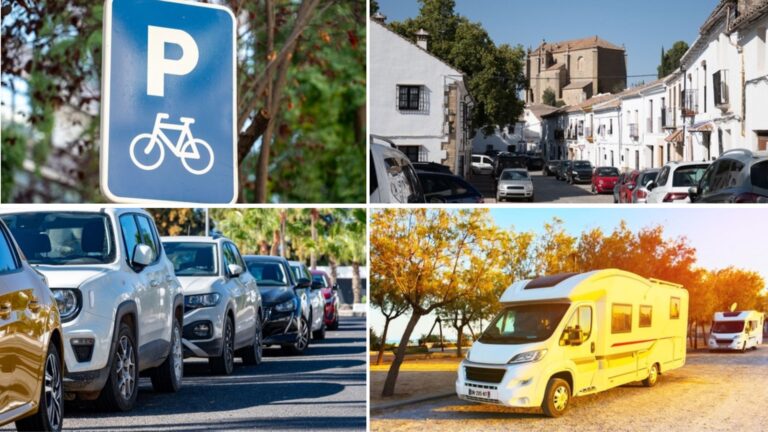
Parking in Spain can be easy or challenging, depending on where you are. Big cities like Madrid, Barcelona, Valencia, and Sevilla have strict rules, while smaller towns tend to be more relaxed. It’s a good idea to know how public and private parking works, which signs to watch for, and what the hourly or daily rates are.
Parking in public spaces
In general, you can park in:
- Designated areas on public roads: Indicated by lines painted on the ground.
- White zones: Free parking with no time limit.
- Blue zones (ORA/OTA): Regulated parking and hourly payment ($1.00 to $3 per hour).
- Green zones: Priority for residents, although in some cases parking is allowed for visitors at a fee ($2.50 to $4 per hour).
- Loading and unloading zones: Only during permitted hours (outside these hours, they are usually open to all vehicles).
To avoid mistakes, always pay attention to road signs and pavement markings, as they show whether parking is allowed, if it’s paid, and the hours it applies.
Places where you CANNOT park
As tempting as it may be to stop for “just a minute,” there are areas where parking is strictly prohibited. These include:
- On sidewalks or footpaths.
- At pedestrian crossings.
- On bends, intersections, or areas with poor visibility.
- In bus lanes or bike lanes.
- Yellow zones or solid yellow lines (always prohibited).
- Loading and unloading zones during active hours.
- Garage entrances and access ramps.
Parking in a prohibited area can result in heavy fines and even the vehicle being towed away.
Regulated parking zones
In many cities, you’ll come across the ORA, OTA, or SER parking systems, depending on the region, but they all work in a similar way. You pay by the hour using a mobile app or a parking meter, and either display the ticket or register your license plate in the app. Maximum parking time usually ranges from two to four hours, depending on the area.
Private parking lots and underground parking garages
If you want to avoid driving in circles or are traveling with luggage, private parking lots can be a convenient option, especially in historic city centers. They are secure and well-located, though usually more expensive than public parking. Typical rates are as follows:
- Per hour: Between $2 and $5, depending on the city.
- Per day: Between $15 and $32.
- Per week: Between $75 and $140 (in large cities).
Traffic signs related to parking
We’ve already told you a little about Spanish traffic signs, but when parking, you’ll need to recognize the following:
- White “P” on a blue background: Parking allowed.
- “P” with restrictions: Time limit or payment required.
- Red circle with a blue diagonal line: No parking.
- Red circle with a blue “X”: No stopping or parking.
- Additional signs: Indicate times, residents, loading and unloading, or other details.
If you’re coming from a country where road signs are very different, such as some in Latin America, you’ll notice that Spain’s system is clearer and more visual, but also stricter.
How to rent a car to drive in Spain?
Renting a car in Spain is a great way to explore the country at your own pace, especially if you’re a tourist, digital nomad, or student. There’s a wide range of options available at airports, train stations, and city-center offices, from international brands like Avis, Hertz, and Sixt to budget companies like Goldcar or Centauro.
For short-term travelers, compact cars are the most popular choice since they’re economical and easy to maneuver in the city. If you’re taking longer trips or traveling with family, you can also opt for an SUV for more space. In most cases, manual transmission is cheaper than automatic.
In terms of cost, renting a compact car usually runs between $27 and $66 per day, or $165 to $385 per week. SUVs are more expensive, typically ranging from $55 to $100 a day depending on the season. Monthly rentals are also common and often come with lower rates.
If you plan to visit several cities, make sure you have a reliable connection for GPS and navigation apps. With Holafly’s eSIM for Spain or their monthly plans, you can stay connected without any issues.
How to rent a car to drive in Spain?
Before hitting the road, it’s a good idea to keep a few things in mind to avoid unexpected problems. Spain is well set up for driving, but each region has its own quirks, so it helps to know them in advance.
Plan your routes in advance
One of the best tips is to plan your routes ahead of time. Some mountain roads, especially in the north or rural areas, can be narrow. In the summer, roadworks and detours are also common. Checking your route beforehand will help you avoid delays and find faster alternatives.
Avoid driving in historic city centers
In many cities, historic centers often have very narrow streets or are even restricted to non resident vehicles. This is especially common in Sevilla, Granada, Valencia, and some northern cities. If you plan to explore an old town, the easiest option is to park your car and continue on foot, which is far more pleasant!
Watch out for cyclists!
It is also important to be mindful of cyclists. Many routes in Spain are popular with cycling groups, especially on weekends. When overtaking, make sure to give at least 1.5 meters of space, and take your time, only passing when you have a clear view of the road ahead.
Watch out for loose animals
On secondary roads, especially in rural areas, you may encounter loose animals or slow-moving farm vehicles. In these sections, it’s best to slow down and be patient, as the stretches are usually short and clearly marked.
Check the weather conditions before hitting the road
If you’re traveling in winter through colder regions like Aragón, Navarra, or Castilla y León, it’s wise to check the weather conditions. Frost and snow can appear on mountain roads, and sometimes chains or winter tires are required. Gas stations often provide updates on road conditions, so you can check before continuing your journey.
Use GPS
Finally, keep in mind that using GPS while driving in Spain is perfectly legal as long as you don’t hold your phone. A windshield or vent mount makes it easier to navigate safely, especially in unfamiliar areas. To stay connected and ensure your navigation app, like Waze, works reliably, a Holafly monthly plan can provide coverage throughout your trip.
Frequently asked questions about driving in Spain
In Spain, you are required to have your driver’s license with you. For Spanish licenses, the official digital version is also valid. Foreign licenses must always be presented in their original form, as photos or scanned copies are not accepted.
Yes, as long as the vehicle has valid international insurance, the original documents, and, if required, the environmental badge. For longer stays, you’ll need to check whether the car requires any additional paperwork to drive legally.
Yes. On highways and in larger cities, it’s common to find gas stations that are open around the clock. Some have attendants, while others operate automatically and accept card payments.
Yes, it can be tricky because of narrow streets and restricted areas. The easiest solution is to park in an underground lot and continue on foot. In smaller towns, on the other hand, parking is usually much simpler.
The rental company will receive the fine and forward it to you. They may also charge an administrative fee for handling it. Following the road signs and speed limits is important to avoid any unexpected costs.
Plans that may interest you


Hi! I'm a Spanish-English translator working with Holafly, helping bring travel content to life for curious travelers. As a digital nomad with a passion for exploring, I'm always adding new spots to my bucket list. If you love to travel like me, stick around because you're in the right place to find inspiration for your next trip! ✈️🌍