Language


 No results found
Driving in South Korea: Tips and requirements
Get behind the wheel and take the best road trips in this country! We'll tell you everything about driving in South Korea.

One of the best ways to explore a foreign country while traveling is to rent a car, as it allows you to move freely without depending on public transportation schedules. If you’re interested in driving in South Korea and want to explore cities like Seoul or Busan, along with their more traditional towns, this article explains everything you need to know about the documents required to get on the road.
We’ll walk you through which driving licenses are accepted in South Korea, the requirements you’ll need to meet, and what the local traffic rules are like. You’ll also find practical information on where to refuel and where parking is allowed. On top of that, we cover your car rental options and share a few final tips to help you enjoy a safe, responsible road trip. Ready to hit the road?
Valid driver’s licenses in South Korea
Whether you’re visiting the country as a tourist or already living here as a digital nomad or student, if you plan on driving in South Korea you’ll need a license that’s officially recognized by the Korean government. The type of license required depends on your nationality and how long you’ll be staying. Below, we explain each situation in more detail.
International Driver’s Permit (IDP)
An International Driving Permit is accepted in South Korea as long as it is accompanied by your valid original driver’s license. If you’re traveling as a tourist, you must apply for it through your country’s traffic authority before your flight, and it is valid for stays of up to one year. South Korea only accepts international permits issued under the 1949 Geneva Convention, and some countries only issue the 1968 version, so you should check this in advance. These are some of the countries that can apply for it:
- Spain
- United States (except certain states)
- United Kingdom
- Australia
- Chile
- Argentina
- Colombia
- Mexico
Validation of your foreign license
If you want to drive in South Korea by exchanging your foreign license, you must be from a country that has a reciprocal agreement with Korea and plan to stay for more than 90 days. This process allows you to skip the practical driving test. You only need to submit a translated copy of your valid license, pass a basic medical exam, and hand in your original license, which the traffic authorities will keep while you use the Korean one.
This procedure is handled at the Driver’s License Examination Office in each city. Some of the countries that have this type of agreement include Spain, the United Kingdom, Australia, Chile, Argentina, Colombia, Mexico, and certain U.S. states.
When to get a Korean driver’s license
If you are staying in South Korea for over a year, you can choose to apply for a Korean driver’s license. This route is also available if your country does not have a license exchange agreement with Korea. To obtain it, you will need to pass the theory test, the practical driving test, and a medical check. The license is issued at the Driver’s License Examination Office and is typically processed within two to three days once all tests are passed.

Requirements and documentation for driving in South Korea
In addition to having a valid license, as we covered earlier, there are several other requirements you must meet to drive in South Korea. These rules cover both the driver and the vehicle, since the country has strict road safety regulations, and not following them can result in fines. Here’s a breakdown of the main requirements:
- Age: The minimum age to drive a car is 18, and there is no maximum age, although drivers over 65 must undergo more frequent medical check-ups. For motorcycles, the minimum age is 16.
- Driver documentation: If you’re driving in South Korea, make sure to have your passport (or Alien Registration Card for stays over 90 days), a valid license or International Driving Permit, and proof of vehicle insurance.
- Compulsory insurance: All vehicles must carry mandatory liability insurance that covers damage to others and personal injuries. If you’re renting a car, this insurance is usually included by the rental company.
- Vehicle inspection: All vehicles must undergo regular safety inspections, with new cars checked every two years and older ones every year, and the inspection sticker must be clearly visible.
- Environmental labeling: South Korea has several low-emission zones, especially in Seoul. Your vehicle must meet the requirements for these zones and, if it’s electric or hybrid, have the Green Vehicle Certification.
Important: If you are a frequent traveler and want to stay connected without worrying about expensive roaming or looking for a new SIM at every destination, Holafly’s subscription plans are for you. With a single eSIM, enjoy internet in more than 160 countries for a fixed price and no surprises on your bill. Travel without limits and connect easily and securely! 🚀🌍

Traffic rules in South Korea and signage
The most important thing to know before driving in South Korea is its traffic rules and road signs, to avoid fines and penalties. The country enforces strict regulations and has an advanced monitoring system on all roads. Here’s a look at the key rules and the penalties for breaking them:
| Violation | Approximate fine |
| Speeding + 10 km/h | $20 |
| Speeding + 20 km/h | $46 |
| Speeding + 40 km/h | $88 |
| Driving under the influence of alcohol (from 0.03%) | Up to $340 or license suspension |
| Running a red light | $40 |
| Using a bus lane | $46 |
Direction of traffic
In South Korea, drivers use the right side of the road, just like in most of Europe, Latin America, and the United States. The steering wheel is on the left, as it is in countries like Spain or Mexico.
Speed limits
Exceeding the speed limit can result in a hefty fine, as South Korea takes speed regulations very seriously. You’ll find signs indicating the limits when entering different sections of highways, school zones, and residential areas.
- Highways: 100–120 km/h
- Rural roads: 60–80 km/h
- Urban areas: 50 km/h on main avenues
- School zones: 30 km/h mandatory (strictly enforced)
Be careful when using your cell phone
Using your phone while driving is completely prohibited, whether it’s texting, using apps, or just holding it in your hand. Traffic cameras in South Korea can detect these actions through the windshield, so only hands-free use is allowed. Fines for holding a phone while driving are around $40, and in serious cases, your license can be suspended.
When to use lights
Headlights are required inside tunnels, even if they are well lit, and are also recommended on rainy or foggy days. Low beams are mandatory, as in most countries, from sunset to sunrise. South Korea also uses smart road signs that tell you which lights to use depending on weather conditions, roadwork, or when approaching a tunnel.
Road signs
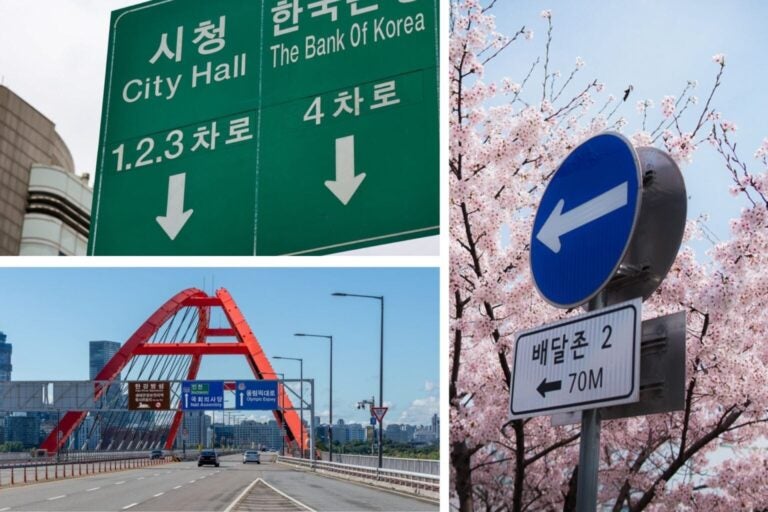
Road signs in South Korea are quite similar to European signs in terms of shapes and colors, but many also include Korean and English text. For example, no-turn signs often feature red arrows with Korean writing. Directional signs use different colors than in Europe: blue for regular directions, green for highways, and yellow in school zones.
Tolls and refueling
If you plan to drive from Seoul to Busan, Gangneung, Incheon, or Gwangju, you’ll be using the country’s highways, which require a toll. Managed by the Korea Expressway Corporation, these highways are fast and well-maintained, and the tolls help keep them in top condition.
Toll prices vary based on the distance traveled, the region, and the type of vehicle. While they are generally cheaper than in Europe, tolls are more frequent, ranging from around $0.80 for short trips to $17 for longer distances. Payment can be made at toll booths using cash, credit card, or T-money, but most vehicles are equipped with the Hi-Pass electronic system, which automatically handles the charge.
When it comes to fuel, you can refuel throughout all major cities and highways, whether it’s gasoline, diesel, LPG, or electricity. Here are some approximate prices for reference:
- Gasoline: From $1.09 per liter
- Diesel: From $0.95 per liter
- LPG: From $0.62 per liter
- Electric charging: From $0.17 per kWh
Parking in South Korea
Now that you know how to drive in South Korea and the main traffic rules, it’s also important to understand how parking works. Cities are full of public and private parking, but there are restrictions in central areas. Signs indicating where parking is allowed are usually blue (free) or white (paid), while no-parking zones are marked with a red circle and an “X” (no stopping or parking) or a diagonal line (no parking), such as in school zones, bus lanes, or crosswalks.
You can park in public lots near subway stations and shopping areas for around $0.69 per hour or $5.45 for a full day. Private lots, which are often found at hotels, malls, and office buildings, typically start at $2.05 per hour or $10.22 for the entire day.
Options for renting a car in South Korea
Let’s take a look at your options for renting a vehicle and driving in South Korea. Whether you need a car to get to a business meeting, university, a coworking space as a digital nomad, or to explore the country at your own pace, here’s where you can rent one and which companies offer the service.
- International airports: Including Incheon (ICN), Gimpo (GMP), and Busan Gimhae (PUS).
- KTX train stations: In Seoul, Busan, and Daegu.
- Urban centers: Where hundreds of rental offices operate.
- Online platforms: These allow you to compare prices and book in advance.
- Main companies: Hertz, Avis, Budget, Enterprise, Lotte Rent-a-Car, SK Rent-a-Car, Kumho, and Rent-a-Car.
| Vehicle type | Models | Rates/day |
| Compact and economy | Kia Morning, Hyundai Casper, Kia Ray | From $37 |
| Sedans | Hyundai Avante/Elantra, Kia K3 | From $58 |
| SUVs and 4x4s | Hyundai Tucson, Kia Sportage, Hyundai Santa Fe | From $75 |
| Luxury cars | Genesis G70/G80, BMW, Mercedes-Benz | From $149 |
| Electric vehicles | Hyundai Ioniq, Kia EV6 | From $58 |
| Minivans | Kia Carnival | From $95 |
Tips for driving in South Korea as a foreigner
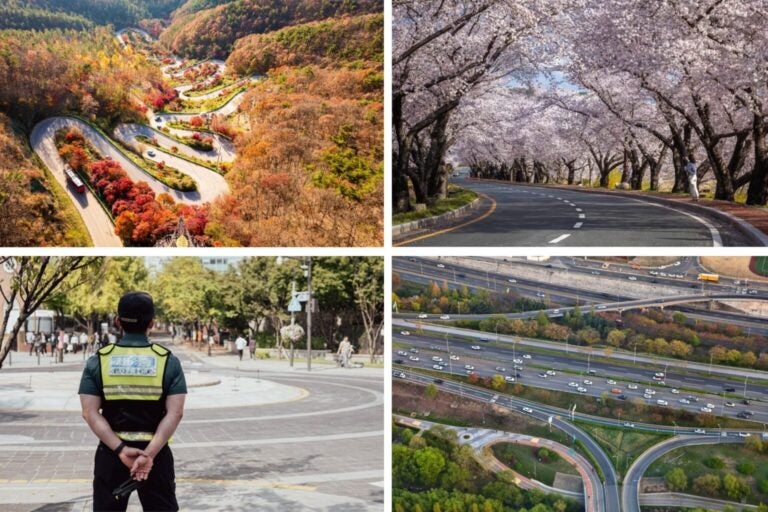
Now that you’ve gone through this guide on driving in South Korea, the next step is to rent a car and choose the one that will take you around the country. The roads are modern, well-maintained, and clearly signed, but navigating traffic and language differences can be tricky. Here are a few final tips to make your driving experience safe and stress-free:
- Always carry your documentation: Valid driver’s license, passport, vehicle registration, and insurance.
- Use local GPS: Naver Map or KakaoMap work better than Google Maps.
- Respect speed limits: There are many cameras, and fines are automatic.
- Hands-free devices are mandatory: Using your cell phone without a hands-free device is punishable by law.
- Anticipate local traffic: Sudden lane changes and braking are common.
- Pedestrians have the right of way: You must come to a complete stop at crosswalks.
- Avoid driving in downtown areas: Traffic is very heavy; use parking lots on the outskirts of town.
- Pay attention to signs in Korean: In rural areas, there may be no translations.
- Use Hi-Pass for tolls: It speeds up the process and avoids manual payments.
- Plan your charging if you use an electric car: There are fewer stations in rural areas.
- Be careful in winter: Ask for winter tires or adequate traction.
- Respect exclusive lanes: Many bus lanes are monitored by cameras.
Lastly, make sure you stay online so you can use GPS to find your way or make emergency calls. If you’re visiting for just a few days, Holafly offers a South Korea eSIM with unlimited data for the duration of your trip. For longer trips, their monthly plans are more convenient, giving you 25 GB up to unlimited data to navigate, stay connected, and communicate without relying on local Wi-Fi. The same eSIM also works in over 160 countries, with plans starting at $49.90 per month and no long-term commitment.
Frequently asked questions about driving in South Korea
Yes, but for stays under a year, you must carry it along with your International Driving Permit (IDP). After that, you can either exchange it for a local license if your country has an agreement with South Korea, or apply for a new Korean license.
There’s a wide network of charging stations across cities and highways. It’s a good idea to check apps like EV Infra, PlugShare, or Kakao T Charging, which show available stations in real time.
The legal limit is 0.03% blood alcohol content. Exceeding this limit can result in fines, suspension of your license, or even imprisonment in serious cases
First, stop the vehicle and make sure all passengers are safe. Then, call the police at 112 and notify the rental company about the accident.
Yes, but it’s a good idea to use a local GPS or a South Korea map app to avoid getting lost, since many road signs are only in Korean.
Plans that may interest you


Hi! I'm a Spanish-English translator working with Holafly, helping bring travel content to life for curious travelers. As a digital nomad with a passion for exploring, I'm always adding new spots to my bucket list. If you love to travel like me, stick around because you're in the right place to find inspiration for your next trip! ✈️🌍