Language


 No results found
Driving in Romania: Tips and requirements
Explore Transylvania at your own pace in your own vehicle! Here is a guide to driving safely and legally in Romania.

There’s nothing quite like getting around in your own vehicle and traveling at your own pace, without having to rely on public transport routes and schedules. If you’re interested in driving in Romania, this article explains which driving licenses are valid for foreign visitors, the requirements for drivers and vehicles, and the mandatory documents you must keep in your car’s glove compartment.
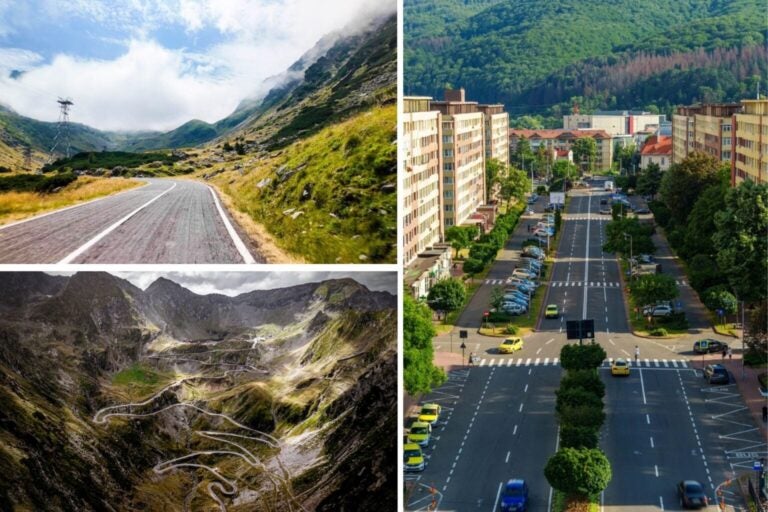
It also helps to be familiar with local driving rules and road signs, how toll systems work, where to refuel, parking options, and how car rental works in Romania. Driving gives you the freedom to explore famous routes like the Transfăgărășan, often considered one of the most breathtaking roads in the world, taking you through medieval villages, iconic castles, and beautiful natural landscapes. Keep these tips in mind to enjoy safe and responsible driving on Romania’s roads.
Driving licenses valid in Romania
The first thing to understand is which type of driving license you will need to drive in Romania, as this depends on your nationality and how long you plan to stay in the country. Whether you are in Romania as a digital nomad, a tourist, or a student and need a vehicle for everyday use, there are several options available, which we outline below.
1. National driving license from the EU/EEA or Switzerland
To begin with, if you are a citizen of the European Union, the European Economic Area, or Switzerland, you can drive in Romania using your valid national driving license without needing any additional permit, as long as your stay is temporary. If you plan to live in the country for a longer period, the best option is to exchange your license for a Romanian one without taking any exams. This process is handled by the Driving and Vehicle Registration Authority (DRPCIV), and you will need to provide proof of your reason for residing in Romania.
2. International Driving Permit (IDP) + original license
If you are not from the EU or EEA, you will need to obtain an International Driving Permit in your home country and carry it together with your regular driving license. This permit is valid for tourists staying in Romania for less than 90 days. Travelers from countries such as Mexico, Argentina, Chile, Colombia, Australia, the United Kingdom, and the United States are required to follow this procedure.
3. Validated foreign license
If you plan to stay in Romania for more than three months and your country is not part of the EU or EEA, you will need to exchange your driving license for a Romanian one. This process is done through the Driving and Vehicle Registration Authority (DRPCIV) and requires submitting your passport, residence permit, original driving license with an official translation, and a medical certificate. In most cases, you will not need to take a practical driving test, although this depends on the bilateral agreements in place with your home country.
4. Romanian driver’s license
Finally, if you don’t have a driving license, you can get a Romanian one from scratch. Like in most countries, the first step is to enroll in an authorized local driving school, complete the required training, and pass both a theory and a practical test. You will also need to undergo a medical exam to confirm that you are fit to drive in Romania.
Requirements and documentation for driving in Romania
In addition to the licenses that are valid for driving in Romania, there are also certain mandatory requirements for both the driver and the vehicle, as well as documents you must always have with you behind the wheel. As you’ll see, these rules are similar to those in other European countries and are designed to help you drive safely and legally. Here’s a list to keep in mind in case you’re not familiar with any of them:
- Valid driver’s license: Based on what we covered in the previous section, this means a national driving license for EU/EEA citizens, or an International Driving Permit (IDP) alongside your original license.
- Age: The minimum age is 18 for cars and 21 for certain high-end rental vehicles. While there is no official maximum age, rental companies may set limits or charge extra fees for drivers over 70.
- Compulsory insurance (RCA): The vehicle must have valid liability insurance in Romania. If you’re bringing your own car from the EU, your policy usually provides coverage, but it’s a good idea to carry the Green Card as proof.
- Vehicle inspection (ITP): All vehicles must have a valid vehicle inspection certificate.
- Environmental sticker or label: Romania doesn’t currently require a specific environmental sticker to drive, but there are plans to introduce an environmental fee in the future.
- Vehicle documents: You are required to carry the vehicle registration, the technical inspection certificate, and, if you’re driving a rental car, the rental agreement.
- Compulsory equipment: Drivers must equip their vehicle with a reflective vest, warning triangles, a first aid kit, a fire extinguisher, and either a spare tire or a repair kit.
Important: If you are a frequent traveler and want to stay connected without worrying about expensive roaming or looking for a new SIM at every destination, Holafly’s subscription plans are for you. With a single eSIM, enjoy internet in more than 160 countries for a fixed price and no surprises on your bill. Travel without limits and connect easily and securely! 🚀🌍

Traffic rules in Romania and road signs
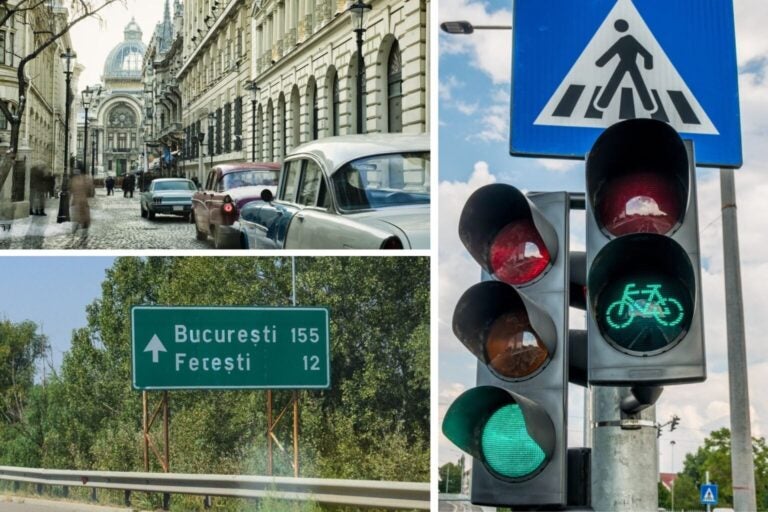
Now that we’ve covered the types of licenses and the requirements for driving in Romania, it’s time to focus on the practical side. You need to be familiar with the main traffic rules and road signs to avoid any issues. While Romania generally follows European standards for signage, it’s worth paying attention to certain details to prevent fines and drive as safely as possible in an unfamiliar environment.
Direction of traffic
Like in most European countries, in Romania you drive on the right and overtake on the left. If you’re coming from the UK, Ireland, Malta, Cyprus, Australia, or other countries where driving is on the left, you’ll need to adjust. It’s a good idea to practice in a safe, traffic-free area until you feel comfortable with this new driving style.
Speed limits
Be careful not to exceed speed limits while driving in Romania, as many roads are monitored with both stationary and mobile speed cameras. Going more than 50 km/h over the limit can result in heavy fines and a temporary suspension of your driving privileges. Maximum speeds vary depending on the type of road:
- 50 km/h in urban areas
- 30 km/h in school zones
- 70–90 km/h on secondary roads
- 100 km/h on expressways and national roads
- 130 km/h on highways.
Use of cell phones while driving
Using your phone while driving is strictly prohibited, as it’s a leading cause of distractions and serious accidents. If you need to make or take calls, you must use a hands-free system or a fixed mount for your device while navigating.
How to use your lights
In Romania, keeping your lights on is a key rule and strictly enforced by traffic authorities. Dipped headlights must be used during the day on highways and main roads, and while not required in cities, they are still recommended. This helps improve visibility between vehicles, particularly on mountainous routes.
High beams can be used on dark roads where there is no oncoming traffic, to avoid blinding other drivers. Drivers should only turn on fog lights in low-visibility conditions, such as heavy rain, thick fog, or snow, because they can distract or annoy other motorists.
Know the legal alcohol limit when driving
In Romania, alcohol limits for drivers are extremely strict. Beginners aren’t allowed any alcohol at all, while the limit for regular drivers is just 0.02%. Violating these rules is taken very seriously and can result in hefty fines, losing your license, or even criminal penalties if your blood alcohol exceeds 0.08%.
Some penalties and fines
| Offense | Approximate fine |
| Speeding 10–20 km/h over the limit | $68 |
| Speeding 21–30 km/h over the limit | $102 |
| Speeding 31–40 km/h over the limit | $137 |
| Speeding 41–50 km/h over the limit | $205 |
| Speeding > 50 km/h | $308 |
| Not wearing a seatbelt | $67 |
| Using a mobile phone without a hands-free device | $271 |
| Running a red light | $171 |
Tolls and refueling
One thing that’s different about driving in Romania is how tolls work. Unlike most countries, you don’t pay based on the distance traveled on highways. Instead, Romania uses an electronic vignette system called the Rovignette. This is a mandatory fee to drive on the national road network, which you need to purchase online or at gas stations before your trip. Here are the prices:
- 7 days: Between $10
- 30 days: Between $16–20
- 90 days: Between $26–32
- 1 year: Between $37–47
In Romania, you’ll find the same types of fuel as in other European countries, and you can refuel at service stations located throughout the country. If you rent an electric car, it’s a good idea to use apps like PlugShare, Renovatio e-charge, or MOL Plugee to locate the nearest charging points.
- Gasoline 95: $1.63–1.81/liter
- Diesel: $1.69–1.86/liter
- Gasoline 98: $1.86–2.10/liter
- LPG: $1.11–1.11 /liter
- Electric charge: $0.37–0.58/kWh
Parking in Romania
What about parking in Romania? The rules are very similar to those in other European countries, with signs that follow standard European regulations, so it’s usually straightforward to know where you can park and where it’s prohibited:
- Permitted parking: Public paid parking areas, regulated areas in city centers, and parking lots.
- No parking: On pedestrian crossings, in public transport zones, near emergency areas, in residential areas without a permit, or on yellow lines marked with “no parking” signs.
- Public zone rates: From $0.40 per hour or $5.00 per day.
- Private parking rates: From $1.00 per hour or $8.00 per day.
Options for renting a car in Romania
A great way to get around Romania is by renting a car. This works well if you want to explore cities like Bucharest, Cluj-Napoca, Brașov, or Timișoara, take a road trip through Transylvania, or move around as a digital nomad. Big rental companies like Hertz, Avis, Europcar, Sixt, and Enterprise have offices at airports, train stations, city centers, and online. Here is a look at some of the cars you can rent and their prices:
| Vehicle type | Models | Rates/day |
| Compact and economy | Toyota Yaris, VW Polo, Dacia Sandero | From $20 |
| Sedans | Skoda Octavia, VW Passat | From $37 |
| SUVs and 4x4s | Dacia Duster, Nissan Qashqai | From $52 |
| Electric vehicles | Renault Zoe, VW ID.3 | From $43 |
| Minivans | Kia Carnival | From $85 |
Tips for driving in Romania as a foreigner
Have you noted all the requirements for driving in Romania? Now it’s just a matter of getting behind the wheel and enjoying a safe drive while following the rules, signs, and obligations we’ve covered in this article. To wrap things up, here are a few practical tips to keep in mind:
- Always carry your documents in the vehicle: License, insurance, registration, and vignette if applicable.
- Use an up-to-date GPS: This is especially useful on rural routes, where road signs can be few and far between. Holafly’s monthly plans are a great option for reliable internet without relying on Wi-Fi, so you can stay connected without roaming charges. If your trip is just a few days, their Romania eSIM with unlimited data lets you stay online only for the days you need.
- Respect speed limits: Fixed and mobile speed cameras are very common throughout the country.
- Avoid driving at night: In rural areas, you’ll find unlit roads, animals crossing, and narrow edges, which can be more dangerous if you’re not familiar with them.
- Keep a safe distance: Some local drivers have a more aggressive style and may overtake you with little warning.
- Keep your lights on during the day: In Romania, it is mandatory to drive with your headlights on 24 hours a day.
- Be careful on turns: On roads such as the Transfăgărășan or Transalpina, there are some very narrow sections.
- Don’t forget your vignette: It’s mandatory for driving on national roads.
- Park only in permitted areas: Fines for illegal parking are common in large cities such as Bucharest, Cluj-Napoca, and Timișoara.
- Carry cash: In some rural areas, smaller toll booths, parking lots, or small gas stations may not accept cards.
- Be cautious when driving in winter: Many mountain routes close and special equipment, such as chains and special tires, is required.
Frequently asked questions about driving in Romania
Yes, if you are a citizen of the EU or EEA. For other nationalities, however, you must carry an International Driving Permit (IDP) along with your original license for stays shorter than 90 days.
If you plan to drive an electric car in Romania, you’ll find charging stations in major cities and along highways. Apps like PlugShare, NextCharge, or Google Maps can help you locate them easily.
In Romania, paying tolls through the electronic Rovignette system is mandatory, with the cost depending on your route and vehicle type. You can purchase this pass at gas stations or online.
Highways and main roads are generally in good condition and well signposted, but some rural and mountain roads can be bumpy, narrow, and have very tight curves.
Plans that may interest you

Hi! I'm a Spanish-English translator working with Holafly, helping bring travel content to life for curious travelers. As a digital nomad with a passion for exploring, I'm always adding new spots to my bucket list. If you love to travel like me, stick around because you're in the right place to find inspiration for your next trip! ✈️🌍