







 Language


 No results found
Driving in Norway: Tips and requirements
Find out all the requirements and documents you need for driving and renting a car in Norway. Keep reading!

Norway’s roads, its landscapes illuminated by the northern lights, and the efficiency of its roadside services are just a few of the reasons why driving in Norway is an unforgettable experience.
To make sure you can do it safely and without missing any important traffic rules, we have put together this guide to help you understand how road signs, tolls, and gas stations work in Norway.
We also explain what kind of driver’s license you’ll need to drive and rent a car, along with some must-know tips to make your journey through Norway smoother and more memorable. Let’s get started!
Driving Licenses Valid in Norway
The rules around driver’s license validity in Norway vary depending on the country or region you come from, and they also depend on whether you are visiting as a tourist or living there as a resident. Here is how each case works.
Traveler’s Driving License
Also known as a National Driver’s License, this document is issued in your home country and is valid in Norway for up to three months. You must be at least 18 years old, and the license needs to be translated. If it isn’t, you’ll need an International Driving Permit, which provides an official translation into English or other languages.
International Driving Permit
This permit is not a driver’s license on its own, but an official translation of your national license that makes it valid for use in Norway. It also makes renting a car easier and allows Norwegian traffic authorities to quickly verify your details.
Norwegian Driving License
This license applies if you intend to remain in Norway beyond the three months permitted for visitors. It is meant for longer stays, and the steps to obtain it differ depending on where you are from.
If you are a resident of or come from a European country, you can exchange your valid national license for a Norwegian one without going through a lengthy process. The same applies to citizens of countries such as the United States, Japan, Australia, Canada, and Switzerland.
On the other hand, licenses from Latin American countries and other regions without reciprocal agreements require you to go through the full process in Norway as a new driver. This includes taking a theory course, completing medical exams, and passing the practical driving tests.
Requirements and documentation for driving in Norway
There are several requirements you must meet to drive in Norway, and skipping them can lead to fines. Keep in mind that once you take possession of a rental car, you are responsible for everything related to it. Here’s a look at the documents you need to have.
Requirements
- You must be at least 18 years old to drive a small car and over 18 to drive trucks.
- Do not drive under the influence of alcohol.
- Any disabilities must be reported to the traffic authorities and reflected on your driver’s license.
- The vehicle must pass the periodic technical inspection (EU-Kontroll).
- You must have all the necessary roadside equipment for emergencies or breakdowns.
Documents
- Valid driver’s license.
- Vehicle registration certificate (vognkort).
- Civil liability insurance.
- Valid passport or ID card.
Important: If you are a frequent traveler and want to stay connected without worrying about expensive roaming or looking for a new SIM at every destination, Holafly’s subscription plans are for you. With a single eSIM, enjoy internet in more than 160 countries for a fixed price and no surprises on your bill. Travel without limits and connect easily and securely! 🚀🌍

Traffic rules in Norway and road signs
Driving in Norway follows rules that are familiar in most countries, especially for Europeans and North Americans. If you come from a country where traffic drives on the left, though, it can take some adjustment. Next, we’ll cover the key traffic regulations and the road signs you are most likely to see.
- Speed limits in Norway: In residential areas, the speed limit is 30 km/h, on secondary roads it’s 80 km/h, and on highways it ranges from 90 to 100 km/h.
- Restrictions on cell phone use: In Norway, you cannot hold your cell phone in your hand while driving or talk on the phone without a hands-free system.
- Use of lights: You must have your headlights on during the day and at night, no exceptions.
- Direction of traffic: Drive on the right and overtake on the left.
- Seat belt requirement: All occupants of the vehicle must wear seat belts.
- Emergency kit: Your car should be equipped with a complete safety kit, including a fire extinguisher, a reflective vest, warning triangles for breakdowns or emergencies, and a first aid kit.
Traffic signs
Road signs in Norway are generally similar in shape and color to those in most countries, with a few unique variations. Some warn about local wildlife, while others are specific to winter conditions, highlighting seasonal hazards.
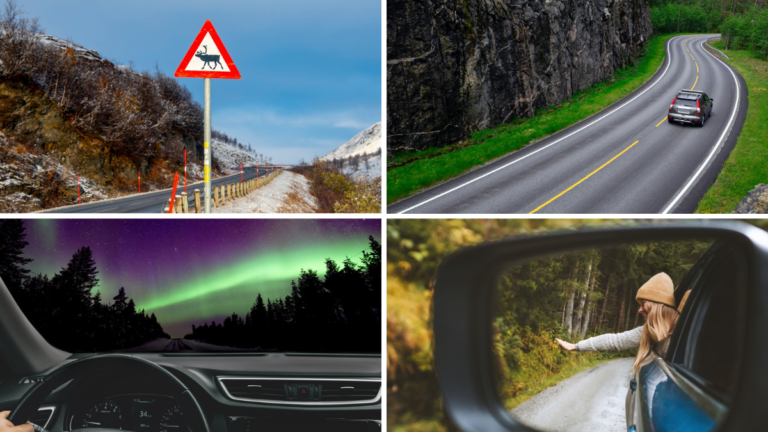
For example, you might see triangular signs with red borders showing a reindeer, warning that these and other animals are likely in the area, so you should drive carefully.
The most common traffic violations in Norway include speeding, which can cost around $540 depending on your speed and is often calculated based on your income, using a mobile phone while driving, which can carry a fine of $975, and driving under the influence of alcohol, which can lead to jail time, a one-year license suspension, and heavy fines.
Tolls and refueling
Norway has a highly efficient network of automatic tolls, allowing travelers to drive on well-maintained roads without delays. Toll fees are charged automatically, but vehicles need to be registered. If you rent a car, the rental company usually takes care of this, though it’s always a good idea to double-check.
You won’t find traditional toll booths with attendants to collect payment and lift a barrier. Instead, cameras record your license plate and the invoices are sent to you by mail afterward.
Toll fees are calculated based on factors like the type and size of your vehicle, the fuel it uses, the time of day you pass through, and the city or area you’re in.
Fuel in Norway
Keep in mind that Norway offers different types of fuel, and the type you use will depend on the rental car you choose. Here’s a look at the approximate costs for each fuel type, according to Global Petrol Price.
- Gasoline from $1.85 per liter depending on whether it is 95 or 98 octane
- Diesel $1.80 per liter
- LPG $1.35
- For electric charging, a slow charge costs around $0.42 to $0.54 per kWh, while fast charging at public street stations is a bit more expensive, ranging from $0.52 to $0.63 per kWh.
For any of these options, you simply go to a self-service station, insert your debit card, enter the amount of fuel you want, and you’re done. Some stations also have attendants who handle the payment for you.
For electric charging, you can use mobile apps like Fortum, Recharge, or Eviny to pay digitally. You can also use RFID charging cards, which are available directly from the providers mentioned and allow you to pay for your electric car charges.
Parking in Norway
Norway offers plenty of parking options, though most are paid and some have time restrictions, particularly on city streets. Knowing how these systems work can help you avoid expensive fines. Here’s a breakdown of where and how to park.
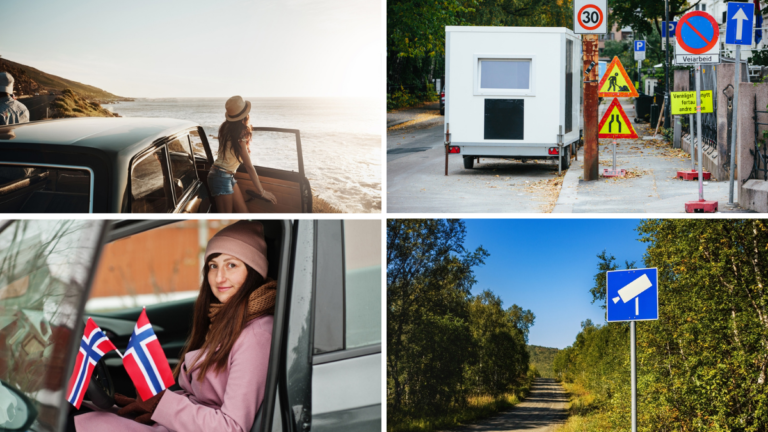
You can park on the street, but look for the blue signs with a white “P”. Nearby, there’s usually an additional sign that tells you the maximum parking time, the hours when parking is allowed, the rate, and how to pay.
You also have public parking lots, often staffed by attendants who handle payment for your stay and ensure the space is properly managed.
If you’re looking for a free option, look for blue circular signs with a white “P” on the streets, along with information on the maximum parking time. Avoid parking on main roads, in front of residential building exits, or on sidewalks.
Options for renting a car in Norway
Renting a car in Norway depends on several factors, including the time of year, the number of passengers, the type of fuel you prefer, and the rental company you choose. Some of the main providers are Hertz, Avis, Europcar, Sixt, and Budget.
Thanks to the country’s good road infrastructure and wide variety of vehicle options, it suits all types of travelers.
| Vehicle type | Price per day | Price per week | Price per month |
| Compact cars such as the Nissan Leaf, Volkswagen ID.3, or Toyota Yaris (gasoline) | $65-105 | $300-600 | $900-1,350 |
| Sedans such as Tesla Model 3/Y, Volvo V60, VW Passat. (Hybrid, electric, or diesel) | $85-145 | $450-750 | $1,200-1,750 |
| 4×4 vehicles such as Toyota RAV4, Skoda Kodiaq, ideal for snowy roads | $95-160 | $500-780 | $1,300-1,950 |
Tips for driving in Norway as a foreigner
After going over all the requirements, documents, and essential information for driving in Norway, we want to share some tips to make traveling by car in this European country much more comfortable.
- Make sure your vehicle is ready to start the journey: Check the vehicle’s documents and condition, and make sure to ask any questions you have about how it works.
- Download Norway’s travel apps: Keep in mind that in Norway, you can pay tolls using apps or cards, and the same goes for fuel, as most stations are self-service.
- Have your documents handy: Make sure to keep your personal and car documents handy so you can quickly show them if Norwegian authorities ask.
- Be careful in winter: Driving in winter can be more challenging, so pick a car that’s suitable for snowy roads. Also, make sure you know how to handle driving in these conditions and how to respond to emergencies.
- Internet connection: Make sure you have an internet connection so you can use maps, locate hospitals, restaurants, and other tourist spots easily. Holafly offers monthly plans with unlimited data or 25 GB that can be shared across devices, covering more than 160 destinations around the world.
Frequently asked questions about driving in Norway
An International Driving Permit is advisable when your national license is not in English or other required languages, depending on the country you are visiting.
One of the key requirements is having a car suitable for these weather conditions. Tires also play a crucial role when driving on snow, as they often come with studs or chains to prevent slipping and getting stuck.
Norwegian authorities have chosen to impose hefty fines on drivers who break the rules as a way to encourage compliance with traffic laws.
Yes, there are even road signs warning you about the presence of these animals in certain areas. When you see them, it’s best to slow down and stay extra alert in case one suddenly appears. Your car insurance typically covers this kind of incident, so make sure you have the contact number handy just in case.
Plans that may interest you


Hi! I'm a Spanish-English translator working with Holafly, helping bring travel content to life for curious travelers. As a digital nomad with a passion for exploring, I'm always adding new spots to my bucket list. If you love to travel like me, stick around because you're in the right place to find inspiration for your next trip! ✈️🌍
