







 Language


 No results found
Driving in New Zealand: Tips and requirements
Are you planning to rent a car for driving in New Zealand? If so, be sure to read this guide, where we provide up-to-date information.

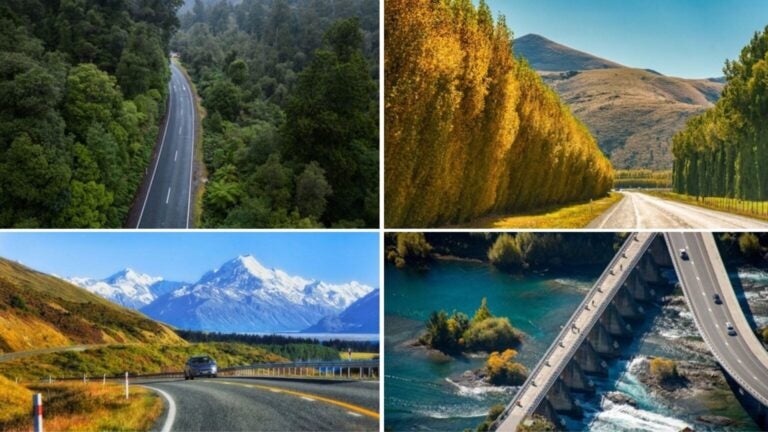
Driving in New Zealand feels less like a way to get from place to place and more like being part of the landscape. The roads lead you through scenes that look almost unreal, passing between mountains, vivid blue lakes, and vast green fields that stretch to the horizon. Every turn brings a new view, and also a reminder that this is a country with its own pace, its own logic, and driving rules that may feel unfamiliar to many visitors.
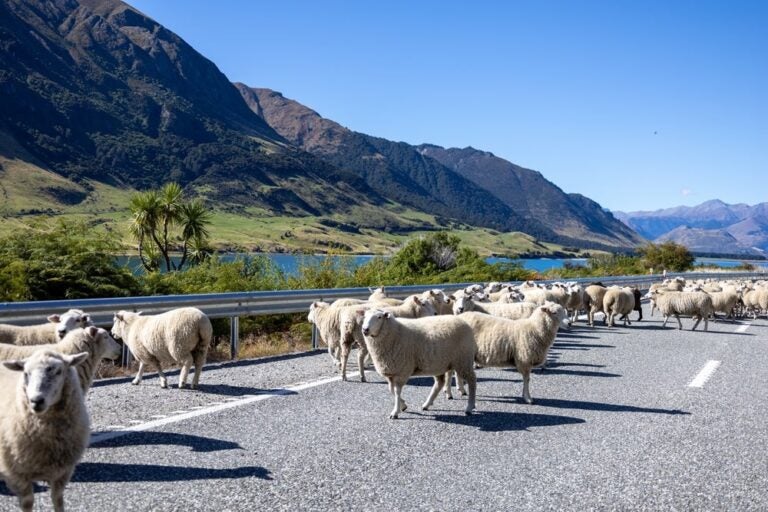
If you are planning to drive in New Zealand as a tourist, digital nomad, or seasonal traveler, be ready for the scenery to catch you off guard more than once. It is a safe country to drive in, but also a demanding one, with narrow roads, strong winds, alpine passes, cliff hugging bends, single lane tunnels, and rural areas where sheep can stop traffic without any warning.
This guide covers everything you need to know to drive around New Zealand with confidence. And if you are already imagining yourself on the right side of the car, heading toward Queenstown with the road opening up ahead of you, then it is time to hit the road!
Valid licenses for driving in New Zealand
New Zealand welcomes thousands of overseas drivers every year, so the rules are clear and generally visitor friendly. You can travel around the country without much hassle as long as your license is valid, easy to understand, and meets the requirements for your permitted length of stay. Let’s take a closer look.
Licenses accepted for tourists and temporary stays
If you are staying in New Zealand for less than 12 months, you can drive using your current home country license as long as it is in English and written in the Latin alphabet. If it is not, you will need to carry your original license along with an official translation or an International Driving Permit.
New Zealand police take this very seriously. If your license is not in English, it is not enough for it to simply look understandable. You must have an approved translation or an International Driving Permit, with no exceptions. This applies to drivers from Spain, Mexico, Argentina, Chile, Colombia, the United States, the United Kingdom, Australia, and most of Latin America.
Permitted duration for driving with a foreign license
You can drive in New Zealand with a foreign license for up to 12 months from the date you enter the country. After that, even if your visa is still valid, you must get a New Zealand license or stop driving.
One of the most common mistakes long-term travelers and working holiday visitors make is assuming the permit automatically extends.
Who can exchange their foreign license
New Zealand lets holders of certain foreign licenses exchange them for a local license without taking the driving test, but it depends on the country. For most Latin American countries, there is no such agreement, so drivers have to go through part of the local process, whether that means the theory test, the practical test, or both.
European, British, and some Asian licenses may be partially recognized.
What category do you need to drive a car?
The standard license for driving private cars in New Zealand is Class 1, equivalent to category B in many countries.
Important details that travelers often overlook
- You must have your license with you; photos or digital copies are not accepted.
- The police may ask for a translation at roadside checks, even if your license appears to be understandable.
- If you rent a campervan, make sure your license is valid for that type of vehicle and weight.
- If you enter and leave the country repeatedly, the 12-month period may be reset, but only if you do not reside continuously in New Zealand.
Requirements and documents needed to drive in New Zealand
Keep this in mind when driving in New Zealand. The roads can be narrow, unguarded, and full of sharp bends, so the country has strict rules, frequent checks, and speed cameras to keep everyone safe from the very first day.
Mandatory documentation
Whenever you get into a car in New Zealand, whether you are driving in urban areas or on highways, make sure you have the following with you:
- Your current driver’s license (and official translation, if applicable).
- International Driving Permit (IDP) if your license is not in English or is not understandable.
- Vehicle insurance (if leased, the company will provide you with the documentation).
Minimum age for driving
In New Zealand, you can start learning to drive at 16, but that only applies to local learner licenses, not visitors. International drivers need to be at least 18. Most car rental companies require drivers to be 21 or older, and those under 25 usually have to pay extra fees.
Driving on the left – The rule that changes everything
The first thing you will notice is that in New Zealand people drive on the left. It can feel a bit odd at first, especially when leaving a parking lot or navigating a roundabout, but after a little practice it quickly starts to feel natural.
The trick is to take it slow and give yourself time to adjust. On roads without a center line, stay to the left and resist the urge to cut corners. It’s a habit from driving on the right that can be risky in New Zealand.
Speed limits in New Zealand
One thing New Zealand makes very clear from the start is that speed limits are meant as a guideline, not a license to speed.
The general rule is:
- 50 km/h in urban areas.
- 100 km/h on rural roads.
- 80–90 km/h on mountainous or winding roads.
- Vehicles weighing more than 3,500 kg or towing: maximum 90 km/h (regardless of the official limit).
The truth is that on many roads it’s simply not safe to drive at the posted speed. If the limit feels like it’s pushing you to go faster, don’t worry about it. In New Zealand, safe driving comes before keeping a constant speed. There are speed cameras everywhere, but more importantly, the roads themselves demand careful and sensible driving.
Minimum alcohol tolerance
In New Zealand drinking and driving is taken very seriously. The legal limit is zero for drivers under 20 and 0.5 for those over, but the safest and easiest rule to follow is simple: if you are driving, don’t drink.
Seat belts for everyone, no exceptions
Seat belts are required for everyone in the car, front and back, no matter how short the trip or how remote the road. If you are traveling with children, the rules are even stricter. Kids must use an appropriate car seat or restraint system until they are seven, and in many cases, up to eight years old.
The authorities check frequently and there is no room for interpretation.
No cell phones in your hands when you’re behind the wheel
New Zealand has a zero-tolerance policy for using your phone while driving. No quick texts at a red light, no checking maps, and no taking calls. If you need your phone for navigation, set up your GPS before you start driving or use it hands-free.
Getting used to the roads
Kiwis often say that in their country “no two roads are the same,” and they’re not exaggerating. A road can start out wide and straight, and just minutes later turn into a narrow path along a cliff or a stretch of loose gravel.
The key is to read the road and adjust constantly. Driving in New Zealand requires your full attention. Slow down when the weather changes, turn on your lights in fog, and ease off the speed before entering a narrow bridge.
A fun fact is that in many rural areas, sheep still have the right of way. If a flock is crossing, just wait. It’s all part of the charm and the way people share the road.
Police checks
If the police signal for you to pull over, do so as soon as it is safe and always on the left. Random stops are not common, but there are checks for alcohol, speed, and documentation. Typically, the officer will approach your vehicle, review your papers, and then let you continue on your way.
The calmer and clearer you are, the quicker everything will be over. New Zealand values courtesy, even in checkpoint situations.
Driver fatigue
In a country where the scenery constantly pulls your attention away and the roads demand focus, driving while tired can be genuinely dangerous. Authorities recommend taking a break every two hours, avoiding driving right after long flights, and above all not underestimating distances. What looks like a short stretch on the map can take much longer because of how winding the roads are.
If your body tells you to slow down, do so. There are rest areas throughout the country, many with views that are worth the break.
Mandatory safety features in vehicles in New Zealand
Vehicles on New Zealand roads must meet a set of basic safety standards. It’s not about carrying a special kit like in some European countries, but about making sure the car is mechanically sound and legally fit to be on the road.
All vehicles must have:
- Valid WOF or COF: The Warrant of Fitness for private vehicles or the Certificate of Fitness for commercial ones confirms that a car meets the minimum safety standards. Without one of these, the vehicle is not legally allowed on the road.
- Fully functioning lights: Low and high beams, indicators, brake lights, and tail lights all need to be in working order. In a country known for rain, fog, and sudden weather changes, proper lighting is essential.
- Tires in good condition: The law requires a minimum tread depth of 1.5 mm, though much more is recommended for rainy or mountainous areas. Worn tires can lead to fines and cause a vehicle to fail its WOF inspection.
- Brakes and seat belts must be operational: All vehicles must have seat belts in perfect working order in all seats.
- Windshield wipers and windshields without serious damage: A small crack may be acceptable, but any damage that reduces visibility will invalidate the WOF.
If you are heading into alpine areas in winter, especially in a rental car, it is a good idea to carry snow chains, even though they are not mandatory nationwide. Some mountain roads may require them during heavy snowfalls or storms.
Traffic signs in New Zealand
Road signs in New Zealand use a mix of universal symbols and short English messages, but the key thing to know is that many of them warn you about real and sudden changes ahead.
Driving in New Zealand is a very visual experience, and an essential part of it is learning to “read” the signs before the road surprises you.
Key signs to look out for
New Zealand road signs are very straightforward, designed to prepare drivers for what lies ahead. You will see:
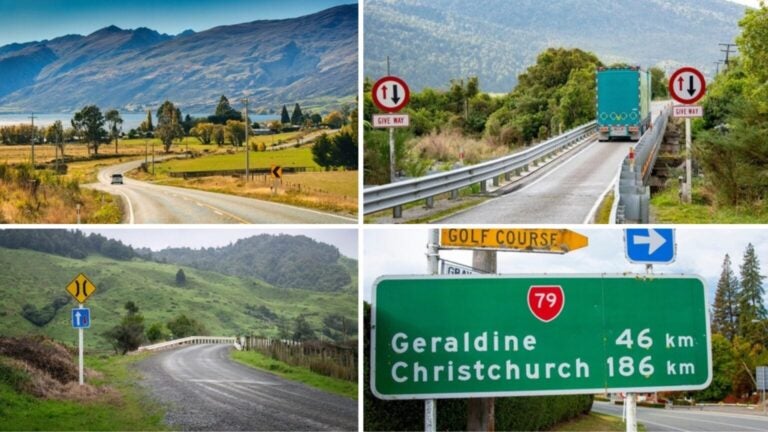
- Yellow signs warning of sharp bends, steep gradients, or sections where the road narrows.
- Signs indicating the recommended speed (not mandatory), especially on curves or in areas exposed to wind. In New Zealand, these recommendations are taken very seriously.
- Signs marking railroad crossings, some without barriers.
Signs about animals on the road should be taken literally. Sheep, cows, and even deer can appear suddenly on rural roads. If you see a livestock crossing sign, slow down and be ready to stop.
Single-lane bridges
Something that surprises many travelers are the one-lane bridges, where only one vehicle can pass at a time. The order of passage is indicated by clear signs:
- A large white arrow: Indicates who has priority.
- A smaller red arrow: Indicates who must yield.
If it’s your turn to give way, wait until the bridge is clear before moving. It sounds simple, but on busy days it takes patience and good eye contact with other drivers.
Roundabouts
Roundabouts are extremely common in New Zealand. They work smoothly, but only if you follow two essential rules:
- Traffic already in the roundabout has priority, and in NZ that means you must give way to vehicles coming from your right.
- Signaling is always the rule, both when entering and exiting.
Roundabout signs are very clear and often reinforced with arrows painted on the road. A common mistake for visitors is not signaling when exiting. In New Zealand, failing to indicate is seen as unpredictable driving and can create dangerous situations.
When the roundabout has several lanes, choose your lane in advance:
- Left lane to exit at the first exit or continue straight ahead.
- Right lane to turn right or take later exits.
Once you enter, stay at a steady pace and follow the traffic. In New Zealand, roundabouts are so efficient that they often replace traffic lights, even on busy main roads.
School zones, construction sites, and crosswalks
Signs warning of schools or roadworks should be taken very seriously. In school zones, speeds can drop to 20 or 30 km/h, and pedestrians are always around. At roadworks, traffic is often controlled by workers with stop/go signs, and if they signal you to stop, you must do so without exception.
Pedestrian crossings are clearly marked, and walkers always have the right of way. In New Zealand, road courtesy is deeply ingrained, so if someone is approaching a crossing, slow down early and give way.
Key tip: The recommended speed limit matters more than you think
Yellow signs with numbers, like “35” on a bend, aren’t official speed limits, but they indicate just how sharp the turn is. Most local drivers follow them closely, and visitors should do the same.
If a curve says “25 km/h,” it’s because you really don’t want to take it any faster.
Fines and penalties in New Zealand
New Zealand is welcoming to travelers, but extremely strict when it comes to road safety. Fines are high, checks are frequent, and there is usually no room for negotiation.
New Zealand police take a proactive approach, so you’ll see speed cameras, alcohol checkpoints, mobile radar units, and even monitoring at roundabouts and pedestrian crossings.
Below is a table showing the most common offenses and their approximate values:
| Offense | Fine |
| Speeding | From NZD 30 to 400 in the most serious cases ($18-240) |
| Dangerous overtaking | NZD 150–300 ($90–180) |
| Failing to stop at a red light | NZD 150 ($90) |
| Failing to give way | NZD 150 ($90) |
| Not wearing a seatbelt | NZD 150 ($90) |
| Using a cell phone while driving | NZD 150 ($90) |
| Incorrect turn at roundabouts | NZD 150 ($90) |
| Illegal parking | NZD 40–100 ($24–60) |
| Driving without a valid license or translation | NZD 400 ($240) |
| Driving an unsafe or defective vehicle | NZD 150–200 ($90–120) |
| Driving under the influence of alcohol or drugs | From NZD 200 to criminal prosecution (from $120) |
Remember this: in New Zealand, being a cautious driver doesn’t just keep you out of trouble, it lets you enjoy the road. Drive at a safe speed, pay attention to the signs, and accept that the roads are meant to be taken slowly, and you’ll have no problems with the law.
Important: If you are a frequent traveler and want to stay connected without worrying about expensive roaming or looking for a new SIM at every destination, Holafly’s subscription plans are for you. With a single eSIM, enjoy internet in more than 160 countries for a fixed price and no surprises on your bill. Travel without limits and connect easily and securely! 🚀🌍

Types of roads in New Zealand and toll system
New Zealand has a wide variety of roads, from modern highways around major cities to narrow rural lanes where the grass almost brushes the car. Knowing the different types of roads and where tolls apply will help you plan safer and more efficient routes.
State Highways
These are New Zealand’s main routes, connecting cities, coastal towns, and mountain areas. They’re labeled with “SH” and a number, like SH1, SH2, or SH6. Some sections are wide highways, while others are narrow, single-lane roads without barriers. This variety is one of the things that makes driving in the country so unique.
Urban and suburban highways
Around Auckland, Wellington, and Christchurch, you’ll find more modern highways with multiple lanes and clearly marked interchanges. The main highways include:
- Auckland Northern Motorway (SH1)
- Auckland Southern Motorway (SH1)
- Auckland Southwestern Motorway (SH20)
- Wellington Motorway (SH1)
Outside these cities, most roads revert to one lane in each direction, even on busy routes.
Rural roads
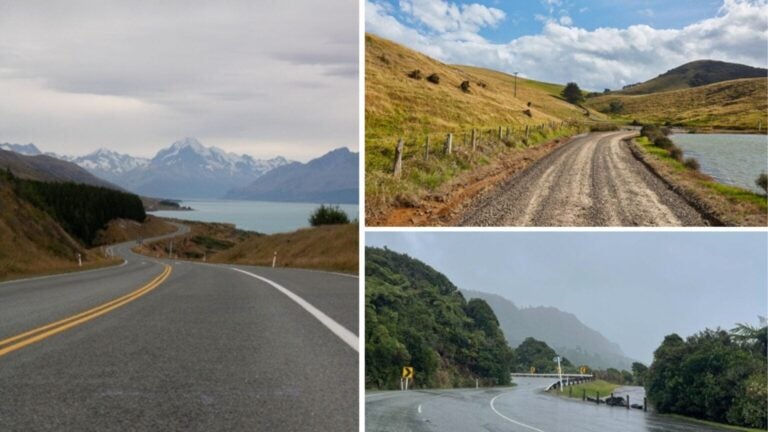
These roads are tight and twisty, often with only one lane going each way. You might come across sharp curves without guardrails, steep inclines, slippery or wet surfaces, single-lane bridges, and stretches of unpaved road.
These roads offer stunning views but can be challenging to drive. If you’re heading to places like Fiordland, Coromandel, the West Coast, or alpine areas such as Arthur’s Pass, you’ll likely encounter several of them.
Gravel roads
In remote parts of the South Island, especially near lakes and trails, gravel roads are common. They aren’t inherently dangerous, but you need to drive slowly to prevent skidding and to avoid stones damaging your windshield.
Tolls in New Zealand
New Zealand doesn’t use traditional toll booths. The system is fully electronic, simple to use, and only applies to a few highways. This means you can drive across almost the entire country without paying a single dollar.
The current toll roads are located exclusively on the North Island:
- Northern Gateway Toll Road (Auckland): Connects Orewa and Puhoi, north of Auckland. Approximately NZD 2.40 for cars ($1.39).
- Tauranga Eastern Link Toll Road (Bay of Plenty): Connects Papamoa East with Paengaroa. Approx. NZD 2.30 ($1.33).
- Takitimu Drive Toll Road (Tauranga): Connects SH29 with the urban area of Tauranga. Approx. NZD 2.10 ($1.21).
How to pay tolls
There are no physical barriers. The system registers your license plate, and there are several payment methods:
- Online on the official NZTA website.
- Automatically if the rental company handles it.
- At authorized points at nearby gas stations
It is important to note that if you do not pay within the established period, an automatic fine is generated, which usually goes to the rental company (and then to you, with a surcharge).
Is it best to avoid tolls?
Most of the time, yes. New Zealand always has free alternative routes, but they’re usually slower and twistier. If you value convenience and saving time, paying the toll is often worth it.
Fuel and refueling in New Zealand
Getting fuel in New Zealand is easy, but you do need to plan ahead. Some stretches, especially on the South Island, are very remote, and you could go over 100 kilometers without seeing a gas station. The best rule is to top up whenever you can so you’re never caught short.
Types of fuel available and approximate prices
At most gas stations, you will find:
- 91 Unleaded: The most commonly used and cheapest standard gasoline. NZD 2.50–3.10 per liter ($1.50-1.88).
- 95 Premium: For cars that require higher octane fuel. NZD 2.80–3.40 per liter ($1.70-2).
- Diesel: Common in large vehicles and campervans. NZD 2.00–2.50 per liter (excluding RUC) ($1.21-1.50).
The most expensive places to refuel are usually Queenstown, the West Coast of the South Island, and remote spots like Te Anau or Haast. In Auckland and Wellington, fuel prices tend to be more reasonable.
One important thing to know is that diesel in New Zealand doesn’t include road taxes, so it may look cheap at the pump. For non-rental diesel vehicles, an extra fee called the Road User Charges (RUC) applies. If you rent a diesel campervan or SUV, the rental company usually includes this in the price or charges you per kilometer, depending on your agreement.
How to refuel
Most stations are self-service, so you fill up the tank yourself. The process is straightforward and similar to other countries with self-service pumps. Common payment methods include:
- International credit or debit cards.
- Payment at kiosk inside the station (when open).
- Local cards such as fuel cards (not applicable to tourists).
In rural areas, some stations are fully automated and open 24/7, with no staff on site. These usually require a credit card. On the other hand, smaller stations may not accept cash or foreign cards. For this reason, it’s safest to always carry a credit card that works internationally.
Are electric chargers available?
Yes, New Zealand is expanding its network of electric vehicle chargers. Big cities have fast-charging stations, but in rural areas they can be few and far between. If you rent an electric car, careful route planning is essential.
Parking in New Zealand
Parking in New Zealand can be either straightforward or a bit tricky, depending on where you are. In cities like Auckland or Wellington, there are well-organized systems with digital meters, while in coastal towns or rural areas parking is usually free, with common sense being the main rule.
Parking in large cities
In Auckland, Wellington, and Christchurch, most parking is paid and managed by the local council. Spaces are clearly marked on the road, and signs show the hours, hourly rates, and maximum time allowed.
Parking meters usually accept card payments, mobile apps, or even a “pay-by-plate” system where you enter your license plate directly. Rates vary, but in central areas they typically range from NZD 2 to 6 per hour ($1.20 to $3.60).
On busy main roads, parking is usually time-limited to keep spaces turning over, while side streets are cheaper and more relaxed. For longer stays, covered car parks or multi-level garages are the easiest option since you don’t have to keep feeding the meter.
Parking in tourist towns
In towns like Queenstown, Rotorua, Wanaka, or Paihia, parking systems are usually simpler, but they can be surprisingly competitive. Most downtown spots charge by the hour, especially during peak season. Rates are often a bit lower than in the big cities, but spaces are limited.
In tourist-focused towns, the rule is simple: the closer you try to park to the historic center or the lake, the harder it will be to find a spot. That’s why it’s usually better to use the larger municipal car parks on the outskirts and walk in.
In areas with popular activities, like hiking trails, viewpoints, or alpine lakes, each parking spot has its own rules. Some charge a daily fee, while others are free but have time limits. In national parks, parking is usually free, but the rules are still clearly marked.
Parking in rural areas
In rural areas or on secondary roads, parking is usually as simple as finding a safe spot off the road. In most small towns, parking on the side of the street is free and doesn’t have a time limit.
Keep in mind that some New Zealand roads can narrow quickly or run along steep cliffs, so it’s never safe to stop on a tight shoulder or where you can’t be seen. If you want to take photos, which is very common, look for a designated rest area or a wide, safe spot to pull over.
Areas where parking is prohibited
Although the signs are clear, it is worth keeping in mind some common prohibitions:
- Never park in front of entrances to houses, garages, or private roads.
- Avoid areas marked in yellow, which indicate a total ban.
- On streets with solid yellow lines near curves or slopes, parking is dangerous and punishable by law.
- Parking is not permitted on sidewalks, walkways, or urban grass verges.
Options for renting a car and driving in New Zealand
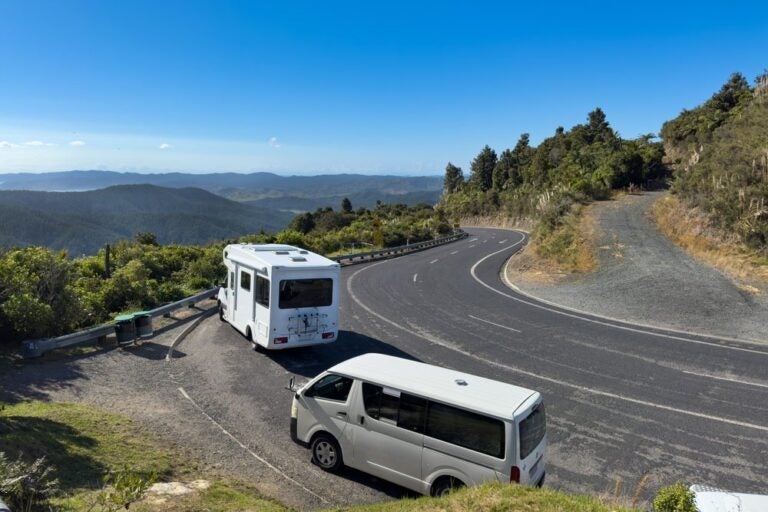
Renting a car in New Zealand is one of the smartest choices if you want to explore the country at your own pace. The distances aren’t huge, but many of the best sights are far from public transport. Having your own vehicle gives you the freedom to stop at viewpoints, take back roads, and travel on your own schedule.
At the main airports in Auckland, Wellington, Christchurch and Queenstown you’ll find the usual international rental companies along with several local firms that often offer better rates. In tourist towns there are also small agencies that work well, but availability can fill up quickly during peak season.
Most rental fleets offer compact cars, SUVs, and campervans. Compact cars are great for cities and main highways, but if you plan to explore the South Island or alpine areas, an SUV can give you more confidence on narrow roads and steep inclines. Campervans are very popular with young travelers and those on longer trips, though they use more fuel and need extra care while driving.
Prices change with the season, usually higher in summer and more affordable in winter. As a general guide, an economy car costs around NZD 40 to 80 per day ($24-48), while an SUV or campervan can run between NZD 100 and 200 per day ($60-120).
Most rental companies require drivers to be at least 21, have a valid license in English or an official translation, and a credit card for the deposit. If you plan to head into alpine areas in winter, make sure to request snow chains and check that the vehicle has a current WOF.
In short, renting a car is easy and convenient, but it’s best to book ahead and pick a vehicle that suits the kind of trip you’re planning. Driving a compact around Auckland feels very different from tackling an alpine pass on the way to Queenstown.
Frequently asked questions about driving in New Zealand as a foreigner
Yes. You can drive for up to 12 months with your home country license as long as it’s in English or comes with an official translation or an International Driving Permit. If you stay longer, you’ll need to get a New Zealand license.
At first it can feel unusual, but most people adjust within a few minutes. The real challenge isn’t the steering wheel on the right side, but the tight bends, single-lane bridges, and roundabouts, which operate differently than in many other countries.
Yes, especially on the South Island and in areas like Fiordland, Arthur’s Pass, or Queenstown. They aren’t dangerous if you drive carefully and stay alert, but they do require experience and the ability to handle winding roads, steep hills, and changing weather.
It depends on the area. In alpine roads, snow chains may be required during heavy snow or storms. If you’re renting a car, request them in advance and make sure you know how to fit them before you set off.
No, you can only camp in designated camping or freedom camping areas. Fines for staying in unauthorized spots are steep. Always check the signs and local regulations for each district.
In cities it’s generally fine, but on rural roads it’s not the safest. There’s often little lighting, animals on the road, and bends that can be hard to see. The practical rule is to avoid driving at night outside urban areas whenever you can.
Plans that may interest you


Hi! I'm a Spanish-English translator working with Holafly, helping bring travel content to life for curious travelers. As a digital nomad with a passion for exploring, I'm always adding new spots to my bucket list. If you love to travel like me, stick around because you're in the right place to find inspiration for your next trip! ✈️🌍
