







 Language


 No results found
Driving in Mexico: Tips and requirements
If you are driving in Mexico, be sure to read this article. We tell you what you need to know to avoid accidents and fines.

Mexico is one of the world’s most diverse destinations, offering everything from vibrant culture and bustling modern cities to pristine beaches, ancient Mayan ruins, mountains, volcanoes, and stunning national parks. It’s no wonder travelers from around the globe head to this incredible country. But with such a vast country to explore, driving in Mexico can be the best way to make the most of your trip. Just be sure to read this guide before you hit the road.
Renting a car and exploring Mexico at your own pace lets you reach remote spots that public transport can’t always get to, avoid being tied to schedules, skip uncomfortable trips, and simply enjoy the freedom to move around. But just like anywhere else, you can’t ignore traffic rules, road signs, local driving habits, the condition of the roads, or the travel documents you need to have on hand at all times.
Get comfortable and let us help you plan the ultimate road trip across Mexico. From which driver’s license you need to the traffic rules you should follow, we’ve got everything covered. Start the engine and let the adventure begin!
Types of driver’s licenses in Mexico
Before you set out on a driving adventure in Mexico, it is important to know which licenses are accepted and whether you will need any extra documents. For most travelers, Mexico is easy to navigate. Usually a valid driver’s license and your passport are enough. Still, the rules can vary depending on where you are from and how long you plan to stay.
Valid licenses for tourists
If you are visiting Mexico for tourism, you can drive with your valid national driver’s license as long as it uses the Latin alphabet. An International Driving Permit is not required, but it can come in handy if your license is not in English or Spanish.
Most car rental companies in Mexico will accept licenses from Latin America, the United States, Canada, EU countries, the UK, Australia, and New Zealand without any issues. As long as your license is valid and matches your passport, you can drive freely throughout your stay.
Is an International Driving Permit (IDP) mandatory?
Mexico does not require an International Driving Permit for tourists, but it can be a good idea if your license isn’t in the Latin alphabet, comes from a country with an unusual format (for example, one that lacks a photo or clear details), or if you plan to drive in states where enforcement is stricter.
An International Driving Permit can be really helpful in these situations, making police checks simpler and avoiding any misunderstandings. Always keep it with your original license!
Licenses for long stays, students, or temporary workers
If you are going to be in Mexico for an extended period, whether for work, study, or living there, the rules are different. There is no official cutoff for when you stop being a tourist, but it is usually a good idea to get a Mexican driver’s license if you plan to stay more than six months or already have temporary or permanent residency.
Mexican driver’s licenses are issued by each state, and requirements and fees can vary. In general, you will need to provide your passport or official ID, proof of address in Mexico, a valid immigration document, as well as a medical exam and photos.
There is no exchange system like in Europe. If you are a resident, you will need to obtain a local license from scratch, although the process is usually quick.
Type of license required to drive a private car
To drive standard cars, you need what is usually called a Type A license or a driver’s license for private vehicles, depending on the state. With this license, you can drive your own car or rent a vehicle without any issues.
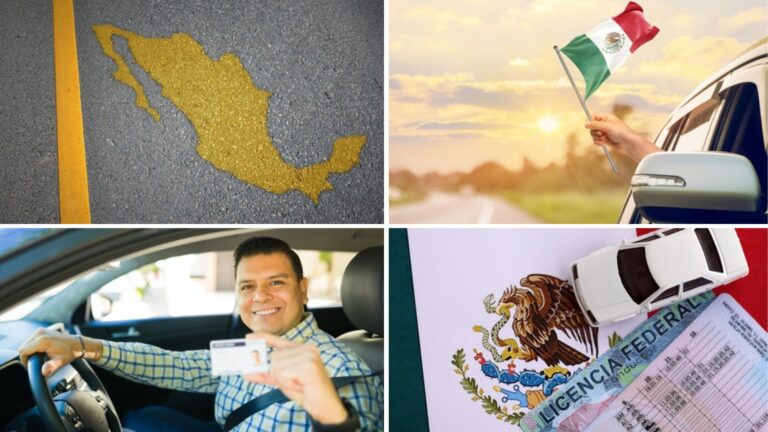
Requirements and documentation for driving in Mexico
Having a valid license is just the starting point for driving safely, even in your own country. Being a responsible driver means meeting basic requirements for yourself and your vehicle. While rules can differ slightly between states, there are general guidelines across Mexico that are good to keep in mind before you hit the road.
Minimum age required to rent a car and drive in Mexico
The minimum age to drive a private vehicle in Mexico is 18. Most rental companies require drivers to be at least 21, and some may charge extra for drivers under 25.
Mandatory documentation you must carry
Whenever you drive, make sure to have your valid license, passport or official ID, your entry record (entry stamp or FMM), the vehicle’s insurance policy, and the registration card (provided by the rental company if you’re driving a rental). Keep these documents handy in case you are stopped by the authorities.
Compulsory insurance
Liability insurance is required on federal highways and strongly recommended throughout Mexico. Basic coverage usually protects against damage to third parties, but many rental companies offer additional coverage to help avoid extra costs in case of an accident or theft.
Vehicle conditions
The car should meet some basic requirements. Brakes, lights, and tires need to be in good condition. It’s also important that the license plates are clearly visible and the registration card is up to date.
Rental cars usually meet all these requirements, but it is still a good idea to check the lights, mirrors, and tire pressure before setting off.
Alcohol and driving
Alcohol limits for drivers are set nationwide under Mexico’s General Law on Mobility and Road Safety, and individual states can enforce stricter rules, but not more lenient ones. In short, the safest approach is to stick to zero, especially in cities where checkpoints are common.
The maximum permitted limits are:
- Private car drivers: Up to 0.25 mg/L in exhaled air or 0.05 g/dL in blood.
- Motorcyclists and new drivers: Up to 0.10 mg/L in air or 0.02 g/dL in blood.
- Public transport, taxis, cargo vehicles, and professional drivers: Zero tolerance (any amount is an offense).
In states like Mexico City, Jalisco, Nuevo León, and Guanajuato, alcohol checkpoints are common, especially on weekends. Penalties can include hefty fines, vehicle impoundment, and in some cases, administrative arrest, depending on the local jurisdiction.
Therefore, even though there is a legal limit, we still recommend that you avoid drinking if you plan to drive.
Stay connected on the road
Mexico has long stretches of highways, rural roads, and areas with spotty signals. Having a reliable internet connection lets you use GPS, check tolls, monitor traffic, and stay in touch in case of an emergency. With Holafly’s eSIM for Mexico, you can do all this without relying on WiFi or roaming, making it perfect for a short trip.
If you plan to cross into the United States, Guatemala, or Belize, or stay in Mexico for a longer period, Holafly’s monthly plans make things much easier. You subscribe once, activate the eSIM before your trip or after landing in Mexico, and you’re all set. The plan renews automatically and can be canceled anytime. The best part is that the eSIM works in over 170 countries, covering nearly the entire Americas.
Ideal for digital nomads, international students, remote workers, frequent travelers, or airline crew members.
Important: If you are a frequent traveler and want to stay connected without worrying about expensive roaming or looking for a new SIM at every destination, Holafly’s subscription plans are for you. With a single eSIM, enjoy internet in more than 160 countries for a fixed price and no surprises on your bill. Travel without limits and connect easily and securely! 🚀🌍

Traffic rules and signs to keep in mind when driving in Mexico
Driving in Mexico means adjusting to a unique pace, with huge cities, busy federal highways, and rural areas where things move a bit slower. Infrastructure is constantly improving and road signs are generally clear, but it helps to know a few key rules to get around more safely and with fewer surprises.
Direction of traffic and right of way
In Mexico, drivers keep to the right, and passing is done on the left. One thing you’ll notice quickly in big cities is that lane changes happen often, so keeping a safe distance from the car in front is essential.
At intersections without traffic lights, the car that arrives first usually has the right of way, but it’s best to proceed cautiously. Pedestrians have priority at marked crosswalks, though they don’t always use them, so stay alert in shopping areas and near public transport stops.
Speed limits
Limits may vary by state, but generally speaking they are:
- 40–60 km/h in urban areas.
- 80–90 km/h on state roads.
- 100–110 km/h on federal highways.
On toll highways, you’ll find clearer signage and wider lanes, making these roads the safest option for long-distance driving.
Use of cell phones and electronic devices
The rule is simple. You cannot use your phone while driving. It can only be used as a GPS if it is mounted on a fixed holder. Some states enforce this very strictly, so it is better not to take any chances.
Lights, weather conditions, and safety
Mexico has very changeable weather. On the same route, you can go from intense sunshine to tropical rain in a matter of minutes, especially in the south.
So, before setting off, remember:
- Turn on your lights if there is rain, fog, or low visibility.
- Drive slowly and with your headlights on low beam in mountainous areas (Oaxaca, Chiapas, Hidalgo), where sharp curves are common.
- Be especially careful in the desert areas of the north, where wind can kick up dust and suddenly reduce visibility.
Another tip is to pay attention to unofficial driving cues, like turn signals. On the road, if the car in front of you flashes its left signal, it usually means it’s safe to pass. Avoid using your own signal to show a lane change, as it can confuse other drivers.
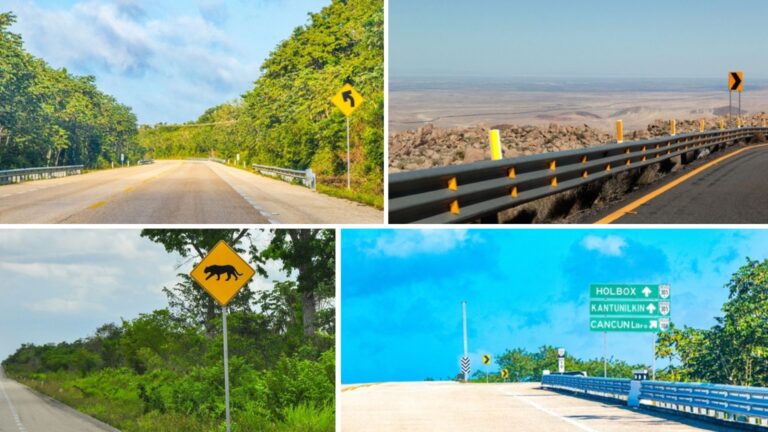
Traffic signs in Mexico
Mexican road signs follow international standards, so if you’ve driven in the Americas or Europe, they’ll look familiar. Still, there are a few useful details worth knowing:
- Warning signs (yellow): Curves, slopes, loose animals, landslide areas.
- Restriction signs (white with red border): Speed limits, no passing, one-way streets.
- Information signs (blue or green): Services, destinations, distances, federal highways.
On long stretches of road, you’ll often see signs showing the next town or city along with the distance in kilometers and the highway number, such as Federal Highway 57. This makes it much easier to find your way.
One very Mexican detail is the presence of speed bumps in rural areas, sometimes with little or no warning. When approaching a small town, it’s best to slow down to avoid surprises and potential damage or accidents.
Most common penalties and fines for driving in Mexico
Penalties vary by state, but some violations are common nationwide. These include speeding in urban areas, using your phone while driving, or not wearing a seat belt. Fines can range from relatively small amounts to much higher penalties in tourist states like Quintana Roo or Baja California Sur, where enforcement is especially strict to protect visitors.
| Common offense | Approximate fine |
| Speeding (urban) | 1,000–2,500 MXN ($59–147) |
| Using a cell phone while driving | 1,500–2,700 MXN ($88–159) |
| Not wearing a seat belt | 500–1,200 MXN ($29–71) |
| Running a red light | 1,800–2,500 MXN ($106–47) |
| Driving under the influence of alcohol (without an accident) | 2,500–5,000 MXN ($147–294) + administrative arrest depending on the state |
| Parking in a prohibited area | 800–1,800 MXN ($47–106) |
| Failing to obey a stop sign/crossing | 1,000–1,800 MXN ($59–106) |
| Driving with expired or unverified license plates (states that require them) | 1,500–2,500 MXN ($88–47) |
| Not carrying a vehicle registration card | 800–1,500 MXN ($47–88) |
| Passing on the left lane without caution (highways) | 1,000–2,000 MXN ($59–118) |
| Blocking disability ramps | 1,400–2,100 MXN ($82–124) |
| Double parking | 900–1,500 MXN ($53–88) |
Tolls, fuel, and refueling in Mexico
Getting around Mexico by road can be very comfortable once you understand the difference between free highways and toll roads, and how tolls work along the way. It also helps to know what types of fuel are available and how refueling works, since quality, prices, and infrastructure can vary from one region to another.
Free roads vs. toll roads
Mexico has an extensive network of federal and state highways known as free roads. They are based on the constitutional principle of free movement, meaning anyone can travel on them without paying tolls. These roads often pass through towns, rural areas, and busier zones, so they tend to be slower, less consistent, and have more speed bumps and intersections.
At the same time, Mexico has developed a modern network of toll highways designed to complement the free roads. These highways are generally in better condition, allow for higher speeds, bypass small towns, carry less heavy traffic, and are safer for long-distance travel.
They are easy to spot. Toll roads usually have a “D” at the end of the highway number, like 180D, 57D, or 150D, and access points are clearly marked with signs that say “Cuota“.
Toll prices vary depending on distance, vehicle type, and region. To plan your trip more accurately, it’s a good idea to use official apps like Mappir or Traza tu Ruta, which automatically calculate costs and travel times.
To give you an idea, the 180D toll road between Valladolid and Chichén Itzá costs about 100 MXN (around $5.50) for just 40 km, but it cuts travel time by more than half compared to the free road.
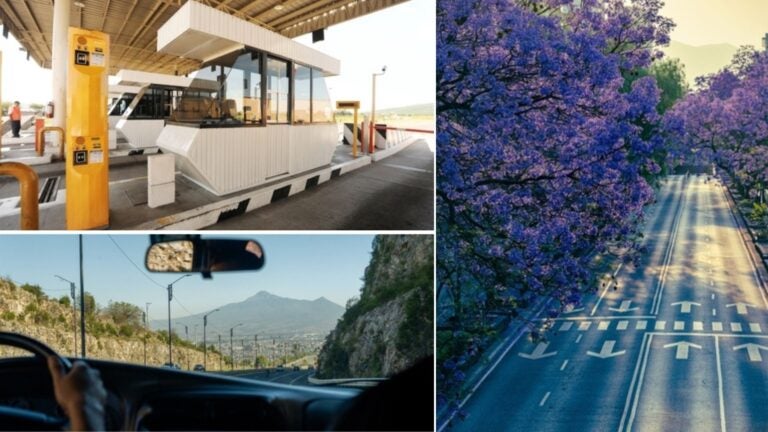
Payment methods on toll roads
Toll highways have booths where you can pay in cash, which is the most common method, by card in some locations, or using an electronic TAG system (IAVE, TeleVía, or PASE), which is perfect if you plan to do a lot of driving.
The newer toll highways accept TAG, allowing you to pass through without stopping. If you’re renting a car, check whether it comes with a TAG device and what extra fees might apply.
Refueling in Mexico
Gas stations in Mexico are plentiful in cities and along main highways, operated by Pemex, Shell, BP, Total, and other brands. In rural areas, however, they can be few and far between, so it’s wise to top off your tank before heading out on longer drives.
The main fuels and their respective prices, which vary by state, season, and daily adjustments authorized by the energy authority (CRE), are:
- Magna (87 octane) – green (21–23 MXN per liter – $1.15–1.26)
- Premium (92–93 octane) – red (23–25 MXN per liter – $1.26–1.37)
- Diesel (23–26 MXN per liter – $1.26–1.42)
Keep in mind that prices tend to be higher in very touristy areas.
How to refuel
Most gas stations in Mexico are full-service, so you won’t need to get out of your car. Just pull up to an attendant, tell them the type of fuel and how much you want, wait for them to fill it, and then pay with cash or card.
Before filling up, always make sure the pump is set to zero, as some travelers have reported scams. Also, double-check that the attendant is using the correct type of fuel for your car. These simple steps can save you from unpleasant surprises or awkward situations.
Parking in Mexico
Parking in Mexico can be easy or a bit tricky, depending on where you are. Big cities and tourist towns each have their own rules, so it’s helpful to know what to expect before you arrive with your car.
Parking in large cities (Mexico City, Guadalajara, Monterrey, Puebla)
In Mexico’s largest cities, parking works in a similar way: there are paid zones, streets with restrictions, and fairly affordable private lots. Signs are usually clear, but it’s important to pay attention, as rules can change depending on the day or time.
In cities like Mexico City, for example, there are regulated areas managed by digital parking meters, such as “ecoParq” in neighborhoods like Roma, Condesa, or Polanco. You can pay through apps or at the machines, usually for a limited time of up to four hours. The system is well marked, but finding a spot in busy areas can be challenging during peak hours.
Private parking is usually the easiest option. Prices range from 20 to 40 MXN ($1–2) per hour, or 150 to 250 MXN ($8–13) per day, depending on the neighborhood. In modern buildings or shopping centers, lots are spacious and monitored, making them a great choice if you prefer to avoid driving in crowded areas.
A useful tip for big cities is that if you plan to visit busy neighborhoods, it is usually easier to park your car and get around on foot or by using public transportation.
Where you cannot park in large cities
The rules are strict in urban areas, especially on avenues and streets with heavy traffic. Avoid parking in:
- Areas with a yellow line on the edge of the sidewalk.
- Garage entrances, ramps, or building entrances.
- Sidewalks, which are intended for pedestrians only.
- Spaces reserved for people with disabilities.
- Streets with “No Parking” signs.
In tourist states such as Quintana Roo or Baja California Sur, fines for illegal parking can be high.
Parking in tourist towns and Magical Towns (Bernal, Bacalar, San Cristóbal de las Casas)
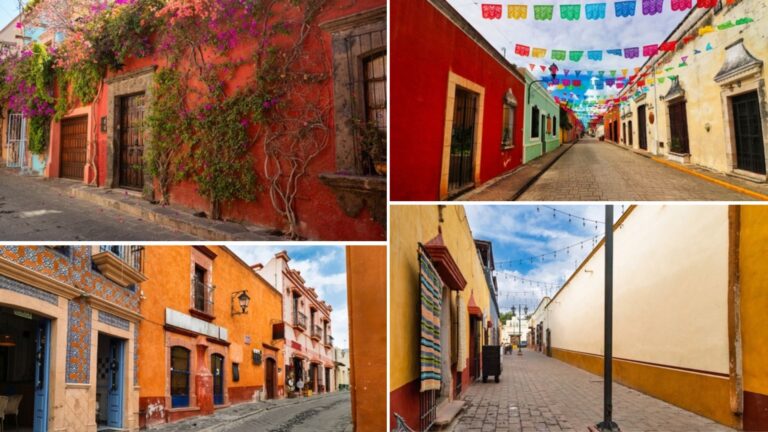
Magical Towns are full of charm, but their streets are usually narrow. Since their centers are carefully preserved, parking can be more challenging than in larger cities.
In these towns, it’s usually best to park outside the historic center and explore on foot, which is much more enjoyable. You’ll also find private lots near main squares. Some streets only allow parking on one side, and if you’re unsure about fees, check the municipal rates, which typically range from 10 to 20 MXN per hour ($0.55–1.10).
Helpful tips:
- In tourist towns, always look for local signs or ask a nearby shop, since rules can change depending on the high season or special events.
- If you visit a Magical Town on a weekend or during peak season, try to arrive early. Parking near the center fills up quickly as the day goes on.
- In popular destinations like San Miguel de Allende, it’s best to avoid driving into the historic center. The streets are often cobblestone, crowded with pedestrians, and subject to frequent restrictions.
General recommendations for parking in Mexico
- Formalities first: Avoid parking where there are hand-painted signs that say “no parking”; these may be unofficial local rules.
- Map app: Use GPS to check for closed streets, metered parking zones, or nearby private parking lots.
- Tourist attractions: At parking lots, check that there are no “informal” fees; choose official parking lots whenever possible.
- Safety: In large cities, avoid leaving objects in plain sight inside your car.
Options for renting a car in Mexico
Renting a car in Mexico is a great way to get around freely, especially if you plan to visit beaches, colonial towns, or Magical Towns where public transportation can be limited. There are plenty of options to suit every budget.
At airports, bus stations, and tourist areas, you’ll find international rental companies like Hertz, Avis, Budget, Enterprise, and Sixt, as well as more budget-friendly options like America Car Rental, Veico, or Firefly. Local agencies are also available and often offer competitive rates, though their insurance and deposit policies can be stricter.
The most popular vehicles for tourists and digital nomads are compact cars and sedans, perfect for city traffic and longer drives. In mountainous areas or for trips to remote locations, an SUV can be more comfortable. Most cars are automatic, but manual models are also available at a lower cost.
In terms of cost, the usual range is:
- 350 to 700 MXN ($19-38) per day for economy cars.
- 1,800 to 3,500 MXN per week ($98-191), depending on season and demand.
- Monthly rentals between 7,000 and 12,000 MXN ($383-657), ideal for long stays.
A key point in Mexico is that the total cost depends on the required insurance. Choosing more comprehensive coverage will increase the price, but it’s strongly recommended for a stress-free trip.
Final tips for driving in Mexico
Driving in Mexico can be a very enjoyable experience if you take a few basic precautions. The country is vast, and safety can vary widely depending on the region, so it’s wise to drive carefully and plan your routes ahead of time.
Road safety – What to keep in mind
Mexico has modern highways and busy routes, but there are also rural areas with limited lighting. Whenever possible, try to avoid driving at night on long or sparsely populated roads, especially in northern states or remote southern regions. It’s not inherently dangerous, but poor visibility and road conditions can make the trip more challenging.
In tourist areas and large cities, driving is safe; you just need to pay attention to lane changes, unexpected speed bumps, and pedestrian traffic.
Areas to avoid or travel through with extra caution
There is no definitive list, but as a general rule:
- On the northern borders, choose toll highways over secondary roads.
- In the northern and northwestern states, avoid remote roads or those with poor signage.
- In rural areas in the south (Oaxaca, Chiapas, Guerrero), drive calmly, especially at night or in adverse weather conditions.
Most tourist destinations are safe for driving. Areas like the Riviera Maya, Yucatán, Baja California Sur, Puerto Vallarta, Guanajuato, Puebla, and Querétaro generally have excellent road infrastructure.
How to behave at a traffic checkpoint
Traffic checkpoints are common and usually quick. The ideal thing to do is:
- Slow down before you reach the checkpoint.
- Turn off your music and roll down your window.
- Only hand over your documents if requested (license, registration card, and insurance policy).
- Speak calmly and respond briefly and respectfully.
Traffic police are usually there to check documents or give safety instructions. Never hand over money or sign anything without reading it first. If you rented a car, call the rental company if you have any doubts.
Recommended precautions for foreign travelers
- Do not leave objects in plain sight inside your car, especially in large cities.
- Use toll roads for long trips; they are safer and faster.
- Fill up your tank if you are going to rural areas; some gas stations are far apart.
- Save the location of your accommodation in your GPS before you leave.
- Maintain a mobile connection to navigate, call for help, or check routes in real time.
An important tip about interacting with locals
Mexico is a friendly country, and drivers are generally patient, but traffic can be unpredictable. If someone honks or tries to force a lane change, the best approach is to stay calm and let them go. Defensive driving is the key to getting around safely and stress-free.
Frequently asked questions about driving in Mexico
Yes. Most tourists can drive with their valid national license. An International Permit is not required unless your license is not in Spanish or English.
In cities and tourist areas, driving at night is usually fine. On rural roads or very long stretches, it’s better to avoid nighttime driving because of limited visibility, loose animals, and unmarked detours.
Rules are very strict. Many cities have regular alcohol checkpoints every week, and national limits are low. The safest approach is not to drink if you plan to drive.
Everything is straightforward if your documents are in order. Slow down, roll down your window, stay calm, and only provide what is requested. Never offer money or sign anything you don’t understand. Keep in mind that a traffic officer cannot take your driver’s license or any other documents. If someone asks you to pay to avoid a fine, refuse, ask to see their badge, and then report the attempted bribe.
Parking can be tricky in central areas. The easiest solution is usually to use a private lot. In Magical Towns, many visitors leave their car on the outskirts of the historic center and explore on foot.
Plans that may interest you


Hi! I'm a Spanish-English translator working with Holafly, helping bring travel content to life for curious travelers. As a digital nomad with a passion for exploring, I'm always adding new spots to my bucket list. If you love to travel like me, stick around because you're in the right place to find inspiration for your next trip! ✈️🌍
