







 Language


 No results found
Driving in Finland: Tips and requirements
We tell you all you need to know about driving in Finland so you can chase the Northern Lights and discover its wildest nature.

The best way to explore Finland’s wild landscapes, its lakes, and vast forests is by driving your own vehicle. Finnish roads are very safe, and drivers tend to be calm and responsible, so you can enjoy every view without any stress behind the wheel. To do it all legally, we’ll explain what type of licence you need as a foreigner, along with the requirements and documents you must have on hand while driving.
We’ll also cover traffic rules, road signs, speed limits, and the main fines to watch out for. Finally, it’s useful to know about parking, fuel types, and your car rental options in Finland. Time to hit the road!
Driving licenses valid in Finland
The first thing you need to drive in Finland is a valid driving licence. Whether your licence is accepted depends on your home country, how long you’ll be staying, and any agreements with the Finnish authorities. We’ll break down the details for you below.
National license from your country of origin
If you’re from the European Economic Area (EEA), you can drive in Finland without any extra paperwork, as long as you’re over 18 and your licence is valid during your stay. In general, EEA countries like Spain, France, Germany, or Italy can use their national driving licences indefinitely while in Finland.
International Driving Permit (IDP)
If you’re visiting from outside the EEA, you’ll need to get an International Driving Permit (IDP) before your trip. You must carry it along with your national licence, and it’s valid for six months. The IDP also needs to be translated into English, Swedish, or Finnish. You can obtain it through your local traffic authority, for example:
- Spain: DGT.
- Mexico: Automóvil Club Mexicano.
- USA: AAA.
- Argentina/Chile/Colombia: Automobile club in each country.
- Australia: Australian Automobile Association.
Validation of your foreign license
If you plan to stay in Finland for more than six months and need to drive, you can exchange your foreign licence for a Finnish one. This isn’t necessary for EEA countries, as we mentioned earlier, but it does apply to some places like certain states in the USA, Canada, or Australia, where you can swap your licence directly without taking a test.
On the other hand, if you’re from Mexico, Colombia, Chile, Argentina, or other Latin American countries, once the six months allowed with your IDP have passed, you’ll need to get a Finnish driving licence by completing the official theory and practical tests.
Requirements and documentation for driving in Finland
Now that you know which type of licence you can use in Finland, let’s go over the other requirements, both for the driver and the vehicle. If you’re renting a car, the rental company should provide all the necessary documents, including liability insurance and the vehicle inspection certificate. Here’s a checklist for you to review carefully:
- Valid driver’s license: License from your country of origin or the IDP, as we saw in the previous section.
- Identity card or passport: This is mandatory for identification purposes when dealing with the police or traffic authorities.
- Driving license: The car must have official documentation proving ownership or rental.
- Compulsory civil liability insurance: All vehicles driven in Finland must have this.
- Minimum age: The minimum age to drive is 18, though some rental companies require drivers to be 21 or even 25. There’s no upper age limit for driving, as long as you’re in good health.
- Mandatory technical inspection: All vehicles must have a valid technical inspection certificate.
- Seasonal tires: In winter, you must have special tires.
- Mandatory vehicle kit: Emergency triangle, reflective vest, spare tire or puncture repair kit, and antifreeze.
Important: If you are a frequent traveler and want to stay connected without worrying about expensive roaming or looking for a new SIM at every destination, Holafly’s subscription plans are for you. With a single eSIM, enjoy internet in more than 160 countries for a fixed price and no surprises on your bill. Travel without limits and connect easily and securely! 🚀🌍

Traffic rules in Finland and road signs
To drive in Finland safely and legally, the first thing to understand is the traffic rules and road signs, which are strictly enforced. While the country has a very safe road infrastructure, extreme weather conditions can make driving more challenging.
Direction of traffic
Like most European countries, driving in Finland is on the right, and overtaking is done on the left. If you’re coming from a country where driving is on the left, such as the UK, Ireland, or Australia, it’s a good idea to practice in a safe, low-traffic area until you get used to the different driving setup.
Speed limits
These are the speed limits you need to follow to avoid fines. Because of Finland’s weather, pay attention to electronic road signs that may adjust the limits when needed. In fact, during winter, many highways reduce the limit to 100 km/h due to ice and snow.
- Urban areas: 30–50 km/h
- Secondary roads: 80 km/h
- Highways/motorways: 100–120 km/h
No smartphone use
To avoid a hefty fine, it’s best to use a hands-free system while driving, as using a mobile phone is completely prohibited. Finland enforces this rule strictly, and it’s considered a serious offense since distracted driving can lead to major accidents.
Use of lights
In Finland, it’s mandatory to keep your low-beam headlights on at all times, day and night, throughout the year. You can also use fog lights in heavy fog, rain, or blizzards. During winter, headlights often get covered in snow, so make sure to clear them before driving.
What the signs look like
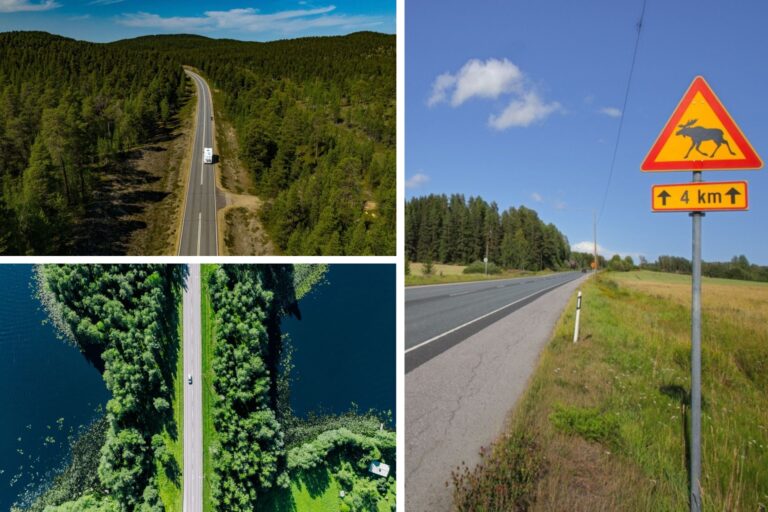
While Finland’s road signs are similar to those in the rest of Europe, there are some differences in color. Informational signs are usually blue, while road signs are yellow with red borders. Many signs also feature icons of moose, reindeer, and other wildlife, which are very common in Lapland.
Common penalties and fines
| Offense | Approximate fine |
| Minor speeding 10–20 km/h over the limit | From $159 |
| Serious speeding +30 km/h | Considered a criminal offense and results in temporary license suspension |
| Failure to use low beams | From $75 |
| Not using winter tires | From $107 |
| Driving under the influence of alcohol | Heavy fine and possible jail time |
| Using a mobile phone without a hands-free device | From $87 |
Tolls and refueling
If you’re driving in Finland, you won’t need to pay any tolls, as all national roads, highways, and expressways are free, including routes connecting to other parts of Europe. The only exception is some bridges in the archipelago, where fees range from $5–20 depending on the vehicle, payable by card or cash.
When it comes to fuel, most petrol stations in Finland are open 24/7, and you can pay by bank card or the station’s own app, such as St1, Neste, ABC, or Shell. If you’re renting an electric car, there’s also an extensive network of chargers across the country, including Ionity, Virta, Tesla, and Fortum:
- 95E10 (standard gasoline): From $7 per gallon.
- 98E5 (premium gasoline): From $7.60 per gallon.
- Diesel: From $7.40 per gallon.
- Electricity: From $0.35 per kWh
Parking in Finland
Finland has a well-organized and strictly enforced parking system, with free zones, metered street parking, and the usual private and underground lots. Parking is prohibited on sidewalks, pedestrian crossings, emergency areas, bus or taxi stops, and bike lanes. Approximate parking fees are as follows:
- Public parking: $1–4 per hour and higher in central Helsinki, where it can double.
- Private parking: From $15–30 per day
Options for renting a car in Finland
Whether you’re a digital nomad living in Finland, a student, or a tourist planning trips along the Archipelago Trail near Turku, the Arctic Route to Rovaniemi, or stretches through Lapland to catch the northern lights in winter, the most convenient option is to rent a car and explore at your own pace. You’ll find major international rental companies like Hertz, Avis, Budget, Europcar, and Sixt at airports, train stations, and city centers in Helsinki, Tampere, Turku, and Rovaniemi.
There are also local companies, like Green Motion and Scandia Rent, which usually offer more affordable rates. In general, these are the typical vehicle types and approximate daily prices:
| Vehicle type | Models | Rates/day |
| Compact and economy | Volkswagen Golf, Dacia Sandero | From $35 |
| Family | Ford Mondeo, VW Passat | From $90 |
| SUVs and 4x4s | Toyota Yaris Cross, Nissan Qashqai | From $70 |
| Electric vehicles | Nissan Leaf | From $43 |
Tips for driving in Finland as a foreigner
You’re now ready to drive in Finland and explore its roads safely! As a quick recap, here are a few final tips to help you remember the most important things to keep in mind. In particular, pay close attention to the country’s weather conditions, make sure your tyres and lights are suitable, and stay alert for wildlife crossings in rural areas.
- Drive with suitable tires: In winter, winter tyres are mandatory, so make sure your rental car is already fitted with them.
- Slow down on snowy or icy roads: Even if the speed limit allows it, adjust your driving to the road conditions, as the surface can be hazardous.
- Be cautious of wild animals: Moose and reindeer may cross the road in rural areas and in the north of the country.
- Always use your lights: In Finland, you are required to keep your lights on 24 hours a day, all year round.
- Avoid using your cell phone while driving: It is only permitted with a hands-free system.
- Respect speed limits: There are automatic cameras on many roads and fines are common.
- Always carry emergency equipment: If you’re traveling through remote areas, it’s a good idea to carry a thermal blanket, a phone charger, an ice scraper, and a reflective vest.
- Plan your routes in advance: Distances can be long and gas stations are further apart than in other countries.
To stay connected on the road and easily access GPS or make emergency calls, we recommend traveling with Holafly. For short stays, the Finland eSIM is the best option, offering unlimited data for only the days you need, starting at $3.90 per day.
For longer trips, Holafly’s monthly plans are a great option, offering a no-commitment subscription, 5G coverage across the country, and access in over 160 destinations without changing your eSIM. If you choose the 25 GB or unlimited plan, you can also connect multiple devices at the same time, starting from $49.90 per month.
Frequently asked questions about driving in Finland
Driving can be challenging because of ice, snow, and reduced visibility, so it’s best to take it slow and drive carefully. Rental cars are usually equipped with the required winter tyres.
Yes, this country uses fixed, mobile, and section speed cameras very frequently, especially on main roads and in urban areas.
There are no standard toll roads, so you can travel freely on highways and main roads. Only a few specific bridges or tunnels may charge a fee.
Yes, the roads are very safe, but there’s always a chance of encountering wildlife, so it’s best to drive at a reduced speed and use high beams when there’s no oncoming traffic.
Plans that may interest you


Hi! I'm a Spanish-English translator working with Holafly, helping bring travel content to life for curious travelers. As a digital nomad with a passion for exploring, I'm always adding new spots to my bucket list. If you love to travel like me, stick around because you're in the right place to find inspiration for your next trip! ✈️🌍
