Language


 No results found
Driving in Cyprus: Tips and requirements
Driving in Cyprus is an experience not to be missed, as you can discover the country's most important places at your own pace.

Cyprus is a destination where having your own car is the best way to truly explore the country. Driving in Cyprus is highly recommended thanks to the excellent road conditions, along with other factors that will pleasantly surprise you as you continue reading this guide.
Here you’ll learn everything from which driving licenses are accepted, the requirements and documents you need to drive, to traffic signs, the most common violations you should avoid, as well as car rental costs and the prices of the most commonly used fuels.
We’ve put together everything you need to know about driving in Cyprus in one place. So you can easily pick up a few helpful tips you may not have considered yet.
Driving licenses valid in Cyprus
To drive in Cyprus, you’ll need to hold a driving license that is recognized in the country, which will depend on how long you plan to stay on the island. To help you choose the option that best suits your visit, below we’ll walk you through the different types of licenses you can use in Cyprus.
EU/EEA licenses
This license lets you drive in Cyprus without any extra paperwork, like translations or conversions. It’s widely accepted for tourists for up to six months. However, if you plan to live on the island, you’ll need to exchange it for a Cypriot license after that period.
National licenses accepted for driving in Cyprus
Cyprus has several bilateral agreements that allow citizens from certain countries to drive with their national licenses, but only as tourists. These countries include Australia, New Zealand, South Korea, Russia, Serbia, Georgia, Iceland, Liechtenstein, Japan, Norway, South Africa, Switzerland, Ukraine, Zimbabwe, the United States, Canada, and the United Arab Emirates.
International Driving Permit
If your driving license comes from outside the EU or from a country that does not have an agreement with Cyprus, such as most of Latin America, Africa, and Asia, you will need an International Driving Permit to drive legally on the island.
If you’re from one of the countries in these regions, you’ll need to carry both your valid national driving license and an International Driving Permit, and you must obtain the permit in your home country before arriving in Cyprus. Always make sure to have your passport or ID with your driving documents as well.
Cypriot driver’s license
Once your time as a tourist is up or your immigration status in Cyprus changes, you’ll need to exchange your driving license. Here, we’ll go over the documents you’ll need to provide to start the process with the Department of Road Transport.
- Completed TOM 7 application form.
- 4.5×3.5 passport-type photos, or you can have them taken at the District Transportation Offices.
- Certificate of Foreigner Registration or Residence Permit in the country (copies and originals).
- Proof that you have been living in Cyprus for at least 6 months, such as utility bills or rent receipts.
- Payment of application fee (approximately $55).
Requirements and documentation for driving in Cyprus
Driving in Cyprus comes with certain requirements and paperwork that you must follow. Ignoring them could get you into legal trouble, including fines or even jail. Here’s what you need to have in order to drive on the island safely and legally:
- Driving license from your country of origin: This is valid if you are from one of the countries that has an agreement with Cyprus.
- Driving license from EU and EEA countries
- International Driving Permit: Citizens from countries outside the EU that don’t have driving agreements with Cyprus must obtain this permit. Keep in mind that you must always carry it along with your home country’s driving license.
- Passport, visa, or national identity card
- Civil liability insurance: Make sure it matches the vehicle you’ll be driving in Cyprus, as all the information needs to line up if a traffic officer asks to see your documents.
Requirements
Now we’ll cover what’s expected of you when driving in Cyprus. Some of these rules might be very different from back home, so it’s worth keeping them in mind.
- Age limits for driving in Cyprus: The minimum age to drive is 18, and the maximum depends on the driver’s ability. For car rentals, the limit is usually 75 years old.
- Disability: People with reduced mobility or other medical conditions can drive as long as a doctor certifies that they are able to safely operate a vehicle on their own.
- Alcohol consumption: While it’s best not to drink at all if you’re driving, the legal limit in Cyprus is 50 mg of alcohol per 100 ml of blood, which is roughly equivalent to one or two beers.
- MOT testing: You must keep the vehicle’s technical inspection up to date, and authorities carry it out every 2 years.
Important: If you are a frequent traveler and want to stay connected without worrying about expensive roaming or looking for a new SIM at every destination, Holafly’s subscription plans are for you. With a single eSIM, enjoy internet in more than 160 countries for a fixed price and no surprises on your bill. Travel without limits and connect easily and securely! 🚀🌍

Traffic rules in Cyprus and road signs
When driving in Cyprus, you’ll notice that some traffic rules and signs are a bit different, especially if you’re from Europe or Latin America. It’s important to familiarize yourself with them before getting behind the wheel.
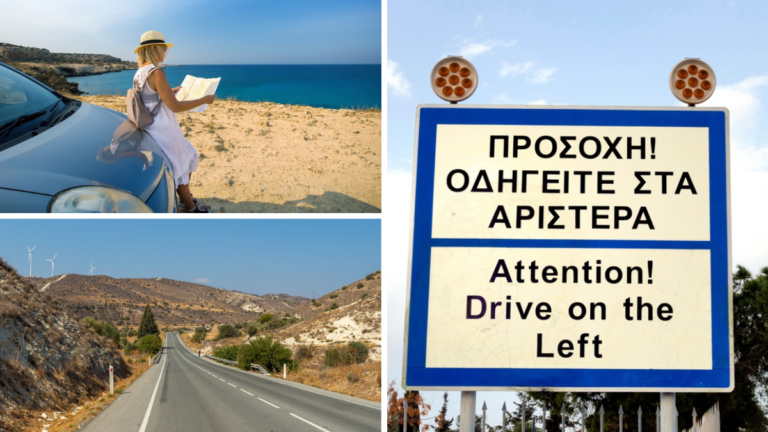
- Direction of traffic: In Cyprus, drivers must drive on the left, so you will need to adjust to the steering wheel being on the right-hand side.
- Overtaking: You can only overtake another car on the right.
- Speed limits in Cyprus: In urban areas, the speed limit is 50 km/h, on secondary roads it’s 80 km/h, and on highways, you should drive between 65 km/h and 100 km/h.
- Lights: During the day, lights are not necessary unless visibility is poor.
- Seat belts: Mandatory for all passengers and the driver.
- Cell phone use: Hands-free devices must be used.
- Emergency kit: You cannot drive without a first aid kit, warning triangle, and fire extinguisher.
- Alcohol and drugs: Authorities do not permit driving under the influence of alcohol or drugs.
Traffic signs and common violations in Cyprus
Traffic signs in Cyprus are largely familiar to international drivers, but there are a few local quirks you should know to avoid fines or penalties.
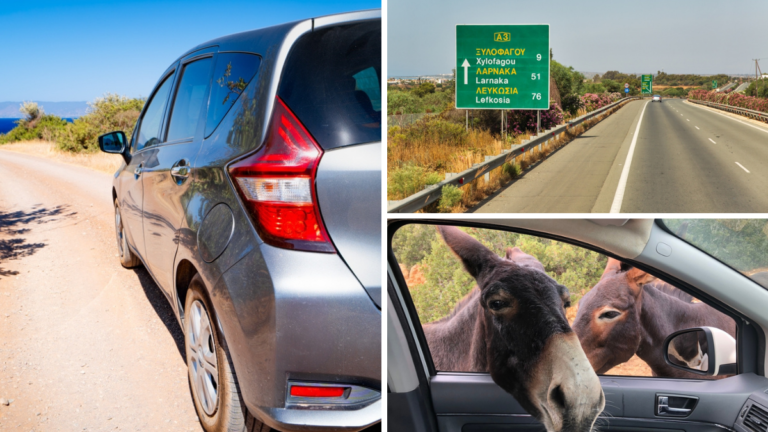
In Cyprus, you might see signs featuring a donkey, warning of animals on the road. There are also brown signs that guide travelers to tourist attractions. Most traffic signs are written in both English and Greek.
Some of the most common traffic violations in Cyprus include speeding, and authorities issue fines based on how much you exceed the limit. Other frequent offenses are using a mobile phone while driving, not wearing a seatbelt, and running a red light, with penalties ranging from 150 to 300 EUR ($170-350).
The most serious and expensive offenses are driving without liability insurance and driving under the influence of alcohol. Not having insurance can result in a fine of up to 3,000 EUR ($3,200), while drunk driving can lead to a combination of fines, jail time, and license suspension.
Tolls and refueling
In Cyprus, there are no toll roads, so you can travel across the country without paying to use the highways. Road maintenance is handled by the Ministry of Communications and Public Works.
On the other hand, there are two types of gas stations in Cyprus. Some stations have attendants during the day who handle payment and fill the tank for you, while others operate as self-service stations 24/7.
The most common fuels you’ll find at gas stations in Cyprus are unleaded petrol and diesel. Unleaded 95 costs around 1.34 EUR ($1.45) per liter, unleaded 98 is approximately 1.40 EUR ($1.50) per liter, and diesel is roughly 1.47 EUR ($1.60) per liter.
In either case, you simply pull your vehicle up to the pump, pay for the amount of petrol or diesel you need, then either you or the attendant will fill the tank. Finally, collect your receipt or invoice.
In general, it’s best to pay in cash at stations with attendants, while debit or credit cards are usually the preferred option at self service stations.
Parking in Cyprus
Parking rules vary from city to city in Cyprus. In places like Limassol or Larnaca, you need to pay close attention to traffic signs, as they clearly indicate where parking is allowed.
In other cities, parking can be a bit more flexible, though that doesn’t mean you can park anywhere. For example, look for white lines on the road, which mark public parking areas regulated by parking meters, where drivers usually pay digitally through apps.
Single, continuous yellow lines, on the other hand, usually allow parking along the curb outside working hours, although these areas are generally intended for passenger loading and unloading.
You’ll also find public and municipal parking lots, where parking may be free at night and on weekends. If you park during paid hours, you can usually pay at a machine using cash or a card, based on how long you plan to stay.
Please note that places such as hotels, airports, restaurants, and shopping centers have paid parking with fixed hourly or daily rates.
Options for renting a car in Cyprus
The most common car rental companies in Cyprus include Hertz, Sixt, Enterprise, Europcar, and Avis. They operate in key tourist areas, such as airports and city centers, making them easy to access.
These rental locations offer cars well suited for Cyprus’ roads, including small, compact models like the Kia Picanto, Volkswagen Up, Chevrolet Spark or Bolt, and Fiat 500. Daily rates start at 11 EUR ($12), weekly rentals range from 120 to 250 EUR ($130–270), and monthly rentals begin at 400 EUR ($430) and up.
You can also choose more powerful vehicles, like 4x4s, including the Toyota Yaris Cross, Kia Sportage, Hyundai Bayon, or Volkswagen T-Cross. Daily rates start at 22 EUR ($24), weekly rentals from 300 EUR ($325) and up, and monthly rentals from 1,000 EUR ($1,085).
Any car you choose will serve you well, as traffic in Cyprus is generally lighter and less congested than in many major European cities. Plus, with no tolls to pay, getting around and exploring the country is more affordable.
Tips for driving in Cyprus as a foreigner
In addition to following all the driving requirements, carrying the proper documents, and obeying traffic rules in Cyprus, we’d like to share a few tips to make your journey around the country smoother and more enjoyable.
- Adapt your reflexes to driving on the left: At first, getting used to it might be a bit challenging, but it’s important to take your time and go slowly as you adjust.
- Be careful at roundabouts: Roundabouts can be tricky when driving in Cyprus, as they move clockwise. Always give way to vehicles coming from your right and keep pace with the local traffic.
- Pay attention to speed limits: Be aware of the limits on each type of road in Cyprus to avoid fines or causing accidents.
- Be careful when driving at night: Especially on secondary roads, there are poorly lit areas and sharp curves.
- Make sure you know how to use self-service gas stations: To save time and avoid confusion at self-service stations, ask someone for guidance on how to make payments and use the fuel pumps.
- Internet connection: You’ll need internet access to check maps of Cyprus and locate tourist spots or emergency services. For this, we recommend Holafly’s monthly plans, which offer 25 GB or unlimited data, allow you to connect multiple devices, and provide coverage in up to 160 countries worldwide.
Frequently asked questions about driving in Cyprus
Getting a Cypriot driving license is usually a quick process as long as your documents are in order. In most cases, you can receive your license the same day, but it may take a few weeks if verifying your information with your home country is more complicated.
It’s best to avoid taking your rental car to the northern part of Cyprus, which is under Turkish control, including areas like Nicosia, Kyrenia, Lefke, or Famagusta. Rental insurance usually doesn’t cover this region, and even if you arrange special coverage for the north, most rental companies may not accept it.
Yes, the highways and secondary roads in Cyprus are generally in good condition for driving. However, it’s always wise to drive cautiously, watch your speed, and pay close attention to traffic signs, especially at night.
Gas stations in Cyprus accept both cash and debit or credit cards. However, drivers more commonly use cards to pay at self-service stations.
Plans that may interest you


Hi! I'm a Spanish-English translator working with Holafly, helping bring travel content to life for curious travelers. As a digital nomad with a passion for exploring, I'm always adding new spots to my bucket list. If you love to travel like me, stick around because you're in the right place to find inspiration for your next trip! ✈️🌍