Language


 No results found
Driving in China: Tips and requirements
Driving in China will allow you to get to know the country in a different way, but first you must meet certain requirements!

When it comes to driving in China, the country is known for its strict rules for both locals and visitors. These regulations are meant to keep drivers safe and ensure everyone can enjoy the country’s roads.
Once you’re familiar with what’s required of foreign drivers in China, all that’s left is to enjoy the scenery and the country’s rich cultural heritage. That’s why we’ve put together all the key information you need to feel confident and drive like a pro while you’re there.
We’ll walk you through which licenses are accepted, the requirements and documents Chinese authorities ask for, and what you need to know to drive legally. We’ll also cover local traffic rules, road signs, and other important details you shouldn’t overlook when driving in China. Let’s get started!
Driver’s licenses valid in China
In China, you can’t legally drive using a foreign license, even if you have an International Driving Permit. Below, we’ll explain which license is accepted and how you can apply for it.
Traveler’s Driver’s License
This is the license you’ll need if you’re staying in China temporarily. It’s valid for the length of your tourist visa, which is usually up to 90 days and can often be extended depending on the procedures you complete while in the country.
To apply for this document, you’ll need to complete a few steps. Visit a Vehicle Administration Office at the provincial or municipal level. In cities with international airports, you may also find offices that offer a simplified application process.
You’ll need to bring your passport and visa, your original foreign driver’s license, a notarized Chinese translation of that license, an application form, and a medical certificate issued in China.
Permanent Chinese Driver’s License
This license is officially recognized and is the right option if you plan to stay in China for more than three months or live there. To get it, you must apply through the Chinese authorities and first pass a theory exam that tests your knowledge of local traffic laws and road signs.
Next, you’ll take a medical check to confirm you’re fit to drive. A road test is only required if your original license was issued within a year of arriving in China. To complete the process, you’ll also need a notarized Chinese translation of your license, plus your passport and residence visa.
Requirements and documentation for driving in China
Driving in China comes with strict requirements, and skipping any of them can lead to heavy fines or even jail time. Below, we break down the mandatory documents and conditions you need to meet to avoid trouble with Chinese authorities while driving.
Requirements:
- Age limits for driving: In China, you can legally drive from the age of 18, but car rental companies usually require drivers to be at least 21. There’s no upper age limit, though anyone over 70 must pass annual tests to renew their license.
- Alcohol restrictions: You cannot drive under the influence of alcohol or hallucinogens.
- Compulsory insurance: You must take out insurance that covers third-party liability.
- Annual technical inspection: All vehicles in China must comply with technical maintenance and environmental labeling standards.
Documentation:
- Valid Chinese driver’s license.
- Passport and visa.
- Vehicle registration certificate.
Important: If you are a frequent traveler and want to stay connected without worrying about expensive roaming or looking for a new SIM at every destination, Holafly’s subscription plans are for you. With a single eSIM, enjoy internet in more than 160 countries for a fixed price and no surprises on your bill. Travel without limits and connect easily and securely! 🚀🌍

Traffic rules in China and road signs
Learning the traffic rules and road signs is essential, but it’s just as important to understand how driving actually works on Chinese streets. Traffic density is high, and while there’s an emphasis on courtesy and mutual respect, those ideals aren’t always followed in practice.
We’ll go over the most important traffic rules you need to know before getting behind the wheel. It’s a good idea to review them carefully before starting your journey through China.
- Direction of traffic: Vehicles drive on the right side of the road and the steering wheel is on the left.
- Speed limits: On highways, the speed limit is generally up to 120 km/h, while urban roads usually allow up to 80 km/h and residential areas around 40 km/h. These limits can change frequently, so it’s important to stay alert to posted signs.
- Cell phone use: Authorities prohibit using your phone while driving. They allow hands-free systems, but still discourage them due to the heavy traffic in most cities.
- Use of lights: Low beams must be used when visibility is poor and when driving through tunnels.
- Seat belts: All vehicle occupants must wear seat belts without exception.
- Emergency kit: You must carry a warning triangle, a fire extinguisher, and a first aid kit.
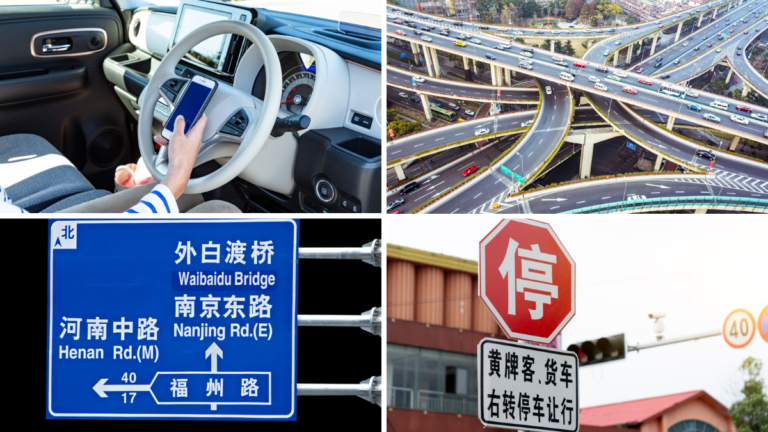
Traffic signs in China
Traffic signs in China are similar in shape, color, and symbols to those used in many other countries. Still, there are a few local specifics you should be aware of, as they can make a difference when driving on Chinese roads.
Most road signs are written in Chinese, though you’ll also see some in English or in pinyin, a phonetic system that helps with pronunciation. You’ll also notice many signs warning drivers about the presence of surveillance cameras.
One sign you shouldn’t overlook when driving in Chinese cities is the one that indicates traffic restrictions on certain roads at specific times. These limits are often based on the last digit of the vehicle’s license plate.
You can recognize these signs by their blue color and rectangular shape. They include all the information you need to avoid breaking the rules.
Most common traffic violations in China
China has a point system that deducts points based on the type of traffic violation you commit. Drivers start with 12 points per year, and if you lose them all, authorities can suspend or revoke your license. In that case, you may need to take a traffic safety course or retake the theory test to drive again.
These are the most common traffic violations in China:
| Offense | Penalty |
| Speeding | Fine ranging from CNY 200 to CNY 2,000 ($28 to $280) depending on the percentage of the speed limit exceeded. You will also lose between 3 and 12 points. |
| Cell phone use | From CNY 50 to CNY 200 ($7-28) and deduction of 2 points. |
| Driving under the influence | The fine is relative to the level of alcohol recorded and may result in license suspension, in addition to a reduction of 12 points. |
| Running a red light | The fine is CNY 200 ($28) and 6 points off your license. |
Tolls and refueling
China has one of the largest highway toll networks in the world. They use a closed system, where you pay a fee based on the distance you travel when you exit the highway.
The toll also depends on the type of vehicle you’re driving and the city or province where the toll is located. For example, traveling in a small or compact car is usually cheaper, costing roughly 0.35 to 0.50 CNY ($0.05-0.07) per kilometer.
It’s handy to carry some small or mid-value cash for tolls to make payment easier. You can also use an electronic QR code system linked to your debit or credit card, but other digital payment methods are only for local residents.
If you travel during national holidays, you will find that tolls are suspended so that tourists can travel around the country freely and at a lower cost.
Refueling
Most vehicles in China run on gasoline or diesel, though a large portion of the fleet is electric. In either case, refueling or recharging is generally straightforward and convenient.
You just need to go to a gas station, like PetroChina or Sinopec, or an electric charging point, such as TELD or Star Charge, and tell the attendant how much fuel or electricity you need for your car.
After that you pay for the fuel or electricity. You can use QR code apps like Alipay or WeChat Pay, prepaid cards from the station, or cash, though cash is used less often nowadays. International debit and credit cards are generally not accepted.
Fuel and electric charging prices, according to the Global Petrol Price website:
- Gasoline: CNY 7.50 ($1.06) per liter, depending on the octane rating (92, 95, or 98).
- Diesel: CNY 7.20 ($1) per liter.
- Electricity: Slow charging 0.80 CNY ($0.11) per kW/h, fast charging 1.50 CNY ($0.21) per kW/h.
Parking in China
With so many cars in China, finding parking can be a challenge. To address this, authorities have upgraded the infrastructure, including automated multi-story garages where a robotic system takes and parks your car.
In the end, you pay based on how long your car stays parked. You’ll also find traditional street parking, underground lots, and private parking at shopping centers, restaurants, and tourist attractions.
Parking fees vary depending on the type of lot and how long you stay. On the street, it usually costs around 6 to 15 CNY ($0.85 to $2) per hour. Private lots range from 8 to 20 CNY ($1.13 to $2.83) per hour, while automated garages charge about 8 to 15 CNY ($1.13 to $2.12) per hour.

Options for renting a car in China
China has a mix of international and local car rental companies offering a wide range of vehicles to suit different drivers and travelers. Prices vary depending on the type of car and rental duration, so here’s an overview of approximate rates per day, week, and month.
Keep in mind that in order to rent a car in China, you must have one of the country’s legal driving licenses.
| Car type | Daily rate | Weekly rate | Monthly rate |
| Compact cars Volkswagen Lavida, Nissan Sylphy, BYD electric cars | Between CNY 150 and CNY 350 ($20–50) | CNY 900 – CNY 2,000 ($125–280) | CNY 3,500 – CNY 6,000 ($500–850+) |
| Sedans Toyota Camry, Honda Accord | CNY 250–500 ($35–70) | CNY 1,500–3,000 ($210–420) | CNY 5,500–8,000 ($770–1,100) |
| 4×4 SUVs Honda CRV, Nissan X-Trail | 300 – 600 CNY ($42–85) | 1,800 – 3,500 CNY ($250–490) | 6,500 – 10,000+ CNY ($900-1,400+) |
Tips for driving in China as a foreigner
There are a few key points to keep in mind when driving in China to help you avoid fines and make your trip smoother. These tips are meant to keep you safe and let you travel with peace of mind.
- Google apps in China: Many Google apps have usage restrictions in China. Instead, you’ll need to rely on Chinese alternatives. It’s important to install them so you can replace apps for maps, translation, and other tools that will be useful during your trip.
- Documentation: Your travel documents, personal ID, and vehicle papers should all be valid, up to date, and easily accessible so you can present them immediately if requested by the authorities.
- Adapting to the driving style in China: In some cities, driving can be a bit more aggressive than in others, so be prepared to stay patient and adapt to local driving habits.
- Internet: Make sure you have internet while traveling and driving in China. It’ll let you access all the local apps you need for smooth navigation and staying connected with family and friends. Holafly’s monthly plans are a convenient choice, providing either unlimited data or 25 GB that can be shared across devices, with coverage in more than 160 countries.
Frequently asked questions about driving in China
Yes, there’s strong demand for electric cars among tourists in China. China has built a well-developed infrastructure with both fast and slow charging stations, totaling over 15 million points nationwide.
In China, you can find local car rental companies such as eHi Car Services, BYD, and CAR Inc., as well as international agencies such as Hertz and Avis.
Baidu Maps and Amap are the most common apps you can use to find your way around China while driving and traveling around the country.
Yes, whether you’re renting a car or just driving in general, foreign visitors need a temporary Chinese driving permit. Even residents must apply for a permanent license.
Plans that may interest you


Hi! I'm a Spanish-English translator working with Holafly, helping bring travel content to life for curious travelers. As a digital nomad with a passion for exploring, I'm always adding new spots to my bucket list. If you love to travel like me, stick around because you're in the right place to find inspiration for your next trip! ✈️🌍