







 Language


 No results found
Driving in Cape Verde: Tips and requirements
Explore each of the 10 islands that make up this African archipelago! Here is the perfect guide to driving in Cape Verde.

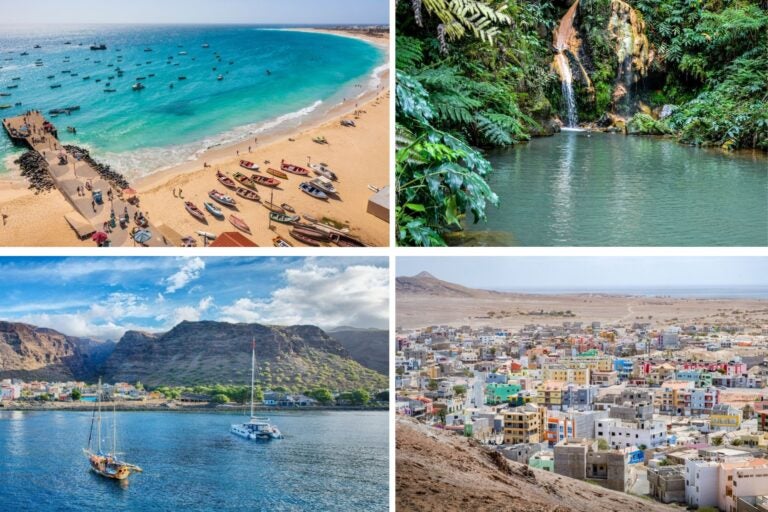
There is no better way to explore this African archipelago of ten islands, filled with paradise beaches, volcanic landscapes and fishing villages, than by following its coastal roads and enjoying the spectacular views. Driving in Cape Verde is essential, as many areas cannot be reached by public transport, and having a car gives you the freedom to explore the country in depth.
In this article, you will learn which driving licences are valid for this destination depending on your nationality and the length of your stay on the islands. We also explain how road signs and traffic regulations work, so you can avoid fines during your trip. Finally, we look at parking, where to refuel, fuel prices and the different options available for renting a vehicle in the country. Don’t miss any of the requirements you need to get behind the wheel in Cape Verde!
Valid driver’s licenses in Cape Verde
Driving in Cape Verde as a foreigner is quite straightforward. In most cases, you only need to apply for an International Driving Permit in your home country, especially if your national licence is not written in the Latin alphabet. Some nationalities, such as travellers from Latin American countries, are required to complete this step, but we recommend not travelling without an IDP. For longer stays, it is also advisable to request a local validation. We explain everything in more detail below:
1. International driver’s license (IDP)
While certain foreign driving licences are valid for driving in Cape Verde, including those from Europe, the United States, Canada and Australia, it is strongly recommended to obtain an International Driving Permit before you travel and carry it alongside your current licence. Many traffic officers and rental companies may not recognise all international licence formats, so having an IDP helps prevent delays or complications. You can apply for it through your local traffic authority, for example:
- Spain: DGT
- Mexico: Automóvil Club Mexicano
- Argentina: Automóvil Club Argentino
- Colombia: Touring y Automóvil Club de Colombia
- USA: AAA or AATA
2. Validated or local license
If you plan to stay in Cape Verde for more than six months, you can apply for a licence validation through the Direção Geral dos Transportes Rodoviários (DGTR). To do so, you will need to present your national driving licence, an official translation, your passport, proof of residence and a medical certificate.
Requirements and documentation for driving in Cape Verde
All drivers, whether foreign or local, must meet certain requirements to drive in Cape Verde. Whether you are visiting as a tourist, a digital nomad, studying or volunteering and plan to use the country’s roads, the rules apply equally to everyone. We also recommend that, if you have rented a vehicle, you keep a copy of the rental agreement and roadside assistance numbers in the glove compartment. Check that you meet all of the following requirements:
- Valid license: International Driving Permit (IDP) along with national license.
- Minimum age for driving: The minimum age is 18 for standard vehicles, although some rental companies require drivers to be at least 21. There is no official maximum age limit, but certain restrictions or additional fees may apply when renting a vehicle above a certain age.
- Identification document: Valid passport for identification at police checkpoints.
- Compulsory insurance: All vehicles must have valid civil liability insurance.
- Technical inspection card: This is a compulsory periodic inspection that certifies that the vehicle is roadworthy.
- Vehicle documentation: The vehicle registration, proof of ownership, and insurance card must always be kept inside the vehicle.
- Environmental labeling: There is no mandatory system, but vehicles must comply with local emissions standards.
- Disabilities: Drivers with disabilities must have certified adaptations in their vehicle and a compatible permit.
- Mandatory equipment in the car: Emergency triangle, reflective vest recommended, spare tire, and basic tools.
Important: If you are a frequent traveler and want to stay connected without worrying about expensive roaming or looking for a new SIM at every destination, Holafly’s subscription plans are for you. With a single eSIM, enjoy internet in more than 160 countries for a fixed price and no surprises on your bill. Travel without limits and connect easily and securely! 🚀🌍

Traffic rules in Cape Verde and road signs
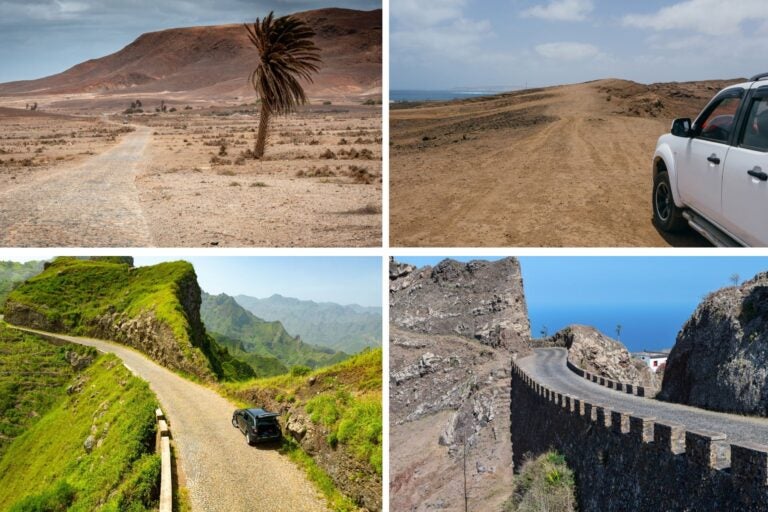
One of the most distinctive aspects of driving in Cape Verde is its cobblestone roads, which naturally keep speeds down. In mountainous areas, you’ll notice sharp curves and often no guardrails. Combined with limited lighting and the frequent presence of animals such as goats, donkeys, or dogs, it means you need to stay alert and drive carefully. Here’s a look at the main traffic rules across the islands.
Direction of traffic and general rules
In Cape Verde, people drive on the right, just like in Spain, Portugal, most of Latin America, and the USA. Vehicles on the right generally have the right of way, unless signs indicate otherwise, and overtaking is done on the left. If you come from a country where driving is on the left, like the UK, it’s a good idea to practice in a low-traffic area until you feel comfortable on the road. Here are the basic traffic rules you should know:
- Seat belt use: Mandatory for all vehicle occupants.
- Mobile phone use: Talking on the phone without a hands-free device or handling a mobile phone while driving is strictly prohibited.
- Lights: Low beams must be used when driving at night or in poorly lit areas.
Speed limits
Speed limits in Cape Verde vary depending on the island and the type of road. With many rural routes and mountain roads, it’s common to drive below the limit for safety. The maximum speeds are:
- Urban areas: 40–50 km/h
- Secondary roads: 60–80 km/h
- Main roads or between cities: 90 km/h (only on signposted sections)
Traffic signs
Road signs in Cape Verde follow the European model. Prohibition, mandatory, and warning signs look the same, speed limits are shown on circular signs, and directional signs use blue or green backgrounds.
One key difference in Cape Verde is that rural roads often have few or faded signs. Many roads lack lane markings, and you’ll find signs alerting you to dirt tracks, potholes, sharp bends, and free-roaming animals, especially on islands like Santiago, Santo Antão, and Fogo.
Drinking and driving limits
In Cape Verde, the blood alcohol limit is 0.08%, and penalties can be heavy, including losing your licence in serious cases. Authorities are very strict about drinking and driving, particularly in tourist areas like Santa Maria, Espargos, Sal Rei, and Plateau, where police often set up checkpoints to keep the roads safe.
Examples of common offenses
| Violation | Approximate fine |
| Speeding + 20 km/h | From $83 |
| Not wearing a seatbelt | From $31 |
| Not using the correct lights | From $40 |
| Driving under the influence of alcohol | From $209 and vehicle impoundment |
| Using a mobile phone without a hands-free device | From $52 |
Tolls and refueling
One of the perks of driving in Cape Verde is that you won’t encounter any tolls. The islands, including Santiago, Sal, Boa Vista, São Vicente, Santo Antão, Fogo, Maio, Brava, and São Nicolau, have a small and simple road network that’s free to use. This makes getting around stress-free, though it’s a good idea to rent a car on each island you visit, since not all ferries carry vehicles.
When it comes to refuelling, all the islands have service stations, with staff on site and extended hours on the more touristy islands like Sal and Boa Vista. You can pay in cash using the local currency, the Cape Verdean escudo, or with international cards. Approximate prices are:
- Gasoline: Between $1.40 and $1.60 per liter.
- Diesel: Between $1.10 and $1.30 per liter.
Parking in Cape Verde
Let’s take a look at parking in Cape Verde. In most towns and villages, you can usually park for free outside of the busiest tourist areas. In busier spots like Praia, Mindelo, Santa Maria, and Boa Vista, there are regulated public and private parking zones. Parking is prohibited in areas reserved for residents and wherever no-parking or no-stopping signs are posted, marked with a red circle and blue stripe. Approximate rates are:
- Public parking: From $0.54 per hour, depending on the city.
- Private parking: From $1.00 per hour.
- In hotel areas: Weekly rates from $25.
Options for renting a car in Cape Verde
The type of vehicle you rent in Cape Verde depends on the kind of trip you have in mind. A small, economical car is fine for city driving or paved roads, but to explore nature, tackle mountain routes, or reach hidden beaches, a 4×4 is the best option.
On the more popular islands, you’ll find well-known international rental companies like Hertz, Avis, Europcar, and Sixt. Each island also has smaller local agencies, such as Rent a Car Morabeza, Boavista Rent, or Santiago Cars, which often offer slightly lower rates. Here’s an example of daily prices:
| Vehicle type | Models | Rates/day |
| Compact and economy | Toyota Yaris, Hyundai i20 | From $35 |
| Small SUVs | Dacia Duster, Suzuki Vitara | From $90 |
| SUVs and 4x4s | Toyota Land Cruiser, Mitsubishi Pajero | From $70 |
| Quads | Yamaha Kodiak 450, Polaris Sportsman 570 | From $65 |
Tips for driving in Cape Verde as a foreigner
To close this guide on driving in Cape Verde, once you have your documents in order and know the traffic rules, signs, and parking options, here are a few final tips to ensure a safe and relaxed driving experience.
- Find out about road conditions: Many roads are unpaved, cobbled, or potholed.
- Rent a vehicle suitable for the terrain: On islands like Santo Antão or São Nicolau, a 4×4 is recommended because many roads are mountainous or made of volcanic rock.
- Respect road signs: In rural areas, road signs are very scarce, so you should exercise extreme caution.
- Always have cash available: Some gas stations on the less touristy islands only accept cash payments.
- Watch out for animals: On several islands, it is common for goats or dogs to cross the road, so slow down in rural areas.
- Avoid driving at night: Many roads are unlit and may have sharp curves or landslides.
Finally, make sure you have a strong internet connection so you can use GPS, stay in touch with family, or share live updates from your Cape Verde trip. Holafly offers an Africa eSIM with unlimited data for just the days you need, starting at $9.41 per day. For longer stays, their monthly plans provide 5G coverage and unlimited data across all the islands, starting at 25 GB or unlimited data for $49.90 per month, with no long-term commitment. You can even use the same eSIM in over 160 destinations without changing it.
Frequently asked questions about driving in Cape Verde
Although it is not always mandatory, we recommend it, as many rental agencies require it along with your national license.
Yes, but you must be very careful due to the poor condition of the roads, poor lighting, and animals crossing the road.
In cities, yes, but outside of them they tend to be scarcer and located at long distances. It is best to fill up your tank before setting off on a trip.
There are no bridges connecting them, and only some ferries accept vehicles, so it is preferable to rent a new car on each island you visit.
Plans that may interest you


Hi! I'm a Spanish-English translator working with Holafly, helping bring travel content to life for curious travelers. As a digital nomad with a passion for exploring, I'm always adding new spots to my bucket list. If you love to travel like me, stick around because you're in the right place to find inspiration for your next trip! ✈️🌍
