







 Language


 No results found
Driving in Bosnia: Tips and requirements
Driving in Bosnia is easy and convenient for exploring the country or its major cities. Here we tell you everything you need to know.

Driving in Bosnia involves meeting certain legal requirements, but also adapting to the unwritten rules and local habits that shape how people really drive. Knowing both helps you get around like a local.
That’s why we’ve put together this guide to help you better understand traffic signs and rules, which licenses are accepted, and the documents Bosnian authorities require to drive legally in the country.
You’ll also find an overview of typical rental prices for the most popular vehicles, along with practical tips to help you get the most out of your stay. Be sure to check out all the useful details we’ve put together!
Driver’s licenses valid in Bosnia
If you plan to drive in Bosnia, there are two specific documents you’ll need, both valid for stays of up to three months: your current home country driver’s license and an International Driving Permit. Below, we explain how each document is recognized by local traffic authorities and why having both is important.
National license or traveler’s license
This is your home country driver’s license, and it must be valid and up to date. It’s generally recommended that it was issued more than a year ago. This document proves that you have received proper training and understand the basic traffic rules required to drive.
International Driving Permit
The IDP translates your home license into several languages, making it easier for traffic police in Bosnia to check and verify it. It’s also required if you want to rent a car, as rental companies will ask for it.
It’s recommended for travelers of any nationality, even EU citizens, although it isn’t always strictly required. An IDP is usually valid for one year or for the remaining validity of your home license, depending on the country and the issuing authority.
Local Driver’s License
Once your three months as a tourist are over and you decide to stay longer or settle in the country, you’ll need to apply for a Bosnian driver’s license.
For most Latin American citizens, the requirements to get a Bosnian license are your home country license and an International Driving Permit so it can be officially recognized. For European citizens and residents, your EU license is usually accepted, though they may still ask for an IDP.
Requirements and documentation for driving in Bosnia
What you need to provide can vary depending on your situation. It all comes down to whether you’re bringing your own car or renting one while in the country. Here’s a breakdown of what’s required in each case:
With your own vehicle
If you’re bringing your own car, it’s important to have liability insurance that’s valid in Bosnia. The “Green Card” used to be required, but since 2020 it’s no longer necessary. Still, if you don’t have insurance, you’ll need to get coverage before crossing any border into the country.
You’ll also need all the vehicle documents, such as proof that it has passed a safety inspection and either the ownership papers or rental agreement from your home country. Naturally, your own ID and driving documents should be with you as well.
For emergencies, you should have a reflective vest, a warning triangle, a first-aid kit, spare bulbs if your car doesn’t have LED lights, and a fire extinguisher. Also, keep in mind that during winter you need to carry seasonal tires in your vehicle.
Vehicle rental
The paperwork and requirements are similar whether you bring your own car or rent one in Bosnia. However, renting is much simpler since agencies typically handle most of the formalities, making it easy for you to get on the road quickly.
The car’s paperwork should be up to date, including liability insurance (usually included with the rental), a valid technical inspection, and a complete roadside emergency kit. Make sure to also have all your personal travel documents on hand.
Other requirements are:
- Minimum driving age: The minimum driving age is 18, but to rent a car you must be at least 21 and have held your driver’s license for more than a year in your home country.
- No drinking and driving: You cannot drive under the influence of alcohol.
- Obey traffic rules: Learn the traffic rules, pay special attention to those unique to Bosnia, and keep them in mind to avoid fines or unsafe driving.
- Cell phone use: You may only answer and talk on the phone using a hands-free system.
Important: If you are a frequent traveler and want to stay connected without worrying about expensive roaming or looking for a new SIM at every destination, Holafly’s subscription plans are for you. With a single eSIM, enjoy internet in more than 160 countries for a fixed price and no surprises on your bill. Travel without limits and connect easily and securely! 🚀🌍
Traffic rules and road signs in Bosnia
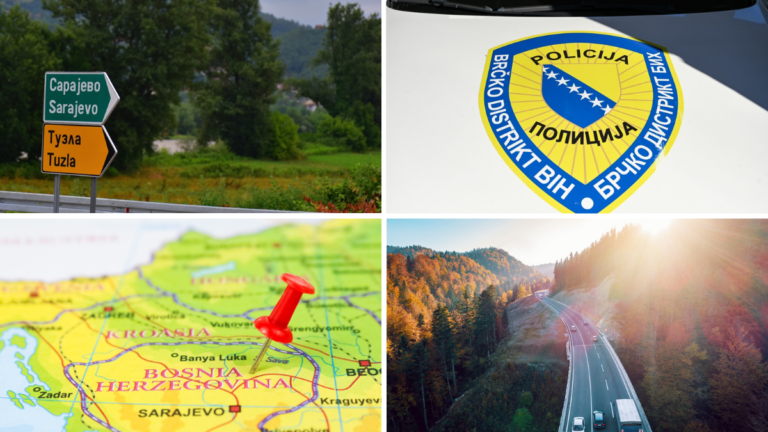
Traffic rules and signs are similar to those in most European and Latin American countries. Still, there are some local variations you should be aware of. Here’s what you need to know:
- Speed limits: In urban areas, you can drive at 50 km/h, on secondary roads at a maximum of 80 km/h, and on highways you can reach 130 km/h.
- Blood alcohol: In Bosnia, the legal blood alcohol limit is 0.05%. However, the recommendation is 0%.
- Seat belts: All occupants of a vehicle must wear seat belts without exception.
- Roadside emergency kit: You are required to carry a warning triangle, a first-aid kit, a reflective vest, and, if traveling in winter, spare tires suitable for the season.
- Direction of traffic: Drive on the right, so you must overtake on the left.
- Mobile phone use: It is prohibited to use a cell phone without a hands-free device, but keep in mind that the use of earplugs is also penalized for drivers.
Traffic signs
Just like in the rest of Europe, traffic signs in Bosnia follow the international system. You’ll see warning, regulatory, and informational signs in the standard shapes and colors.
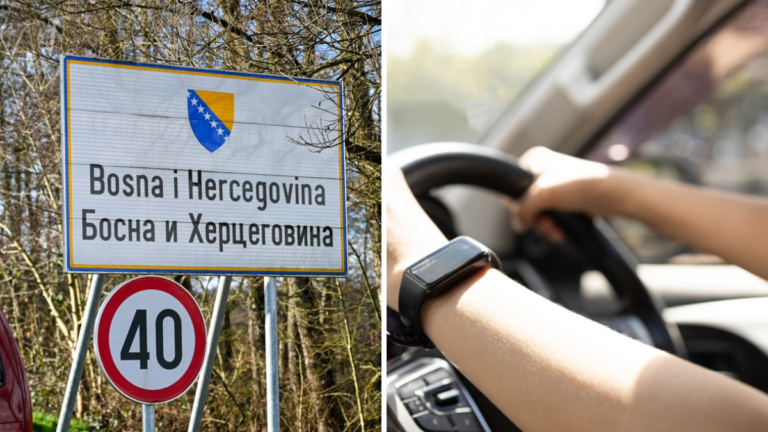
However, there are some local quirks to be aware of, like signs written in Bosnian and in Cyrillic. You should also pay attention to how local drivers behave, especially at roundabouts that aren’t clearly marked.
When it comes to fines, speeding is one of the most common offenses in Bosnia, with penalties reaching up to $540 depending on how much the limit is exceeded. Other violations, like using your phone while driving or not wearing a seatbelt, can cost about $55.
Finally, driving under the influence, not carrying the required emergency kit, or driving recklessly can lead to anything from hefty fines and having your car impounded to even jail time.
Tolls and refueling
Bosnia has a toll system along the A1 highway, the country’s main route. When you enter, you take a ticket, and when you exit, you pay based on the distance traveled. The fee also depends on the type of vehicle you’re driving.
You can pay tolls with cash, debit or credit cards, or electronically using a transponder attached to your windshield. This works like a prepaid card and is automatically read as you pass through the dedicated lane, so you don’t have to stop.
Fuel is another important consideration when traveling in Bosnia. Depending on your vehicle, you’ll need unleaded petrol with 95 or 98 octane, which costs about 1.23 EUR per liter ($1.33), diesel at 1.26 EUR per liter ($1.36), or Autogas at 0.64 EUR per liter ($0.69).
To refuel, just stop at a service or self service station, choose how much fuel you need, and pay at the counter or pump. Cash or card works, especially at larger gas stations.
Parking in Bosnia
Parking requires extra care in larger cities, where spaces are limited and rules are stricter. Always look for signs that show where you can park, the allowed times, and the fees.
Usually, payment is required Monday through Friday, while weekends are free. Most people pay with cash or through local mobile apps.
In addition to street parking, you also have private options like underground garages, hotel lots, restaurants, and shopping centers, where the fee depends on how long you stay.
Avoid parking in pedestrian areas, on corners or intersections, and in spaces reserved for people with disabilities. Always follow traffic signs indicating where parking is allowed.
Car rental options in Bosnia
Renting a car is a great way to get around the country, giving you the freedom to explore Bosnia at your own pace. The country offers several rental options, including local companies like Euro Rent a Car, Kapitals Rent a Car, or Guma X, as well as international brands such as Europcar, Hertz, or Sixt.
Depending on the kind of trip you’re planning, these agencies offer vehicles suited to your needs. Here’s a look at the types of cars you can rent and their costs.
| Vehicle type | Day | Week | Month |
| Compact (Skoda Fabia, Volkswagen Polo) | $17-30 | $130-200 | $550-800 |
| Sedan (Skoda Octavia, Volkswagen Golf) | $30-40 | $200-270 | $800-1,050 |
| 4×4 SUVs (Seat Arona, Skoda Kodiaq) | $55-75 | $310-500 | $1,100-1650 |
Tips for driving in Bosnia as a foreigner
To truly enjoy driving in Bosnia, make sure you follow the traffic rules and stay alert to road signs. We’ve also compiled some practical tips to help you make the most of your time on the country’s roads.
- Internet connection: Holafly offers unlimited data or 25 GB that you can share with other devices, covering travel in over 160 countries through their monthly plans. This lets you check maps, translate, find tourist spots, and stay prepared for emergencies.
- Required documentation: Always keep your vehicle papers and personal documents with you, including your driver’s license and IDP.
- Traffic regulations: Study the specific traffic signs in Bosnia to avoid getting fined.
- Travel insurance: Take out travel insurance that covers different emergencies, including those related to driving in the country.
Frequently asked questions about driving in Bosnia
Yes, it is mandatory to have your lights on at all times when driving in the country, as this is a way of warning other drivers of your presence.
You need to be at least 21 to rent a car in Bosnia, and your driver’s license must have been valid for at least one year.
Yes, some companies do offer electric cars for rent. However, these vehicles have more limitations for longer trips since the country’s charging infrastructure is still limited. They are mainly recommended for use in larger cities.
Yes, credit cards are widely accepted at gas stations across the country and are especially convenient for self-service pumps. Still, it’s always a good idea to have some cash on hand.
Plans that may interest you


Hi! I'm a Spanish-English translator working with Holafly, helping bring travel content to life for curious travelers. As a digital nomad with a passion for exploring, I'm always adding new spots to my bucket list. If you love to travel like me, stick around because you're in the right place to find inspiration for your next trip! ✈️🌍
