Language


 No results found
Driving in Bali: Tips and requirements
Driving in Bali is an option that will allow you to get to know the island better. Here we tell you everything you need to know.

Driving in Bali is a smart choice. It lets you experience everyday local life, get around the island more confidently, explore at your own pace, and enjoy a much more comfortable alternative to public transportation.
That said, it can also be challenging, especially if you’re not used to driving on the left. This and a few other things are best learned as soon as you arrive in Bali and rent a car, because if you don’t adapt quickly, driving there can become stressful.
Here, we’ve put together a practical, easy-to-follow guide to help you understand what you need to drive in Bali, how local traffic rules and road signs work, and what to expect when it comes to parking. We’ve also included information on fuel prices and how toll roads operate on the island.
Stick with us and, at the end, you’ll find a set of tips we’ve picked to help you make the most of your trip or stay on the island of Bali, Indonesia.
Valid driver’s licenses in Bali
If you want to drive in Bali as a tourist, you’ll need two documents. One is proof that you’re licensed to drive in your home country, meaning your national driver’s license. The other is a document that translates your license into multiple languages so local authorities in Bali can easily verify it.
National Driver’s License
Your national driver’s license is the first document you’ll need in order to drive on the island of Bali. While it isn’t enough on its own, it is mandatory, and it must be valid for at least one year.
On its own, this license isn’t enough to legally drive any vehicle in Bali. However, it allows you to apply for an International Driving Permit. Below, we’ll explain more about this international license, which is valid in many countries and plays an important role.
International Driving Permit
The International Driving Permit is the final document you need to carry, along with your national license, to drive in Bali. Its purpose is to translate your main license into several languages so traffic authorities in different countries can easily review it.
You must apply for this in your country of origin or residence, as it may be more complicated or impossible to do so once you arrive in Bali.
Bali Driver’s License
If you plan to live in Bali, the International Driving Permit is no longer valid once your legal tourist stay ends and your immigration status in Indonesia changes. However, you’ll need a valid International Driving Permit in order to apply for a local Bali license.
You’ll also need to have all your legal residency documents, such as your KITAS visa, the SKTT residency permit, biometric data records, a health certificate, results from psychological tests, and you’ll need to pass both the theoretical and practical driving exams.
Requirements and documentation for driving in Bali
The process for getting the documents you need to drive in Bali is fairly straightforward. That said, missing any of the required paperwork means you won’t be able to rent or drive a car on the island. Let’s go over the key requirements and the documents you need to get around safely.
Documentation:
- Valid passport.
- Your visa.
- Your country’s driver’s license.
- International Driving Permit.
- Complete documentation for the vehicle you rented.
Requirements:
- Age: The minimum age to drive is 17, but to rent a car you generally need to be at least 21, depending on the rental company. The maximum age for renting is 70.
- Alcohol and drug use: You cannot drive under the influence of hallucinogens or alcohol.
- Civil liability insurance: This insurance is often not included in the car rental price, so it’s essential to get coverage. You can even check that your travel insurance includes it. It protects you from medical costs if you cause an accident involving others, and it can also provide legal assistance if you face claims for damages while driving.
Important: If you are a frequent traveler and want to stay connected without worrying about expensive roaming or looking for a new SIM at every destination, Holafly’s subscription plans are for you. With a single eSIM, enjoy internet in more than 160 countries for a fixed price and no surprises on your bill. Travel without limits and connect easily and securely! 🚀🌍

Traffic rules in Bali and signage
Traffic rules and road signs in Bali can differ slightly or significantly depending on where you’re coming from. That’s why it’s important to take a moment to familiarize yourself with them before hitting the roads on the island.
- Speed limits: In city streets and other towns or districts, the speed limit is 50 km/h. On secondary roads, it’s 80 km/h. On major highways, the maximum is 100 km/h, with a minimum of 60 km/h.
- Direction of traffic: In Bali, people drive on the left side of the road, which is a big change for most countries where driving on the right is the norm.
- Mobile phone use: Using a mobile phone without a hands-free system is prohibited.
- Alcohol and drug consumption: Driving under the influence of alcohol and drugs is not permitted.
- Lights: Drivers in Bali must use their lights throughout the day.
- Seat belt use: This rule applies to the driver and front passenger.
- Overtaking: While the proper way is to use your turn signals before changing lanes and overtaking, in Bali it’s common to use the horn to indicate that you’re about to pass.
- Roadside and emergency kit: You should have your car stocked with basic tools for minor repairs, or at the very least, warning signals to alert others if you’re stopped and waiting for help. A first aid kit is also essential.

Traffic signs in Bali and the most common penalties for drivers
While road signs in Bali are familiar to most drivers, how people follow them can be different. For instance, at stop signs, locals often just slow down and move forward carefully rather than coming to a full stop.
You’ll see the same behavior at traffic lights, U-turns, and when turning at corners, where caution alone isn’t always enough to prevent accidents. This is actually one of the most common violations on the island, so it’s best to stick to the rules.
Other common traffic violations in Bali include not wearing a seatbelt, which can result in a fine of 250,000 rupiah ($15), not carrying your legal driving documents, which can cost 1,000,000 rupiah ($61), and running a red light or using your phone while driving, which could set you back 500,000 rupiah ($30).
Tolls and refueling
In Bali, tolls can be paid digitally using approved cards like Mandiri e-money, Flazz BCA, BRIZZI BRI, or TapCash BNI. On the Bali-Mandara highway, this is the only accepted method of payment.
These cards are issued by banks and can be reloaded for use not only at tolls but also for other purchases, through the banks’ apps, ATMs, or at convenience stores like Indomaret. The cost depends on your vehicle type and the distance traveled, so there isn’t a fixed toll rate.
Another thing to keep in mind when traveling around Bali is the location of gas stations. Pertamina is the island’s main fuel provider, with stations mainly located in tourist areas and places with higher traffic.
Gasoline, which is the most commonly used fuel, costs around $0.76 per liter. Prices may vary by the time you visit, so it’s a good idea to check the current rates based on the octane you need. Most stations accept cash, and some also take debit or credit cards.
Parking in Bali
Parking in Bali can feel a bit chaotic in some areas, especially in public spaces, since it’s not as strictly regulated as in other parts of Indonesia. In other areas, however, there are parking attendants who watch over your car and charge a small fee for their service.
Most tourist spots in Bali have clearly marked parking areas with staff to guide you to a proper spot. This includes beaches, shopping centers, hotels, and restaurants. Fees are usually very reasonable, rarely exceeding $1 per hour.
On the streets, you’ll often find parking attendants, known as Juru Parkir, stationed in areas where street parking is allowed. The fee isn’t always fixed, so you can often negotiate the price, though some attendants may provide a set rate when you park.
Avoid parking on your own, as you could be committing a reckless act or an offense without realizing it.
For example, it’s important to follow traffic rules and pay attention to no-parking signs, especially on curves, crosswalks, busy roads, or residential areas where you could block driveways.
Options for renting a car in Bali
Renting a car in Bali is a great option. Whether you’re a tourist, a temporary resident, a short-term worker, or a digital nomad, the island offers a wide range of rental options to suit every type of foreign traveler.
Renting a motorbike is very common in Bali, especially for solo travelers or pairs. It’s also quite popular to rent small cars that comfortably fit four people, with just enough trunk space for a trip with minimal luggage.
The table below shows the types of cars you can rent in Bali and their approximate rates, which can vary depending on the season.
| Vehicle type | Cost per day | Cost per week | Cost per month |
| Motorcycles Honda Vario, Scoopy, PCX, Yamaha NMAX | From $6 | From $37 | From $90 |
| Car Kia Rio, Nissan Versa, Chevrolet Spark | From $22 and up | From $90 | From $250 |
| 4×4 vehicle or van Toyota Avanza- Suzuki Ertiga | From $33 and up | From $140 | From $360 |
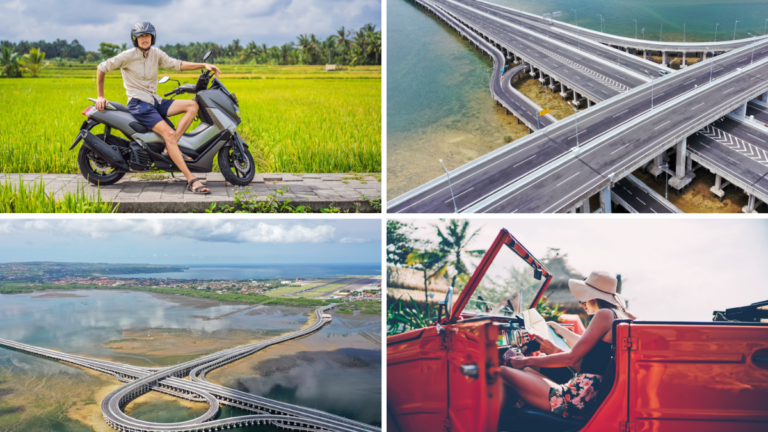
Tips for driving in Bali as a foreigner
The top recommendation for driving in Bali is to follow the traffic rules. Take the time to understand unfamiliar signs and watch how local drivers handle the roads.
Here are some tips to make driving in Bali less challenging and more enjoyable:
- Documents for driving: It’s important to keep all your travel, personal, and vehicle documents handy, as this makes it easier for traffic officers to check your information if needed. It’s also essential to have everything ready in case of an emergency.
- Use of GPS: Using GPS apps in Bali is very helpful, as they can save you time and also show you the locations of hospitals, gas stations, restaurants, and other points of interest.
- Avoid driving at night: Driving during the day can be a bit stressful due to heavy traffic and noise. At night, it can be even more challenging, as some roads may be in poor condition and visibility is limited in areas with little lighting. Plan your route carefully and make sure to rest when needed.
- Carry cash: Always keep some cash on hand and don’t rely entirely on digital payments, as they can fail and cause inconvenience, potentially delaying your trip.
- Internet connection: Make sure you stay connected and don’t depend on public WiFi. A Holafly monthly plan is a better option, giving you 25 GB or unlimited data to share across devices, with coverage in more than 160 countries.
Frequently asked questions about driving in Bali
It’s unlikely that you’ll be able to rent a car at 18, as most rental companies require drivers to be at least 21 years old.
Yes, the US dollar is widely accepted in Bali, but it’s usually not the best option in most shops, as prices in dollars can end up being higher than in the local currency. It’s a good idea to always have Indonesian rupiah on hand for your expenses.
Travel insurance isn’t required to rent a car in Bali. What is mandatory for foreigners is liability insurance, which you must have in order to rent a vehicle. Some travel insurance policies may include this coverage.
No, an International Driving Permit usually needs to be arranged before traveling to Bali. In other words, you have to apply for it in your home country, since the process requires submitting documents and biometric data in person.
Plans that may interest you


Hi! I'm a Spanish-English translator working with Holafly, helping bring travel content to life for curious travelers. As a digital nomad with a passion for exploring, I'm always adding new spots to my bucket list. If you love to travel like me, stick around because you're in the right place to find inspiration for your next trip! ✈️🌍