Language


 No results found
Travel with pets to the Australia: Complete guide
Everything you need to travel with pets to Australia. Document requirements, microchips, vaccines, transport options, and quarantine rules explained.

As a pawrent, I know pets aren’t just animals. They’re part of the family. I love how they greet you like you’ve returned after decades when you come back from a grocery run! So if you’re relocating or planning a long-term move, leaving them behind isn’t really an option, is it?
If you want to travel with pets to Australia, you already know it’s not a casual process. Australia has some of the strictest biosecurity laws in the world. But that’s not meant to scare you, it’s meant to prepare you.
In this complete guide, you’ll learn about the official requirements to travel with pets to Australia, the microchip rules and timelines, which vaccinations are mandatory, the required health certificates and approvals, as well as the quarantine requirements.
Let’s get you and your pet ready.
Requirements to travel with pets to the Australia
Australia’s biosecurity system is designed to protect its unique ecosystem. That means strict rules, especially for animals.
When you travel with pets to Australia, requirements generally depend on:
- The country you’re traveling from (Australia classifies countries by rabies risk).
- The type of pet (dogs and cats are most commonly approved).
- Compliance with microchipping, vaccination, and import permits.
- Quarantine upon arrival.
Before anything else: Check whether your country is approved for direct import. Some countries are eligible for direct export. Others require pets to spend time in an approved third country.
Now let’s break down the key requirements.
Microchip
Microchipping is compulsory. You cannot travel with pets to Australia without an ISO-compliant microchip. The microchip must be implanted before any rabies vaccination or blood testing. If vaccinations are done before microchipping, they won’t be valid for entry.
Australia requires:
- ISO 11784/11785 compliant microchips.
- 15-digit, non-encrypted.
If your pet has a non-ISO chip, you may need:
- A compatible scanner upon arrival.
- Or re-microchipping (which must be done carefully to avoid invalidating earlier vaccinations).
An accredited veterinarian must:
- Scan and verify the microchip number.
- Record it in all vaccination and laboratory documents.
- Issue documentation confirming implantation date.
Every document must match the microchip number exactly. One digit off can cause delays.
Costs of the microchip vary by country. For example, in the USA, it’ll cost you $25-75 while in the UK it’ll be £10-30, and in Canada, the cost is generally CAD 40-80.
There is no time rule specifically for microchipping, but, as mentioned before, it must happen before the rabies vaccination. Since rabies blood testing and waiting periods may require several months, most pet parents begin the process 6-7 months before travel.
Vaccination
Vaccination rules are strict and time-sensitive. When you travel with pets to Australia, rabies vaccination is central, even though Australia itself is rabies-free.
For dogs and cats entering from approved countries, these are the vaccinations required:
Rabies vaccination:
- Must be administered after microchipping.
- Must be inactivated (not live).
- Pets must be at least 90 days old at vaccination.
Rabies Neutralising Antibody Titre Test (RNATT)
- Blood test required.
- Must be done 3-4 weeks after vaccination so antibody levels develop fully.
- Minimum waiting period (usually 180 days) may apply depending on the country category.
For dogs, additional vaccinations required are:
- Canine distemper.
- Hepatitis.
- Parvovirus.
- Bordetella (in some cases).
For cats, additional vaccinations required are:
- Feline enteritis.
- Feline herpesvirus.
- Feline calicivirus.
Recommended but not mandatory vaccinations:
While not always legally required, veterinarians often recommend:
- Leptospirosis (dogs).
- Tick prevention treatments should start at least 30 days before travel and continue through departure.
- Internal parasite treatments must be within 45 days before the export date, and be spaced at least 14 days apart.
Missing timing windows can mean redoing procedures, and restarting waiting periods.
| Time before departure | What must happen |
| 7-9 months ahead | Microchip your pet (ISO 11784/11785 compliant). Must be done before rabies vaccination. |
| 7-8 months ahead | Rabies vaccination after microchip implantation. The pet must be at least 90 days old. |
| 6.5-7 months ahead | RNATT (Rabies Neutralising Antibody Titre Test). The result must be ≥ 0.5 IU/mL. |
| Start of 180-day waiting period | The mandatory 180-day wait begins the day the lab receives the blood sample, not the day it’s drawn. |
| 3-5 months ahead | Apply for the Australian import permit through the BICON system. |
| ~45 days ahead | Begin internal parasite treatments (two treatments required, at least 14 days apart). |
| 5 days before departure | Final internal parasite treatment + official veterinary health examination + government-endorsed export certificate. |
| Departure day | Travel with all original, endorsed documents. |
Health certificate
You cannot travel with pets to Australia without official veterinary documentation.
What must the health certificate include?
- Microchip number.
- Vaccination details (dates, batch numbers).
- Rabies titre test results.
- Clinical examination confirmation.
- Parasite treatment confirmation.
- Export country details.
- Owner declaration.
Can any vet issue it?
No. The vet must be:
- Government-accredited.
- Authorized to complete international export documentation.
Without government endorsement, entry into Australia will be denied.
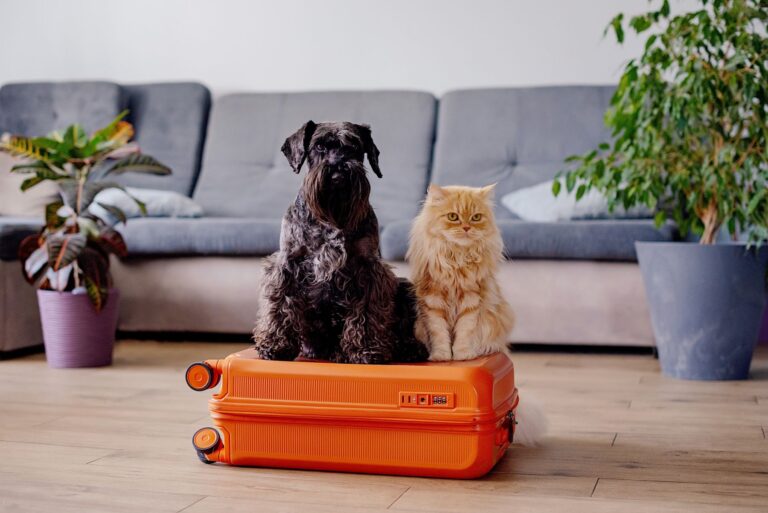
Ways to travel with pets
When you travel with pets to Australia, transport options are limited due to geography and biosecurity controls.
1. By plane (most common)
Commercial air travel is the primary method. Pets usually travel as manifest cargo, and compulsorily through approved pet transport companies.
Pros:
- Fastest option.
- Most regulated.
- Required for most imports.
Cons:
- Expensive.
- Stressful for pets.
- Strict crate requirements.
Airlines must comply with IATA Live Animal Regulations. And the crates must be properly ventilated, large enough for standing and turning, and escape-proof.
2. By boat
Private yachts or cargo ships may allow animal transport, but import permits are still mandatory. And your arrival must be coordinated with Australian biosecurity officials.
Pros:
- May reduce air travel stress.
Cons:
- Complex approval process.
- Longer travel duration.
- Still subject to quarantine.
Quarantine rules
In most cases, quarantine is compulsory, and dogs and cats entering Australia have to undergo quarantine at an approved facility. When we say “in most cases”, we mean that pets coming from New Zealand generally do not require quarantine if they meet specific rules, and identification conditions. For all others, the standard quarantine period is 10 days. However, this can extend if your documentation is incomplete, or if any health issues arise. The quarantine fees are substantial too, with a 10-day stay costing roughly $1,200-1,450 (AUD 1,700-2,000).
General advice
Here are a few things to keep in mind while planning your Australian adventure with your pets:
- Start very early, at least six to eight months before travel. Waiting periods alone can take half a year.
- Research on all pet friendly airlines, and their policies and crate standards before narrowing down your options.
- Budget carefully because costs vary widely depending on country of origin. Vet procedures can cost $500-$2,000, blood testing is another $200-$500, government endorsements could be $50-$300, and air transport can set you back by another $2,000-$6,000. Add to this the quarantine fees mentioned above and you’re looking at a substantial amount.
- Use a professional pet transport company. These help you manage paperwork, book approved flights, coordinate the quarantine, and reduce error risks.
- Australia categorizes countries by rabies risk. Requirements differ depending on whether you’re coming from low-risk countries like the USA, UK, Canada, European Union countries, Singapore and Japan, or high-risk countries, which may require third-country relocation first.
- Some dog breeds are restricted or banned. Always verify before beginning the process.
- Prepare your pet emotionally. Crate train months in advance.
- Avoid sedation (generally not recommended for flights).
- For more tips on how to travel with pets, check out our in-depth guide.
Ready to travel with pets to Australia?
Traveling internationally is complicated. Traveling with a pet? Even more so. But it’s absolutely possible. The system is strict for a reason — to protect Australia’s unique wildlife and agriculture. But if you start early, follow timelines carefully, and keep documentation precise, the process becomes manageable.
Important: If you are a frequent traveler and want to stay connected without worrying about expensive roaming or looking for a new SIM at every destination, Holafly’s subscription plans are for you. With a single eSIM, enjoy internet in more than 160 countries for a fixed price and no surprises on your bill. Travel without limits and connect easily and securely! 🚀🌍