Language


 No results found
Scuba diving in Sri Lanka: Best spots and prices
Come diving in Sri Lanka and immerse yourself in some of the most crystal-clear waters! We'll tell you about the best places and schools to learn.

If you are travelling through South Asia and love water sports, you cannot miss the experience of diving in Sri Lanka, known as the ‘Pearl of the Indian Ocean’. Besides being a tropical paradise with stunning jungles and ancient temples, this island boasts perfect beaches for diving in warm waters, coral reefs, shipwrecks, and a fascinating marine biodiversity.
In this article, we have prepared a complete guide for you to discover the best places to dive in Sri Lanka, the certified centres you can find, and the courses they offer. Even if you have no experience, there are different programmes available, from beginner to professional level, suitable for all profiles. Dive in and explore the marine life this island has to offer!
Diving centres and courses in Sri Lanka
Are you spending a few days as a tourist in this destination? Or perhaps you’ve settled for a while as a digital nomad. Regardless of your situation, besides visiting the most popular tourist spots such as Polonnaruwa, Anuradhapura, or the Temple of the Tooth in Kandy, you can also try diving in Sri Lanka for a thrilling experience.
There are numerous PADI and SSI certified centres, the main international diving organisations, guaranteeing quality and safety in their courses. These centres are mainly located along the west, south, and east coasts, as the most popular diving spots are Negombo, Unawatuna, Hikkaduwa, Mirissa, Trincomalee, and Nilaveli. Here are some of the best-known centres and the courses they offer:
- Poseidon Diving Station (Hikkaduwa): The oldest centre on the island, founded in 1973, offering courses for all levels, from introductory dives to advanced certifications.
- Trincomalee Diving Centre (Trincomalee and Nilaveli): On the east coast, open only from April to October, perfect for exploring the reefs of Pigeon Island National Park.
- Blue Deep Diving (Unawatuna): Certified courses at all levels, offering dives in reefs, caves, and the famous wreck SS Rangoon.
- Sri Lanka Diving Tours (Negombo): Near Colombo airport, organising trips to dive the most famous wrecks in the country, such as Chief Dragon or the Earl of Shaftesbury.
- Mirissa Dive Centre (Mirissa): On the south coast, offering whale-watching trips and certified diving courses, from introductory to advanced levels.
| Course | Level | Details |
|---|---|---|
| Discover Scuba Diving (introductory dive) | Beginners | Theory and guided shallow-water dive. No certification required. |
| Open Water Diver | Beginner-Intermediate | International certification (PADI or SSI) to dive up to 18 metres. |
| Advanced Open Water Diver | Intermediate | For certified divers wishing to improve skills and dive up to 30 metres. |
| Rescue Diver | Advanced | Training in underwater safety and rescue. Advanced Open Water Diver certification required. |
| Divemaster | Professional | To work as a professional diver and train other instructors. |
Diving course in Sri Lanka.
The best places to dive in Sri Lanka
Diving in Sri Lanka offers colourful corals, reefs, and historical shipwrecks, from the calm waters of the south in Unawatuna and Hikkaduwa, to the wrecks of Batticaloa and whale-watching excursions in Kalpitiya. Each location has its own characteristics suited for different diver profiles. Here are five top spots to choose from.
1. Unawatuna – Near Galle. Southwest coast.
The first recommended spot for diving in Sri Lanka is the coastal town of Unawatuna, six kilometres from Galle. It boasts some of the island’s most popular beaches, such as Unawatuna Beach, a horseshoe-shaped beach lined with palm trees, and Dalawella Beach, famous for its sea swing popular on social media. Both are perfect for beginners.
Here you can dive in calm waters and explore deeper areas, including colourful reefs and one of the oldest historical wrecks, the SS Rangoon, sunk over a century ago. This dive is recommended for more advanced divers, as it reaches 30 metres. Marine life includes clownfish, nudibranchs, lionfish, and hawksbill turtles.
2. Hikkaduwa – Southwest Coast. Galle District
Located 100 kilometres south of Colombo, Hikkaduwa is a town in the Galle district. Due to its easy access from the coast and the wide range of certified schools, it is a recommended place to get started in this activity. It also hosts a protected marine park with several coral reefs and schools of tropical fish at shallow depths, alongside moray eels, green turtles, and rays.
3. Trincomalee – Northeast Coast. Eastern Province.
Trincomalee is one of the best diving spots in Sri Lanka and all of Asia, with excellent visibility and warm waters. Its most famous site is Pigeon Island National Park, where you can swim with reef sharks, eagle rays, turtles, and schools of fish. With depths between 3 and 10 metres, it is perfect for beginners and snorkelling.
For experienced divers interested in underwater history, the British Sergeant Wreck, a British ship sunk in 1942, lies at depths of 24–40 metres. Its structure has become a home for corals, moray eels, and larger fish.
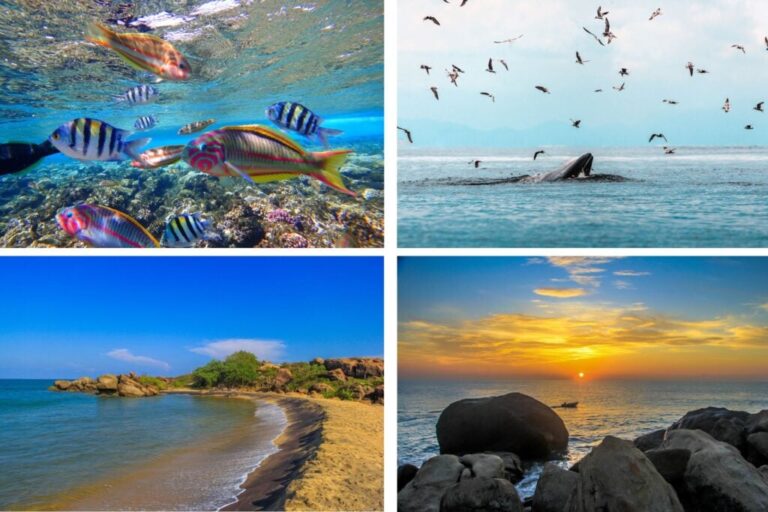
4. Kalpitiya – North-West Coast, Puttalam District
Less touristy diving spots include Kalpitiya, about 70 km from Puttalam, consisting of 14 islands. This destination is popular with surfers and for whale and dolphin watching. Marine life is wild and pristine, with large species and untouched corals.
Beginner divers can explore the island’s largest reef, Bar Reef Marine Sanctuary, covering over 307 km². Intermediate or advanced divers can dive the The Cargo Wreck, a freighter sunk in the 1990s at 30 metres, home to sponges, lionfish, rays, lobsters, and reef sharks.
5. Batticaloa – East Coast, Batticaloa District
Finally, Batticaloa is ideal for exploring shipwrecks, with over 20 wrecks in its waters. Some are over 50 metres deep, such as the Hermes II Wreck, a British aircraft carrier, or the British Sergeant Wreck, at 30 metres.
For beginners, Passikudah Reef, near the shore, offers good visibility and marine life including hard corals, anemones, green turtles, and tropical fish.
Connectivity while diving in Sri Lanka
Internet connectivity in Sri Lanka can be unstable, especially in remote areas. It is important to have reliable connectivity to stay in touch with your dive centre, quickly activate GPS to reach dive sites, or stream live on social media while exploring the underwater world.
We recommend Holafly’s eSIM for Sri Lanka for short trips, offering unlimited data from $6.90 (€5.90) per day. For longer stays, the Holafly monthly plans provide stable 5G coverage in Sri Lanka and over 170 countries without changing SIMs. Multiple devices can connect simultaneously from $50.50 per month with no contract.
Important: If you are a frequent traveler and want to stay connected without worrying about expensive roaming or looking for a new SIM at every destination, Holafly’s subscription plans are for you. With a single eSIM, enjoy internet in more than 170 countries for a fixed price and no surprises on your bill. Travel without limits and connect easily and securely! 🚀🌍

How much does diving in Sri Lanka cost?
Compared to other destinations, diving in Sri Lanka is relatively affordable, with lower prices than the Maldives or Thailand. The cost of living is reasonable, reflected in course fees, accommodation, and meals, allowing for longer stays on a moderate budget. Here are some typical prices from certified centres:
| Course | Details | Rates |
|---|---|---|
| Try Dive | Basic theory and a 5–10 metre dive | From $75 (€65) |
| Open Water Diver (Certification PADI/SSI) | 3–4 day course with international certification and 4 dives | From $416 (€360) |
| Advanced Open Water | 5 themed adventure dives | From $380 (€330) |
| Liveaboard | 1–3 day trip with accommodation and meals | From $490 (€425) |
| Individual dive (with guide & equipment) | Equipment rental and boat transfer | From $57 (€50) |
| Rescue Diver | PADI certification for becoming a rescue diver | From $543 (€470) |
Diving course fees in Sri Lanka.
In conclusion, to save up to 40% compared to other Southeast Asian countries, diving in Sri Lanka is an excellent choice. You can experience a complete mix of culture, history, and nature for much less than luxury destinations elsewhere.
Frequently asked questions about diving in Sri Lanka
The best time for diving in Sri Lanka depends on the coast. For the west and south coast, the best season is November to April. On the east coast, conditions are better from May to September.
If it’s your first time, no certification is needed, as you can take a beginner course with an instructor. For deeper dives, a PADI or SSI certificate is required.
You can see green turtles, manta rays, lionfish, moray eels, reef sharks, and schools of tropical fish. From December to April, blue whales and dolphins can also be spotted.
Yes, the sea conditions are stable, and the centres are certified, making it safe when diving with an instructor.
Absolutely! You can dive, surf, hike, or explore cultural sites—from the temples of Anuradhapura to the scenic train ride to Ella, there are plenty of activities on the island.