Language


 No results found
Driving in Thailand: Tips and requirements
Travel without limits and explore every corner of this country. We'll show you how to drive in Thailand: requirements, rules and tips.

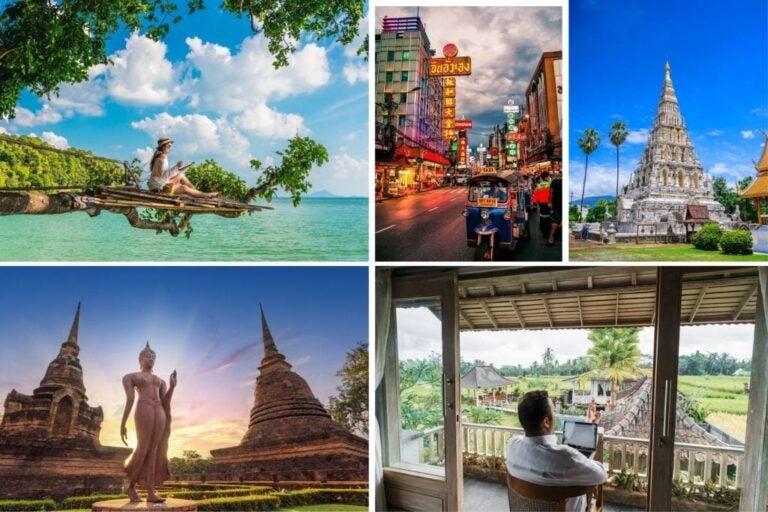
There’s nothing better than driving in Thailand to explore this Southeast Asian country in a more exciting way. This way, you can access places that public transport can’t reach or avoid having to stick to schedules.
You’ll discover the most inaccessible and paradisiacal beaches in Phuket or walk mountain trails in northern Chiang Mai with total freedom, but do you know the requirements to drive in this country?
To begin with, we’ll warn you that in Thailand, they drive on the left, so you’ll need to switch gears! Stay tuned for more interesting details in this post about which licences are valid, safety, traffic rules, tolls, and parking areas.
Valid Driving Licences in Thailand
Does your country’s licence work for driving in Thailand? We’ll tell you in advance that in order to drive in this country, you’ll need to apply for an International Driving Permit (IDP), as no other licence will be valid due to the lack of bilateral agreements on this matter.
Only a few Asian countries have agreements that allow for more flexibility in driving. Here’s more detail:
International Driving Permit (IDP)
It’s mandatory for Western countries, so you must apply for it at the relevant authority before your trip and bring it along with your original licence to drive in Thailand.
The IDP must be formatted according to the 1968 Vienna Convention, as Thailand is part of this agreement. It’s valid for one year, and if you plan to establish residency in the country, you’ll need to apply for a local licence. Here are examples of where some countries can apply for it:
- Spain: at the Directorate General of Traffic (DGT)
- Mexico: at the Mexican Automobile Association
- USA: at the American Automobile Association (AAA) or American Automobile Touring Alliance (AATA)
- UK: at the Post Office
- Australia: at state transport offices
- Argentina and Chile: at national motoring clubs
- Colombia: does not issue an IDP officially accepted in Thailand
National Licence with Official Translation
Some neighbouring Asian countries, such as Japan, South Korea, Malaysia, and Singapore, can drive in Thailand with their national licence translated into English. They also have more flexibility to validate it at the Land Transport Department and obtain a Thai licence without a test.
Thai Driving Licence
For travellers who are staying for a longer period in Thailand, such as digital nomads working remotely with a 10-year digital nomad visa, it’s advisable to apply for a local licence. Here are the requirements you must meet:
- Valid visa (cannot be a tourist visa)
- Medical certificate
- Proof of address (rental contract, residency certificate, or immigration letter)
- International or national licence with a legal translation (for validation)
It is issued at the Land Transport Department in any city in Thailand, and you will need to present all documentation, take a vision test, and if necessary, a theoretical and practical test.
Requirements and Documentation to Drive in Thailand
Now that we know which type of licence you need to drive in Thailand, there are other important requirements, both for the driver and the vehicle. It’s crucial to meet them to avoid fines and be protected in case of an accident.
Minimum and Maximum Age
The minimum age to drive a motorcycle in Thailand is 15 years old, and for a car, it’s 18 years old. However, most car rental companies require a minimum age of 21 and one year of driving experience.
There is no official maximum age limit, but after 70, some rental agencies may impose restrictions.
Physical Condition and Disability
A good driver should have adequate vision, reflexes, and mobility to drive safely in Thailand.
For people with disabilities, the vehicle must be adapted and approved by the Land Transport Department. Additionally, these drivers must present their disability certificate along with a medical exam. Some of these adaptations include:
- Manual controls: for brakes and accelerator
- Special buttons: instead of pedals
- Modified steering wheels: for better grip
Blood Alcohol Limit
In Thailand, the legal blood alcohol limit is 0.05 g/dL, and for novice drivers or those under 20 years old, it’s 0.00 g/dL.
The police conduct frequent checks to prevent the high accident rate, especially on motorcycles, due to alcohol consumption. Fines are hefty, and penalties can include imprisonment or deportation.
Mandatory Insurance
Any vehicle driving in this country must have at least third-party liability insurance (Compulsory Motor Insurance). However, we recommend adding supplementary insurance to cover other additional damages.
If you rent a vehicle, the company is required to provide it with valid insurance, so you won’t need to purchase it separately.
Vehicle Documentation
Inside the vehicle, you must carry the technical inspection certificate, the current insurance, and the registration. As for environmental labeling, it’s not mandatory in Thailand, but it’s recommended to keep the car in good condition to minimise emissions.
It’s not mandatory to carry a reflective vest or an emergency triangle like in other countries, but we recommend having them as a protection measure in case of a breakdown.
Connectivity on the Road
Driving in Thailand means venturing into rural areas and mountain roads where local coverage might be scarce. For this reason, we recommend the eSIM for Thailand if your trip is only for a few days. You’ll have unlimited data and a stable connection only for the days you need it.
For a longer stay, Holafly monthly plans will protect your road trip with stable and unlimited connectivity in Thailand and up to 170 destinations, without the need to change eSIM. If you choose the unlimited plan, you can share your data on other devices, use GPS without disconnection, enjoy 5G coverage nationwide, and activate the eSIM in just a few seconds, starting at $50.50 (€47.00) per month, with no contract. Holafly’s monthly plans
Important: If you are a frequent traveler and want to stay connected without worrying about expensive roaming or looking for a new SIM at every destination, Holafly’s subscription plans are for you. With a single eSIM, enjoy internet in more than 170 countries for a fixed price and no surprises on your bill. Travel without limits and connect easily and securely! 🚀🌍

Traffic Rules in Thailand and Signage
If you want to avoid traffic violations while driving in Thailand, it’s important to know the local traffic rules. In some cases, they are quite different from those in other countries, as we’ll see below:
Direction of Travel
In this country, they drive on the left, so the steering wheel is on the right side of the vehicle. Countries like the UK, Australia, and Japan drive the same way, but for drivers from other countries, this can be confusing at first.
Speed Limits
Signage in some rural areas is scarce, so you must exercise caution and respect the following speed limits.
- Urban areas: 50–60 km/h
- Main Roads: 80–90 km/h
- Highways: up to 120 km/h
- School/Hospital Zones: 30–40 km/h
Mobile Phone Use
One of the most common violations among tourists driving in Thailand is mobile phone use. It is prohibited and can only be used with a hands-free system. The fine can range from $30–55 (€27–60).
Use of Lights
Lights are mandatory when driving at night or in low visibility conditions. Additionally, in rural areas, it’s recommended to use low beams even during the day.
Motorcycles contribute to a high percentage of accidents in this country, so they must keep their headlights on all day long.
Traffic Signs
The main problem for foreign drivers is that traffic signs are written in Thai and, in some tourist areas, they are translated into English.
In general, the design and symbols are similar to those in other countries, but in rural areas, there are signs created by the local inhabitants without official standards. These are the most common signs:
- Red circles for prohibitions
- Triangles for warnings
- Blue rectangles for information
Common Offenses and Penalties
Officers conduct many daily checks to prevent the high accident rate in this country. Tourists may be required to pay the fine immediately. These are the most frequent violations and their penalties:
| Violation | Penalty |
|---|---|
| Speeding | $15–30 (€13–27) |
| Not wearing a seatbelt | $15 (€13) |
| Driving without a valid licence | $15 (€13) |
| Driving under the influence | High fine, jail, or deportation |
| Not respecting traffic lights or signs | $6.58 (€6.00) |
| Illegal parking | €2.00 – 6.00 ($2.20 – 6.58) per litre. |
Tolls and Fuel Charging
Thailand has toll highways, so if you’re travelling to Bangkok, Pattaya, or Ayutthaya, you’ll need to pay the following toll fees:
- Cars: $0.80 to $2.70 (€0.73–2.46) per section, and about $8.00 (€7.30) for long distances.
- Payment method: cash or via electronic payment using a sticker on the windshield called M-Pass.
As for fuel, you can refill your vehicle at the main stations in the country (PTT, Shell, or Esso), where you can pay with cash, card, or mobile app. These are the fares:
- Gasohol 91 / 95 (E10/E20): $0.90 to $1.00 (€0.82–0.81) per litre.
- Diesel B7: $0.90–$0.99 (€0.82–0.90) per litre.
- Pure 95 Petrol: about $1.21 (€1.10) per litre.
Parking in Thailand
Finding parking in Thailand can be a challenge in cities like Bangkok, something that doesn’t happen in less touristy areas. Here’s where you can park:
- Public streets: white lines (allowed) or red/white (prohibited).
- Parking meters: pay by the hour, starting at $0.58 (€0.53).
- Private parking: shopping malls, hotels, and buildings with paid parking, starting at $0.88 (€0.80).
Parking is prohibited at temple entrances, schools, and hospitals, as well as in lanes reserved for motorcycles or tuk-tuks.
Options to Rent a Car in Thailand
To rent a car and drive in Thailand, you can book services from major agencies like Avis, Budget, Hertz, and Sixt directly from the airport. There are also local agencies with more affordable prices. Here are the average rates:
- Economy cars: Toyota Yaris, Honda Jazz, recommended models for the city, starting at $20.00 (€18.00) per day.
- SUVs: Honda CR-V, Toyota Fortuner, best for rural routes, starting at $44.00 (€40.00) per day.
- Motorbikes and scooters: very popular but with higher accident risk, starting at $5.50 (€5.00) per day.
Tips for Driving in Thailand as a Foreigner
After learning about the requirements and features to drive in Thailand, here are some tips to make your driving experience enjoyable and allow you to visit the best cities, beaches, and towns without any issues: explore the best cities
- Familiarise yourself with driving on the left and the steering wheel on the right.
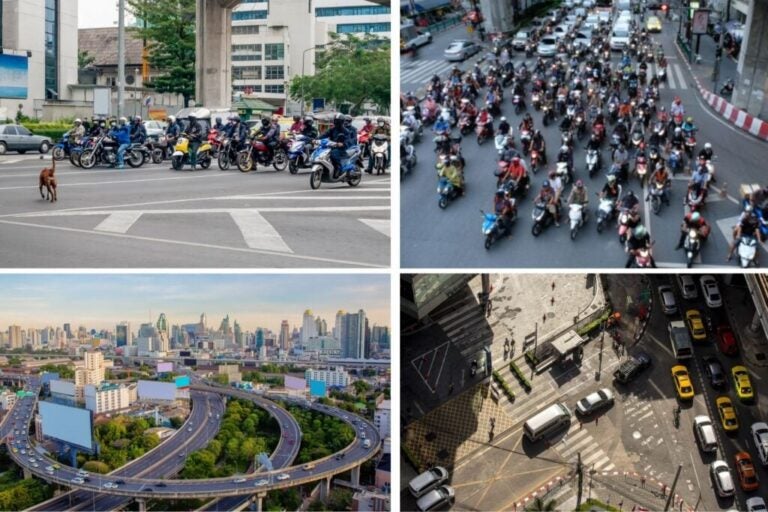
- Be careful of the chaos on the road, where lanes are often not respected.
- Avoid driving at night in rural areas.
- Use GPS to reach your destination.
- Be cautious of motorcycles, as they are numerous and unpredictable.
- Always wear your seatbelt.
Now you’re ready for your adventure on Thailand’s roads, have a great trip!
Frequently Asked Questions about Driving in Thailand
Traffic in Bangkok and Phuket can be somewhat chaotic, so caution is needed. In rural areas, the signage is also quite scarce and roads are in poor condition. Driving in Thailand is not dangerous if you take the right precautions.
Some local agencies also accept cash or bank transfer payments, but international agencies require a credit card for the security deposit.
Do not move the vehicle, call traffic police at 191, and if there are injuries, call 1669 for medical assistance. Contact your rental company and insurance to report the accident, and they will guide you through the necessary steps.
You cannot. You need a specific motorcycle licence along with an international permit.