




 Language


 No results found
Driving in Poland: Tips and requirements
Knowing the rules and requirements for driving in Poland will help you enjoy your experience on the road to the fullest.

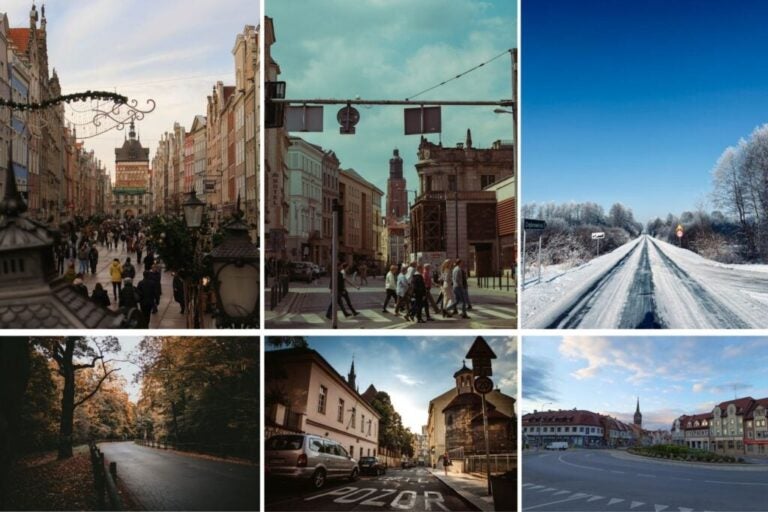
Cities filled with old-world architecture like Warsaw, Krakow, and Gdansk; medieval villages and beautiful national parks, make Poland a very attractive destination to discover on four wheels. The exquisite mix of history and natural beauty in this Central European country attracts travellers of all types, from digital nomads to road trip enthusiasts. Regardless of the reason that brings you to this part of the planet, renting a car and driving in Poland will surely leave a lovely memory in your travel journal.
Travelling on your own will take you to discover medieval castles, national parks, and picturesque villages that are often not part of the usual tourist tours. All this at your own pace, without relying on public transport schedules and with the freedom to stop the car to take photos whenever you like.
Poland has an extensive network of roads that ranges from modern motorways to rural paths that cross landscapes full of history. If you already feel the adrenaline of setting off to explore its routes, this article is for you: we’ll tell you everything you need to know to drive in Poland as a foreigner. Keep reading and you’ll discover that travelling by car through the country can be easier and more enjoyable than you might think.
Valid Licences for Driving in Poland
Let’s start with a key point to drive legally in Poland: having a valid licence. In fact, this might be one of your first questions. The good news is that Polish authorities accept a wide variety of permits, but there are some conditions you need to meet (especially if you come from outside the European Union) or if you’re planning to rent a car.
Which Licences Are Accepted in Poland?
All foreigners arriving from countries within the European Economic Area (EEA) or the European Union (EU) can drive in Poland with their valid national licence (which must include a photo).
You won’t have the same luck if you come from Latin America or other countries, as an international permit is also required. That is, tourists from Mexico, Argentina, Colombia, Chile, or the United States (for example) can use their licence to drive in Poland, but they will also need the international permit.
Is an International Driving Permit (IDP) Required?
As you already know, those without a driving licence issued by the European Union or the European Economic Area need an International Driving Permit.
This permit translates the licence into the world’s main languages, including English, so it helps Polish authorities read the information. You will also need the IDP if your licence isn’t written in the Latin alphabet (for example, if you come from China or an Arabic-speaking country) and to rent a car, as many agencies require it.
An important part of this story is that you need to obtain the IDP in your home country before travelling to Poland, as you won’t be able to get it once you’re in the country. Let’s assume you’re travelling from Argentina. In this case, you must go to an Automóvil Club Argentino branch to get the permit. It’s generally done quickly and isn’t excessively expensive.
Another detail you cannot forget is that the permit must accompany the original driving licence (it doesn’t replace it). So whenever you get into the car, make sure you have both documents with you.
What Happens If I Stay in Poland for More Than Six Months?
Poland is a very attractive country for international students and digital nomads. If you’re in this group, it’s likely that your stay will extend beyond six months. In that case, you will need to exchange your licence for a Polish one, provided your country has a bilateral agreement (countries such as Japan, South Korea, Switzerland, Turkey, and others).
Mexico, Argentina, or Colombia, on the other hand, do not have an automatic exchange agreement. This means you’ll have to take a theoretical and practical test to obtain a Polish licence and continue driving legally in the country.
Requirements and Documentation for Driving in Poland
To drive legally in Poland, it’s not enough to just have a valid licence. There are other requirements you must meet, such as being the right age, having insurance, and having the necessary vehicle equipment, among other things. Let’s take a closer look at what all this involves.
- The minimum age for driving in Poland is 18 years. However, to rent a car, agencies usually require you to be at least 21 and have held your licence for one to two years. In some cases, they apply an additional fee for young drivers under 25 years old (between €8-15 [$8.80-16.60] per day).
- All vehicles circulating in Poland must have liability insurance (OC), which provides protection against potential damages caused to third parties. This basic insurance is included in rented cars, so you shouldn’t worry about it.
- For added safety and peace of mind, we recommend you take out additional coverage (theft, collision, roadside assistance), especially if you plan to take a long trip or drive through rural areas.
- Another tip is to carefully review the rental contract before signing. Keep in mind that damage deductibles can be high if you don’t take out full coverage.
- The documentation you must not forget before getting in the car includes: your national driving licence (and the international permit, if applicable), your passport or identity document, the vehicle rental contract (if applicable), proof of the car insurance, and the vehicle registration.
- According to Polish regulations, all cars must carry: a reflective vest, an emergency triangle, a first aid kit, a fire extinguisher, and a spare wheel or repair kit. If you rent a car, these items must be included, so make sure the agency provides them.
Stay Connected During Your Trip to Poland
Whether you’re travelling for a few days or several weeks (or even months), having internet in Poland is key. The country’s digital infrastructure is very good, but relying on public Wi-Fi networks can be very annoying (and even unsafe). And don’t get me started on international roaming, which can really hit your wallet. Therefore, if you’re travelling for a few days, the eSIM for Poland from Holafly is an excellent option with unlimited data and a stable connection and you only pay the days that you need.
On the other hand, for longer trips, Holafly’s monthly plans give you unlimited data, stable and secure 5G connection, and coverage in over 170 countries. So, you can continue your road trip through Europe without needing a new eSIM for each destination. Get the unlimited plan from $50.50 (€46.46) per month and connect multiple devices simultaneously, with no contract.
Important: If you are a frequent traveler and want to stay connected without worrying about expensive roaming or looking for a new SIM at every destination, Holafly’s subscription plans are for you. With a single eSIM, enjoy internet in more than 170 countries for a fixed price and no surprises on your bill. Travel without limits and connect easily and securely! 🚀🌍

Traffic Rules for Driving in Poland and Signage
Knowing the local rules is key to avoiding fines and driving safely. In Poland, traffic rules are well signposted and similar to the rest of Europe. However, it’s always a good idea to review them so you can get behind the wheel with confidence.
Basic Rules for Driving in Poland
Let’s start with the basics: in Poland, driving is on the right and overtaking is done on the left, just like in most European and Latin American countries. If you’re coming from these places, it’s a good start, as you won’t need to get used to driving with the steering wheel on the right-hand side.
Another basic rule in Poland (like the rest of the world) is the use of the seatbelt, which is mandatory for all passengers, regardless of their position in the seat. Also, children up to 150 cm must use an appropriate restraint system, such as booster seats or chairs according to their age and weight.
Regarding alcohol tolerance limits, Poland is very strict. Any driver exceeding 0.2 g/l of blood alcohol will be penalised with hefty fines, a suspended licence, and even prison time if there’s an accident or repeat offence.
The low beams must be on at all times, even during the day. This is another rule you must comply with to avoid a fine, which can be as high as $76.09 (€70). Using a mobile phone while driving is also prohibited without hands-free equipment.
Pedestrians, Cyclists, and Priority
There are three more basic rules you need to be aware of when driving in Poland:
- At marked crossings, pedestrians always have priority.
- Keep a minimum distance of 1.5 meters when overtaking cyclists.
- At roundabouts, priority is given to those already inside the ring unless stated otherwise.
Speed Limits
The speed limits are also something you need to stick to when driving in Poland, whether in cities or towns, or on the roads. These limits may vary depending on the type of road and weather conditions, but in general, the values are as follows:
- Urban areas: The speed limit in cities and towns is usually 50 km/h.
- Within city limits: 20 km/h.
- Rural roads: 90 km/h, unless indicated otherwise by specific signs.
- Dual carriageways: Up to 110 km/h.
- Motorways: 130 km/h, but this may vary in some sections, so keep an eye on the signs.
Speed cameras are common in Poland, and fines for speeding can exceed $510.89 (€470), especially if you exceed the limit by more than 50 km/h.
Traffic Signs
The first thing you need to know is that traffic signs are written in Polish, but don’t panic because most of them use international symbols that make understanding much easier. Still, here are some common signs you can learn before hitting the road:
- STOP: Same as in Spanish.
- Uwaga: Attention.
- Zakaz wjazdu: No entry.
- Koniec: End (of a restriction).
- Objazd: Detour.
Pay special attention to school zone signs (szkoła), roadworks signs (roboty drogowe), or wildlife crossing signs (dzikie zwierzęta).
What Are the Most Common Fines in Poland?
The fines foreigners commonly face when driving in Poland are related to not complying with the aforementioned rules. This includes exceeding speed limits, using a mobile phone while driving (without hands-free), or driving with lights off. These are fines that can easily be avoided if you stick to the rules. After all, it’s better to use the euros you’ve saved for museum tickets, national parks, excursions, or food experiences rather than paying a fine.
The most frequent infractions and their approximate values are:
- Speeding: From $25–488 (€23–450).
- Not wearing a seatbelt: $25–76 (€23–70).
- Using a mobile phone without hands-free: Around $118 (€109).
- Failing to yield to pedestrians: From $368 (€340).
- Driving under the influence (0.2–0.5 g/l): from $617 (€570) plus licence suspension.
- Illegal parking: Between $25–195 (€23–180).
If you rent a car and commit an infraction, the fine will be sent to the agency, which will pass it on to you with an additional administrative charge.
Tolls and Fuel in Poland
Driving in Poland is relatively cheap, especially when it comes to tolls and fuel. However, to avoid surprises that could impact your budget, there are some things you should know. Let’s go over that now.
Did you know that Poland doesn’t use euros? Although the country is part of the EU and the Schengen Area, it isn’t in the eurozone. The official currency is the Polish złoty (PLN). Therefore, we always recommend carrying some local cash, although credit cards are widely accepted, even for paying tolls or refuelling.
Tolls in Poland
Poland’s road network is very well-developed, with modern motorways (indicated by the letter A followed by a number), national routes (marked with the letter S and a number), and local roads. The first ones are usually the toll roads, so if you’re driving on them, you’ll need cash or a credit card for the toll booths. The main toll motorways in Poland are A1 (North-South), A2 (East-West), and A4 (Kraków – Wrocław – Germany).
Pay attention to this: since October 2022, a electronic eToll system has been operating for all heavy vehicles (over 3.5T) on Poland’s national roads. However, for tourists, there are two mandatory sections to pay via this system: on the A2 and A4 motorways. On non-state motorways, toll payments are made in cash, by debit or credit card, or through the Autostrady Autopay system, which saves time. So, make sure you download the relevant app depending on the route you’ll be taking.
If you rent a car, check if it’s already registered in the e-TOLL system. If not, you’ll need to register the car’s licence plate or pay manually for each section.
The cost of tolls in Poland depends on the type of road. A long section on the A2 (e.g., from Warsaw to Poznań) can cost up to $25 (€23), while a typical 100 km section can range between $5–8 (€4.5–7).
Fuel in Poland
Now, let’s move on to another important topic: fuel refills. Petrol stations in Poland are well distributed and operate similarly to the rest of Europe, with brands like Orlen, Shell, BP, and Lotos present.
When you see a fuel station sign (indicated by a black pump icon), you’ll also see information about the type of fuel it sells.
- If the pump sign is black and green, it means the station sells unleaded fuel.
- The abbreviation LPG means the station also sells LPG (Liquefied Petroleum Gas).
- The abbreviation LPG GAZ indicates that the station only sells gas.
The most commonly used fuels in Poland are:
- 95 Pb (benzyna): Standard unleaded fuel. The average price is $2 (€1.45) per litre.
- 98 Pb: high-octane petrol.
- Diesel (olej napędowy). Average price: $2 (€1.42) per litre.
- LPG (autogaz): Only for adapted vehicles ($1 (€0.73) per litre).
Fuel stations generally accept credit or debit cards, but in rural areas, we recommend carrying cash.
Parking in Poland
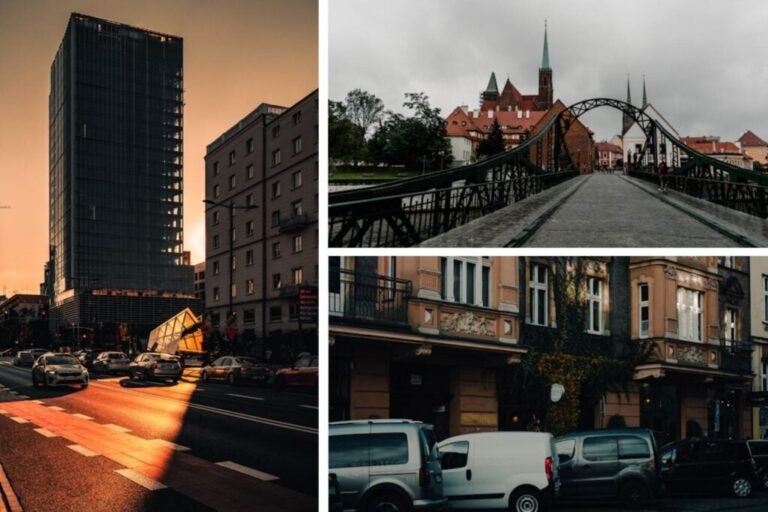
Finding a place to park in Polish cities can be easy or a real challenge, depending on the area and time of day. While prices are relatively affordable compared to other European countries, the rules are strict, and fines are often applied.
Public parking zones are marked with colours and vertical signage. The main categories are:
-
- Paid zones (Strefa Płatnego Parkowania): Located in city centres and operating from Monday to Friday, between 8:00 AM and 6:00 PM (may vary depending on the city).
-
- Residential zones: Only for residents with permits.
-
- Free zones: Located further from the city centre or on weekends and night-time hours.
Keep in mind that in cities like Kraków, Gdańsk, or Warsaw, free parking in the city centre is scarce. To avoid fines, we recommend using an underground car park or leaving your car in a park and ride (P+R) and continuing your sightseeing on foot or by public transport. Don’t forget that these cities’ historic centres are best explored on foot.
Parking can be paid using mobile apps such as SkyCash, moBILET, mPay, and AnyPark, coins (and cards in some cases) at parking meters, or with physical tickets (only in some cities). In all cases, make sure to leave the receipt visible on the windshield if the system is not digital.
Now, the price of parking varies depending on the city and area. For example, in major Polish cities, it can cost between $1–2 (€0.90–1.60) per hour, while in less central areas, it’s cheaper. Underground parking costs from $10 (€9) per day.
Options for Renting a Car in Poland
Now you know that renting a car in Poland is a great idea for exploring the country at your own pace and going beyond the main tourist spots. Additionally, it’s affordable compared to other European destinations.
Rental agencies in Poland are available throughout the country:
-
- International airports in Warsaw-Chopin, Kraków, Gdańsk, Wrocław, and Poznań.
-
- Train stations, especially in Warsaw, Kraków, and Gdańsk.
-
- Central areas of all major cities.
-
- Platforms like Rentalcars, DiscoverCars, Kayak, or directly from the websites of Avis, Europcar, Hertz, Sixt, or Budget.
These platforms will allow you to compare prices, evaluate options in peace, and make a reservation in advance.
The available vehicles are the same as anywhere else: compact and economical cars, SUVs or family cars, automatic vehicles, electric or hybrid cars, and premium models. So, what you’ll need to do is choose the vehicle type that best suits your trip. Another thing to consider is the season you’ll be travelling in, as driving in winter differs from driving in spring. In the first case, you may need a special car.
Prices naturally vary according to the model. For example, a manual compact car costs about $27 (€25) per day, while an automatic SUV starts from $49 (€45) per day.
The base price includes mandatory insurance, but additional coverage can add €10-20 ($11-22) per day, depending on the company.
Final Tips for Driving in Poland
-
- Pay attention to trams: Trams are a very common mode of transport in Poland, especially during peak hours. If you’re not used to sharing the road with them, it may cause some difficulties. Keep in mind that passengers getting off trams and crossing the street have priority, so you’ll need to stop and give way. Also, in intersections without traffic lights in historic centres, trams also have priority.
-
- Drive carefully on rural roads: Although Poland has a very good road infrastructure, rural roads can be narrow and somewhat poorly maintained. Drive slowly and cautiously when on these roads. Additionally, they are often poorly lit, so driving at night is not recommended.
-
- Be mindful of the weather: Road conditions can vary depending on the season. The winter months are the most challenging for driving in Poland, as heavy snow and icy roads often require vehicles to be equipped with appropriate tyres and to carry supplies like a shovel, ice scraper, and de-icer.
-
- Follow the rules, even if others don’t: On some roads, especially outside cities, you’ll see drivers speeding without hesitation. Don’t be tempted to imitate them, as Poland’s radar system is very well distributed.
-
- Use apps to avoid tolls or traffic jams: Tools like Google Maps, Waze, or AutoMapa (popular in Poland) help you anticipate detours, tolls, roadworks, and avoid slow routes or heavy traffic in large cities like Warsaw or Kraków.
Driving in Poland: Frequently Asked Questions
Yes, you can as long as your licence is in the Latin alphabet and valid. Make sure it’s been valid for at least 12 months and you have a credit card in your name. Additionally, some agencies may require an international driving permit as an extra requirement.
Most rental cars are already registered in the e-TOLL system. In that case, the agency will charge you for the sections you’ve driven at the end of the contract. If not, you can use mobile apps or pay manually depending on your route.
If you have a traffic accident or problem on the road, call 112 immediately, the European emergency number. If you rented a car, also contact the agency and follow their instructions. Don’t move the vehicle unless it’s in danger or blocking traffic.
Yes, driving in Poland is safe. The roads are well-maintained, signposted, and the road safety level is high. In rural or mountainous areas, there may be more challenging conditions, but with caution and planning, you shouldn’t face any issues.
Overtaking is allowed on both sides, but in certain situations, it is prohibited: at intersections, railway crossings, and pedestrian crossings.
We believe that autumn and spring are the most beautiful seasons to drive in Poland. The weather is mild, there are fewer tourists than in the summer, and the landscapes are painted in incredible colours. We discourage winter, especially for those not accustomed to driving in snow.