Language


 No results found
Driving in Morocco: Tips and requirements
Driving in Morocco as a foreigner is not only possible, but also one of the most enriching ways to get to know the country. We tell you everything you need to know.

Driving in Morocco can be a great adventure. However, to ensure your road trip doesn’t turn into a complicated journey, there are a few key details you need to know before getting behind the wheel.
This country, rich in culture and natural beauty, is one of the best travel destinations in Africa: from the Berber villages of the High Atlas to the desert dunes in Merzouga, or monumental cities like Marrakech, Fez, or the famous Chefchaouen, the “blue city of Morocco”. Anyway, renting a car will give you the freedom to move at your own pace, travel less crowded roads, and stop as often as you think necessary.
Although the country has modern highways and spectacular landscapes, you will also find secondary roads, chaotic traffic in the big cities, and rules that, while clear on paper, are not always strictly followed.
In this guide, we explain everything you need to know to drive in Morocco as a foreigner: what types of licenses are accepted, what documents you need to carry, how insurance and tolls work, and what basic rules you must follow as a driver.
Are you ready to explore Morocco on wheels? Then, shift into first gear and let’s get started.
Valid Driving Licenses in Morocco
The first thing you need to know before venturing onto Moroccan roads is whether your driving license from your home country is valid in Morocco. Generally, there is a fairly flexible policy towards foreign drivers, but the conditions may vary depending on the driver’s nationality and how long they will stay in the country.
National License from Your Home Country
The good news is that you can drive in Morocco with your valid national license for a maximum period of one year from the date of entry into the country. However, it must be written in the Latin alphabet (such as Spanish, English, or French) and include a photo. So, if you’re coming from countries like Mexico, Argentina, Colombia, Chile, Spain, or the United States, you won’t have any problems driving legally in Morocco with your license.
However, if the document is not written in the Latin alphabet (e.g., if it’s in Arabic, Cyrillic, or Chinese), you will need to bring an official translation or, preferably, an International Driving Permit (IDP).
Is an International Driving Permit required?
While it’s not mandatory in all cases, obtaining an IDP and carrying it during your trip to Morocco is a smart decision. This document translates your license into over 10 languages and serves as proof of your driving credentials, ensuring you’re authorised to drive in Morocco for the duration of your stay. It can also help in the case of traffic incidents or accidents, as it proves your legal status on the road, something you will undoubtedly appreciate if you’re involved in a legal dispute.
Lastly, we recommend the IDP for car rentals, as rental agencies in Morocco will typically ask for this document, along with your national license and passport. In conclusion, you should apply for it in your home country before traveling to Morocco. The process is simple, and it’s often granted automatically, saving you a lot of potential headaches. However, the IPD does not replace the national license. You should always carry both documents together.
Which Countries Have a License Exchange Agreement with Morocco?
If you fall in love with Morocco and decide to extend your stay, or if you plan to live and work in the country for more than 12 months, you will need to apply for a Moroccan license. Only certain countries have bilateral agreements that allow you to exchange your license without an exam, so it’s important to check this before proceeding.
Currently, countries like France, Spain, and Belgium have exchange agreements. Travelers from Latin American countries are not as fortunate and will need to take both a theoretical and practical exam if they want to obtain a local license.
Requirements and Documents to Drive in Morocco
Driving in Morocco requires more than just a valid license: certain conditions must be met according to Moroccan law. While many of these rules are similar to those in other countries, there are specifics you should be aware of before hitting the road. Police checks are common, and there is no tolerance for exceeding speed limits. The same goes for the mandatory documents, which we’ll discuss here.
Therefore, it’s a good idea to spend your flight time reviewing this article and avoid starting your road trip on the wrong foot.
Here are some key points you should not overlook:
- The legal driving age in Morocco is 18. However, to rent a car, most agencies require a minimum age of 21 and at least one year of driving experience. Some agencies may ask for 23 or even 25 years old if you want to rent premium models, SUVs, or 4x4s.
- Every vehicle circulating in Morocco must have valid third-party liability insurance (known as “assurance au tiers”).
- If you rent a car, a basic insurance (CDW) is typically included in the contract, but additional coverage can be added. Consider opting for full insurance, which will provide peace of mind knowing you’re fully covered. Moroccan roads often warrant such an investment.
- One tip: check the rental contract carefully. Some insurances have high deductibles and restrictive conditions. Also, check that the vehicle has no scratches or dents, and if it does, take photos and note them in the rental report. This will prevent you from being blamed for damages that weren’t yours.
- If you’re driving a borrowed or private vehicle, ensure it has passed the technical inspection (visite technique). It’s mandatory and must be up to date for the vehicle to be roadworthy. If you rent a car, the agency takes care of this requirement.
- The documents you can’t forget before hitting the road are your driving licence and international permit (if applicable), your passport, the vehicle rental contract (if applicable), insurance certificate, and the technical inspection certificate (if using a private vehicle).
Need internet in Morocco? Hitting the road without mobile data is not a good idea, as tools like GPS are essential in such countries. If you’re visiting Morocco for a few days, the eSIM for Morocco from Holafly offers unlimited data and stable connectivity that you can purchase by the day.
For longer trips, Holafly’s monthly plans are an affordable and practical solution that allows you to enjoy unlimited data, multiple device connection, and global coverage in over 170 countries. While not a requirement for driving in Morocco, it will undoubtedly make your experience on the road much easier.
Important: If you are a frequent traveler and want to stay connected without worrying about expensive roaming or looking for a new SIM at every destination, Holafly’s subscription plans are for you. With a single eSIM, enjoy internet in more than 170 countries for a fixed price and no surprises on your bill. Travel without limits and connect easily and securely! 🚀🌍

Traffic Rules in Morocco and Signage
Driving in Morocco can be as exciting as it is challenging. While the traffic rules are clear and fairly similar to European ones, the actual behaviour on the streets, especially in cities, can be somewhat chaotic. Understanding the legal framework and how Moroccans drive will give you more confidence behind the wheel. Want to know more? Below, we explain some key aspects of driving rules in the country.
Direction of Travel and Right of Way
If you’re coming from Latin American or European countries, you won’t have an issue with this, as in Morocco, driving is on the right and overtaking is on the left. In other words, the steering wheel is on the left side of the vehicle, just like in most Western countries.
What about intersections? If it’s an intersection without clear signage, the vehicle coming from the right has priority. On roundabouts, you must give way to vehicles already circulating within the ring (though, in some older roundabouts, the opposite applies: pay attention to the signs). A tip is to stay alert in both situations, as sudden turns and lane changes without signals are common.
Speed Limits
Speed limits vary depending on the type of road and are indicated with round signs with a red border. However, what’s really important is that Moroccan authorities are strict about this rule. Exceeding the speed limit by just 5 km/h can result in a fine! Moroccan police have a bad reputation for issuing fines to tourists, so don’t give them a reason to sanction you.
What are the actual limits? The speed limits are 60 km/h in urban areas, 80-100 km/h on secondary roads, and 120 km/h on highways. Keep in mind that Morocco has both fixed and mobile speed cameras on highways and national roads.
One tip: when you enter villages, you’ll likely encounter police checks. If this happens, try to reduce your speed by at least 10 km below the expected limit. Also, if you see a stop sign, stop immediately and don’t proceed until the officer instructs you to do so.
Seatbelt and Mobile Phone Use
This rule isn’t much different from other countries worldwide: seatbelt use is mandatory for all passengers in the vehicle, and it’s prohibited to use a mobile phone while driving, unless you have a hands-free system. Plain and simple. Violations of this type are fined between 150 and 400 MAD (dirhams), which is around $16-43 (€14-37).
Signage in Morocco
The signage is similar to European standards, and although most traffic signs are in Arabic, they are accompanied by international symbols. For example, the stop sign is in Arabic, but it’s easily recognizable as it’s marked in red. You may also come across some traffic signs in French and English, especially in tourist areas. In rural areas, however, signage may be sparse or hard to see, especially at night.
A tip to avoid relying solely on signage (though you shouldn’t ignore them) is to use a GPS or Google Maps. It will help you reach your destination much faster. It will also be very useful on poorly signposted routes.
Tolls and Fuel in Morocco
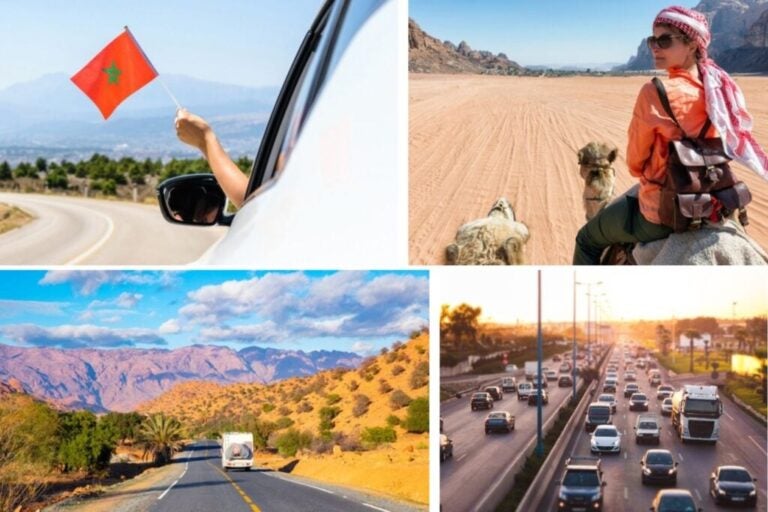
Morocco has a modern and well-maintained highway network connecting the country’s major cities, such as Casablanca, Rabat, Marrakech, Fez, and Tangier. These highways are toll roads, while national and secondary roads are usually free, though slower and with variable traffic.
That said, let’s look at how tolls and fuel work in Morocco.
How Do Tolls Work in Morocco?
The Moroccan toll system is simple: when you enter a highway, you receive an entry ticket and pay when you exit, either in cash or by card, depending on the distance covered. The price varies based on the distance and type of vehicle. For example, traveling from Casablanca to Rabat (80 km) costs around 20 MAD (€1.85, $2.16), while traveling from Rabat to Marrakech (320 km) costs 80 MAD (€7.42, $8.60).
Highways are fast and safe, making them ideal for long journeys. If you want to save money, you can choose national roads, but be aware they are slower and sometimes in poor condition.
The toll booths are clearly marked, and there are specific lanes for:
- Paiement en espèces: cash payment (dirhams).
- Paiement par carte bancaire: payment with a local or international card.
- Jawaz: an electronic prepaid system for private vehicles (not applicable to rental cars).
A helpful tip is that if you’re renting a car, always carry cash, as some booths don’t accept foreign cards.
Fuel in Morocco
In Morocco, you will find service stations on highways, national roads, cities, and villages, with the most well-known brands being Afriquia, TotalEnergies, Petrom, and Shell. However, you should know that they are not abundant. On the more touristy highways and national roads, there are plenty of stations, but as you head towards more remote areas, like the desert, the number significantly decreases. Therefore, we recommend filling up before venturing into the more isolated areas of the country.
Available fuels are:
- Sans Plomb (unleaded petrol): equivalent to 95 octane. The average cost is around 13-14.50 MAD/litre (€1.21-1.35, $1.40-1.57).
- Gasoil (diesel): very common in rental vehicles. Between 11.50-13 MAD/litre (€1.07-1.21, $1.24-1.40).
Keep in mind that stations on highways are a bit more expensive, so refueling in urban areas or at supermarkets with pumps can help you save money. In terms of payment, you can use cash (in dirhams), credit or debit cards (accepted at most large stations), and some stations allow mobile payments, but only with local apps.
Another tip if you’re driving through rural or less touristy areas is not to assume that stations will be open 24 hours. Plan your fuel stops ahead of time, especially if you’re traveling at night or during religious holidays.
Parking in Morocco
Parking in Morocco can be quite challenging in large cities like Casablanca, Rabat, or Marrakech, where traffic is dense, streets are often narrow, and signs don’t always clearly indicate whether parking is permitted. Additionally, it’s common to find informal “car watchers” (known as Gorrillas) who manage public parking spaces.
Here’s a brief guide to parking in Morocco, so you won’t be surprised when leaving your vehicle.
Where Can I Park?
In Morocco, there are different types of parking:
- On the street (public road): You can park as long as there’s no sign prohibiting it. In most cases, you must pay, although people don’t always clearly indicate it.
Monitored public parking: The local authority or concessionary companies usually manage these. They signpost them as ‘Parking’ or ‘Parc Auto.’
Private parking: Found in shopping centres, hotels, restaurants, or tourist attractions.
Parking at hotels: Many accommodations offer free parking or a fixed daily rate.
If you’re unsure whether parking is allowed, it’s better not to park or ask a traffic officer if one is around. Another point to consider is the medinas (historic centres) in cities like Marrakech or Fez. It’s best not to drive into these areas, as parking can be really difficult. Plus, part of the charm is walking through them and soaking in the magic of the medinas.
Who Charges for Parking?
In many cases, you will encounter people wearing reflective vests who charge for parking spaces in cash. They’re not official, but the system is tolerated and widespread. They’ll give you a ticket and “watch” your vehicle while it’s parked. A tip is to agree on the price before leaving to avoid any misunderstandings. The fee is usually low, but in highly touristy areas, they may try to charge more.
How Much Does Parking Cost in Morocco?
Parking fees vary depending on the city and area:
- On public roads: between 2-5 MAD per hour ($0.22–0.54, €0.20–0.50).
Monitored parking in central areas: between 10-30 MAD per day ($1–3, €1.00–3).
Private parking (shopping, airport): between 5-10 MAD per hour ($0.54–1, €0.50–1) or 40-70 MAD per day ($4–8, €4–7).
Options to Rent a Car in Morocco
Renting a car in Morocco will allow you to reach remote places, organise your itinerary as you wish, and have a more authentic experience. Moreover, the main routes are in good condition, and there is a wide range of vehicles for all budgets. However, there are some details you can’t overlook, especially in terms of choosing the type of car that best suits the route you have in mind, as it’s different to travel between cities than to explore the Berber villages of the High Atlas.
- To rent a car in Morocco, you can head to agencies located at the international airports in Casablanca, Marrakech, Fez, Rabat, Agadir, or Tangier, in central areas of the main tourist cities, and at train stations or bus terminals. You can also use platforms like DiscoverCars, Rentalcars, or directly book from well-known agencies’ websites.
- The main international agencies operating in Morocco include Europcar, Sixt, Avis, Hertz, and Budget. There are also local companies like AirCar, LocationAuto, Medloc, Wanalou, and others.
- Local agencies usually have lower prices, but it’s crucial to read the terms, check if insurance is included, and review customer feedback before booking.
- The requirements to rent a car are to be at least 21 years old with a valid license that you have held for at least one year. You will also need an international permit (if applicable), a credit card for the deposit, and a valid passport.
- The vehicle fleet available is vast, from economy and compact cars, ideal for city-to-city travel, to 4x4s or SUVs. If you plan a route through the Atlas Mountains or even wish to visit the Merzouga desert, it’s advisable to go for one of the latter options, as they will offer more comfort on those rough roads. Don’t rule out the idea of booking an excursion for the more challenging stretches and leaving the driving to experts in areas with better routes.
- The price depends on the vehicle model and includes mandatory insurance, but you pay separately for additional coverage such as zero deductible, collision damage, or theft protection. In general, renting a car in Morocco is not expensive compared to other countries and can be very convenient, especially if you’re traveling with several people and can share the total cost.
Final Tips for Driving in Morocco as a Foreigner
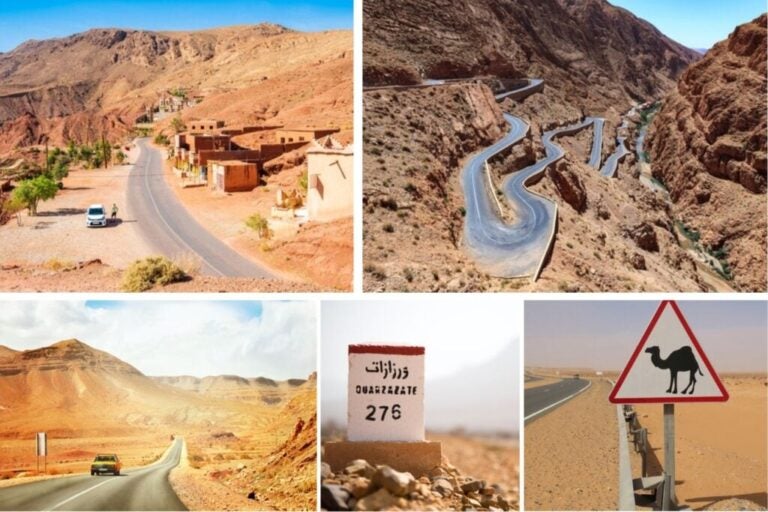
Now you have a clearer idea of what it means to drive in Morocco. You know that while the experience can be incredible, it can also be challenging if you don’t do things right. From reviewing key traffic signs to being cautious about where you park, these small details can make all the difference in the overall outcome of your trip. A fine for speeding could ruin a day of sightseeing or even negatively impact your budget. That’s why we advise you: whenever you drive in a foreign country, take it seriously and get well-informed before you get behind the wheel.
These final tips will help you move with confidence on Moroccan roads and enjoy your trip with peace of mind.
- Stay calm in urban traffic: You already know this. City traffic is chaotic. This includes Marrakech and Fez. Horns are honking. Motorcycles weave in and out. Pedestrians cross suddenly. Cars ignore lane rules. Try not to get stressed, drive slowly, leave space, anticipate moves, and don’t react impulsively. If things get overwhelming, park the car and take a walk, or sit down for a nice coffee.
- Use offline maps or a reliable GPS: While the signage is clear, rural or mountainous areas may not always have them. Also, it’s common to lose internet signal as you move away from cities. Download offline maps using Google Maps or use apps like Maps.me to navigate without a connection.
- Avoid driving at night, especially on secondary roads, which are often poorly lit, with limited signage and the presence of loose animals. Some stretches may also have potholes or be narrow. It’s best to plan your routes to travel during the day, especially if you’re heading to rural or desert areas.
- Respect the speed limits: Be aware of speed cameras on major roads. They are mobile and fixed. Fines are often enforced. This includes speeding and phone use. Fines may go to the rental company. Police checks still occur.
- Use official parking whenever possible: Avoid leaving your car in unregulated or unmonitored areas, especially in highly touristy cities. Informal “car watchers” are common, but if you’re unsure, look for public or private parking.
- Fill up the fuel tank whenever you can: As you head south, fuel stations become less frequent. Therefore, plan your refueling stops based on your route to avoid getting stranded in the desert.
Driving in Morocco: Final Questions
Driving in Morocco is relatively safe, but it depends on the area. Highways are in very good condition. Secondary roads have issues. You may see slow trucks or loose animals. Expect poor lighting and unlit vehicles. Do not drive at night. Always move cautiously and patiently. Follow traffic rules to avoid accidents. This also prevents bad experiences with the police.
Autumn and spring are the best times to visit Morocco. The country’s geography is highly varied. The north has a Mediterranean climate. The Sahara has desert conditions. The Atlas range has mountain climates. We don’t recommend summer. Temperatures can reach 50 degrees in cities like Marrakech. Winter brings rain or snow in the Atlas Mountains.
Generally yes. Morocco has a good railway network that connects the major cities (Tangier, Fez, Nador, Rabat, Casablanca, and Marrakech). There are also high-speed trains connecting Tangier and Casablanca in about two hours. Buses are the most popular form of transport among Moroccans, with low prices and frequent services. However, we believe that driving a car is still the most convenient way to move freely around the country.
Parking in restricted or prohibited areas will result in a fine of 150–300 MAD ($16–32, €15–30). In serious cases, the municipal police may tow the car.
No. Morocco does not apply systems like Low Emission Zones (LEZ) nor requires environmental stickers. However, in many cities, it’s not allowed to drive into the medinas (historic centres).