Language


 No results found
Driving in Malta: Tips and requirements
We tell you everything you need to know about driving in Malta: traffic regulations, valid licences, parking and much more.

Have you heard of the island of Malta? This small Mediterranean paradise, with its historic cities and dreamy beaches, is a perfect destination for a road trip. However, it’s not as simple as renting a car and driving around the island. Its old roads and somewhat chaotic traffic (especially during peak season) make driving in Malta quite a challenge. Don’t worry, though, because with the right information, you can discover its attractions on four wheels without any issues. From the historic streets of Valletta to the hidden beaches of Gozo, renting a car will allow you to make the most of your time in Malta and explore the island at your own pace and leisure.
In this article, we’ll tell you everything you need to know to drive in Malta as a foreigner: Which licenses are valid, whether you need an international permit, how mandatory insurance works, and what traffic rules you need to keep in mind before hitting the road.
Everything you need for your journey in Malta to be a success is here. So, get comfortable, put on your glasses, and start taking notes on everything we have to tell you.
Valid Driving Licenses in Malta
The first thing you need to know to drive in Malta as a foreigner is whether your national license is valid or if you need any additional documentation. In general, a wide variety of licenses are accepted, but the requirements may change depending on your country of origin and the length of your stay.
National License from Your Home Country
If your license was issued in an EU or EEA member country, you can drive in Malta without restrictions. However, make sure your license is valid and in good condition.
If you’re coming from Mexico, Argentina, Colombia, Chile, or the United States, for example, you can also drive in Malta with your national license for up to 12 months. However, we recommend also bringing an International Driving Permit (IDP) as a backup.
What if I decide to live in Malta? In that case, you will need to exchange your license for a Maltese one after one year of residency. The process is the same as in most countries: demonstrate your driving skills and knowledge of traffic regulations through a theoretical and practical exam.
International Driving Permit (IDP)
Although it’s not mandatory in all cases, an IDP is especially recommended if your license is not in the Latin alphabet, doesn’t include a photo, or is not well known to local authorities.
The process for obtaining an IDP is simple, done in your home country, and generally resolved quickly and favourably. For example, if you’re from Mexico, you need to apply through the National Automotive Association (ANA), while in Argentina, the process can be done at any branch of the Automóvil Club Argentino.
Keep in mind that the IDP does not replace your national license, so be sure to carry both documents.
Exchanged or Validated License
You know that if you plan to live in Malta for more than 12 months, you’ll need to get a local license. However, if you’re from a country with a bilateral agreement, you can exchange your license for a Maltese one without taking a test. Some examples are Australia, Switzerland, the UK, Canada, and some Latin American countries.
If your country doesn’t have an agreement, your only option will be to apply for a new license in Malta, which requires passing both the theoretical and practical exams.
Requirements and Documentation to Drive in Malta
Now you know that having a valid license isn’t enough to drive in Malta, or anywhere else for that matter. It won’t help to have the right and valid license if you’ve been drinking alcohol or aren’t wearing your seatbelt. In other words, there are other requirements you must meet to drive in Malta without issues. Some are related to the vehicle, others to the driver. And, since it’s a country where people drive on the left, there are certain aspects that deserve special attention. Let’s see:
- Minimum age to drive: The minimum age to drive in Malta is 18 years old. However, if you’re renting a car, most rental agencies require you to be at least 21 years old and have held your license for at least one year.
- Mandatory vehicle insurance: As in most countries, every vehicle in Malta must have mandatory third-party insurance. This is included in rental cars, but if you’re driving your own vehicle to the island, it’s your responsibility to have the proper insurance.
- Vehicle Inspection (MOT): Vehicles registered in Malta must undergo regular technical inspections. Again, if you’re renting a car, this will already be taken care of by the agency. However, if you’re driving your own vehicle, make sure it’s in order and has a valid MOT certificate.
- Driving on the left: One of the biggest challenges you’ll face is that in Malta, people drive on the left. The steering wheel is on the right side of the vehicle, and overtaking is done on the right. This requires more concentration, especially when turning or entering roundabouts. A tip if you’ve never driven on the left before is to choose an automatic car to make the adaptation easier.
- Mandatory documentation: Don’t hit the road without your valid national driving license, International Permit (if applicable), passport or ID, vehicle insurance, and rental agreement (if applicable). If you come across a checkpoint and don’t have any of these documents, you could face issues with the Maltese authorities. It’s better not to give them a reason to stop you, so make sure all your documents are present, valid, and in order.
How to Get Internet in Malta
It’s not a requirement for driving in Malta, but having internet will make your travels around the island much easier. As you start driving through its routes, you’ll notice that signs aren’t always there, or sometimes they’re confusing. That’s why using GPS or apps like Waze is essential. How to do it? Very simply: With Holafly’s monthly plans.
This solution for frequent travellers lets you have internet in over 170 countries worldwide, without international roaming fees or any unpleasant surprises on your bill. The plan renews monthly, but you can cancel it at any time with no penalties. Plus, you can share internet with other devices, with the unlimited plan for $50.50 (€46.10) per month, making it ideal for digital nomads or people travelling in groups. Alternatively, if your trip will be for a few days, we recommend the eSIM for Malta, with unlimited data only for the days you need.
Important: If you are a frequent traveler and want to stay connected without worrying about expensive roaming or looking for a new SIM at every destination, Holafly’s subscription plans are for you. With a single eSIM, enjoy internet in more than 170 countries for a fixed price and no surprises on your bill. Travel without limits and connect easily and securely! 🚀🌍

Traffic Rules and Signage
Maltese roads are special: They have a mix of modern roads and routes built centuries ago that reflect the island’s rich heritage. For example, the stretch between Valletta and Malta International Airport is traversed via wide, properly marked roads. However, the older, secondary routes tend to be narrow, in poor condition, and many of them only have one lane in each direction, with limited visibility on some curves.
Additionally, in cities like Valletta or Sliema, the streets are narrow, and traffic is heavy, which makes driving quite stressful. Fortunately, your experience will be easier if you study the island’s routes in advance and, above all, learn the traffic rules and signs. This will give you confidence in an unfamiliar but exciting destination.
That said, let’s take a look at the traffic rules you cannot overlook:
Direction of Travel and Right of Way
As you know, just like in the UK, in Malta, they drive on the left. Therefore, the steering wheel is on the right, overtaking is done on the right, roundabouts are counter-clockwise, and exits are on the left side of highways. Yes, this likely means you’ll need to adjust to a different driving system than your home country. Take the first few minutes calmly, avoid busy areas at the start, and gradually, you’ll gain confidence. Before you know it, you’ll be an expert at driving in Malta.
One more thing: Malta has many roundabouts (more than other countries). Vehicles inside the circle have the right of way. Also, at intersections without signs, priority goes to vehicles coming from the right.
Speed Limits
Although the island follows the same rules as many European countries, Malta has lower speed limits (due to the island’s particular geography and road conditions):
- In the city: 50 km/h
- On rural roads: 60 to 80 km/h
- On highways or expressways: 80 km/h
Many of Malta’s routes have speed control cameras, both mobile and fixed, so stay alert as fines for speeding can reach $116 (€100) or more.
Alcohol and Driving
Another important rule to keep in mind when driving in Malta concerns the blood alcohol limit for drivers. The limit is 0.05% and not respecting this limit is a serious crime that can result in expensive fines and possible prison sentences.
Using Mobile Phones While Driving
No matter if you’re in Malta, the United States, or Argentina: Driving with your mobile phone in hand is wrong. In fact, the island is very strict with this rule, and the only way to drive and talk on the phone at the same time without getting fined is by using a hands-free system. Manipulating your phone can result in an immediate fine, so it’s best to avoid it.
Seat Belts and Safety Systems
Another golden rule: Every occupant of the vehicle must wear a seat belt at all times. Additionally, if you’re travelling with a child under three years old, they must be in a special child seat (keep this in mind when renting a vehicle). If the child is under 12 years old, they cannot sit in the front seat.
Signage in Malta
Another thing you need to know is that signs in Malta are in English and use universal symbols, making them easy to understand. You don’t need to be fluent in the language; with some basic knowledge, you’ll be able to interpret the signs without issues. However, some signs have their own peculiarities. For example:
- Give Way: Means ‘give way’.
- No Overtaking: Prohibits overtaking
- Speed Camera Zone: Automatic radar zone
- Bus Lane: Lane reserved for buses, with specific times
The main issue with traffic signs in Malta is that sometimes they simply don’t exist. This won’t be a problem in tourist areas, but in more remote regions, signage may be scarce. That’s why it’s important to use a GPS.
Common Fines and Penalties
Fines in Malta are common, especially for foreigners who arrive without knowing how traffic works on the island. These fines can either be applied on the spot or sent by mail if you’re using a rental car. The most common fines are:
- Speeding: From €35 to over €100 ($43-870).
- Parking violations: Between €20 and €65 ($23–75).
- Using a mobile phone without hands-free: €100 ($116) fine.
- Failing to yield: Around €70 ($81).
- Driving without a seatbelt: Between €45 and €60 ($52–70).
Tolls and Fuel Charging
Did you know that Malta is one of the few European countries where there are no tolls on the roads? Highways, streets, and routes are open to traffic with no additional costs, which simplifies travel planning. This also applies to the routes in the islands of Gozo and Comino, the other islands in the Maltese archipelago. Therefore, driving in Malta is free, both for residents and tourists.
The only exception is parking costs in urban areas or tourist spots, which may charge by the hour or day. We’ll explain this in detail shortly.
Fuel Refills
Fuel in Malta is sold per litre, and service stations are well distributed throughout the main island. However, it’s always a good idea to fill up in the cities and not risk running low on fuel in more remote areas. Most stations offer self-service and accept international cards, although in rural areas, it may be helpful to have some cash on hand.
The types of available fuel are unleaded petrol (Unleaded Petrol) and diesel, common in larger or commercial vehicles. The average prices for March 2025 are:
- Unleaded Petrol: €1.34/Litre ($2)
- Diesel: €1.21/Litre ($2)
- Electric charging: Around €0.20/kWh at public stations ($0.22)
Fuel prices in Malta are regulated by the government, so they don’t vary between stations.
Parking in Malta
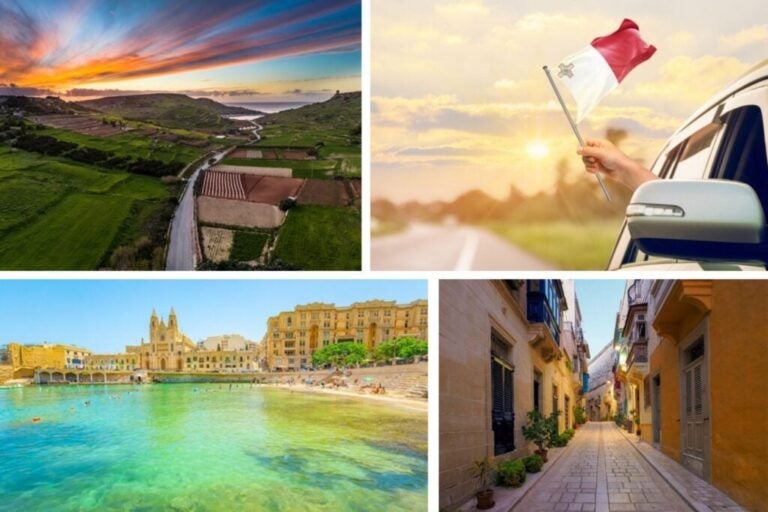
Another challenge when driving in Malta is parking, which can be a real headache, especially in Valletta, where the streets are narrow and parking spaces are limited. Our advice is to park as soon as you find a spot and start exploring the city on foot. The capital of Malta is one of those places that are best enjoyed by walking.
When it comes to parking, knowing the color system, tariffs, and allowed areas will help you avoid fines and move around with more ease.
Parking Zones in Malta
Malta uses a color-coded system on the ground to indicate the parking conditions:
- White lines: Free and unrestricted parking.
- Blue lines: Paid parking. Requires a parking meter ticket or app.
- Yellow lines: Parking is prohibited.
- Zones with specific signs: Reserved for residents, taxis, or official services.
Don’t just look down. Pay attention to the vertical signs as well, which indicate payment hours and restrictions. Also, keep in mind that some free parking spaces become paid during weekdays or special events.
How Do You Pay for Parking?
- Physical parking meters: Accept coins, and in some cases, cards.
- Mobile apps like PayByPhone or Tallinja: Allow you to pay, extend time, and check availability.
- Physical tickets: Available at kiosks or authorized shops in some areas.
How Much Does Parking Cost in Malta?
Parking fees vary by city and area:
- In urban areas: Between €0.80-1.50 ($0.93–1.74) per hour
- Underground or private parking: From €5.00-20.00 ($6–23) per day
- In historic centres like Valletta: Parking can cost up to €3.00 ($3)per hour in premium zones
One piece of advice: If you plan to visit tourist areas with your car, try to look for public parking lots or park-and-ride services on the outskirts, where the rates are lower, and availability is better. Alternatively, when possible, use underground parking or park-and-ride services, which offer transport to city centres.
Where is Parking Prohibited?
- On sidewalks or ramps for disabled persons
- In front of garages, emergency exits, or pedestrian crossings
- In loading and unloading zones during business hours
- Double parking or blocking other vehicles
Fines for illegal parking can range from €20.00–65.00 ($23–75), and in severe cases, your vehicle may be towed.
Car Rental Options in Malta
We’re almost at the end of this driving guide for Malta. But before you go, here’s a brief guide on the car rental options, which you’ll likely need if you want to explore the island on your own. Keep in mind that you can also take your own vehicle across on a ferry. Even though it’s a small country with challenging secondary roads, having your own transportation will allow you to discover hidden coves, coastal towns, and explore at your own pace without relying on public transport schedules.
Where to Rent a Car in Malta?
As with all countries, you’ll find rental agencies at Malta International Airport, in tourist areas like Sliema, Valletta, and St. Julian’s, and at ferry stations (especially for crossing to Gozo). You can also use online platforms like Rentalcars, DiscoverCars, or directly visit the websites of companies like Avis, Hertz, Europcar, and Sixt.
If you’re renting a car in Malta, keep in mind that during the high season (May to September), you’ll need to book in advance to ensure availability and secure better prices.
The types of available vehicles are varied, from compact and economical cars, ideal for city driving and saving on fuel, to small SUVs, perfect for trips in Gozo or rural areas. There are also automatic vehicles, which can be helpful if you’re not used to driving on the left.
Estimated Rental Prices
Renting a car in Malta can be somewhat cheaper than in other European countries. Here’s an average of prices for March 2025:
- Per day: From €25.00 for a compact car to €55.00 ($29–64) for an SUV or automatic vehicle.
- Per week: Between €150–350 ($174–406), depending on the model and agency
- Per month: From €700 ($812) ideal for digital nomads or temporary workers visiting Malta for an extended period.
The rental price includes a basic mandatory insurance, but you can add additional coverage (damage, theft, 24-hour assistance) for an extra €10.00–20.00 ($12–23) per day.
Tips for Driving in Malta as a Foreigner
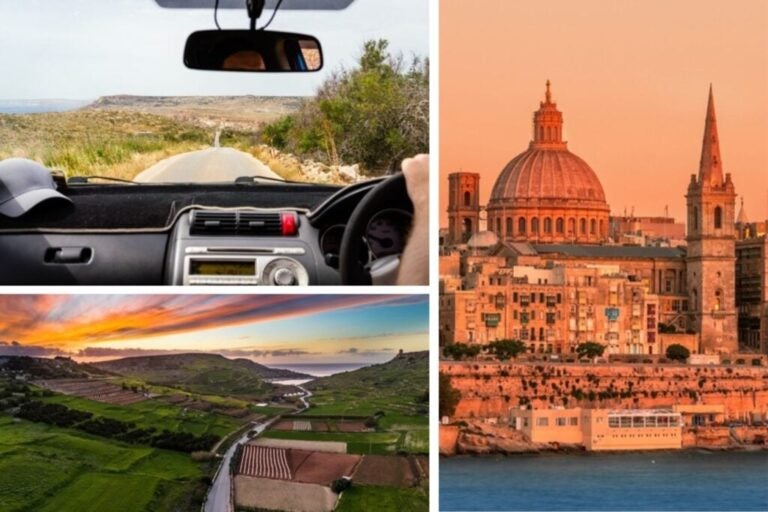
You’re closer to your road trip adventure in Malta. Driving on the island can be as exciting as it is challenging and chaotic. However, if you’ve reached this point, you’re probably more aware of what to expect when you’re behind the wheel. Driving in a new country without knowing how traffic works or what the roads are like is something we don’t recommend at all.
With that in mind, we want to leave you with a series of tips that will help you drive safely, avoid fines, and enjoy your trip around Malta without any issues.
- Adapt to driving on the right side of the road: This will be your first big challenge when driving in Malta. It can be confusing at first, especially when turning or entering a roundabout. Take the first few kilometres slowly and choose an automatic car if it’s your first time with this system.
- Avoid peak hours in urban areas: Cities like Valletta and St. Julian’s can be tricky between 8:00 and 10:00 am and from 5:00 to 7:00 pm. To avoid stress, try to schedule your trips outside of these times.
- Be cautious on secondary roads: On the main highways of the island, you can drive without much trouble. However, secondary roads are a different story. Many are narrow and may be in poor condition. Keep your speed moderate and stay alert to avoid accidents.
- Park carefully: Maltese streets are often narrow, and there are many areas with parking restrictions. Be sure to check the signs, use apps to pay for parking, and never park in double rows or block exits.
- Plan your routes in advance: One of the best things about travelling is the excitement of planning an itinerary and mapping out a route. So, before heading to Malta, study its roads and create a route that avoids tricky areas or stretches with little information available.
- Use GPS: In some areas of Malta, road signs are scarce and confusing. So, before trusting the road signs, use the GPS.
- Visit the islands of Gozo and Comino: They’ll enrich your trip. Remember, you can take your car to Gozo by ferry. However, Comino can only be accessed by boat or speedboat.
- Be patient and pay attention at all times: It may seem like basic advice, but in Malta, you’ll need to apply both skills. Local driving can seem chaotic: honking, sudden overtakes, and unindicated turns are common. Staying calm, respecting the rules, and not rushing will help you a lot.
Driving in Malta as a Foreigner: Frequently Asked Questions
Even if the car is rented, if you get a fine, you’ll need to pay it. The fine will be sent directly to the rental agency, which will then charge you along with an administrative fee. Therefore, it’s important to respect speed limits, parking regulations, and traffic signs.
In general, driving in Malta is safe. However, traffic can be heavy and disorderly in urban areas, and signage is poor in less populated parts of the island. So, be prepared to drive cautiously, follow the rules, and stay focused, especially on narrow streets or rural roads.
No. All roads are free, and there are no tolls in Malta or Gozo. You’ll only pay for parking in regulated areas or if you use private parking facilities.
As it is an EU-issued document, Malta accepts the Spanish driving licence. If you’re importing a vehicle to the country, it must be registered within 30 days of entering Maltese territory.
Malta is a small island, with a surface of 316 km². Therefore, in three days you can explore its whole territory without trouble. Although we advise spending between five and seven days to make the most of your stay, move without rushing and visit Gozo and Comino.