Language


 No results found
Driving in Italy: Tips and requirements
If you are going to drive in Italy, read and take note of everything we have to tell you. We have the most comprehensive guide for four-wheeled journeys around the country.

Are you planning to travel to Italy? If so, don’t miss out on renting a car to explore the country on four wheels. Driving in Italy can be an exceptional experience, with a unique dose of postcard-worthy landscapes and roads full of history. From the Amalfi Coast to rural Tuscany or the highways in the north, this mode of travel will allow you to discover hidden gems not featured in tours and move around freely.
Did you know? Italy has over 6,000 km of highways and one of the oldest road networks in Europe. It’s also famous for its ZTL areas (Limited Traffic Zones), which have led to more than one fine for unsuspecting tourists.
To make sure you’re not caught off guard by a ZTL or are aware of the maximum speeds on Italian highways, we’ve prepared this article where we tell you everything you need to know to drive in Italy as a foreigner. We’ll cover which licences are valid, whether you need an international permit, how mandatory insurance works, and what traffic rules you need to know before hitting the road. We’ll also offer some useful tips and answer the most common questions about driving in Italy.
Planning a road trip in Italy? If so, keep reading. Driving through vineyards, medieval towns, or modern highways will be easier if you have the correct information.
Valid Driving Licences in Italy
Before you hit the road, it’s important to know which licences are valid for driving in Italy. Depending on your nationality, you may need an additional permit or need to meet certain requirements to avoid fines or complications with Italian traffic authorities.
National Licence
Let’s start with the golden rule: the first thing you need to rent a car and drive around Italy is your driving licence. If it was issued in a European Union (EU) or European Economic Area (EEA) member country, you won’t need to translate it or provide any other documents. It just needs to be valid and in good condition.
If you’re from Mexico, Argentina, Colombia, Chile, or the United States, your national licence will be valid only if it’s accompanied by the International Driving Permit (IDP). What’s this? We’ll explain it in the next section.
International Driving Permit (IDP)
The IDP is a document that will be required to drive in Italy and many other countries worldwide. It translates your licence into the standard format approved by the United Nations, so it’s mandatory for all citizens travelling from non-EU countries.
Bear in mind that you’ll need to get it before travelling, in your home country. The process is generally quick and requires submitting a series of documents and paying a fee. The place where it’s processed may vary. For example, in Argentina, it’s handled by the Argentine Automobile Club.
Another detail is that the IDP doesn’t replace your national licence; it complements it. Therefore, you’ll need to carry both documents when driving.
Exchanged or Validated License
Italy allows the exchange of foreign licences, but only for countries with a bilateral agreement. Also, this process doesn’t apply if you’re a tourist or staying for less than 185 days.
Some of the countries that have exchange agreements with Italy include Switzerland, Japan, South Korea, and some regions of Canada. Mexico, Argentina, and the United States don’t have agreements, so if you’re from these countries and plan to live in Italy, you’ll need to obtain an Italian licence.
Requirements and Documentation to Drive in Italy
Driving in Italy involves more than just having a valid licence. There are other requirements you must meet to drive legally, both for you as the driver and the vehicle you use. Also, there are specific rules (e.g., ZTL) that could lead to fines if you’re not properly informed. Here are some useful details that will help you drive in Italy and avoid headaches.
- Minimum Driving Age: The minimum driving age in Italy is 18. However, when renting a car, companies typically require drivers to be at least 21 and have held their licence for at least one year.
- Mandatory Vehicle Insurance: All vehicles on Italian roads must have mandatory third-party liability insurance (RC Auto). If you rent a car, basic coverage will be included, but you can add extras like theft protection, damage coverage, or roadside assistance for an additional fee.
- ZTL (Zona a Traffico Limitato – Limited Traffic Zones): ZTLs are found in almost every city and town in Italy. As the name suggests, they are areas where traffic is restricted, meaning only authorised vehicles can circulate at certain times. If you enter a ZTL without permission, you’ll get an automatic fine, even if you’re a tourist and the car is rented.
- Vehicle Technical Inspection: All vehicles registered in Italy must undergo a mandatory technical inspection every two years. If you rent a car, don’t worry, it will already have the required inspection.
- Alcohol Limit: Like most countries, Italy has a maximum blood alcohol concentration (BAC) limit for driving. What’s the limit? It’s 0.5 g/l for general drivers and 0.0 g/l for those under 21 or with less than three years of driving experience. Respect this rule, as penalties include hefty fines or even the confiscation of the vehicle.
- Other important requirements: Other requirements for driving in Italy include wearing seat belts (all occupants), using dipped headlights outside urban areas (even during the day), and carrying the
- emergency triangle and reflective vest in the car. You also can’t use your mobile phone while driving unless it’s hands-free.
Don’t Travel to Italy Without an Internet Connection
Internet isn’t just necessary for posting on social media or making video calls to your loved ones. You’ll also need it for GPS, checking road conditions, and more. To avoid costly international roaming or relying on Wi-Fi networks, get the eSIM for Italy from Holafly if your trip is short, as you’ll get unlimited data for only the days you need. For longer stays, the monthly plans from Holafly let you share internet with other devices or with your travel companions’ phones, and you’ll get data not just in Italy but in 175 countries without changing eSIM. Without a doubt, the best ally for your adventures around the world.
Important: If you are a frequent traveler and want to stay connected without worrying about expensive roaming or looking for a new SIM at every destination, Holafly’s subscription plans are for you. With a single eSIM, enjoy internet in more than 170 countries for a fixed price and no surprises on your bill. Travel without limits and connect easily and securely! 🚀🌍

Traffic Rules in Italy and Road Signs
Now that you know some fundamental rules for driving in Italy, let’s go over other regulations you need to follow to avoid ruining your trip with a traffic fine. Italy combines excellent road infrastructure with a very particular driving style. While the rules are clear and well signposted, it’s important to be aware of them before getting behind the wheel, especially if you’re coming from outside Europe. Let’s look at some of them!
Direction of Travel and Right of Way
Let’s start with some basic rules about driving direction and right of way. In Italy, they drive on the right side, and the steering wheel is on the left. Roundabouts are common, especially in large cities, and drivers already inside the roundabout have the right of way unless indicated otherwise by signs. This is a basic rule that applies in many other countries, so you’re probably already familiar with it.
And what about pedestrians? They have the right of way at marked crossings, and failing to respect this can result in severe fines. Therefore, always give way, especially if it’s a distracted tourist admiring the façade of a church or other historical building.
Speed Limits
The speed limits for driving in Italy vary depending on the type of road:
- In the city: 50 km/h.
- On secondary roads: 90 km/h.
- On fast roads (superstrade): 110 km/h.
- On highways (autostrade): 130 km/h (or 110 km/h in case of rain).
Check these values before you hit the road and don’t press the accelerator too much. Fines for speeding start at €40 ($43) and can exceed €800 ($870) if you’re speeding by more than 40 km/h.
Traffic Signs in Italy
Italian road signs follow the European system and are mostly understandable, but there are a few that might cause confusion if you’re not familiar with them:
- Blue signs indicate mandatory roads or allowed directions.
- White signs with black borders usually indicate urban streets.
- Green signs indicate toll highways (autostrade).
- Brown signs indicate tourist spots.
Don’t forget one of the most important signs in Italy: the ZTL. These are easy to spot, They are generally indicated by the initials and a red circle, and they appear at the entrances to historic centres. Just pay a little attention, and you won’t have any issues. Also, walking through these areas is much more enjoyable than driving. Leave the car behind and focus on enjoying yourself!
Common Fines and Penalties
The Italian authorities are strict when it comes to traffic regulations and enforce fines rigorously. What’s more, you don’t need an officer to fine you, as many fines are generated automatically by cameras. You also won’t escape if you’re driving a rental car, as the fine will go to the agency, which will then forward it to you (with an administrative fee).
What are the most common violations?
- Speeding: From €40 to over €800 ($43-870).
- Unauthorized entry to ZTL: Between €80-200 ($87-217) for each entry.
- Using the mobile phone without hands-free: Up to €160 ($173).
- Not wearing a seatbelt: Around €80 ($87).
- Parking in forbidden places: Between €40-100 ($43-108).
- Driving under the influence of alcohol: Penalties may include jail, licence suspension, or vehicle confiscation.
If you receive a fine, you can pay it online with a discount if you do so within the first five days.
Tolls and Fuel Charging
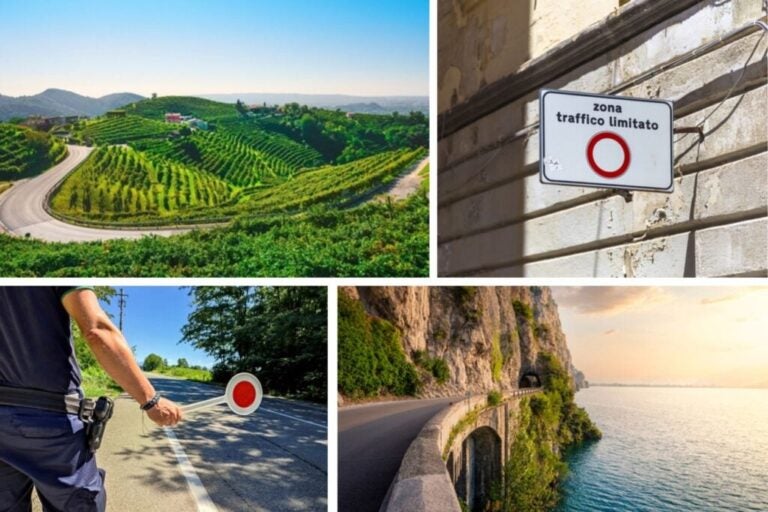
Let’s continue with this masterclass for driving in Italy. Now we’ll talk about two more things you need to keep in mind: Tolls on highways and fuel recharge at service stations. Knowing how these work will help you save time, money, and avoid headaches during your trip.
Tolls on Italian Highways
Highways in Italy (autostrade) are toll roads, but the system is different from other countries (especially in Latin America). Here’s how it works: there’s an automatic toll booth at the entrances and exits of each section. When you enter, you take a ticket; when you exit, you hand it in and pay based on the distance you’ve travelled. Don’t lose the ticket, because if you do, you’ll be charged the longest possible distance.
The price is calculated per kilometre, but here are some reference values:
- Turin – Milan (140 km): Around €11 ($12)
- Rome – Florence (270 km): Around €22 ($24)
Naples – Salerno (55 km): About €4 ($4.35)
You can pay with euros in cash, credit or debit cards, or use automatic systems like Telepass, which is included in some rental cars. This option is convenient and will help you avoid the long queues that often form at toll booths.
Types of Fuel in Italy
In Italy, service stations sell fuel by the litre, and prices vary depending on the area, being more expensive on highways and tourist spots. The most common types are:
- Benzina (unleaded petrol) – 95 octane (€1.83/litre ($1.99))
- Gasolio (diesel) (€1.76/litre ($1.91))
- GPL (liquefied gas) – only for specific cars (€0.73/litre ($0.79))
There are two types of service stations: self-service (cheaper) or with assistance (slightly more expensive). Payment is made in cash or by card directly at the pump or inside the shop.
Parking in Italy
One of the biggest challenges you’ll face when driving in Italy is finding a place to park your car, especially in historic cities, where space is scarce, and the rules are strict. Knowing the colour system, the rates, and the restrictions will help you avoid fines and save time.
Where to Park, Payment Methods, and Costs
Italy uses a system of coloured lines on the ground to indicate parking zones. This is one of the first things you need to pay attention to:
- White lines: free parking, though some areas may be time-limited.
- Blue lines: paid parking (pay at the nearest parking meter).
- Yellow lines: reserved parking for residents, disabled people, taxis, or authorised deliveries. It’s prohibited for tourists.
Also, check the vertical signs, which indicate the allowed hours and applicable rates. Read them carefully before leaving your car.
Parking in Italy can be paid via physical parking meters, which accept coins or bank cards; and through mobile apps like EasyPark, MyCicero, or Telepass Pay, which also allow you to extend your time or find available spaces.
As for the prices, they vary depending on the city and the area.
- In small cities or less crowded areas: From €0.50-1 per hour ($0.54-1.08)
- In urban and tourist areas (like Rome or Florence): Between €1.50-3 per hour ($1.63-3.25)
In private or underground car parks: From €15-35 per full day ($16.30-38.00)
Areas Where Parking is Forbidden
Take note of the following areas where you won’t be able to park your vehicle to avoid unnecessary fines:
- ZTL zones (Limited Traffic Zones).
- Streets with yellow lines.
- In front of emergency exits, ramps, or fire hydrants.
- Double parking or sidewalks.
- Bus or taxi stops.
Fines for illegal parking range from €40-85 ($43-92), and your car may be towed.
Options for Renting a Car in Italy
We’re nearing the end of this practical guide on how to drive in Italy. But we can’t leave without addressing a topic that will definitely be useful to you: Where to rent a car? As a tourist, you’ll likely turn to a rental agency to get a vehicle to explore the country. In fact, this is a comfortable, flexible, and very popular option among travellers. Whether you’re touring Tuscany, visiting coastal towns, or moving between cities, you’ll find plenty of options tailored to your type of trip.
Where Can You Rent a Car?
The main car rental agencies in Italy are Hertz, Avis, Europcar, Sixt, and Rentalcars, although there are many more. You’ll find offices at all international airports, at train stations, and even in the centres of tourist cities. You can also manage your car reservation online. A good tip is to book in advance to compare prices, vehicle types, and availability.
You’ll find everything from compact and economy cars, perfect if you’re getting around a city or going on a short road trip, to SUV and family vehicles, which are ideal if you’re touring Italy with friends or family. There are also electric or hybrid cars, which are gaining popularity due to environmental restrictions. Remember, most rental cars in Italy are manual, so if you prefer an automatic, make sure to request it.
Rental Prices
Prices vary depending on the season (higher in June, July, and August), the city, and the type of vehicle. As a reference, you can check the costs for March 2025:
- Per day: From €35 ($38) for a compact car, up to €80 ($87) for SUVs or automatics.
- Per week: Between €220-500 ($238–540).
Per month: From €900 ($972), ideal for longer stays.
The price may or may not include basic insurance (make sure to check beforehand), and additional charges may apply for an extra driver, GPS, child seat, or toll system (Telepass).
Tips for Driving in Italy as a Foreigner
Driving in Italy can be an unforgettable experience… or stressful. It all depends on how well you know the local rules and customs (as long as you respect them). To finish off this guide, here are some useful tips to make your road trip safer, legal, and much more enjoyable.
- Avoid ZTLs at all costs: Remember that only authorised vehicles can enter, and cameras automatically fine violators. If your accommodation is inside a ZTL, ask them to arrange permission before you go in.
- Always keep the parking meter ticket: If you park in a blue zone and don’t pay, a fine is almost certain. Use apps like EasyPark to pay without cash and extend your time without going back to the car.
- Follow the rules… even if others don’t: In some places, you’ll notice that Italians drive with a certain ‘creativity’. Don’t follow their example and set the right one yourself. Also, if you break a rule, the fine will inevitably go to your card (via the rental company).
- Pay attention to highway signs: Italian highways have green signs and are usually toll roads. If you see an entrance with blue signs, it’s a free or secondary road.
- Fill up in urban areas: In small towns or rural roads, there may be few stations or they may be closed due to hours. Plan your refuelling, especially if you’re travelling on weekends or holidays and through more remote areas.
- Check the car’s condition before you leave: Before signing the rental contract, check the car’s general condition and take photos (including scratches, tyres, and fuel level). This way, you’ll avoid unfair charges when returning it.
- Always carry your documents with you: Never drive without your driving licence, international permit, passport, car rental agreement, and insurance. The police may ask for them at any time.
Driving in Italy: Frequently Asked Questions
These zones were created to reduce traffic and pollution in historic centres, many of which are UNESCO World Heritage sites. Additionally, these areas are frequented by a large number of tourists, and the streets in historic centres tend to be very narrow. Therefore, it’s much more pleasant to walk through them when there are no vehicles circulating.
ZTLs are well signposted, so you shouldn’t have any problem identifying them. The signs consist of a white circle with a red border and a white background. They also display the phrase “Zona a Traffico Limitato” and the specific restrictions for that ZTL below. Often, there’s also information about the hours. For example, if it says: ‘7:30 – 19:30’; it means that outside that time frame, it’s allowed to drive through the zone. In the case of the image, it clearly states that the ZTL is active from 8 am to 8 pm.
It depends on the city, but it usually ranges between €40 and €85 ($43–91). Pay close attention especially in cities like Rome or Florence, where fines for improper parking are applied frequently and automatically.
Yes, you’ll be able to do it, but you’ll also need to carry the International Driving Permit (IDP). Keep in mind that driving with only your national licence is not valid if you come from outside the European Union.