Language


 No results found
Driving in Iceland: Tips and requirements
Do you dream of discovering Iceland on wheels? Then reading this practical guide on how to drive in Iceland is the first thing you need to do.

Driving in Iceland is, for many travellers, a key part of the experience. This country is not just a postcard of wintry landscapes or the Northern Lights: it’s a land designed to be explored in motion. With your own car, you can reach hidden waterfalls, remote glaciers, and coastal villages that aren’t included in any tour. It’s fine to cycle around Reykjavik or hike in the mountains. But to make the most of your stay in the country, a vehicle will be your best ally, as it gives you freedom and flexibility in your travels.
However, driving in Iceland has its peculiarities. Snow, wind, unpaved roads, or single-lane bridges can catch you by surprise if you’re not well prepared. Driving in summer is not the same as in winter. And while the rules are clear and the infrastructure is excellent, it’s not as simple as just getting in the car and going.
In this guide, we’ll tell you everything you need to know to drive in Iceland as a foreigner and offer practical tips so that your adventure on the road goes smoothly.
Valid Driving Licences in Iceland
Let’s start with the basics: the licences accepted for legally driving in Iceland. This is the first thing you need to check, as if your licence is not valid or not up-to-date, your dream road trip in Iceland will be cut short right from the start.
Which type of licence is valid?
To drive in Iceland with your national licence, certain conditions must be met: it must be valid for your entire stay, written in the Latin alphabet (such as Spanish, English, French, etc.), and it must include your photograph and signature. If not, you’ll need an International Driving Permit (IDP) along with your original licence.
Is the international permit mandatory?
The International Driving Permit is not mandatory if your national licence is in a recognisable language and includes all the necessary details. However, it’s recommended to carry it if you plan to travel in remote areas or if your country’s documents are less familiar to local authorities.
Additionally, if you rent a car, many agencies require it, especially if your licence is not in English. Given that it’s a quick process and usually resolved positively, we think it’s worth doing. Keep in mind that, in the event of any incident on the road, it will provide you with legal backup for your situation as a driver.
How long can I drive in Iceland with my national licence?
Iceland allows tourists to drive with their foreign licence for up to six months from the date of entry into the country. After this period, you’ll need to apply for an Icelandic licence if you plan to stay longer.
Licence Exchange
Iceland has exchange agreements with certain European countries. This means that you can swap your national licence for an Icelandic one without having to take a test, as long as the agreement is in place. For temporary visitors, this does not apply. The same goes for countries like Mexico, Argentina, or Colombia: There is no exchange agreement, so the national licence and IDP are the valid documents.
Requirements and Documentation to Drive in Iceland
Okay, you’ve got your valid driving licence and international permit. Great, but there’s still more to consider when preparing to drive in Iceland. There are other requirements you need to meet, both as a driver and with the vehicle you’ll be driving. Also, there are practical details, such as the use of special tyres, that you wouldn’t typically consider for road trips in other countries. Here’s everything you need to know:
- The legal driving age in Iceland is 17 years for residents, but if you are renting a car as a tourist, agencies require a minimum age of 20, and in some cases, 23 or older for 4×4 vehicles or campervans. Another requirement is having at least 1 year of driving experience.
- Every vehicle on Icelandic roads must have valid liability insurance. If you rent a car, this insurance is included by law, but it does not cover vehicle damage unless you opt for additional coverage. Regardless, make sure to review the contract conditions before heading out. Some damages, such as crossing rivers or overturning the car, are not covered by any insurance, even if you pay for the full package.
- Coverage options you can add: CDW (Collision Damage Waiver): Reduces or eliminates the deductible in case of an accident; SCDW (Super CDW): Extended coverage that includes more extensive damages; GP (Gravel Protection): Covers damages from stones on unpaved roads; SAAP (Sand and Ash Protection): Useful in volcanic and ash zones.
- Vehicle inspection and condition: Rental cars must be in excellent technical condition. However, we recommend checking the tyres (they should have studs if you’re driving in winter), the fuel level, and the general condition of the vehicle before setting off.
- The documents you can’t forget before hitting the road are your driving licence and international permit (if applicable), your passport, the vehicle rental contract (if applicable), insurance certificate, and the technical inspection certificate (if using a private vehicle). While controls are rare in Iceland, if the police stop you, they may ask for these documents at any time.
Don’t travel to Iceland without a Holafly mobile data package. While it’s not a requirement to drive, it will help a lot during your journey around the island, especially for downloading maps, using GPS, paying tolls, and more. For short stays, the Iceland eSIM gives you unlimited data for just the days you need.
For longer trips, Holafly’s monthly plans offer global coverage in over 170 destinations with the same eSIM. Plus, with the unlimited plan, you can connect multiple devices at once, starting from $50.50 (€46.10) per month with no commitment.
Important: If you are a frequent traveler and want to stay connected without worrying about expensive roaming or looking for a new SIM at every destination, Holafly’s subscription plans are for you. With a single eSIM, enjoy internet in more than 170 countries for a fixed price and no surprises on your bill. Travel without limits and connect easily and securely! 🚀🌍

Traffic Rules and Road Signs in Iceland
Driving in Iceland is easy, especially on paved roads, which are generally in excellent condition, well signposted, and have little traffic. Moreover, the country has a clear and well-applied set of traffic rules. However, knowing the rules and peculiarities is important, especially due to the island’s climatic and geographical conditions.
Peculiarities to Consider: Iceland’s Roads
Before we talk about traffic rules and road signs in Iceland, there are a few things you need to know. First, the island has three types of roads: Paved, gravel, and F-roads.
The Ring Road, also known as Route 1, is Iceland’s most travelled road. Its more than 1,300 km are paved and open all year round, although temporary closures can occur in certain areas during harsh weather conditions. Travelling along this route is a great idea as it leads to the island’s main tourist points. It has two lanes throughout and a speed limit of 90 km/h.
- Some must-see stops along this route include: Reykjavik, Iceland’s capital; the village of Vik and its black sand beach; Jokulsarlon and Myvatn, a volcanic lake surrounded by hot springs, but there is much more to explore.
Gravel roads are another type of road you may encounter during your journey across the island. These can be driven by normal cars and don’t require four-wheel drive. However, it’s always recommended to reduce speed when transitioning from a paved road to a gravel one to avoid losing control of the vehicle.
F-roads or mountain roads lead to the heart of the island. They are located in northern Iceland and in the region known as the Highlands. These are long stretches of rough, narrow roads, often in poor condition, with many rocks, potholes, and sometimes water crossings. This makes it illegal to drive on F-roads with any vehicle other than a 4×4. So, if you plan to venture into the Highlands, it’s best to rent a vehicle of this type. The experience will be well worth it, as you’ll reach some of the island’s most incredible spots.
Basic Rules for Driving in Iceland
Before we dive into road signs in Iceland, let’s go over the main basic rules you need to follow as a driver. Let’s see:
- In Iceland, you drive on the right, and the steering wheel is on the left side of the vehicle, just like in most European and Latin American countries. This means you can only overtake other vehicles on the left.
- In two-lane roundabouts, vehicles in the inner lane have priority (this may surprise some international travellers).
- On bridges in rural or remote areas, priority goes to the vehicle that arrives first. You’ll see that the two-lane road narrows in these areas, allowing space for only one vehicle at a time.
- Seatbelt use is mandatory for the driver and all passengers. Additionally, babies and children under 135 cm must travel in specific child seats. Children under 12 years old cannot sit in the front seat. If you’re travelling with children and renting a car, you can add a child seat to the rental contract.
- Lights must always be on, even during the day and in summer.
- Using a mobile phone while driving is strictly prohibited unless you use a hands-free system.
- Iceland has a zero-tolerance alcohol policy, with a legal limit of 0.02 g/l, which is practically none.
- It is not recommended to stop at the roadside to take photos. The island’s geography will tempt you to stop often to capture postcard-like images. However, be cautious of where you park, as accidents frequently happen when tourists stop in dangerous spots.
- During the winter season (November to April), vehicles must have studded tyres. Unlike in other countries, chains are not allowed in Iceland. Additionally, it is recommended that travellers driving in winter rent 4×4 vehicles, which offer more security on snow and icy roads.
- Keep in mind that some roads may be closed in winter, especially F-roads in the Highlands. Even during the summer months (from mid-June to September), it’s only possible to drive these routes with 4×4 vehicles and when conditions allow. Closed roads are signposted with the word: ‘Lokað’. If you see this sign, do not ignore it.
- Driving off-road is illegal and penalised with heavy fines.
Speed Limits
We’ve dedicated a section to speed limits, as this is something you must respect as a driver, especially when weather conditions require it. In these situations, it is even recommended to reduce your speed, even if there are no signs indicating it.
The speed limits in Iceland are:
- In cities: 50 km/h
- On gravel roads: 80 km/h
- On paved roads: 90 km/h
Other tips regarding speed
- When approaching a gravel road, gradually reduce your speed. Keep in mind that tyres lose grip when transitioning from a paved road to gravel, so not reducing speed could cause you to lose control of the vehicle.
- Be careful with wet, slippery, and icy roads, which make driving much more difficult. The same applies during windstorms and blizzards. In these situations, drive as slowly and attentively as possible.
- Regardless of weather conditions, the Icelandic police can fine you for exceeding the speed limits. Speed cameras are spread throughout, so if you speed, you’ll likely receive a fine.
Traffic Signage
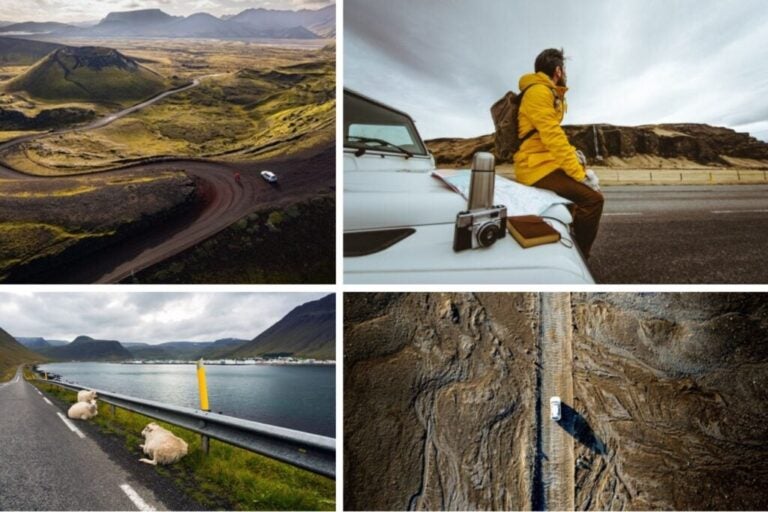
Road signs in Iceland are written in Icelandic, but they use international symbols, making them easy to understand. It’s essential to pay attention to them, especially in winter or in remote areas. For these situations, digital signs are often used, changing their status according to the weather.
Some signs you should be aware of include:
- ‘Malbik Endar’: End of pavement (meaning you’re transitioning to a gravel road).
- ‘Einbreið brú’: Single-lane bridge (give way if you don’t arrive first).
- ‘Ófært’: Impassable road (due to snow, water, or official closure).
- ‘Lokað’: Closed.
Fines, Tolls, and Fuel in Iceland
We continue in this ultimate guide for driving in Iceland. You’re now up to date with the documentation, road types, and basic rules. Now, we’ll explain everything related to fines, tolls, and fuel, which are also an essential part of any road trip on the island.
Common Fines in Iceland
Icelandic authorities enforce fines strictly. It doesn’t matter if you’re a tourist or a local; if you break the law, you’ll get a fine, and often the cost can be high. The most common fines are:
- Speeding: Between kr20,000 and 100,000 (€137–687, $159–796)
- Not wearing a seatbelt: kr20,000 (€137, $159)
- Using a mobile phone while driving: kr40,000 (€275, $319)
- Driving under the influence of alcohol: Fines starting from kr100,000 (€687, $797), licence suspension, and even imprisonment.
What about rental cars? If you incur a fine while renting a car, the agency will receive and pay it, then charge you the amount plus an administrative fee.
Are there tolls in Iceland?
One of the best things about driving in Iceland (at least for your wallet) is that its roads don’t have tolls, so you can drive freely around the country without paying for sections. The only exception is the Vaðlaheiðargöng tunnel (near Akureyri), which has a fee of around kr1,500 (about €10, $12) per crossing. You can pay online at tunnel.is within 24 hours before or after the crossing.
If you don’t pay on time, the late payment fine can exceed kr4,000 (€27, $31), and the rental agency will charge it to you.
Fuel Types and Prices
Let’s move on to another concern regarding driving in Iceland: Fuel refills. The first thing to know is this. Service stations are well-distributed. They’re in all municipalities. They line the main roads and are even in remote areas. However, not all stations operate 24 hours or accept cash, so you need to be prepared.
Most Common Fuel Types:
The most common fuel types in Iceland are:
- 95 octane (Bensín): Unleaded petrol, the most common.
- Diesel (Dísel): For larger vehicles or vans.
- Electricity: Growing, but still limited outside Reykjavik.
Brands like ÓB, Orkan, Dælan, and Atlantsolía offer the cheapest fuel prices in Iceland, while N1 and Olís tend to be more expensive. One tip is to fill up at the Orkan station on Bústaðavegur Street (in Reykjavik), which has the lowest prices in the country. You can also save money by renting a diesel car (like the Dacia Duster), as it’s cheaper than petrol.
Electric Car Charging
Electric cars are becoming more popular in Iceland. Therefore, if you’re renting one, it’s best to plan your route around charging stations. Although the infrastructure is growing, there are fewer charging stations than petrol stations, so you’ll need to plan accordingly to avoid running out of battery.
In the main cities along the Ring Road, you’ll find charging stations, as well as at many N1 stations. However, always check availability and the type of charger for your vehicle when planning your trip itinerary.
Parking in Iceland
Parking in Iceland is usually easy outside the main cities, but in places like Reykjavik, Akureyri, or major tourist spots, you’ll need to be familiar with the rules to avoid fines or towing. Additionally, parking is free almost everywhere on the island, except in the cities.
You may also have to pay to park at natural attractions such as Thingvellir National Park, Skaftafell National Park, Seljalandsfoss waterfall, Blue Lagoon, or the Fagradalsfjall eruption site. All you have to do is look for signs, which clearly indicate the parking conditions.
Where Can I Park?
In most villages and rural areas, parking is free and unregulated unless stated otherwise. However, in cities and tourist spots, you’ll see regulated areas marked by color or signs:
- P Zones (Pay and Display): You’ll need to pay and place the ticket visible on the windshield.
- Blue zones: Allows parking with a parking disc or for a limited time.
- Private car parks: With fixed hourly or full-day rates.
You can pay by card or with coins (kr10, kr50, and kr100, €0.07–0.68, $0.08–0.79) at physical parking meters near parking spots. You can also do it via mobile apps like EasyPark or Parka, available in Reykjavik and other cities, which are a much more practical option; and through automatic terminals, usually at tourist sites.
Is parking expensive in Iceland?
Parking rates in Iceland vary depending on the city and area, but they generally range from kr90 to kr250 per hour (€0.62–1.72, $0.67–1.85). Keep in mind that parking in Reykjavik may be more expensive, while private or covered car parks cost around kr1,500 per day (€10, $12).
Tip: many places offer the first 15 to 30 minutes for free, which is perfect for quick errands. Also, parking anywhere in Reykjavik is free after 6 pm and on Sundays.
Car Rental Options in Iceland
Now, let’s go over a few things you need to know before renting a car in Iceland:
- As you know, having your own vehicle can make a huge difference during your trip around Iceland. Additionally, there are plenty of rental agencies in the country, with options at Keflavik International Airport, Reykjavik, and intermediate cities like Akureyri, Selfoss, or Egilsstaðir. Of course, you can also turn to platforms like Rentalcars, DiscoverCars, or directly to local companies.
- A crucial tip is to book in advance, especially if you’re travelling in peak season (June–August) or planning to rent a 4×4 or campervan. Availability tends to fill up quickly.
- Now, regarding the type of vehicle, everything depends on the kind of trip you want. Compact cars work well for travelling around the country, yet some areas require a four-wheel-drive vehicle. In any case, check with the agency which model is most suitable for your itinerary.
- The weekly rental for a car can cost between kr55,000 and kr110,000 (€378–756, $438–877), depending on the model, season, and included coverage.
Final Tips for Driving in Iceland
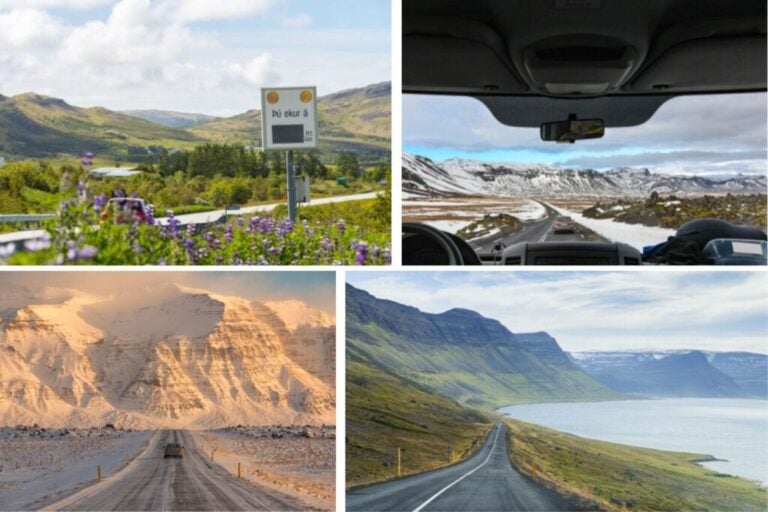
Excited to drive through Iceland? How great! You’re almost ready to hit the road. But before you do, take note of these final tips.
- Always pay attention to the weather: Getting to grips with Iceland’s weather can be one of your main challenges when driving. Conditions change constantly, often without much warning. Therefore, you must check the weather forecast before heading out, especially if strong winds, snow, or storms are predicted (particularly in winter). Keep in mind that in this season, road conditions can be tough, so it’s best to rent a four-wheel-drive vehicle.
- Useful apps for Iceland: There are some mobile apps that will help you on your road trip around the island. Two of them are road.is, for real-time road conditions
- and vedur.is, a weather app with wind and alert notifications.
- Watch out for sheep!: Just as kangaroos are common in Australia, in Iceland, you may come across sheep. Lambs are born in spring, so in summer, many of them wander onto the roads. If you see sheep in the area or even on the road, slow down and be cautious, as they can be unpredictable when vehicles approach.
- Drive carefully on gravel roads: Driving on these roads isn’t hard as long as you go slow. If you get excited and accelerate too much, you could lose control of the vehicle due to loose stones and gravel. If this happens, don’t make sharp turns or brake suddenly. Try to stay calm and steer the vehicle in the direction it’s sliding, while keeping the clutch pressed.
- Avoid driving at night: We don’t recommend driving at night in Iceland, especially in less trafficked areas and if it’s your first time on the island. A good tip is to check the time the sun sets before heading out, to ensure you reach your destination before nightfall. This applies mainly to gravel roads. Driving at night can be dangerous!
- Stay on the road: Driving off marked roads is illegal and damages fragile ecosystems. If you leave tracks in mossy or volcanic soil, the authorities could fine you thousands of euros. Don’t underestimate this rule.
Driving in Iceland: Frequently Asked Questions
N1 is the largest chain of service stations in Iceland, with branches throughout the country. It’s one of the most reliable and convenient options for refuelling or charging electric cars. N1 stations are strategically located along the Ring Road, so if you’re travelling the Golden Circle route, the south coast, or the western fjords, you’ll encounter several N1 stations.
Driving in Iceland is safe, as long as you respect traffic rules and use common sense. Authorities maintain the roads well, and drivers highly respect each other. Also, remember to stay informed about the weather, be cautious on gravel roads, one-lane bridges, and closed routes.
The first thing you should do in an emergency is call 112, which is available 24/7 throughout the country. This service can provide medical assistance, fire services, rescue teams, and police depending on the type of emergency.
If you have any issues with the car, contact the rental agency as soon as possible and report the situation. Most rental companies offer basic roadside assistance as part of their packages, but this isn’t always the case. Be sure to confirm this before signing the contract.
Citizens travelling from European Union and European Economic Area countries can drive with their national licence, as long as it is valid and within the required time limit (without needing to take any additional steps).
Yes, you can, as long as you rent a 4×4 vehicle. Additionally, many companies do not allow driving on these roads without the appropriate car and insurance. If you plan to venture into the Highlands, check with the rental agency what options they offer and which is the most suitable.