Language


 No results found
Driving in France: Tips and requirements
Driving in France lets you discover the country’s best spots, but staying updated on traffic rules is essential.

If you’re planning to travel to France and are thinking about renting a car to explore the country on four wheels, you’ve come to the right place. This European country is full of treasures waiting to be discovered. One tip: step off the beaten tourist tracks and dare to create your own itinerary. You’ll come across hidden corners not found in travel guides or blogs. Another tip: don’t stop reading this article, as we’ll tell you everything you need to know about driving in France. It’s not enough just to venture into a beautiful country. You need to be up to date with the requirements you’ll need to meet as both a driver and a vehicle user, whether it’s your own car or a rental.
For your driving experience in France to be safe and enjoyable, you’ll need to know the country’s specific traffic rules and even the French driving habits. We’ll cover all of that and more today. Get comfortable, take notes, and enjoy your trip!
Valid Licenses for Driving in France
Before deciding whether you’ll take a trip through the Loire Valley’s castles, the villages of Provence, or the cliffs of Normandy, you’ll need to make sure your driving license is valid in France. The country accepts foreign licenses, but the conditions depend on where you’re from and how long you’ll stay.
For example, if your driving license was issued by a European Union (EU) country, the European Economic Area (EEA), or the United Kingdom before 2021, your license is valid for driving in France as long as certain conditions are met. First, the license must be valid, it should not have been suspended, restricted, or revoked in your home country, and you need to be over 18 years old. Additionally, it’s important to comply with the medical information listed on the document (for instance, wearing glasses if that’s required).
Regarding the duration of your trip, if you stay in France for less than 185 days (a short stay), and you have a non-European driving license, you can drive with your license as long as it’s valid and in French. Otherwise, it must be accompanied by an official translation or an international driving permit.
Is an International Driving Permit (IDP) Mandatory?
As mentioned earlier, this permit is only mandatory in specific cases.
- If your license is in a language other than French or English
- If it’s not written in Latin characters (e.g., Arabic, Russian, or Chinese licenses)
- If you are renting a car (some agencies require it as an additional condition)
If needed, you should apply for the IDP in your home country before travelling. Remember that the IDP does not replace your national license, so you’ll need to carry both documents to avoid any issues with French traffic authorities.
What if I Decide to Stay Longer in France?
If you fall in love with France and decide to extend your trip or even settle down there, there are several steps you need to take. Regarding driving, the first thing you need to do is check if your country has any license exchange agreement with France. If so, you can exchange your license for a French one without taking a test.
Countries with agreements include Argentina, Colombia, Chile, Brazil, Japan, South Korea, and some states of the United States.
The process must be done within 12 months of your official residence in France. If you don’t do it on time, you’ll have to take both the theoretical and practical exams like any French citizen.
Requirements and Documentation for Driving in France
Having a valid license is just the first step to driving in France. In addition, you’ll need to meet certain conditions, such as the minimum age and mandatory equipment in the vehicle. In short, there are several details you need to know before hitting the road.
Minimum Age for Driving and Renting a Vehicle
The minimum age for driving in France is 18 years old. Whether you’re a resident or a foreigner, you must meet this requirement. However, if you plan to rent a car, the rules may vary depending on the agency.
Most agencies require you to be at least 21 years old to rent a compact vehicle, while others (for SUVs, automatic cars, or high-end models) require a minimum age of 25. They also usually ask for one to two years of driving experience, depending on the vehicle model. Another thing to keep in mind is that if you are between 21 and 24 years old, you may be charged an additional daily fee for being a young driver, which can range from €25 ($29) per day.
Mandatory Insurance
Whether you’re driving your own vehicle or renting one, you must have third-party liability insurance to cover potential damages in case of an accident. Rental cars typically include this coverage in the base price, so you don’t have to worry about it.
However, while this insurance is sufficient to drive, it may not cover damage to the vehicle, theft, or roadside assistance. So, if you plan to drive long distances or through unfamiliar areas, it’s recommended to purchase additional coverage for peace of mind. Also, be sure to review the insurance policy before signing (including the fine print), as some policies have high deductibles that could cost you a significant amount of money.
Crit’Air: Mandatory Environmental Sticker
In some French cities, it’s mandatory to carry the Crit’Air sticker, a mandatory environmental label that allows you to drive in low emission zones (ZFE-m). It classifies vehicles according to their level of pollutant emissions, thus helping reduce air pollution in urban areas.
Some of the low-emission zones are: Ville de Paris, Grand Paris, Lyon, Toulouse, Montpellier, Marseille, Strasbourg, St-Etienne, among others. We recommend checking the cities and areas where the Crit’Air regulation applies on the official website (Crit’Air Certificate map).
Documentation You Must Carry
Before hitting the road, make sure you have the following documents:
- Valid passport or ID document.
- Valid driving license (and international permit, if applicable).
- Car rental contract (if applicable).
- Vehicle insurance proof.
If you happen to encounter a police check and don’t have these documents, you may be fined immediately or, in some cases, your vehicle could be impounded until the situation is clarified.
Mandatory Equipment Inside the Vehicle
In France, the law requires all cars, including rental vehicles, to have certain safety measures: a reflective vest, a warning triangle, and spare bulbs. Rental agencies usually provide these items with the car, but it’s always a good idea to check them before leaving, especially if you plan to drive outside of cities or on secondary roads.
Internet Connection on French Roads
It’s not a requirement for driving in France, but having internet will make it much easier to get around the country. The Holafly eSIM for France is perfect for short trips as it allows you to purchase unlimited data for the days you need it. This way, you’ll be able to check road conditions, use apps like Google Maps, GPS, or Waze, and manage your parking right from your phone as soon as you land at the airport.
For longer stays, the Holafly monthly plans are a great option for frequent travellers, giving you internet in over 170 countries worldwide, with no roaming charges or surprises on your bill. The plan renews monthly, but you can cancel it at any time with no penalties. Additionally, you can share your internet with other devices, making it ideal for digital nomads or people travelling in groups, with the unlimited plan starting from €46.10 ($50.50) per month.
Important: If you are a frequent traveler and want to stay connected without worrying about expensive roaming or looking for a new SIM at every destination, Holafly’s subscription plans are for you. With a single eSIM, enjoy internet in more than 170 countries for a fixed price and no surprises on your bill. Travel without limits and connect easily and securely! 🚀🌍

Traffic Rules and Signage
France has an organised, clear and well-marked traffic system, and it also follows very strict rules. So before hitting the road, take some time to familiarize yourself with its traffic rules. They are quite specific and strictly enforced, with a control system that leaves no room for mistakes, especially for tourists. Therefore, driving attentively and knowing the local details can help you avoid unnecessary fines and complications during your trip.
Direction of Traffic and General Driving Rules in France
Let’s start with the basics: in France, driving is on the right side of the road, and overtaking is done on the left, just like in most Latin American and European countries. So, you shouldn’t have any problems if you’re coming from one of them.
A practical tip: In France, people tend to drive fast. So, try to stay in the right lane if you’re driving at a lower speed, and only move to the left lane if you plan to overtake another vehicle.
Another rule you’ll need to remember as a foreigner is the ‘priorité à droite’ rule: if you reach an intersection with no signage, the vehicle approaching from your right has the priority, even if you’re on what appears to be a main road. This rule is more common on secondary roads and in small towns. In larger cities and on main highways, there are usually clear signs indicating the right of way.
Speed Limits
Speed limits are well signposted with red circular signs. However, the values can change depending on the type of road and weather conditions:
- In urban areas: 50 km/h.
- On secondary roads: 80 km/h (previously 90 km/h, but this has been reduced in many regions).
- On expressways: 110 km/h.
- On highways (autoroutes): 130 km/h, but this drops to 110 km/h if it rains. Electronic panels will inform you of any changes, especially in case of accidents or bad weather conditions.
Two things to keep in mind: if you’re a new driver (less than 3 years of experience), the limits are lower: 110 km/h on highways and 100 km/h on expressways, even if weather conditions are ideal. Also, in France, radar presence is not announced in advance, so you need to remain attentive to avoid exceeding the speed limits at all times.
Roundabouts and Pedestrian Crossings
Let’s talk about roundabouts and pedestrian crossings. Roundabouts are abundant all over France. The rule of circulation is very simple: the vehicle already circulating on the roundabout has the priority. Therefore, you must yield when necessary. It’s as simple as it is in many other countries.
Pedestrian crossings are sacred. If there are people waiting to cross, you must stop. Failing to comply with this rule can result in an immediate fine, as many urban areas have cameras and frequent police controls.
Use of Mobile Phones, Seat Belts, and Alcohol Limits
As in most countries worldwide, using a mobile phone while driving is prohibited in France, even if you use earphones or hands-free systems, as it impairs your concentration. Also, all passengers in the vehicle must wear seat belts, without exception.
As for the legal blood alcohol limit, it is 0.5 g/l, but it is reduced to 0.2 g/l for novice drivers and professionals. The fines for non-compliance are severe, reaching up to €750 ($870). So, don’t drive if you’ve been drinking.
Common Traffic Signs
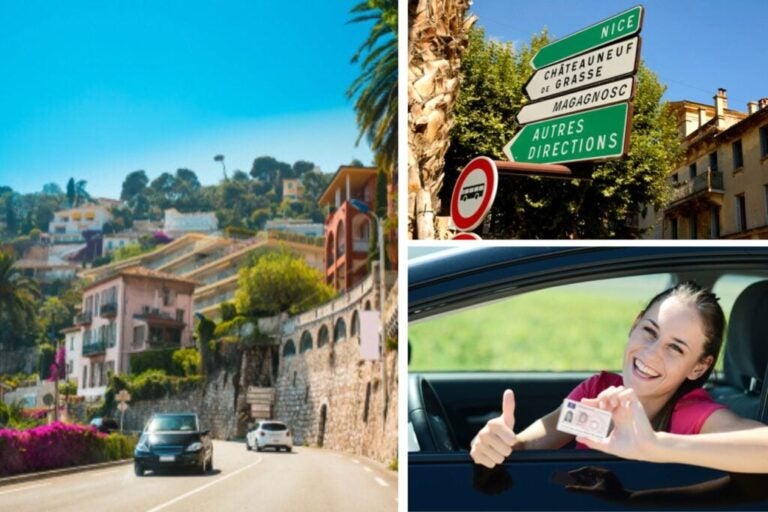
Although most signs are written in French, most traffic signs use international symbols that are familiar to most drivers, so you shouldn’t have problems interpreting them. Nonetheless, it’s a good idea to familiarize yourself with a few French words you might see on signs:
- Rappel: Reminder (e.g., for a speed limit).
- Cédez le passage: Yield.
- Sens interdit: No entry.
- Sortie: Exit.
- Toutes directions: All directions.
- Autres directions: Other directions.
Highways are indicated by blue signs, and national or departmental roads by white signs. This color code can help you anticipate the type of road you’re on.
Tolls and Fueling in France
If your plan is to explore France by car, you’ll likely encounter some toll highways. Although there are many free national roads, toll roads (autoroutes) allow you to travel faster and enjoy better infrastructure. Also, knowing where and when to refuel can save you money and prevent mishaps, especially if you plan to drive outside large cities.
How Do Tolls Work in France?
French toll highways are distinguished by their excellent condition. They are managed by private companies, and the sections are clearly signposted from the start, with visible warnings indicating ‘péage’ or ‘autoroute à péage.’
The sistem is closed. You take a ticket when you enter the motorway, (if you don’t have an automatic device) and you hand it over when you exit, so they calculate the amount to pay according to the kilometres travelled. Some sections have a fixed rate, where you pay when entering.
If you’re not in a hurry, we recommend driving on the national roads. They are not only free but also pass through charming villages and offer beautiful scenic views. In general, they are in good condition, so we highly recommend them.
The price of the tolls varies depending on the route, the type of vehicle, and the category of the highway. Here are some approximate values (March 2025) for private cars:
- Paris – Lyon (460 km): €35 ($41).
- Paris – Bordeaux (580 km): €45 ($52).
- Marseille – Nice (200 km): €16 ($19).
You can pay in three ways:
- Cash: in booths marked with ‘Espèces’, where there is usually staff present.
- Credit or debit card: in booths with the ‘CB’ (Carte Bancaire) symbol, commonly used and convenient for foreigners.
- Télépéage / Liber-t: an electronic device installed on the windshield that allows you to pass without stopping. If you rent a car with this system, the charges are added to your contract and deducted at the end of your trip.
Fuel Stations: When and Where to Refuel?
On highways, you will find fuel stations every 30 or 40 km. They are also located on national roads and within towns, where fuel prices are generally lower. Por ende, a good practice is to leave the motorway and fill the tank at a local station.
When you arrive at a station, you’ll notice that the fuel types are clearly identified. But if you’re not familiar with the French terms, here’s what you should know:
- SP95 (Sans Plomb 95): Unleaded petrol, 95 octane. Between €1.85–2.10 ($2.15–2.44) per litre.
- SP98 (Sans Plomb 98): Unleaded petrol, 98 octane, slightly more expensive but better quality. Between €1.95–2.20 ($2.27–2.56) per litre.
- E10: Petrol with 10% ethanol. Not all cars accept it.
- Gazole: Diesel, very common in European vehicles. Between €1.75–2.00 ($2.27–2.56) per litre.
- GPL: Liquefied petroleum gas (for adapted vehicles).
Prices vary depending on location. On highways, fuel is typically 10–20 cents more expensive than at local stations or supermarkets with fuel pumps.
Tip: before refueling, check the rental car contract or the cap of the fuel tank to make sure you’re using the correct type of fuel. Using the wrong fuel can damage the engine, and this won’t be covered by the insurance on rental cars.
Parking in France
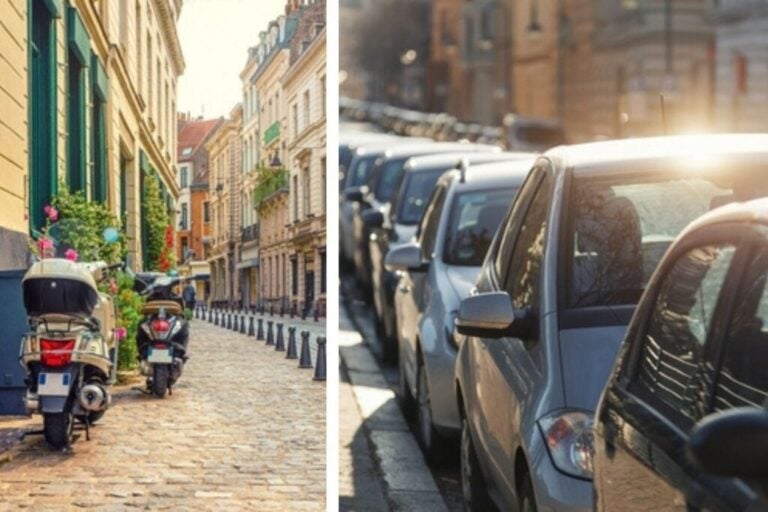
Parking in France can be one of the most stressful parts of driving, especially in large cities like Paris, Marseille, or Lyon. With restricted areas, limited hours, variable fees, and scarce space, you could end up with quite a headache. To save yourself some stress, it’s best to know how the system works before you arrive. With the right information, you can avoid fines and move around with more ease.
Where Can I Park?
France uses a colour-coded signage system that clearly indicates where parking is allowed, the hours it is permitted, and under what conditions. So all you need to do is pay attention.
- White lines: Authorised parking. It may be free or paid, depending on the area and day. Always check the vertical signs before leaving your car.
- Blue lines (zone bleue): Free parking, but with time limits. It requires a parking disc that shows the time of your arrival. Valid only on weekdays and usually for one to two hours.
- Yellow lines: No parking or reserved (for loading and unloading, taxis, buses, or emergency services). Parking here can result in an immediate fine or your vehicle being towed away.
If you’re in touristy areas or residential neighbourhoods, be aware there may be time restrictions. For that, pay attention to the vertical signs that often indicate, for example, if parking is allowed only from Monday to Saturday or if it’s prohibited during certain hours of the day. When in doubt, don’t take risks and look for a public parking lot.
How Do You Pay for Parking?
There are three main ways to pay for parking on public streets:
- Physical parking meters: Located along the streets and they work with coins, credit cards, or contactless cards. They issue a ticket that must be displayed on your dashboard (unless the system is digitalized).
- Mobile apps: Such as PayByPhone, Flowbird, or EasyPark. These allow you to pay from your phone, receive alerts when your time is about to expire, and extend your parking duration without returning to your vehicle.
- Public parking lots (parkings payants): These are paid parking spaces, either underground or outdoors, with automatic access. They are more secure, have better availability, and offer flat rates by the hour or for the entire day. Moreover, you can reserve a space in advance via platforms like Parclick or Zenpark.
How much does parking cost?
Prices vary depending on the city, district, and type of parking. Here are some estimated prices (March 2025) to help you plan your budget:
- Central Paris: Between €2.50–6.00 ($3–7) per hour, depending on the area.
- Medium-sized cities (such as Strasbourg or Bordeaux): Between €1.50–3 ($2–3) per hour.
- Public parking lots: From €15–40 ($17–46) for a full day, depending on the location and services included.
Did you know that many cities offer free parking at night, on Sundays, or on public holidays? For example, in Paris, it’s free from 8:00 pm to 9:00 am the following day, so take advantage of this benefit.
Options for Renting a Car in France
Renting a car in France is an excellent option for exploring the country with flexibility and without relying on public transport. You can move at your own pace, improvise routes, and explore less touristy regions such as Alsace, Corsica, or the villages in the Central Massif. Additionally, French roads are in great condition and clearly signposted.
Where Can You Rent a Car?
There are many options for renting vehicles in France. One of them is the international airports such as Charles de Gaulle (Paris), Orly, Nice, Lyon, Toulouse, Bordeaux, or Marseille. You’ll also find agencies at the train stations of major stations (for example, Gare de Lyon, Gare du Nord, Gare Saint-Lazare, or Gare de Marseille-Saint-Charles). In these cases, you might pay a slightly higher price, but you gain convenience and a wide range of vehicle options.
In central areas of almost all medium-sized or large cities, you’ll find agencies like Hertz, Europcar, Avis, or Sixt. Otherwise, you can book in advance through online platforms like Rentalcars, DiscoverCars, Auto Europe, or directly on the websites of the agencies.
The variety of cars is vast, including both manual and automatic vehicles. For a short trip or if you’ll be driving in the city, we recommend a compact car, which is more fuel-efficient and easier to park. SUV or family cars are perfect for longer trips, group travel, or if you’ll be driving on rural roads. You’ll also find automatic and electric or hybrid cars (popular in areas with low emissions).
Estimated Rental Prices (March 2025)
Prices vary depending on the season, city, vehicle type, and contract duration. However, you can use these prices as a reference:
- Manual compact car: From €35 ($41) per day.
- Automatic SUV: From €60–70 ($70–81) per day.
- Weekly rental: Between €250–450 ($290–522), depending on the model.
- Monthly rental: From €850–1,200 ($986–1,392).
The base price usually includes mandatory civil liability insurance and limited mileage (sometimes 150–200 km per day). If you plan on long journeys, look for options with unlimited mileage or negotiate a more flexible rate. Don’t forget to check if the car has a toll device (Liber-t), built-in GPS, or connectivity for charging your mobile phone.
Tips for Driving in France as a Foreigner
Now that you know the basic rules for driving in France. You also know that the experience of moving freely will allow you to discover the best parts of the country. In other words, you’re almost ready to hit the French roads. But before you do, don’t forget to read these final tips.
- Avoid driving in major cities: Paris, Marseille, Lyon, or Toulouse have heavy traffic, confusing circulation, and limited parking. So, if possible, leave the car at your hotel or parked and move around on foot or using public transport. Walking through the tourist areas of these cities is a visual pleasure, and you’ll catch details that can go unnoticed from a car.
- Don’t rely only on the GPS, also pay attention to signage: Google Maps or Waze will be your best allies while driving in France. However, they don’t always update well on temporary restrictions, construction zones, or detours. So also pay attention to the signs, as they are clear, frequent, and reliable.
- Don’t refuel on highways: Gas stations on highways are convenient but more expensive. If you’re not in a rush, take the exit and look for stations in small towns or cities. You’ll save 10 to 20 cents per litre, which can make a significant difference on long journeys. Moreover, many local stations have up-to-date prices on apps like Essence&Co or Gaspal.
- Be aware of Low Emission Zones (ZFE): Don’t forget that several French cities have restricted zones for polluting vehicles. To drive in them, your car must have a Crit’Air sticker, which classifies the vehicle based on its emissions. If you rent a car, check with the agency to see if it has this sticker. Entering areas like Paris, Lyon, Grenoble, or Strasbourg without it can result in fines of up to €135 ($157).
- Stay calm if you encounter an aggressive driver: In some urban areas or secondary roads, you might notice that the French honk frequently, overtake quickly, or don’t wait long to pressure you. Don’t stress, maintain your speed, signal all your manoeuvres, and avoid reacting aggressively.
Driving in France: Frequently Asked Questions
<!– wp:yoast/faq-block {"questions":[{"id":"faq-question-1","question":"What are French roads like?","answer":"France has over one million kilometres of roads. From high-speed highways to winding departmental roads through hills, there are options for every taste. Highways are modern and fast, but most are toll roads. In contrast, rural roads offer spectacular views but require more attentive driving."},{"id":"faq-question-2","question":"How do I get the Crit’Air sticker?","answer":"Getting the sticker is easy. Simply visit the official website (Crit’Air Certificate), available in French, English, and German, and fill out a form with details about your vehicle, including its category and emission level. Then proceed with the payment, which you can do online. Afterwards, you’ll have your sticker, and you must place it on the vehicle’s windscreen."},{"id":"faq-question-3","question":"What happens if I park illegally?","answer":"If you park your vehicle in a prohibited area, you will need to pay a fine. The amount can range from €35 to €135 ($41–157), depending on the violation. In more serious cases, your car may be immobilised with a wheel clamp or towed to the municipal impound lot (fourrière)."},{"id":"faq-question-4","question":"What are the requirements for renting a car in France?","answer":"Each agency has its own policies, but in general, the basic requirements are the following:– You must be 21 or older, although some categories accept drivers from 18, while others require at least 25.
– You need a driving licence with at least one or two years of experience, depending on the car type.
– You must hold a valid licence in Latin characters. Therefore, if it isn’t in French or English, we recommend the International Driving Permit, and some agencies even demand it.
– You must present a credit card under the main driver’s name, and it’ll work as a guarantee.”},{“id”:”faq-question-5″,”question”:”What happens if I commit an offence with a rented car?”,”answer”:”It doesn’t matter if the car is rented, if you commit an offence and are fined, you will have to pay. The fine is sent to the rental agency, which will pay it and then charge you along with an administrative fee. This applies to common offences such as speeding, illegal parking, entering restricted areas without permission, and others. Some fines may even arrive by post weeks after your trip.”}]} –>
France has over one million kilometres of roads. From high-speed highways to winding departmental roads through hills, there are options for every taste. Highways are modern and fast, but most are toll roads. In contrast, rural roads offer spectacular views but require more attentive driving.
Getting the sticker is easy. Simply visit the official website (Crit’Air Certificate), available in French, English, and German, and fill out a form with details about your vehicle, including its category and emission level. Then proceed with the payment, which you can do online. Afterwards, you’ll have your sticker, and you must place it on the vehicle’s windscreen.
If you park your vehicle in a prohibited area, you will need to pay a fine. The amount can range from €35 to €135 ($41–157), depending on the violation. In more serious cases, your car may be immobilised with a wheel clamp or towed to the municipal impound lot (fourrière).
Each agency has its own policies, but in general, the basic requirements are the following:
– You must be 21 or older, although some categories accept drivers from 18, while others require at least 25.
– You need a driving licence with at least one or two years of experience, depending on the car type.
– You must hold a valid licence in Latin characters. Therefore, if it isn’t in French or English, we recommend the International Driving Permit, and some agencies even demand it.
– You must present a credit card under the main driver’s name, and it’ll work as a guarantee.
It doesn’t matter if the car is rented, if you commit an offence and are fined, you will have to pay. The fine is sent to the rental agency, which will pay it and then charge you along with an administrative fee. This applies to common offences such as speeding, illegal parking, entering restricted areas without permission, and others. Some fines may even arrive by post weeks after your trip.