



 Language


 No results found
Driving in England: Tips and requirements
Ready to drive on the left? Learn all the requirements and traffic rules for driving in England as a foreigner.

One of the most important things you need to know if you want to drive in England is that driving is on the left, so the steering wheel is on the right.
This feature makes it a bit more complicated for drivers from other countries who are used to driving on the right side of the road, but with practice and a high level of attention, you’ll be used to it in a few days.
We want to explain in this post the main requirements to drive on the roads of this country, the documentation you need, the license, and other useful tips so you can explore the main English cities.
Valid Driving Licenses in England
The first step to driving in England is to check if your country’s license is valid. Although the UK is no longer part of the European Union since 2020 following Brexit, it still maintains some agreements and pacts with various countries that make it easier to exchange a foreign license for a British one.
Your Country’s Driving License
Citizens of the European Union and the European Economic Area (EEA) can drive in England with their country’s license for a maximum of 12 months.
If you’re a digital nomad planning to settle in the country for a longer period or perhaps a student starting a program at an English institution and needing a car to get around England, bear in mind that after one year, you’ll need to apply for a British license to continue driving in the country.
International Permit
For travelers from countries outside the EU, like China, it will be necessary to obtain an International Driving Permit in their home country and attach it to their original license.
Exchanging for a British License
The UK has a series of bilateral agreements with some countries, allowing their citizens to exchange their driving license for a British one without needing to take a test. Some of these countries are: Australia, Canada, the United States, South Korea, Spain, Portugal, and Switzerland.
To do so, they must complete the process within five years of obtaining British residency, and it can be done at the Driver and Vehicle Licensing Agency (DVLA), either in person or online.

Requirements and Documentation to Drive in England
Next, we’ll detail what requirements and documentation are needed to drive in England, both for the driver and the vehicle:
- Minimum age: 17 years for private cars and 21 for commercial or rental vehicles.
- Driving License: A license from your home country for EU drivers or those with bilateral agreements. International permit for countries without an agreement.
- Mandatory insurance: At least third-party liability insurance.
- Vehicle inspection: mandatory for vehicles over three years old, to check their mechanical state and emissions.
- Road tax: To drive in England, you need to pay the Vehicle Excise Duty (road tax), an annual fee.
- Alcohol consumption: The limit is 0.8 g/l, much higher than in other countries.
- Environmental label: In London, there are low emission zones (ULEZ), so only vehicles with this label can circulate in its streets.
In addition to the mandatory requirements, it is advisable to be sure to have ample coverage on your smartphone and for all other vehicle occupants. For short stays, the best option is the eSIM for England from Holafly, with unlimited data only on the days you need it.
On the other hand, for longer stays, the best solution is Holafly’s monthly plans. Plus, you can check GPS to reach your destination and share data with another device at the same time. Also, you get unlimited data for a more entertaining trip, from €46.46 ($50.50) per month with no lock-in.
Important: If you are a frequent traveler and want to stay connected without worrying about expensive roaming or looking for a new SIM at every destination, Holafly’s subscription plans are for you. With a single eSIM, enjoy internet in more than 170 countries for a fixed price and no surprises on your bill. Travel without limits and connect easily and securely! 🚀🌍

Traffic Rules and Signage in England
Do you already know which licence you must have to drive in England and whether you meet the main requirements? Well, now you should learn how the traffic rules work in this country.
Driving Direction
In the UK, driving is on the left side of the road, as we mentioned at the beginning of this post, so the steering wheel is on the right side of the car. This completely changes the driver’s perspective and how distances are judged if you’re not used to it. Here are some important tips:
- Roundabouts: You must yield to vehicles coming from the right.
- Overtaking: Overtaking is done on the right, unlike most countries.
- Shifting gears: In manual cars, you’ll need to shift gears with your left hand.
- Intersections: Be careful not to get into the wrong lane when turning.
Speed Limits and Signage
The speed limit for driving in England is 113 km/h on motorways, 97 km/h on secondary roads, 48 km/h in urban areas, and 20 km/h in school zones.
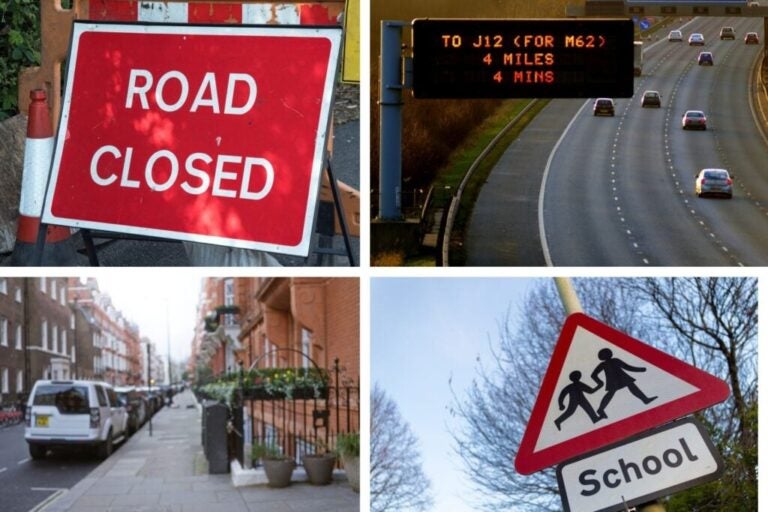
Most signs are in English, with symbols similar to those in other European countries, but we recommend familiarizing yourself with them before getting behind the wheel.
Lights and Mobile Use
It is mandatory to use lights in situations of reduced visibility, such as heavy rain or fog, which are very common in the country.
As for mobile phone use, it is strictly forbidden without a hands-free device, with heavy fines and points deducted from your license.
Penalties
Failure to comply with the previous rules may result in fines and points being deducted from your driving license. Here are some of the most common penalties:
- Speeding: From $125 (€114) and up to 6 points.
- Not wearing a seatbelt: Fine up to $625 (€570).
- Using a mobile phone: From $250 (€228) and up to 6 points.
- Reckless driving: More severe penalties, license suspension, and possible imprisonment.
Tolls and Fuel Charging
Most motorways in the country are free, so there are very few tolls. Some tunnels and crossings, such as the Dartford Crossing, do require a payment ranging from $3.00 – $7.50 (€2.75 – €6.85), depending on the type of vehicle. This payment can be made via bank card, online, or with an automatic subscription.
For refueling, you can do so as in most countries:
- Unleaded gasoline: Starting at $1.90 (€1.73).
- Diesel: Priced at $2.00 (€1.82).
- Electric: Charging stations available in urban areas and motorways.
- Payment method: Via card, cash, or apps.
Parking in England
Parking in England works similarly to the rest of Europe, with free zones and paid zones:
- Blue Badge Zones: For parking for people with reduced mobility.
- Yellow Lines: Have restrictions during certain hours of the day.
- Urban Areas: Many streets require a resident permit or payment at parking meters starting at $1.25 (€1.14) per hour.
- Private Parking: Starting at $12.50 (€11.40) per day in small cities or $30.00 (€28.00) in central London.
Car Rental Options in England
You can drive in England with your own vehicle or rent one from various companies such as Enterprise, Hertz, or Europcar. These can be found at airports, train stations, or city centers:
- Small Vehicles: Can be manual or automatic, recommended for city driving starting at $30.00 (€28.00) per day.
- SUVs, family cars, or vans: For longer routes if you’re in a large group or with family starting at $60.00 (€55.00) per day.
- Electric or Hybrid Vehicles: Recommended for easier driving starting at $50.00 (€45.00) per day.
Tips for Driving in England as a Foreigner
Finally, we want to give you some tips to make driving in England a rewarding experience so you can travel the best routes from Liverpool to the Lake District, Jurassic Coast from London, or through the Cotswolds from Oxford:
- First, familiarize yourself with driving on the left before hitting the road.
- Rent an automatic car so you don’t have to shift gears with your left hand.
- Study typical UK traffic signs.
- Always use GPS with voice navigation to avoid distractions.
- Check that your license is valid or exchangeable depending on your home country.
- Get a good travel insurance and vehicle coverage.
- Stay connected with the monthly plans from Holafly to use Google Maps, Waze, or contact assistance at all times.
- Drive with caution in rural areas, where roads can be narrow and visibility limited.
Frequently Asked Questions About Driving in England
It is not mandatory, but it is recommended to carry an emergency triangle, reflective vest, and first aid kit.
Fines will go directly to the rental company, which will charge them to your credit card along with an administrative fee.
It can be confusing at first, so it requires some practice on quiet streets or in rural areas with little traffic. Most foreign drivers adapt in a couple of days.
Yes, if your license was obtained in an EU country or one with a bilateral agreement, you can drive with it for up to 12 months. After this time, you will need to exchange it for a British license.