







 Language


 No results found
Driving in Croatia: Tips and requirements
Driving in Croatia will allow you to discover everything from the Dalmatian coast and the Dinaric Alps to the walled city of Dubrovnik and the island of Korčula.

Driving in Croatia can be a truly enjoyable experience. Its roads wind through national parks, medieval cities, and coastal towns, passing beaches along the Adriatic Sea, winding northern mountains, and even Roman ruins that are off the beaten tourist track. With your own vehicle, you can move at your own pace and stop whenever you want at any viewpoint, without having to rely on public transport and its sometimes tricky schedules.
Did you know that Croatia has over 1,300 islands? The interesting thing is that many of them are connected by ferries and a modern motorway network that links the inland with the coast, so you can cross with your vehicle and explore pristine beaches. Of course, driving in Croatia also comes with some challenges, including restricted traffic zones, winding rural roads, and some legal peculiarities that are best known before hitting the road.
In this guide, we’ll tell you everything you need to know about driving in Croatia as a foreigner: which licences are valid, which documents you can’t forget, how tolls work, how far gas stations are, the traffic rules that apply, and the most common penalties. Take note of everything and get ready to explore Croatia by car – the experience will definitely be worth it.
Valid Driving Licences in Croatia
The first thing you need to check before setting off on your driving adventure in Croatia is whether your national licence is valid. Fortunately, the country has a flexible policy for visitors, but it’s essential to meet certain basic requirements. Additionally, the validity of your driving licence depends on your country of origin and how long you plan to stay in Croatia.
Can I drive with my national licence?
You can drive in Croatia with the licence issued in your country of origin for a maximum of 12 months, as long as the document is written in the Latin alphabet (such as Spanish, English, French, or Portuguese), valid, and includes a clear photograph and personal data.
This applies to countries like Argentina, Mexico, Colombia, Chile, Uruguay, Spain, the United States, and most of Europe and Latin America.
Do I need an International Driving Permit (IDP)?
It’s not mandatory if your licence meets the above requirements, but there are certain cases where it’s recommended to have an international permit. For example, if your licence is written in another alphabet (Arabic, Cyrillic, Chinese), if it lacks a photograph, if it’s not in English or another commonly used language in Europe, or if you’re renting a car, as some agencies require it as a protocol.
The International Driving Permit (IDP) is processed in your country of origin and must always be accompanied by your original licence. This is a detail you shouldn’t overlook, as presenting only one of the documents when requested by Croatian traffic authorities can result in a fine.
Our advice is to bring it, even if you think you won’t need it. The process is simple and usually completed the same day. Especially if your licence is in Spanish, the IDP can help avoid delays or misunderstandings with local authorities, especially outside tourist areas.
What if I stay more than 12 months in Croatia?
If you plan to reside in Croatia indefinitely (for work, study, or immigration purposes, for example), you will need to exchange your licence for a Croatian one within the first year. This is as long as your country has exchange agreements with Croatia that allow you to swap your licence without having to take a theoretical or practical exam.
Countries with exchange agreements include Argentina, Chile, South Korea, some Canadian provinces, Switzerland, Bosnia and Herzegovina, the United Kingdom, and Serbia. However, Mexico, Colombia, and the United States do not have exchange agreements, so in these cases, you’ll need to apply for a new licence in Croatia if you plan to stay longer than a year.
Requirements and Documentation for Driving in Croatia
Having a valid licence is the first step before driving in Croatia. Once you’ve got this sorted, you’ll need to keep up to date with other requirements that must be met, especially if you want to avoid fines. Let’s look at what it’s all about:
- The minimum legal age to drive a private vehicle in Croatia is 18 years, although if you’re between 21 and 24 years old, you might face a surcharge for being a young driver.
- To rent a car, most agencies require you to be at least 21 years old and have one year of driving experience. Some vehicles, such as SUVs or high-end models, may require you to be 25 years or older.
- All vehicles in circulation must have third-party liability insurance (RC) covering damages to others. If you rent a car, this insurance is already included, so you won’t need to purchase it separately. However, we recommend checking the policy carefully and, if necessary, taking out additional coverage for vehicle damage (CDW), theft, roadside assistance, etc.
- It’s mandatory to carry a reflective vest in the vehicle and wear it in case of an accident or breakdown. Additionally, in these cases, you’ll have to stay outside the car on the road.
- The documents you cannot forget if you’re driving in Croatia are your valid passport or ID card, your national licence, and the IDP (if applicable), the vehicle rental contract (if applicable), and proof of insurance.
Croatian authorities may check all these requirements and documents during random inspections, especially on routes leading to coastal or border areas. Make sure everything is in order, as not having this documentation can result in fines or vehicle impoundment.
Don’t Lose Connection on Croatia’s Roads
It’s not a requirement for driving in Croatia, but having internet is crucial to navigate with Google Maps or Waze, download maps, use parking or payment apps, and more. Public WiFi along the roads is not an option, but the eSIM for Croatia can be very useful if your trip is only a few days. This way, you can use unlimited data and a stable connection only for the days you need it.
For longer trips, the best solution is the monthly plans from Holafly, with 5G coverage in over 170 destinations, no need to change eSIM, and no worries about running out of data, as it renews automatically. Sign up for the unlimited plan starting at $50.50 (€46.70), with no contract, and connect on multiple devices at the same time.
Important: If you are a frequent traveler and want to stay connected without worrying about expensive roaming or looking for a new SIM at every destination, Holafly’s subscription plans are for you. With a single eSIM, enjoy internet in more than 170 countries for a fixed price and no surprises on your bill. Travel without limits and connect easily and securely! 🚀🌍

Traffic Rules and Signage for Driving in Croatia
The rules for driving in Croatia are not very different from most European countries. However, the driving style can vary depending on the region, being more orderly on northern highways and more informal in rural or coastal areas.
Additionally, there may be some rules you are not used to, such as the mandatory use of lights during the day in winter (from late October to April) or snow tires and chains from mid-November to mid-April.
Don’t worry, because we’ll go over the main traffic rules for driving in Croatia and tell you what you need to know about signage.
Direction of Traffic and General Behaviour
Just like in almost all European countries, in Croatia, they drive on the right, which might be unusual for those coming from Australia, New Zealand, South Africa, or the UK (among others). But if you’re coming from another part of the continent, the US, or Latin America, you’ll have no problem with this rule. Driving on the right means overtaking is done on the left.
Let’s review some rules regarding right of way:
- At intersections without signs, priority is given to the vehicle coming from the right, even if it’s public transport or a school bus.
- At roundabouts, priority is given to those already circulating within the ring, unless signs indicate otherwise.
- On mountain roads, priority is given to vehicles traveling uphill.
Speed Limits (Private Vehicles)
The following speed limits are standard for cars without trailers, but they may vary depending on road conditions, so be attentive if there are signs indicating changes.
- In cities or urban areas: 50 km/h.
- On secondary roads: 90 km/h.
- On highways (autoceste): 130 km/h.
- In rain or bad weather: 110 km/h maximum, even on highways.
Keep in mind that if you are a novice driver (less than 2 years of experience), the limits are automatically reduced. For example, on highways, the maximum is 110 km/h for this group.
Mobile Phone Use, Seat Belts, and Alcohol: Basic Driving Rules in Croatia
As in most countries worldwide, in Croatia it is prohibited to use a mobile phone while driving unless you have a hands-free system.
It is also mandatory for all vehicle occupants to wear seat belts, both in the front and rear seats.
Regarding the alcohol limit, the tolerance is 0.5 g/l, but for novice and professional drivers, the tolerance is zero (0.0 g/l).
Careful! Fines for breaking these rules range from 300 Croatian kuna (kn) to kn2,000 ($44–294, €40–270) and can include suspension of the licence or vehicle immobilisation.
Traffic Signs
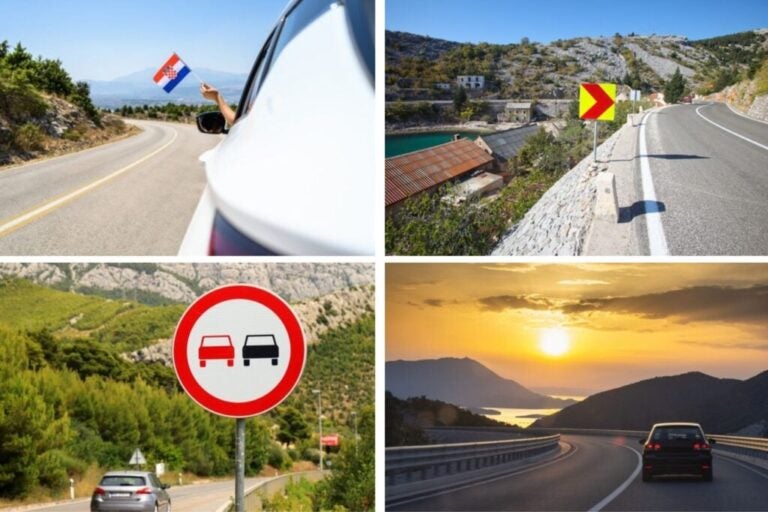
Are you worried about not understanding the traffic signs in Croatia? Don’t worry, because although they are in Croatian, they are clear and follow international symbols.
For example, motorway signs (interstate) can be identified because they have the letter A followed by two digits, a green background, and an image of a motorway in white. State roads have the letter D, and rural roads have the letter Z followed by four digits.
Here are some key words you will find on the signs:
- STOP: same as in Spanish.
- Ulaz zabranjen: no entry.
- Pozor!: Attention!
- Raskrižje: intersection.
- Naplatna postaja: toll station.
- Radovi na cesti: roadworks.
Keep in mind that in rural or coastal roads, signage may be scarce or appear late. To avoid problems, we recommend always using updated GPS and avoiding driving at night on these sections.
Driving in Croatia: Tolls and Fuel Charging
Another thing you need to understand when driving through Croatia is how tolls on the highways (autoceste) work and what options you have for refueling during your trip. The country has modern infrastructure, affordable rates, and well-distributed stations, but there are some details you shouldn’t overlook when heading out on the road.
How Do Tolls Work in Croatia?
Croatia has a closed toll system, similar to Italy or France. This means you take a ticket at a booth when entering the highway and hand it over when exiting, paying based on the distance traveled.
The rates vary depending on the section, vehicle category, and distance. For example, traveling from Zagreb to Split (400 km) costs approximately kn200 ($29, €27), while traveling from Zagreb to Rijeka (140 km) costs around kn85 ($12, €11).
How do you pay the toll? The stations accept cash (kuna or euros), bank cards, and in some cases, contactless or mobile apps.
You can also use the ENC (electronic toll system), which allows you to pass through fast lanes. To use it, you’ll need to install an ENC device on your vehicle’s windshield. Once you reach the toll station, the device is scanned, and the payment is processed automatically.
This system works with all vehicle categories and is very convenient for those who frequently use highways. ENC prepaid accounts can be topped up with cash at authorized Croatian Motorways points of sale or via the HAC ENC mobile app.
Some rental agencies offer cars with this device included, but you should confirm this when making your reservation.
Fuel in Croatia
Fuel stations in Croatia are well distributed throughout the country. There are over 900 gas stations, many of which are located along Croatian roads.
Most of them have a shop, bar, bathrooms, and sometimes restaurants, making them perfect stops for long trips. Regarding opening hours, most stations are open from 06:00 to 22:00, although many on highways and main roads operate 24 hours a day.
Types of Fuel Available and Cost:
- Benzin 95 (Eurosuper 95): unleaded petrol (the most common) – between €1.48 and €1.58 ($1.59–1.68).
- Benzin 100 (Eurosuper 100): premium petrol, more expensive.
- Dizel: diesel – between €1.52 and €1.62 ($1.61–1.72).
- LPG (Autoplin): available at large stations – around €0.95 ($1.03).
A tip is to avoid refueling at highway stations, as service stations in rural areas tend to have prices 5-10% lower.
Parking in Croatia
Parking in Croatia can be easy in small towns or rural areas, but in places like Zagreb, Split, or Dubrovnik, finding a spot can be a real challenge. Also, each city manages its own parking zones with varying hours, rates, and payment systems according to the district. For example, parking prices on the Adriatic coast and islands can be higher during the summer.
Therefore, knowing how the system works will help you save on fines and avoid wasting time looking for parking spaces.
Where Can I Park?
The parking zones in Croatia are divided by colours, which indicate whether the parking is free or paid and how long you can stay:
- White zone: free parking, usually without a time limit.
- Blue zone: paid parking, for a limited time (between 1 and 3 hours).
- Red or yellow zone: higher rates or short-term parking, especially in historic centres or high-traffic areas.
Zones are clearly marked. They use vertical signs. Lines are painted on the ground. Stay alert and pay attention to the indications.
However, a tip is to avoid parking within historic centres, where congestion is very high and prices are steep. The best option is to find a spot in residential areas, where parking signs are often somewhat hidden among tree branches.
Other universal basic rules to be aware of before parking are:
- Avoid parking in spots reserved for disabled people.
- Never park in front of building entrances, shops, courtyards, or garages.
- If you park on the sidewalk, leave at least one meter of space, as otherwise, you could receive a fine.
How Much Does Parking Cost and How Can I Pay?
Parking rates vary depending on the city, area, and time. As a reference:
- Blue zone (medium-sized cities): €0.70–1.50 ($0.75–1.61) per hour.
- Red zone (historic centres): €1.50–3 ($1–3) per hour.
- Public or private parking lots: €10–20 ($10–21) per full day, depending on location.
Payment can be made in several ways:
- Parking meters: Located near the area. They accept coins, some cards, and are usually in Croatian and English.
- SMS: In many cities, you can pay by text. Send the plate number via message. Use the number indicated on the sign.
- Mobile apps: Like Bmove or PayDo, available for iOS and Android. They allow you to pay, extend your time, or check availability.
- Tickets at kiosks: In some areas, you can buy parking tickets at nearby shops or kiosks.
If you use SMS or apps, save the digital receipt. This lets you justify the payment. You may need it during a check.
Options for Renting a Car in Croatia
Now you know that renting a car in Croatia is an excellent way to explore the country at your own pace. You’ll be able to access hidden beaches, natural parks, medieval villages, and viewpoints not found on typical itineraries. Additionally, the rental process is quite accessible, with options for all budgets.
Here are some basic points about the rental process:
- Rental agencies are widespread. They are at international airports. These include Zagreb and Split. Look near train and bus stations. They are also in tourist city centers. Find them on platforms like Rentalcars. Check direct websites like Sixt or Hertz.
- If you travel during high season, book in advance. This is June to September. Booking early avoids high prices. It also ensures better availability.
- Available models range widely. Options include compact, economical cars. These are ideal for cities and tight budgets. You can find sedans or SUVs. These are better for long trips. Automatics are offered. Also look for electric or hybrid vehicles.
- If you’re visiting islands like Korčula, Hvar, or Pag, make sure to rent a vehicle with coverage for ferry trips and check if the insurance covers it.
- Costs vary depending on the model, rental period, and season. For example, it can range from €30/day ($32) for compact cars to €75 ($81) for automatic SUVs. A weekly rental, on the other hand, can range from €200–450 ($216–487), while renting a car for a month could cost around €850 ($918) (ideal for digital nomads or long stays).
- Prices include mandatory basic insurance. Additional coverage such as CDW (damage), TP (theft), or extended assistance can cost between €10 and €25 ($11–27) per extra day.
- Before signing the rental contract, inspect the car: take photos of the bodywork, wheels, and fuel level to avoid unjustified charges when returning it.
Reminder: To rent a car, you need to be 21. Some companies allow 18 with a surcharge. Your license needs one year of experience. An International Driving Permit may be required. You must show a credit card for the deposit. It must be in the main driver’s name.
Final Tips for Driving in Croatia as a Foreigner
Now you have everything you need to hit the Croatian roads. Get ready to explore a country of exceptional beauty, with amazing national parks and cities where history can be felt in every corner. But before we say goodbye, here are some final tips that will help you make the most of your driving trip through Croatia.
- Plan your routes in advance: Croatia is a small country, so the distances are short. However, don’t take this for granted, as driving time can vary depending on the season, traffic, and weather conditions. Using Google Maps or Waze is very helpful for calculating travel times. Keep in mind factors like road closures in low season, border delays, and ferry schedules.
- Follow the rules (even if the locals don’t): When driving in Croatia, drivers often skip turn signals. They park in double lines. They also overtake on the right. This happens on the open road and in towns or cities. As a foreigner, stay calm, stick to the rules, and set a good example.
- Be patient in high season or tourist weekends: Croatia is a highly visited country, so roads can get very congested, especially in July and August, the peak tourist months. If you’re travelling during this time or on a holiday weekend, expect long queues at toll booths and traffic jams. A good alternative is to take local roads or brza cesta, which are toll-free.
- Use snow chains or winter tires: Snow chains or winter tires are mandatory in winter. This applies outside urban areas. The dates are November 15th to April 15th. Follow this rule carefully. Driving without this gear leads to fines. Police may even prohibit your journey.
- Don’t know where to go? Despite being small, Croatia has plenty to offer. A lovely winter route to enjoy snowy nature is from Zagreb to the Plitvice Lakes National Park and Zadar (2-3 days). Halfway, you can stop in the village of Rastoke, famous for its mills and waterfalls.
- Tour the Dalmatian coast: Another perfect itinerary to do by car is the Dalmatian coast, from Split to Dubrovnik. You can do this trip in three to five days. It passes coastal villages and cliffside views. You will see sea-view restaurants. This route is a classic both for summer and winter.
Driving in Croatia: Frequently Asked Questions
Yes, there are many charging stations. They are distributed throughout the country. You can find them in large parking lots. They are also at service stations and malls. Check hotels and restaurants, too. So, in cities and tourist areas, you won’t have a problem. The cost of charging is between €0.20 and €0.35/kWh ($0.21–0.37), depending on the provider.
Rental cars don’t always come with the ENC system (check with the agency beforehand if they offer this service). If the vehicle lacks a system, use the traditional method. Take a ticket upon entry. Pay upon exiting (cash or card).
Yes. Croatia has good roads, low crime rates, and frequent controls. Highways have no problems. Mountain or island roads are different. They can be narrow and winding. Drive cautiously in these areas. Avoid driving at night if the route is new.
Depending on the city, it can range from kn300 to kn700 (€40-95, $43-102).
If the municipal police tow the car, you must also pay the transport and storage fee, which can exceed €100 ($108).
Generally, yes. But it’s always a good idea to check with the agency before crossing into another country (such as Bosnia, Montenegro, or Slovenia), as some agencies apply extra fees or require special permits.


