Language


 No results found
Driving in Canada: Tips and requirements
Driving in Canada can become the adventure of a lifetime. Read this guide to learn the country’s key traffic regulations.

Canada is a vast, diverse country full of contrasts. From the Rocky Mountains to the forests of Quebec, passing through lakes, coastal villages, and major cities like Toronto and Vancouver, road trips are one of the most practical and exciting ways to explore its charms. But don’t hit the road before understanding the basic rules of driving in Canada.
Although public transport works well in urban areas, driving your own vehicle will give you the freedom to explore more remote corners, discover landscapes at your own pace, and stop whenever you want (many routes have viewpoints where it’s well worth taking a break).
To make sure you’re well-prepared for your trip, we’ve created a complete guide with all the requirements and tips for driving in Canada. We’ll cover everything from local regulations to valid licences, and give you practical tips that will save you time, money, and more than one headache along the way.
Ready for your Canadian road trip? Then, keep reading. Here’s the ultimate guide to confidently and comfortably driving across Canada.
Valid Driving Licences in Canada
Can I drive in Canada with my licence? This is probably one of the first questions that comes to your mind. If you’re planning to rent a car as soon as you land, you’ll want to clear this up so you don’t run into any issues with rental agencies.
To start, you need to know that Canada accepts foreign licences, but conditions change with your stay, trip length, and province. General rules stay similar across the country, yet each province or territory may apply specific requirements about translations, validity, or the need for an international permit. So, the first step is to know which areas of Canada you’ll be driving in, and based on that, find out whether the licence issued in your home country is valid.
Can I drive in Canada with my foreign licence?
Yes. If you’re travelling as a tourist, student, or temporary visitor, you can drive with your national licence for a limited period, as long as it’s valid, written in the Latin alphabet, and accompanied by the documents required by the province where you’re staying.
Licences issued in countries such as Mexico, Argentina, Spain, Colombia, Chile, or the United States are generally accepted for the first few months, but it’s always useful to also carry an International Driving Permit (IDP).
Is an International Driving Permit required?
It’s not always a legal requirement, but many Canadian provinces recommend or require it in certain situations. So, to know whether you need to apply for an IDP, you’ll need to check if your licence is written in Latin characters, in English or French, and if it includes a photo. If these three conditions are not met, you’ll need an international permit or an official certified translation into English or French.
We recommend the permit over the translation, as the process is simple, usually issued on the spot, and not very expensive. Plus, it will help you drive in many other countries worldwide. Keep in mind, however, that the IDP does not replace your national licence, so make sure to carry both documents with you.
How long can I use my licence for?
This is another question you might have about your licence. Well, as a general rule, in most provinces, you can drive with your foreign licence for up to 90 consecutive days. Some provinces even allow up to six months or even a year if you’re a tourist (for example, Alberta or Manitoba). If you’ll be driving across several provinces, remember to check the local rules, as the validity of your licence may vary between provinces or depending on your immigration status.
What if I want to exchange my licence for a Canadian one?
If you plan to stay longer or live in Canada, you’ll need to apply for a Canadian driving licence. First, check if your home country has a licence exchange agreement, as this way you can skip the test. This may also vary by province, so consider each case individually.
Some countries with direct exchange agreements include France, Germany, South Korea, Japan, the United Kingdom, Switzerland, the United States, and Australia. You won’t be as lucky if you’re coming from Latin America, as there is no direct agreement in these cases, and you’ll need to take both a theoretical and possibly a practical exam to get a Canadian licence.
Types of Canadian Licences
Did you know that in Canada, there are three levels of driving licences, each with its own specific requirements?
- Full Licence: Allows you to drive a car with no restrictions. It’s the same as a regular licence in most countries.
- Learning Permit: Allows you to drive only under the supervision of a fully licensed driver. The minimum age for this type of licence is typically between 14 and 16, but this can vary by province.
- Intermediate Licence: This type of permit has fewer restrictions than the learning permit, but there are still certain conditions, such as the prohibition of driving at night.
Requirements and Documentation for Driving in Canada
Now that you’ve sorted the licence issue, it’s time to get up to speed on the requirements and documentation needed to drive in Canada (again, these can vary by province). While the country has a well-organised road infrastructure and a clearly marked transit system, getting in your car without knowing what documentation you need or what conditions you must meet based on your immigration status could lead to negative consequences and spoil your Canadian road trip.
Here are some important points to consider:
- Minimum age to drive and rent a vehicle: In most provinces, you’ll need to be at least 16 to drive in Canada, though it may be 17 or 18 in some, like Alberta or Saskatchewan.
- Minimum age to rent a car: Almost all rental agencies require you to be at least 21, but for certain vehicles or categories (SUVs, vans, luxury cars), the minimum age rises to 25.
- Minimum licence experience for renting a car: Many companies require at least one year of driving experience.
- Mandatory insurance: All vehicles in Canada must have mandatory third-party liability insurance covering damages to others in the event of an accident (at least 200,000 CAD (€134,000)). This applies whether the vehicle is owned or rented. In the latter case, the policy usually includes basic third-party insurance, limited collision coverage (Collision Damage Waiver – CDW), and theft protection.
- Documents you must carry: Valid passport, national driving licence, IDP or certified translation if your licence is not in English or French, vehicle insurance proof, and rental agreement.
- Mandatory equipment in the vehicle: There isn’t a unified list, but generally, it’s recommended that the vehicle have a basic first aid kit, a safety triangle, a spare tire, and a hydraulic jack. For winter, it’s also recommended to carry an ice scraper, a shovel, and anti-freeze liquid for the windshield.
- Special requirements: In provinces like Quebec, it’s mandatory to use winter tires between December 1 and March 15. If you rent a car during this period, make sure they’re included at no extra cost.
- Additional tip: Don’t travel to Canada without planning how you’ll have internet access in the country. One of Holafly’s monthly plans can be an effective solution to use GPS, apps like Waze, or check route conditions in Canada. The service is simple, affordable, and offers global coverage (in over 170 countries). You can also opt for a Canada eSIM for unlimited data for the days you need, with no roaming charges.
Important: If you are a frequent traveler and want to stay connected without worrying about expensive roaming or looking for a new SIM at every destination, Holafly’s subscription plans are for you. With a single eSIM, enjoy internet in more than 170 countries for a fixed price and no surprises on your bill. Travel without limits and connect easily and securely! 🚀🌍

Traffic Rules and Signage in Canada
One of Canada’s peculiarities is that there’s no single traffic regulation. Instead, each province follows its own rules. Moreover, the language of the signs isn’t always the same; many provinces use English, while others like Quebec use French. Therefore, we suggest you check the rules of the areas you’ll be travelling through to avoid surprises and misunderstandings.
Regardless of the area or province, Canada is a country where traffic rules are followed seriously. While driving can feel relaxed outside of major cities, the rules are strict, and violations (even minor ones) are punished without exception. Therefore, understanding how to drive, which signs to follow, and what habits to adopt is key to ensuring your trip is a success.
Direction of Travel and Basic Rules
Let’s start with a fundamental aspect: in Canada, you drive on the right, with the steering wheel on the left side of the vehicle. This is the same as most European and Latin American countries, so you probably won’t have any issues with this.
Pay attention to the carpool lanes. What does it involve? These lanes are exclusive for vehicles with multiple passengers. This means you can’t use them if you’re driving alone. They’re identified with a diamond symbol on the road.
What about right of way? If you arrive at an intersection at the same time as another vehicle, the vehicle on your right has priority unless there’s specific signage. Make sure to follow this rule, as Canadians tend to drive courteously and expect the same from tourists or foreigners visiting the country.
A particularly interesting driving rule is that you’re allowed to turn right at a red light, unless otherwise indicated. This applies throughout the country (except in Montreal).
Speed Limits
Speed limits in Canada vary by province. However, the streets and highways are well-marked, with rectangular black-and-white signs indicating speed limits in kilometres per hour (Km/h). As a reference, you can expect the following values:
- Urban areas: 50 km/h, except in school or residential zones where the limit is reduced to 30 km/h.
- Secondary roads: 80–90 km/h.
- Highways: Between 100 and 120 km/h, depending on the province.
Be aware, locals often drive fast and sometimes ignore these limits. Don’t follow their lead – stick to the rules, as speeding fines can be a real headache. Additionally, Canada uses fixed radars, cameras at traffic lights, and mobile patrols to monitor violations (of any type).
Here’s an approximate cost of fines for common violations, although these can vary by province:
- Minor speeding violation: From $100 (€67 ($71 USD)).
- Running a red light: $300 – 500 (€200-334 ($214-358 USD)).
- Using a mobile phone while driving: Up to $600 (€400 ($430 USD)) and loss of points.
- Not wearing a seatbelt: $150 – 300 (€100-200 ($107-214 USD)).
Use of Mobile Phones, Seatbelts, and Alcohol
As for these points, the rules in Canada are similar to most countries, except that the tolerance for alcohol is slightly higher.
- The use of mobile phones while driving is prohibited, unless you’re using a hands-free system. Holding the phone, even if you’re not talking, is considered a violation.
- The use of seatbelts is mandatory for all passengers.
- The blood alcohol limit is 0.08 g/l, but it’s recommended not to drink at all if you plan to drive. Some provinces have zero tolerance for novice drivers or those under 21 years old.
Traffic Signs in Canada
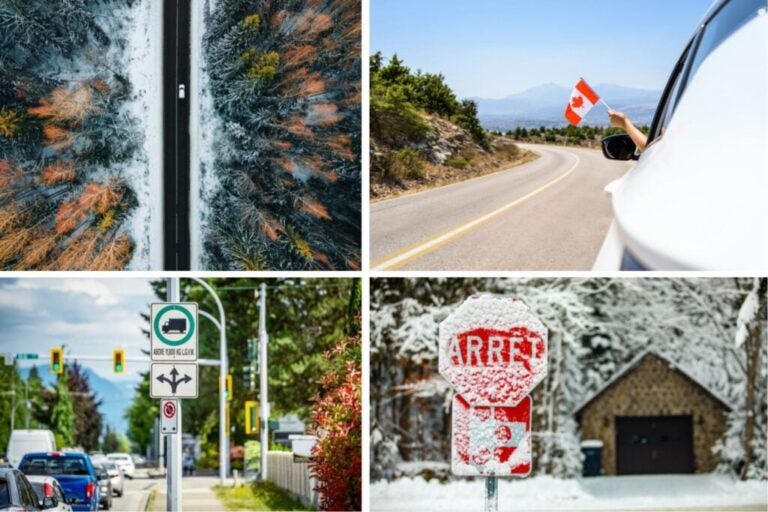
Let’s move on to another topic that often worries travellers who will drive in Canada: traffic signs. As mentioned before, they are generally in English, but in some provinces, especially in Quebec, they are in French. In bilingual areas like Montreal, you’ll see signs in both English and French. However, they’re usually easy to interpret, as they use international symbols.
Here are some expressions that are useful to know:
- Stop: Stop required (Arrêt in French)
- Yield: Yield to traffic.
- No U-turn: U-turns prohibited.
- School zone: School zone.
- Maximum 100: Speed limit 100 km/h.
- Do not pass: No overtaking.
- One way: One-way street.
Tolls and Fuel Refuelling in Canada
Driving in Canada is generally simple and accessible. The good news is that most routes are free, well-marked, and in good condition. However, stay alert, as some highways, bridges, and tunnels do charge tolls. We’ll explain all this shortly, as well as what you need to know about refuelling.
Are there tolls in Canada?
Yes, but they are few. Unlike Europe or some Latin American countries, most highways in Canada are free. Tolls are concentrated in specific areas. For example:
- Ontario: The 407 ETR highway (also known as the Express Toll Route, around Toronto) uses an electronic payment system. Tip: You can avoid it by driving on Route 401, which runs parallel to the 407 and doesn’t have tolls.
- Quebec: Some bridges and tunnels, such as the A-25 and A-30 bridges, also use automatic payment.
- Nova Scotia: Route 104 (Cobequid Pass) has about 45 km of tolls for standard vehicles. Tip: you can avoid it by taking Highway 4.
How are tolls paid?
In general, there are no toll booths on Canadian roads; instead, the toll system works through cameras that record the license plate and send the bill to the vehicle’s owner. For rented cars, you’ll need to check if the vehicle has a transponder or electronic pass. If it doesn’t, the toll will be registered through the license plate, sent to the rental agency, which will pay the toll and then charge you an administrative fee, typically between $10–30 CAD (€6.70–20.10 ($7.40–22.20 USD)).
If you know in advance that you’ll use toll highways, ask the agency if you can pre-book a pass. Or you can avoid toll routes directly from your GPS.
How Much Do Tolls Cost?
The price varies depending on the section and the system used, but here are some values for reference:
- Highway 407 (Toronto): Between $0.25–0.60 CAD (€0.17–0.40 ($0.19–0.44 USD)) per kilometre (plus access fees).
- A-25 Bridge (Montreal): Between $3–5 CAD (€2.01–3.35 ($2.22–3.70 USD)) per crossing.
- Confederation Bridge (Prince Edward Island): A flat fee of $50 CAD (€33.50 ($37.00 USD)) per vehicle (only paid when exiting).
Fuel Refuelling in Canada
Refuelling in Canada is similar to most countries. Service stations are well distributed across the country, even on rural routes, and are present both in large cities and small towns, shopping centres, or on the side of highways. Most stations operate on a self-service basis, and payment can be made directly at the pump with a card or inside the shop if paying by cash. They usually operate from 6:00 AM to 10:00 PM, though many are open 24 hours.
Be aware of very cold or remote areas, as there may be fewer available service stations.
Types of Fuel
Fuel in Canada is known as “gas,” and there are typically three types of octane levels (87, 89, and 91-93). The first is the most commonly used for standard vehicles, the second is suitable for vehicles with higher compression, and the third is for high-performance engines. Diesel is also used, especially for trucks, SUVs, and larger vehicles. Additionally, hybrid and electric vehicles are common, especially in Quebec and British Columbia.
Before refuelling, check the gas cap or the car manual, as not all vehicles accept all octane levels. Using the wrong fuel can damage the engine, and this is not typically covered by insurance policies.
Estimated Prices (March 2025)
Prices can vary between provinces and regions, but here are some values to use as a reference:
- Regular Gasoline: Between $1.50–1.85 CAD (€1.01–1.24 ($1.11–1.37 USD)) per litre.
- Premium Gasoline: Between $1.75–2.20 CAD (€1.17–1.47 ($1.30–1.63 USD)) per litre.
- Diesel: Between $1.60–2.00 CAD (€1.07–1.34 ($1.18–1.48 USD)) per litre.
A tip to save money is to refuel in cities or towns, as service stations on highways tend to have higher prices than those in urban areas. Some useful apps for comparing prices include GasBuddy, Petro-Canada, and Waze.
Parking in Canada
Parking is another topic that can cause confusion for tourists driving in Canada. It’s similar to most countries worldwide: In large cities (such as Vancouver, Toronto, and Montreal), it can be quite difficult. Additionally, each city has its own laws, with variations depending on times and areas. A constant factor is that the rules are enforced strictly, and fines for illegal parking are not cheap.
That being said, the best approach in major Canadian cities is to leave your vehicle at your accommodation and use public transport, which is very efficient. Alternatively, you can opt to park in smaller cities or towns, where the atmosphere is more local and parking is less of an issue. In many cases, it’s even free.
Here are some basic guidelines regarding parking in Canada to help you avoid fines.
Where Can I Park?
In urban areas, parking is regulated by signs that indicate allowed hours, maximum stay, whether it’s paid or free, and if there are days with restrictions due to street cleaning. Basically, all you need to do is read and correctly interpret the sign. If you have doubts, it’s better to look for another spot or a parking lot rather than risk a fine.
Keep in mind that unlike some other countries, in Canada, parking zones aren’t marked with colours on the pavement. Everything is regulated by vertical signage (tip: look up).
How much does parking cost?
Another question you might be asking. Once again, the answer is relative, as it varies from city to city and even between areas. For example:
- Toronto, Vancouver, or Montreal: Between $2.00–5.00 CAD (€1.34–3.35 ($1.48–3.70 USD)) per hour in central areas.
- Small cities: Between $1.00–2.00 CAD (€0.67–1.34 ($0.74–1.48 USD)) per hour.
- Underground or private parking lots: From $15 CAD (€10.05 ($11.10 USD)) to $40 CAD (€26.80 ($29.60 USD)) per full day.
Some parking lots offer flat night or weekend rates, which are more convenient if you’re leaving the car for several hours. For payment, we recommend using apps like PayByPhone, ParkMobile, and HonkMobile.
Car Rental Options in Canada
Now you know that renting a car in Canada can be a great way to explore the country. Although it’s very large and has remote areas, with time and planning, you can create a good itinerary and make the most of your stay. Here’s some essential information you need to know about renting vehicles.
- Rental agencies are present at the major airports (Toronto Pearson, Vancouver, Montreal-Trudeau, Calgary, or Halifax), at train stations, bus terminals, and in the centre of medium and large cities.
- You can also use online platforms like Rentalcars, DiscoverCars, Expedia, or Kayak to compare prices and conditions.
- The main international agencies present in Canada include Hertz, Avis, Budget, Enterprise, National, and Alamo. Local options include Discount Car and Truck Rentals, Routes Car Rental, and Econorent.
- To rent a vehicle in Canada, you must be over 21, have a valid licence written in Latin characters and with over 1 year of driving experience, present an international credit card in your name, and carry an IDP (only if applicable).
- In Canada, almost all vehicles are automatic.
- The range of rental vehicles is high, from compact cars or sedans (suitable for city driving or short trips) to electric or hybrid cars. Vans or minivans are common, especially for group trips, and 4×4 pickups are available for mountain areas.
- Rental prices vary depending on the city, season, duration, and vehicle type. For example, an economy car can cost from $45 CAD (€30.15 ($33.30 USD)) per day, while a minivan or pickup can cost $90–120 CAD (€60.30–80.40 ($66.60–88.80 USD)) per day.
Tips for Driving in Canada

You’re about to hit the road. You’ve checked you have the necessary documents, your licence is valid, and you’ve studied the main traffic rules. You can feel the excitement of exploring Canada. But before you go, take a moment to go over these final tips. They’ll be a big help, trust us.
- Be aware of roadworks: Canada has severe weather, which directly impacts road conditions, especially from November to May when ice and snow cause disruptions. During this time, many routes may be closed, so it’s best to check ahead. From June to October, weather conditions improve, but there are often roadworks to repair damage caused during winter months. If you encounter one, take a deep breath and be patient.
- Avoid peak hours: In large cities like Montreal and Toronto, certain times, especially between 5:00 PM and 7:00 PM, can be really chaotic. If possible, avoid driving during this time.
- Use rest stops: Canada is a vast country, and the hours behind the wheel can be long. Luckily, there are rest stops along the routes, ideal for stretching your legs, getting some fresh air, eating, or using the bathroom. They’re also practical for RVs as they allow free overnight stays for up to eight days.
- Watch out for animals on the road: Canada’s landscapes wouldn’t be the same without its iconic wildlife. But be careful, as animals often cross the road and may be hit. For example, in the Rocky Mountains, you may see bears, moose, deer, and many other species. Pay attention to animal warning signs, respect speed limits, and avoid driving at night. And if you do encounter an animal, don’t do anything foolish, like getting out of the car to feed them. They are wild, and you never know how they might react.
- Use a GPS: Signs in Canada are clear, but it’s not always easy to spot them, especially if you’re driving at 120 km/h on a highway. For this, there’s no better ally than a GPS. This approach will help you prevent mistakes when merging and will improve your driving experience overall. You can also download maps on Google Maps and use them offline.
Frequently Asked Questions
Yes, in general, Canadian roads are in excellent condition. The main highways usually have multiple lanes, all well-marked with easy gradients in mountainous areas, with few sharp curves or steep inclines. Secondary roads typically have just two lanes, but they are also well-marked. In more remote areas, there may be gravel roads, but they are suitable for all types of vehicles.
Canada offers many routes that deserve a drive. One of them is the Icefields Parkway, which links Lake Louise with Jasper and features glaciers, waterfalls, and lakes. Sea to Sky Highway (Route 99) runs from Vancouver to Whistler through stunning coastal landscapes. There’s also the Great Lakes route, starting from Toronto and following the world’s largest group of freshwater lakes. These are just a few options—there are many more.
If you park in a prohibited area, you’ll receive a fine and need to pay it. These fines range from $30–100 CAD (€19.39–65.99 / $21–71 USD), depending on the city and the offence. If the car is rented, the fine goes to the agency, and they’ll forward it with an extra fee. If you’re unsure, choose a paid or covered car park to avoid problems.
The cheapest provinces for fuel usually include Alberta and Saskatchewan. Meanwhile, the most expensive places are Vancouver and Victoria in British Columbia, and Whitehorse in Yukon.
No, Canada doesn’t use mandatory eco labels to drive in urban areas. However, if you rent an electric or hybrid car, you may find special lanes you can use, especially in Ontario and British Columbia.