







 Language


 No results found
Driving in Australia: Tips and requirements
Australia is the land of road trips. Exploring the country on wheels can be a great adventure, as long as you understand the essentials of driving in Australia.

Are you eager to go on a road trip through the land of kangaroos? Then, make sure to read this article. We’ll tell you everything you need to know about driving in Australia, including traffic rules and useful tips to enhance your experience on the road.
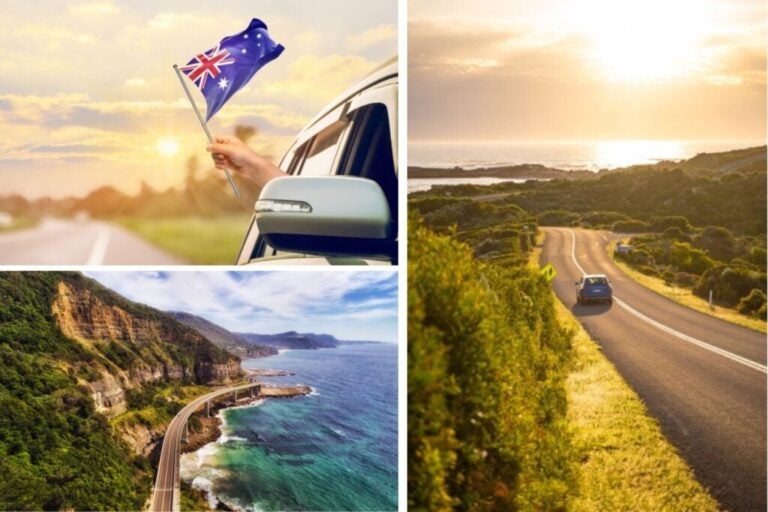
Australia is a vast, diverse country full of landscapes that dramatically change from one region to another. That’s why driving on its roads is more than just a way to get around: it’s part of the experience of discovering its wonders. Whether you want to explore the Great Ocean Road, get lost in the Red Centre desert, or travel Queensland’s coast, having your own vehicle will allow you to witness the country’s beauty at your own pace.
The Australian road network is well-maintained, the signs are clear, and most roads are designed for independent travellers. However, there are some important details you should know before getting behind the wheel. We talk about them in this article Everything you need to know about how to drive in Australia as a foreigner is in this article.esi
Valid Driving Licences in Australia
The first thing you need to check is whether your national driving licence is valid for driving in Australia. The country allows tourists and temporary visitors to drive legally with their foreign licence, but certain conditions must be met. Let’s see:
Can I drive in Australia with my national licence?
You can, as long as you are from countries such as Argentina, Mexico, Spain, Colombia, Chile, or the United States. Your licence will allow you to drive legally in Australia for the duration of your stay as a tourist or temporary visitor, as long as you meet these three key conditions:
- Your licence must be valid and up-to-date in your home country.
- It must be written in English or accompanied by an official translation.
- It must be a full licence (not a learner’s or provisional one).
If your licence is written in another language (such as Spanish, French, Portuguese, or German), you’ll need to carry an official translation into English or an International Driving Permit (IDP) alongside your original licence.
What is the International Driving Permit (IDP)?
The IDP is a supplementary document that translates your licence into multiple languages, including English, and is recognised in all countries that are parties to the Vienna Convention on Road Traffic. Therefore, you’ll need it to drive in Australia if your licence is not written in English. However, keep in mind that the IDP does not replace your national licence; it must be used alongside it. In fact, if you don’t carry both documents, you may face penalties and fines.
The IDP must be processed in your home country before you travel. For instance, if you’re coming from Argentina, you’ll need to obtain it from the Automobile Club of Argentina (ACA); from Spain, at the Provincial Traffic Headquarters; or from Mexico, at the National Automobile Association (ANA).
How long can I drive with my foreign licence?
The length of time you can legally drive in Australia with your foreign licence depends on the type of visa you have and the Australian state you’re in. But as a general rule:
- If you enter Australia as a tourist or with a temporary visa, you can drive with your foreign licence for up to three months or until your visa expires, whichever comes first.
- If you have a student, work, or residency visa, you’ll need to exchange your licence for an Australian one after a certain period (usually between three and six months, depending on the state where you’re residing).
In some states, you can drive indefinitely with your foreign licence, even if you’re not a permanent resident, while others require you to exchange it as soon as you’ve been in the country for three months. Therefore, it’s best to check these conditions based on the states you’re planning to visit.
What if I want to exchange my licence for an Australian one?
Australia has direct exchange agreements with some countries, but not all. This means that if your country is on the list, you can apply for an Australian licence without taking a test. If it’s not, you’ll have to pass both a theoretical and practical exam.
Which countries have an exchange agreement with Australia? Although this may vary from state to state, the list generally includes Germany, the United Kingdom, Spain, Italy, Japan, South Korea, Canada, and New Zealand. Argentina, Mexico, Colombia, and most Latin American countries do not have exchange agreements. So if you’re from one of those countries and need an Australian licence, you’ll have to take the test.
Requirements and Documentation for Driving in Australia
Having a valid licence to drive in Australia is not enough to avoid fines. In addition to that, you’ll need to comply with other legal and practical requirements to avoid issues with the traffic authorities, such as having the minimum age, appropriate insurance, and the mandatory vehicle equipment. Below, we explain everything you need to know before hitting the road.
Minimum Age for Driving and Renting a Vehicle
Australia is the land of road trips, so you’ll likely end up driving a car during your travels. In that case, it’s essential that you are over 17 years old. However, this only applies to those with an Australian licence who have gone through the local training system (including supervised driving periods and practical tests).
For tourists or foreigners with an international licence, a different logic applies:
- Minimum age to drive as a visitor: 18 years old with a valid foreign licence.
- Minimum age to rent a car: Most companies require you to be at least 21 years old and have at least one year of driving experience. Some vehicle categories (SUVs, vans, luxury cars) may require you to be 25 or older.
- Drivers between 21 and 24 years old may sometimes be charged a ‘young driver surcharge’, which can range from 10 to 25 AUD per day, depending on the agency ($6-15 US, €6-14).
Mandatory Insurance
As in most countries, in Australia, all vehicles must have at least third-party liability insurance, covering damages you might cause to others. You won’t need to worry about this if you rent a vehicle, as it’s included in the basic rate. However, for extra peace of mind, we recommend purchasing additional coverage, such as theft or damage protection and 24/7 roadside assistance.
As we always advise, carefully review the fine print of your rental agreement. Some insurance policies have high excess fees, meaning you may have to pay significant amounts of money in the event of an accident, even if it wasn’t your fault.
What Documents Should I Have to Drive in Australia?
Whether you’re driving a personal car or a rental, make sure to always carry the following documents (even for driving around cities):
- Your valid national driving licence.
- Your International Driving Permit (IDP) or certified English translation.
- Your passport (or other identity document with a valid visa).
- The vehicle rental agreement, if applicable.
- The proof of valid insurance.
Try not to forget these documents, as Australian traffic officers conduct routine checks, and you never know when you might encounter one. If you don’t have them with you, the situation will likely end with a fine or the vehicle being impounded, especially if you’re driving without an IDP or translation.
Basic Equipment Your Vehicle Must Have
Although the list is not as strict as in some European countries, we recommend that the car you drive (whether personal or rented) have a spare tyre in good condition, a hydraulic jack, a reflective vest (not mandatory but very useful), and a basic first aid kit.
On less crowded roads or off-road areas, these items can make a difference in case of an emergency. Imagine having a flat tyre in the middle of the desert? It’s always a good idea to be prepared for such unexpected events.
Don’t Drive in Australia Without Internet
Besides having the proper documents and knowing the Australian traffic rules, it’s important to have internet while driving. With a Holafly monthly subscription plan, you’ll be able to use GPS, Google Maps, or Waze without any issues, and check the weather or road conditions.
Important: If you are a frequent traveler and want to stay connected without worrying about expensive roaming or looking for a new SIM at every destination, Holafly’s subscription plans are for you. With a single eSIM, enjoy internet in more than 170 countries for a fixed price and no surprises on your bill. Travel without limits and connect easily and securely! 🚀🌍

Traffic Rules in Australia and Signage
One key part of driving in Australia is respecting the traffic rules, which are quite strict. Following them is not difficult as they are well signposted. This way, you’ll avoid unnecessary infringements that, however minor, can lead to high fines, points off your licence, or even the cancellation of your rental contract.
Direction of Travel and Basic Rules
One of the most noticeable changes for foreigners is that in Australia, they drive on the left side. This means the steering wheel is on the right side of the vehicle, overtaking is done on the right, and roundabouts turn clockwise. Yes, it sounds daunting, but it’s not as bad as it seems. Here are some tips to make driving on the left easier:
- Rent an automatic car, as you won’t need to worry about changing gears with the opposite hand. This small adjustment will make a huge difference when it comes to tasks as mechanical as shifting gears.
- Practice on less busy streets in the cities or in quiet areas before hitting the main roads. It’s essential to feel comfortable with the orientation before entering busier roads.
- Avoid urban routes during peak hours, when traffic is denser.
- Always stay in the left lane, even if there’s no traffic (tourists often get confused and end up driving in the wrong lane).
Although it may seem difficult at first, with time you’ll gain confidence and security in driving on the left side. After all, as the famous saying goes, “practice makes perfect.”
Speed Limits
Another important topic for driving in Australia is respecting the speed limits. They are clearly signposted and given in kilometres per hour (km/h), so you shouldn’t have any trouble understanding them. The limits vary according to the type of road and the state, but you can take the following values as a general reference:
- Urban areas: 50 km/h (or 40 km/h near schools, residential or commercial areas).
- Regional roads and highways: Between 80 and 100 km/h.
- Motorways: Up to 110 km/h (in some parts of the Northern Territory, there’s no limit, but this does not apply in tourist areas).
Stay tuned! If you see a sign that says “SPEED LIMIT 60”, it means the maximum allowed is 60 km/h. There is no tolerance, as in some other countries, so make sure to stick to the limit if you don’t want to get fined.
Speed Checks and Penalties
The number of fixed and mobile speed cameras, red-light cameras, camouflaged patrol cars, and automatic systems to detect violations in Australia is huge. Therefore, don’t expect a police officer to stop you and give you a warning: fines will arrive by mail or directly to the rental agency. The most common fines are:
- Speeding: From 100 AUD to over 1,000 AUD ($61-612 US, €56-563).
- Running a red light: From 450 AUD ($275 US, €253).
- Using a mobile phone without hands-free: From 500 AUD ($306 US, €282).
- Not wearing a seatbelt: From 300 AUD ($183 US, €169).
Mobile Phone Use, Seatbelt, and Alcohol Consumption
As in most countries:
- The use of a mobile phone is strictly prohibited while driving, unless you’re using it with a fixed mount and hands-free mode.
- All occupants must wear a seatbelt, regardless of their seat position in the vehicle.
- The blood alcohol limit is 0.05 g/l, though some states lower this to 0.02 or even 0.00 if you’re a novice or professional driver.
Traffic Signage
Are you worried about not understanding Australian traffic signs? Don’t stress too much, because while they are written in English, they use international symbols that are familiar if you’ve driven in other countries. Still, it might help to know some common expressions:
- Give Way: Yield the right of way.
- Stop: Stop completely.
- No U-Turn: No U-turn.
- School Zone: School zone (pay attention to timings).
- Keep Left: Keep left.
- Roundabout Ahead: Roundabout ahead.
Generally, the signs are placed well in advance, giving you time to prepare for any manoeuvres, lane changes, or speed reductions.
Tolls and Fuel in Australia
Now you know the basic rules for driving in Australia. Let’s take a look at two other key aspects: understanding how tolls work and what options are available for refueling. These may seem simple, but a small mistake can lead to automatic fines or unexpected costs if you don’t manage them properly from the start.
Are there tolls in Australia?
Yes, but not on all roads or in all states. Most toll roads are concentrated in urban areas of major cities like Sydney, Melbourne, and Brisbane. Unlike other countries, there are no toll booths to pay by cash or card. All tolls work through a fully electronic system.
So, toll payments in Australia are made via an e-TAG, an electronic device that attaches to your windshield and is linked to a payment account. What if you don’t have one? In that case, you’ll need to use the e-PASS or Linkt Pass and pay online within three days after using the toll road.
If you rent a vehicle, check in advance whether it’s equipped with an e-TAG. Some agencies include it by default and charge you at the end of the trip for the tolls used, plus a small administrative fee. If you don’t have an e-TAG or pay the toll within the deadline, you’ll receive an automatic fine (between 180 and 250 AUD – $110-150 US, €101-138). This will be sent to the rental agency, which will then pass the charge to you with an extra fee for management.
The toll cost depends on the section, city, and highway. However, as a reference, you can take these values:
- Urban toll roads in Sydney: Between 3 and 7 AUD per trip ($1.80-4.30 US, €2-4).
- Tunnels or bridges in Melbourne or Brisbane: Between 4 and 9 AUD ($2.45-5.50 US, €2-5).
- Full sections with multiple toll stations: Up to 15 AUD ($9.20 US, €8).
Where and How to Refuel?
You’ll have no trouble refueling in Australia as service stations are well-distributed across the country. While you’ll find them easily in urban areas, keep in mind that Australia is huge, and there are many remote regions. Be mindful of this as you can travel for many miles without seeing a petrol station (especially in the desert). This is usually indicated by signs like «Last petrol station in X km«.
Having clarified that, you will see that most of the stations are self-service. This means you need to handle the refueling and pay by card either at the pump or inside the store.
The available fuel types are:
- Unleaded (91): Regular unleaded gasoline. Between 1.65 and 2.10 AUD per litre, depending on the region ($1.00-1.30 US, around €1).
- Premium Unleaded (95 or 98): Higher octane and performance fuel. Between 1.85 and 2.30 AUD per litre ($1.10-1.41 US, around €1).
- Diesel: Common in SUVs and large vehicles (Between 1.75 and 2.20 AUD per litre ($1.00-1.35 US, around €1)).
- LPG: Only for adapted cars (less common).
In general, prices are higher at highway stations or in tourist-heavy areas and cheaper in supermarket stations like Coles Express or Woolworths Caltex.
Parking in Australia
Parking in Australia may seem easy at first, but many areas have time restrictions, strict rules, and automated controls. So don’t get too comfortable, as a small mistake like leaving your car a few minutes too long or misinterpreting a sign can lead to an automatic fine. A good practice is to look for accommodations with parking to avoid the hassle of finding a parking space. If you’re sleeping in a van, you’ll probably need to find a parking spot or rest area outside the city.
Where Can I Park?
In most cities, the parking system is based on vertical signs indicating if parking is allowed, when, how long you can stay, and whether the area is paid, free, or for residents only.
Australia does not use coloured lines on the ground like in other countries, so reading the signs is key to knowing whether you can park or not. For example, if the sign just says ‘P,’ you can park for as long as you like. If it says ‘2P,’ you can only park for two hours, ‘3P’ means three hours, and so on. A small but important detail is that this sign doesn’t mean parking is free.
They also often include time ranges. For example, if you see a sign that says: ‘2P Mon–Fri 8am–6pm’, it means you can park for up to two hours (2P), Monday to Friday, between 8:00 AM and 6:00 PM. If in doubt, it’s better to find another spot as many fines come from misinterpreting the signs.
Be careful in areas where parking is strictly prohibited, especially in high-traffic zones like Sydney or Melbourne, where there is zero margin for error. These areas are marked with the following signs:
- No Stopping: No stopping, even for a moment.
- No Parking: You can stop only to drop off or pick up passengers, without leaving the vehicle.
- Clearway: Mandatory traffic lanes during peak hours. If you park there, your vehicle will be towed.
How much does parking cost?
The parking prices vary greatly depending on the city and area. For example, in central Sydney, parking can cost between 4 and 9 AUD per hour ($2.50-5.60 US, €2-5), between 3 and 7 AUD in Melbourne ($1.90-4.30 US, €2-4), while in smaller cities, the price drops to 1-4 AUD per hour ($0.60-2.50 US, €1-2).
To pay for parking, we recommend using apps like PayStay, EasyPark, or ParkMobile, which allow you to pay via your phone and extend the time if needed. Another tip is to take advantage of the times when parking is free, usually at night, on weekends, or public holidays. If that’s the case, it will be indicated with a sign.
You can also use private or underground parking located in central or commercial areas. Platforms like Secure Parking, Wilson Parking, or Parkopedia allow you to compare prices, reserve a spot, and pay in advance.
Options for Renting a Car in Australia
As we mentioned earlier, Australia is a country where road trips are extremely popular. Therefore, it’s quite likely that you’ll end up renting a car to explore the country freely and comfortably. By driving yourself, you’ll be able to visit cities at your own pace, delve into national parks, discover hidden beaches, and embark on scenic routes not covered by public transport.
Where can I rent a car and what options are available?
Australia has a large number of rental agencies, both international and local, with offices located in various places. One common place to rent is at international airports in Sydney, Melbourne, Brisbane, Perth, Adelaide, or Cairns, though prices may be slightly higher there. There are also rental agencies at train stations, intercity bus terminals, and central areas of major cities. The same goes for popular tourist spots like the Great Ocean Road, Byron Bay, or Alice Springs.
You can also book online through platforms like Rentalcar, DiscoverCars, Hertz, Avis, Budget, Europcar, Thrifty, or local agencies like Jucy, Apollo, and East Coast Car Rentals.
The fleet of available vehicles is extensive and caters to different types of trips:
- Compact or hatchback cars: Ideal for cities and short trips.
- SUVs: highly recommended for long trips, rural areas, or unpaved roads.
- Campervans or motorhomes: Popular among travellers who want to move and sleep in the same vehicle.
- 4×4: Necessary for remote areas like the Outback or unpaved roads.
- Electric cars: Still limited but increasingly available in large cities.
Almost all cars are automatic, though some agencies offer manual options at a lower cost.
How much does it cost to rent a car?
Prices vary by city, season, duration, and vehicle type. But as a reference, you can use these values (March 2025):
- Compact car: From 40 AUD per day ($25 US, €23).
- Automatic SUV: From 70 AUD per day ($43 US, €40).
- Basic campervan: From 100 AUD per day ($62 US, €57).
- Weekly rental: Between 250 and 500 AUD, depending on model and coverage ($155-310 US, €142-285).
- Monthly rental: From 1,000 AUD upwards ($620 US, €570).
Final Tips for Driving in Australia
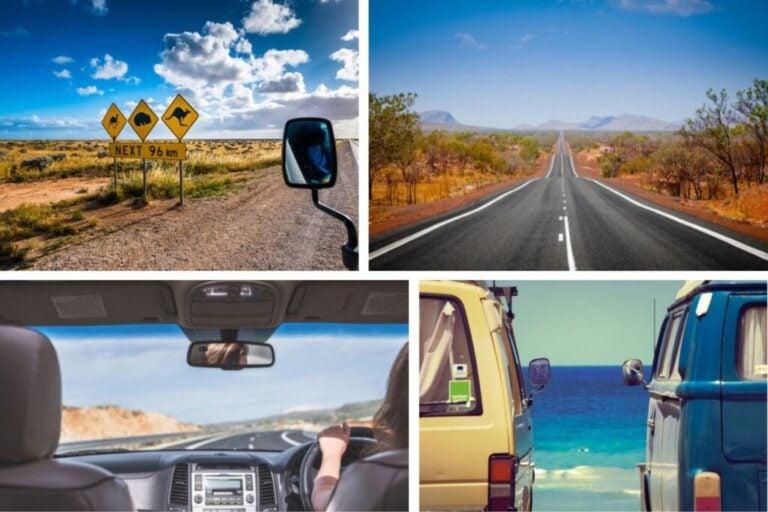
Driving in Australia may seem challenging, but you know that with the right info it becomes one of the most rewarding ways to explore the country. From East Coast beaches to the red heart of the Outback, your own vehicle offers a freedom public transport won’t match.
To wrap up, we’ll share these tips so you enjoy your experience as much as possible:
- Keep an eye on the distances: Australia is a huge country. Imagine that it’s bigger than the whole of Europe combined! Distances always feel longer than they look, so when you estimate travel times, add 30% to Google Maps’ result. This approach helps you drive without stress, especially if you hit roadworks, traffic or stop to take photos at a viewpoint.
- Be careful with animals: It’s common to find wildlife crossing Australian roads. In fact, you’ll probably see one lying injured on the roadside. Imagine seeing a kangaroo in that condition. Don’t add to that and stay alert while respecting speed limits and signs warning about loose animals. Pay extra attention at night, because this is when it is most dangerous.
- Check the weather before you start your drive: Australia has weather conditions that may catch you off guard. The climate can become extreme in some areas or during certain seasons. Therefore, check the forecast before travelling, so you don’t drive stressed during sudden heavy rain, as often happens in the north during summer.
- Don’t risk running out of fuel: You’ll find many stations on main routes, but remote areas don’t offer that security. To avoid issues, download an app that shows where the next service station is.
- Sleep well before driving: Australia offers stunning views, but some stretches stay straight and boring without anything interesting. If you slept poorly, fighting fatigue on those stretches becomes difficult. So choose a co-pilot who stays awake, listen to music or a podcast, and stop whenever you need to clear your mind.
Frequently Asked Questions
Don’t think the rental will save you from paying the fine. If you rent a car and commit an offence, the fine goes to the company, and they’ll charge you with an extra management fee, usually 25-75 AUD ($15-45 US, €14-41).
Parking fines range from 80 to 300 AUD ($50-185 US, €46-171), depending on the state and the offence. In Clearway zones, officials might tow your vehicle immediately, and you’ll pay extra for towing and storage. If you rent a car, the agency receives the fine and then charges you with the fee.
Yes, but you need to stay prepared. Roads may be very long with weak phone signal, few towns and loose animals. It’s vital to carry water, maps, phone battery and enough fuel. Never underestimate a route just because it looks straight or calm.
Yes, it’s one of the documents officials may request during a traffic stop. Every vehicle in Australia must have at least liability insurance. If you rent a car, that insurance comes included, but you can buy extra cover to reduce the excess or get roadside assistance.
As a tourist, you can drive with your foreign licence while your visa stays valid, or for three months if you move and change your status. If you get a residency or work visa, you must apply for an Australian licence after a set period (it varies by state).


