Language


 No results found
Surf in Munich: Best beaches and prices
Surfing in Munich offers a unique experience. Discover everything about its famous Eisbach wave and other options in the Bavarian capital.

It might seem strange to talk about surfing in a city hundreds of kilometres from the sea, but Munich broke the rules decades ago. Instead of waiting for ocean waves, surfers here found their paradise in the heart of the Isar river, where a permanent wave (the famous Eisbach Wave) challenges locals and visitors every day of the year. Thanks to it, surfing in Munich isn’t just possible, it now shapes a real cultural scene.
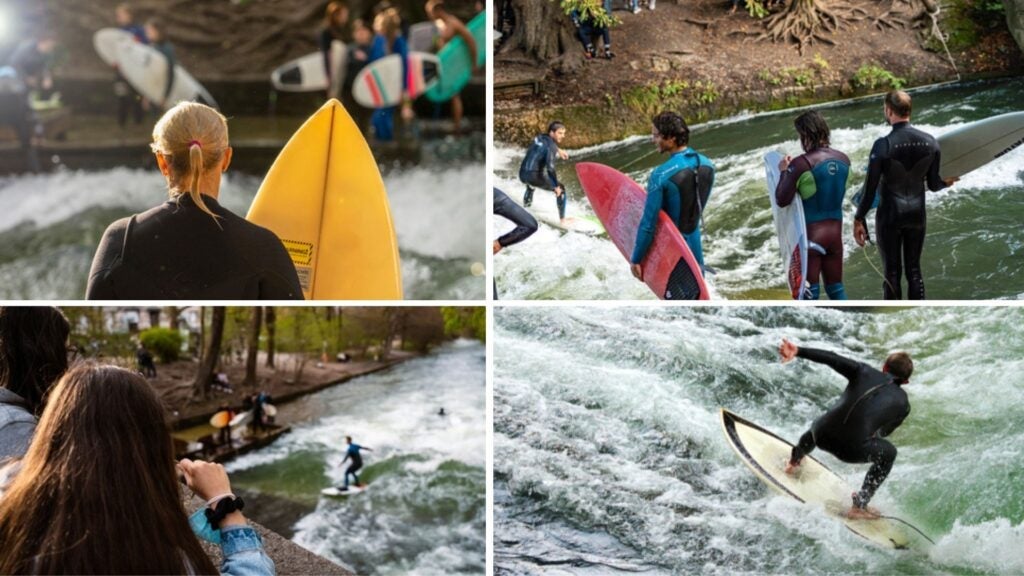
The Eisbach, which in German means “icy stream”, is an artificial canal that runs through the Englischer Garten, the huge urban park that crosses the city. At a very specific point, right at the start of the canal, a fast and powerful current creates a static wave that holds steady twenty-four hours a day.
That’s where surfers in wetsuits meet with their boards and try to master this famous wave while tourists watch from the bridge. Some riders dominate it for years, while others compete here during the summer. Either way, surfing on this corner of the Isar river turned into a hallmark of the capital of Bavaria.
In this guide we’ll explain how the Eisbach wave works, who can surf there, which alternatives exist in the city for beginners, and how much it costs to enjoy this unique experience in the heart of Bavaria.
What’s surfing on the Eisbach Wave like?
The Eisbach Wave is one of those quirks that only Germany turns into a tradition. Right in the middle of the Englischer Garten, just a few steps from the Haus der Kunst museum, the Isar river canal forms a static wave over one metre high. It doesn’t depend on wind or tides, but on the constant flow of water that runs under the bridge. The result is a powerful, fast and icy wave, which explains its name, Eisbach, meaning “ice stream”.
Surfers from all over the world come here to face it with board in hand and thick wetsuit. The water rarely rises above ten degrees, even during summer. The space is tight, the current is strong and the turns are short: Each surfer jumps in, rides for a few seconds and then gives the spot to the next one. This ritual mixes respect with adrenaline and feels closer to urban art than a typical beach sport. So yes, surfing in Munich feels completely different from what you already know.
Unlike ocean waves, the Eisbach wave doesn’t move forward. The board slides over a fixed wall of water. Keeping balance demands extreme precision, so the city restricts it to experienced surfers. Clear signs warn everyone: “Only experienced surfers — Danger of injury or death”. Falls hit hard and the riverbed has rocks, so this spot doesn’t work for learning.
The atmosphere, however, feels incredible. Dozens of people gather on the canal banks to watch the tricks, applaud the moves and feel the roar of the water. On sunny summer days, the bridge fills with photographers, tourists and locals having lunch while they look at the wave. This place blends sport, spectacle and Munich’s urban culture perfectly.
A unique community
Behind the Eisbach there’s a solid community of local surfers who defend their right to surf here for over forty years. During the seventies, when the wave started gaining popularity, the authorities tried to ban it for safety reasons. Local surfers didn’t give up: they protested, negotiated and finally managed to get the wave officially recognised as an urban surfing spot.
Today, the Eisbach Wave stands as a symbol of the city’s identity. Organisers even hold events and competitions such as the Rapid Surf DM (German River Surfing Championship), which brings together the best river surfers in Europe.
Can you surf there as a beginner?
You can’t surf the main wave. However, Munich thought of everyone and just a few minutes from the Englischer Garten you’ll find the E2 Wave, another wave on the same river but much gentler, designed for beginners and intermediate surfers. You can learn there safely, practise turns and gain confidence before you even consider the Eisbach.
Moreover, on the outskirts of the city you’ll find indoor artificial waves, such as the Jochen Schweizer Arena, where professional instructors teach river surfing in controlled conditions throughout the year.
Which other surfing spots exist in Munich?
As we mentioned earlier, there are other options for people who want to surf in Munich but don’t have the level needed for the Eisbach wave. In fact, in recent years the city developed a genuine urban surf culture with alternative spaces designed for every level. From friendlier waves for beginners to cutting-edge indoor simulators, Munich proves that you don’t need the sea to feel the surfing spirit.
E2 Wave: The calm side of the Eisbach
About seven hundred metres downstream from the main wave you’ll find the E2 Wave, a softer and less crowded version of the Eisbach. The current feels weaker, the flow stays more predictable and the atmosphere remains much more relaxed.
This spot works perfectly for beginner and intermediate surfers who want to get used to riding a static wave without the risk of the main canal.
No fixed instructors operate here, but local surfers usually help newcomers and share tips. If you want to practise your first turns, improve balance or simply enjoy the river without pressure, this place offers an ideal starting point.
Jochen Schweizer Arena: Indoor surfing
About twenty minutes from Munich’s city centre, in the town of Taufkirchen, you’ll find the Jochen Schweizer Arena, an extreme sports complex with one of the most advanced artificial waves in Europe.
You can surf here all year long, whatever the weather, and choose different wave heights and speeds. The environment stays fully controlled, with certified instructors, equipment included and sessions tailored to each surfer’s level. The venue also offers a wind tunnel, climbing walls and a restaurant with direct views of the wave. Without doubt, it’s a great place to experience surfing in Munich in a different way.
Citywave Munich (Surf & Style at the airport)
Every summer, Munich Airport turns into an unexpected surfing hotspot: The Surf & Style event, where a Citywave installation appears in the middle of the main hall. This wave imitates the dynamics of an ocean wave but runs with a constant water flow. Because of that, organisers use it for technical training and for sporting events.
For several weeks, professional surfers and amateurs meet here and take part in tournaments, lessons and free exhibitions. The experience feels unique: You surf an artificial wave under the roof of one of Europe’s busiest airports.
Surf parks and future projects
Enthusiasm for urban surfing keeps growing across Germany, and Munich sits at the centre of this revolution. At the moment, planners study projects for new permanent waves on the Isar river and in the Fröttmaning area, designed for public use and learning.
Several gyms and adventure clubs also offer simulators and specific training to maintain balance and strength during the winter months.
Thanks to these initiatives, Munich achieved the unthinkable: it turned an icy river and a landlocked city into a global surfing reference. Whether you stand on the bridge at the Eisbach, enjoy the comfort of an indoor wave or ride under the airport roof, the spirit stays the same. You feel the power of the water, the balance of your body and the freedom of movement, even though the sea lies hundreds of kilometres away.
When’s the best time to surf in Munich?
Surfing in Munich doesn’t depend on tides or wind but on the Isar’s flow and, above all, on the weather. The Eisbach Wave offers a constant wave all year, although the experience changes a lot with each season.
Summer (June to September): The ideal time for most people
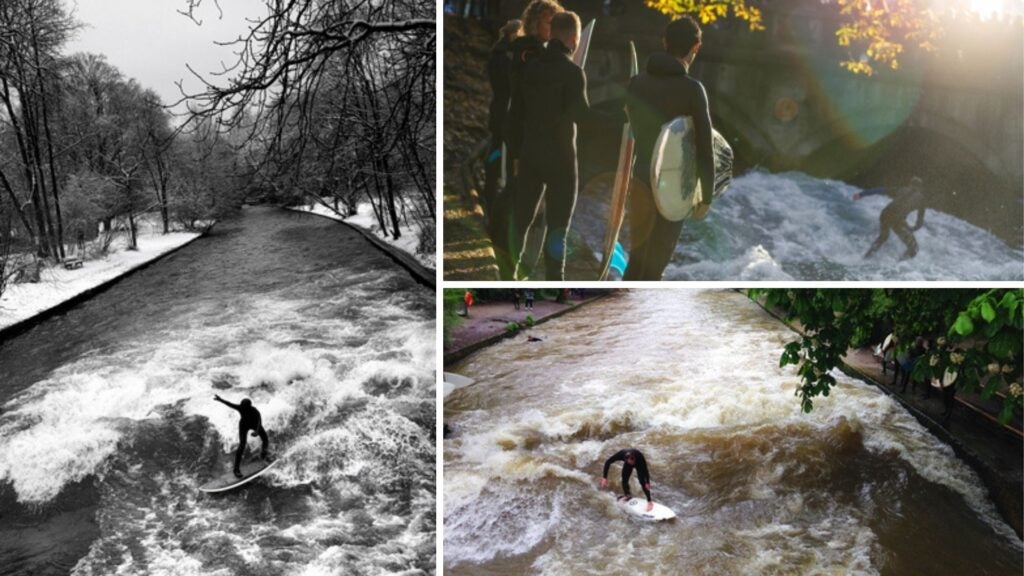
Summer is, without doubt, the best season to surf in Munich. Temperatures hover around 20–30 °C, the sun shines on the Englischer Garten until late afternoon, and the city buzzes with energy.
The water in the Eisbach is still cold (around 12–15 °C), but with a good wetsuit or even without one, surfers can enjoy long, comfortable sessions.
During this season, the spot fills with life. Tourists, locals and photographers gather on the bridge to watch the moves, and the surfing community organises small friendly competitions or shared sessions. It’s the best moment to watch or take part, as long as you have enough experience to handle the current.
Autumn (October to November): Fewer people, more space
When summer ends, air temperatures drop and crowds disappear. Autumn offers a quieter wave and a more local atmosphere. The leaves in the Englischer Garten change colour and the scenery turns magical.
The water drops to around eight to ten degrees, so you’ll need a thick wetsuit (4/3 mm or 5/4 mm) and boots. This season suits surfers who already master river surfing and prefer to practise without many spectators. In fact, many local surfers say that autumn is their favourite season, because you see fewer cameras, enjoy more silence and still feel the same power of the Eisbach.
Winter (December to March): Only for the brave
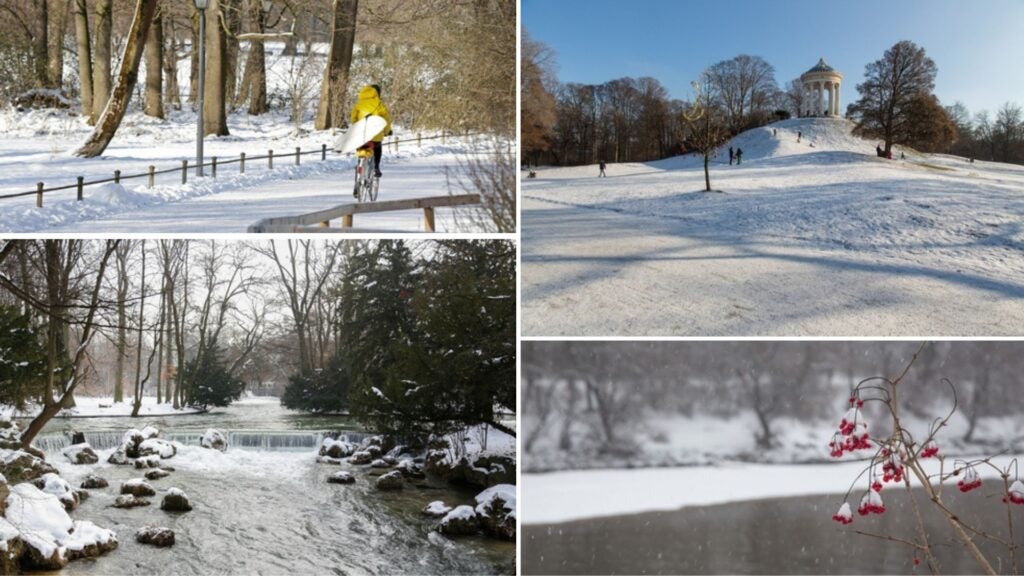
Winter in Munich really tests your limits. Air temperatures can fall below zero, and the Eisbach water stays around four to six degrees. Even so, the most committed surfers, or the most stubborn ones, keep going in with dry suits, gloves and thermal hoods.
Surfing in mid-winter counts as a local tradition and helps people keep their bodies active during the toughest months. Images of surfers riding a wave while snow falls already form part of Munich’s folklore and show that the surfing spirit ignores the seasons.
Spring (April and May): The river comes back to life
Spring marks the gradual return of warmer weather and a renewed river flow. Rain and melting Alpine snow increase the Isar’s discharge, so the wave becomes more powerful and sometimes more technical.
This transition period works perfectly when you want to pick up your surfing again after winter, test new manoeuvres or simply enjoy the city when the Englischer Garten trees start to bloom.
How much does surfing in Munich cost?
Surfing in Munich feels unique, and the best part is that you don’t need to spend much. The Eisbach Wave, the epicentre of European urban surfing, stays completely free and accessible twenty-four hours a day, three hundred and sixty-five days a year. You won’t find entrance fees or special permits here, only unwritten rules of respect and safety.
However, for people who are just starting out or want more controlled conditions, the city offers alternatives with different prices. Indoor waves, surf schools and private sessions let you learn safely and enjoy the sport all year, even under a roof.
Below, we break down the average costs, including equipment hire and the main surfing options in the Bavarian capital.
| Place / Experience | Location | Approx. price (EUR/USD) | Includes | Ideal for |
|---|---|---|---|---|
| Eisbach Wave (free access) | Englischer Garten | Free | Free access to the canal, no instructor or rental | Experienced surfers |
| E2 Wave (secondary Eisbach wave) | Englischer Garten (downstream) | Free | Free access; you should bring your own board and wetsuit | Beginners / intermediates |
| River board rental (half day) | Local shops / surf shops (e.g. SantoLoco, Munich Surfboard Rental) | €20–35 ($22–39) | Board + leash | People who don’t travel with gear |
| Wetsuit rental | Local surf shops | €10–20 ($11–22) | 4/3 or 5/4 mm wetsuit | All year |
| Indoor surf lesson (45 min) | Jochen Schweizer Arena (Taufkirchen) | €39–49 ($43–54) | Instructor, board and wetsuit | Beginners |
| Intro indoor surf course (90 min) | Jochen Schweizer Arena | €69–79 ($76–87) | Guided instruction, equipment and insurance | Entry level / families |
| Advanced session (1 h) | Jochen Schweizer Arena | €55–65 ($61–72) | Instructor, board and customised wave settings | Intermediate / advanced |
| Surf & Style – Citywave event | Munich Airport (summer) | Free (spectator) / €25–35 ($28–39) (surfer) | Citywave, board included, public event | All levels |
| Group river-surf lessons (training on E2 or in a park) | Organised by local instructors | €45–70 ($50–77) | Instruction + equipment | Beginners |
| Urban surf camp (summer) | Different clubs in Munich | €180–250 ($198–275) | Two to three days on indoor waves and the river | Basic / intermediate level |
Approximate surfing costs in Munich
Surfing in Munich can cost you zero euros or turn into a premium experience, depending on how you choose to live it. Here are several tips that’ll help you feel surfing in a different way without spending too much:
- If you’re going to surf the Eisbach or E2, bring your own gear, because you won’t find rental shops on site.
- Thick wetsuits (4/3 mm or more) stay essential for most of the year.
- You should book indoor sessions in advance, especially during winter or at weekends.
- In summer, events such as Surf & Style usually stay free for the public and offer a great chance to watch professionals in action.
Connectivity while you surf in Munich
Whether you travel to Munich only to try your luck on its famous Eisbach wave or combine surfing with remote work, a stable internet connection will help a lot. With either an eSIM for Germany or a subscription to Holafly Plans, you’ll enjoy unlimited data and avoid roaming charges. You save money and skip the hassle of hunting for a local SIM as soon as you land.
The main difference is that with the Germany eSIM you only get data in that country. With Holafly Plans, on the other hand, your connection works in over one hundred and seventy countries. Therefore, the service suits you perfectly if you plan to keep travelling across Europe or the rest of the world while you search for new surf destinations.
Important: If you are a frequent traveler and want to stay connected without worrying about expensive roaming or looking for a new SIM at every destination, Holafly’s subscription plans are for you. With a single eSIM, enjoy internet in more than 170 countries for a fixed price and no surprises on your bill. Travel without limits and connect easily and securely! 🚀🌍

Frequently asked questions about surfing in Munich
Yes. The Eisbach Wave creates a permanent wave that works 365 days a year, even in midwinter. The canal current stays constant and doesn’t depend on rain or tides. Conditions change with each season though. In summer the atmosphere feels festive and the water sits around 12–15 °C. In winter the temperature drops to about 4–6 °C and only the most experienced surfers enter the water.
No. Only experienced surfers use the main wave. Its power, fast current and rocky riverbed create real danger for anyone without river-surfing experience. If you’re starting out, it’s best to practise first on the E2 Wave downstream or at Jochen Schweizer Arena. There you can learn with certified instructors and fully controlled conditions.
Yes, but they don’t operate directly on the Eisbach. Several local schools offer indoor surf courses, balance training and river-surfing technique classes. Urban clubs also organise summer surf camps with sessions on rivers and artificial waves.
River-surf boards are shorter, wider and stronger than ocean boards. They usually measure between 5’2 and 6’0 feet in length, with extra reinforcement on the nose and fins. Conventional sea boards break easily because of the water pressure or contact with rocks. In local shops such as SantoLoco or Bavarian Surfboards you can rent or buy models designed especially for the river.
Yes. Besides Munich, you’ll find waves in Nuremberg (Fuchslochwelle), Plattling, Cologne (Citywave) and Berlin (Wellenwerk). Germany now ranks among the leading countries in urban and river surfing. Local projects use technology that creates constant waves indoors or in canals.