Language


 No results found
Scuba diving in Thailand: Best spots and prices
Explore scuba diving in Thailand: prices, best spots, courses, and tips for an unforgettable underwater adventure.

Scuba diving in Thailand reveals a world that seems limitless: colourful reefs, whale sharks, sea turtles, and visibility that amazes even the most experienced divers. If you’re planning a diving trip in Thailand, this guide provides everything you need to organise your adventure: the best centres and courses for all levels, the most spectacular dive sites (like Koh Tao, the Similan Islands, or Phi Phi), and a clear guide on how much diving costs in this paradise. Prepare to see why Thailand has become one of Southeast Asia’s most complete, accessible, and fascinating diving destinations.
Diving Centres and Courses in Thailand
If you plan to dive in Thailand, you’ll discover a country made for learning, practising, and enjoying the underwater world. From the calm bays of Koh Tao, where most people get certified for the first time, to the vibrant reefs of the Similan Islands, this destination offers schools for every level and travel style.
Koh Tao: Thailand’s Diving School Island
Koh Tao is undoubtedly the epicentre of diving in Thailand. Every year, thousands of travellers take their first plunge here thanks to its relaxed atmosphere, low prices, and crystal-clear waters. Centres like Black Turtle Dive or Buddha View Dive Centre are renowned for their comprehensive PADI courses: from Open Water to professional levels, always with small groups and personalised attention. If you dream of getting certified in a safe, tropical environment, this is the perfect place.
Phuket: Diving with All the Comforts
Phuket is ideal if you want a well-organised diving experience in Thailand with access to iconic sites like Phi Phi, Racha, or King Cruiser. Schools such as All 4 Diving and Super Divers offer everything from the basic Discover Scuba Diving course to Divemaster, with their own boats, certified instructors, and daily trips. Here you can learn while enjoying the lively atmosphere and southern Thai beaches.
Khao Lak: Gateway to the Similan Islands
Between November and May, Khao Lak becomes the starting point for one of Thailand’s top dive destinations: The Similan Islands. Schools like Khao Lak Scuba Adventures or Sea Dragon Dive Center run PADI courses and liveaboard expeditions to some of Southeast Asia’s most impressive reefs. If you already have experience, you can spot manta rays, turtles, and whale sharks in waters with exceptional visibility.
Koh Lanta: Relaxed Diving Amid Postcard Scenery
Further south, Koh Lanta offers a more intimate and relaxed diving experience in Thailand. Centres like Lanta Diver and Hidden Depths Diving run small-group trips to sites such as Hin Daeng, Hin Muang, or Koh Haa, rich in soft corals and tropical fish. It’s an excellent choice if you want to dive away from mass tourism.
Diving Courses in Thailand
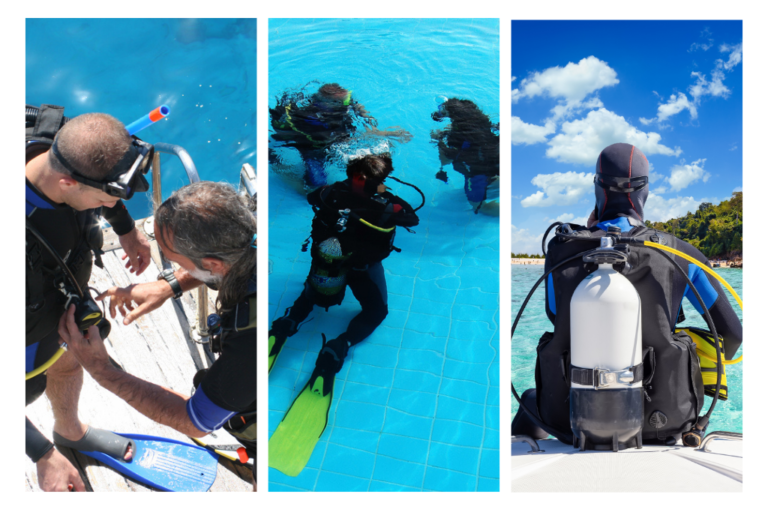
- Discover Scuba Diving: The perfect experience if you want to try diving without committing to a full course. It lasts one day under direct instructor supervision.
- Open Water Diver: Thailand’s most popular diving course. In 3 or 4 days, you get your PADI certification to dive up to 18 metres, including theory classes, pool training, and open-water dives.
- Advanced Open Water: Designed for those with experience. deeper sites, practice underwater navigation, or even try night diving.
- Rescue Diver and EFR: Courses focusing on underwater safety and first aid, highly recommended if you plan to dive frequently.
- Divemaster and Instructor: The professional diving route in Thailand. Many foreigners stay in Koh Tao or Phuket to complete these certifications and work as guides or instructors.
Best Places to Dive in Thailand
Here are the best diving spots in Thailand. Each location has its charm, marine life, and a special reason to be on every diver’s list.
Richelieu Rock (Surin Marine Park)
About two hours by boat from Khao Lak, Richelieu Rock is Thailand’s most legendary dive site. This horseshoe-shaped pinnacle rises alone in the sea, attracting abundant marine life. Between February and April, you might spot whale sharks, plus huge schools of barracuda, moray eels, and tiny nudibranchs. More than a dive site, Richelieu is a full experience: visibility of up to 30 metres, pristine corals, and the deep-blue silence only found far from the coast. Ideal for experienced divers seeking a world-class spot.
The Similan Islands
The Similan Islands are a natural paradise in the Andaman Sea, off western Thailand. Imagine granite boulders covered in corals, clear waters, and manta rays gliding lazily. Notable spots include Koh Bon, Elephant Head Rock, and Koh Tachai, each with unique features: Gentle currents, dramatic drop-offs, or extraordinary wildlife.
The destination shines from November to May, when the park is open and liveaboard cruises explore its corners. It’s Thailand’s jewel for multi-day sea adventures and dives among otherworldly landscapes.
Hin Daeng and Hin Muang
These two open-ocean pinnacles are famous for their red and purple hues, thanks to the soft corals covering them. Daily boats depart from Koh Lanta, and it’s common to encounter oceanic manta rays or even a whale shark.
The feeling here is being in the middle of the ocean: no noise, no land in sight, surrounded by endless blue. The sites are more challenging, with strong currents and depth, but perfect for experienced divers seeking Thailand’s wildest adventures.
Koh Haa
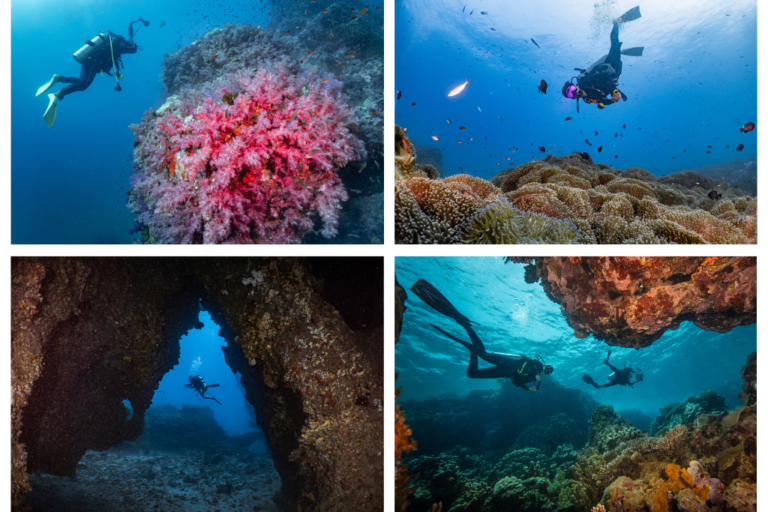
About 25 kilometres from Koh Lanta, the small Koh Haa archipelago (“five islands”) is perfect for calm and beauty. Caves, rock chimneys, and an inner lagoon make it one of Thailand’s most photogenic dive spots. Marine life is abundant: groupers, moray eels, seahorses, and colourful soft corals. Ideal for couples or families, combining gentle dives with dreamlike scenery and turquoise waters.
Racha Noi and Racha Yai
Just one hour by boat from Phuket, Racha Noi and Racha Yai are perfect for beginner divers. Racha Yai has shallow reefs, gentle currents, and rich marine life including clownfish, turtles, and trevally schools.
Racha Noi offers more adventure: deeper walls and occasional manta rays. It’s the perfect balance between comfort and exploration, ideal for a full day of diving without straying far from the coast.
King Cruiser Wreck, Shark Point, and Anemone Reef
This trio forms one of Thailand’s most complete dive circuits. First, the King Cruiser wreck, a ferry sunk in 1997, now covered with corals and schools of fish. Nearby are Shark Point, often hosting resting leopard sharks, and Anemone Reef, covered in anemones and clownfish. A perfect day of varied dives: History, marine life, and colourful underwater landscapes.
Chumphon Pinnacle and Sail Rock
In the Gulf of Thailand, Chumphon Pinnacle and Sail Rock are the top spots if diving from Koh Tao. Chumphon is a deep pinnacle with large barracuda schools, and Sail Rock is famous for its “chimney,” a vertical opening divers can ascend through bubbles.
Both offer excellent chances to spot whale sharks in season and are ideal for newcomers seeking excitement without going too far.
Connectivity While Diving in Thailand
If you dive in Thailand, having good connectivity is very useful for checking dive maps, contacting your school, or sharing your dives without relying on local WiFi. In remote areas, signal can be patchy, and international roaming is usually expensive, so it’s wise to prepare in advance.
The easiest option is a Holafly Thailand eSIM, with unlimited data and instant activation via QR code. You don’t need to change your physical SIM, and you can keep your usual number for calls or messages. Holafly also provides 24/7 technical support in English, ideal if you have questions during your trip.
Important: If you are a frequent traveler and want to stay connected without worrying about expensive roaming or looking for a new SIM at every destination, Holafly’s subscription plans are for you. With a single eSIM, enjoy internet in more than 160 countries for a fixed price and no surprises on your bill. Travel without limits and connect easily and securely! 🚀🌍

How Much Does Diving Cost in Thailand?
Diving in Thailand is not only unforgettable, it’s also one of the world’s most affordable places to learn or enjoy daily dives. Prices vary by island, season, and whether you dive from shore or boat, but overall the value for money is excellent.
- If you’ve never dived before, try a beginner experience from $95 (€88.50) to $120 (€111.70). In places like Koh Tao or Phuket, it includes basic theory, shallow-water practice, and one or two guided dives. It’s a safe, fun introduction without a full course.
- It’s the most popular course and the starting point to becoming a certified diver. In Koh Tao, it costs between $300 and $330 (€280 – 310), including all equipment, theoretical classes, pool sessions, and four open water dives. Thailand is so economical that many travellers choose the country just to get their licence here.
- If you already have experience and want to improve, the next step costs around $300 (€279) to $350 (€325.50). In just two days, you can practice deeper, night, or navigation dives, exploring less-touristy areas.
- If certified, 2- or 3-dive trips range from $120 (€111.70) to $180 (€167.50), depending on distance and whether the package includes equipment or lunch. In Phuket, for example, you can dive the King Cruiser, Shark Point, and Anemone Reef in a single day.
- If your dream is waking each day at sea and diving remote sites like the Similan or Surin Islands, liveaboards start around $500 (€465) for 3–4 nights, with luxury options exceeding $2,000 (€1.860). It’s a unique experience: dawn dives, onboard meals, and views only seen from the ocean.
Frequently Asked Questions about scuba diving in Thailand
The price depends on which side of the country you visit. In the Andaman Sea (Phuket, Khao Lak, Koh Lanta), the best season is November to May, when the sea is calmer. In the Gulf of Thailand (Koh Tao, Koh Phangan, Koh Samui), diving is possible year-round, although conditions are best from June to September.
No. Many centres offer the Discover Scuba Diving experience, designed for beginners who want to try diving without certification. If you enjoy it, you can continue with the PADI Open Water course, which lets you dive up to 18 metres anywhere in the world.
Yes, as long as you dive with certified PADI or SSI centres and follow the instructors’ guidance. Thai dive schools have vast experience with beginners and international travellers and mostly operate under international safety standards.
Most dive cruises in Thailand offer between 3 and 4 dives per day, including one night dive. The number depends on the itinerary and sea conditions, but you’ll always have time to rest and enjoy the scenery.
Dive centres usually include full equipment rental (short wetsuit, fins, mask, buoyancy vest, and regulator). Experienced divers can bring their own dive computer, mask, or fins for comfort.
You can try the Discover Scuba experience, as you don’t need to be a perfect swimmer. However, for certification courses, it’s recommended to have basic swimming skills and feel comfortable in water.