Language


 No results found
Scuba diving in the Maldives: Best spots and prices
Scuba diving in the Maldives is among the best in the world. Discover everything you need to experience an unforgettable underwater adventure.

Imagine descending through crystal-clear waters where sunlight filters like a veil over colourful coral gardens. Tropical fish swim in perfect schools, manta rays glide like silk wings, and in the distance, a hammerhead shark traces its silhouette in deep blue. This is how scuba diving in the Maldives feels, one of the most spectacular destinations on the planet to explore the ocean.
Located in the heart of the Indian Ocean and composed of 26 atolls and more than 1,000 islands, this archipelago is synonymous with vibrant marine life, extraordinary visibility and perfect diving conditions year-round. Its unique geography, channels, outer reefs, lagoons, and thilas (underwater mountains), offer such diverse experiences that no dive is ever the same.
Whether you’re seeking your first dive or have already accumulated hundreds of descents, the Maldives invites you to experience the sea from within: With world-class diving centres, specialised resorts, and a biodiversity that turns each dive into an unforgettable adventure.
Stay with us to learn all about diving in the Maldives, from the best schools to the top dive sites, and get ready for an underwater experience like no other.
What are the main diving centres and schools in the Maldives?
Talking about diving in the Maldives is talking about excellence. With a world-renowned infrastructure, the country combines PADI 5 Star Centres, international instructors, state-of-the-art equipment, and an endless variety of dive sites.
The majority of the centres are located on local islands easily accessible from Malé (the capital of the Maldives): Maafushi and Thulusdhoo (Kaafu Atoll), Rasdhoo, Ukulhas and Dhigurah (North and South Ari), Fulidhoo (Vaavu), and Dharavandhoo (Baa). These islands allow you to enjoy the most iconic reefs without relying on luxury resorts or liveaboards (diving cruises), offering a more authentic and affordable experience.
From small schools with a family-like approach to centres that train professional instructors, each place has its style. Below, we present the most recognised and reliable centres in the Maldives, all operational and highly rated in 2025.
Maafushi Dive & Water Sports – Maafushi (South Malé Atoll)
Located on one of the most accessible islands from Malé airport, Maafushi Dive & Water Sports is one of the most popular centres for those looking to combine diving with local life. It’s a PADI 5 Star Dive Center, with certified instructors offering courses from beginner to advanced levels.
They offer daily trips to nearby reefs like Cocoa Corner, Kuda Giri Wreck or Guraidhoo Channel, where you can commonly see reef sharks, eagle rays, and schools of jacks. They also organise snorkelling and water sports excursions, ideal if you’re travelling with non-diving companions.
The great value for money and the convenience of its location (just 30 minutes by boat from Malé) make it one of the best options for beginners.
Arena Dive Club – Maafushi (South Malé Atoll)
On the same island is Arena Dive Club, a smaller centre but with very personalised attention. It’s associated with the Arena Beach Hotel, making it ideal if you want to have both accommodation and diving in the same place.
They offer all PADI courses, guided dives, and combined packages that include several discounted outings. The most visited sites are Cocoa Thila, Guraidhoo Corner, and Kandooma Caves, areas known for their gentle currents and abundant wildlife.
The centre stands out for its professional and friendly atmosphere. Small groups, new equipment, and a multilingual team are factors that guarantee a safe and relaxed experience.
Sea Star Diving Club – Thulusdhoo (North Malé Atoll)
Thulusdhoo is an ideal island for surfers and divers looking for a quieter environment than Maafushi. Sea Star Diving Club operates there, a highly rated PADI centre with a sustainable approach and a team of local and European instructors.
They organise daily dives to reefs like Lankan Manta Point, where you can see manta rays all year round, and HP Reef, one of the most famous coral walls in the Maldives.
They also offer courses for beginners, snorkelling programmes, reef cleaning, and underwater photography. It’s an excellent option if you want to dive away from mass tourism and be in direct contact with the local community.
Rasdhoo Dive Centre – Rasdhoo (North Ari Atoll)
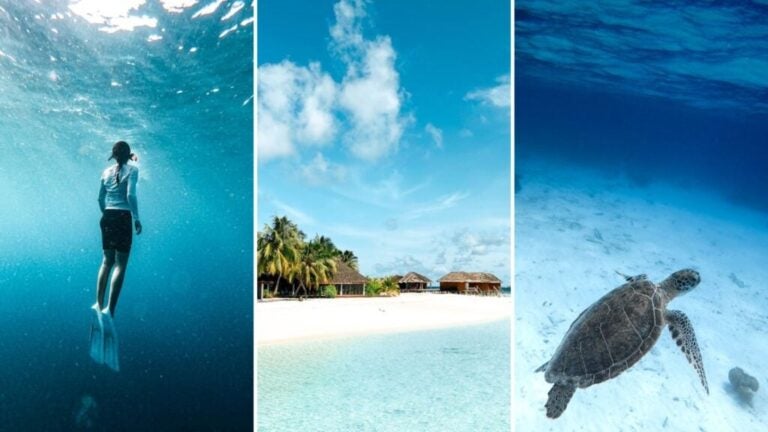
In the heart of the North Ari Atoll, Rasdhoo Dive Centre is a reference for those who want to experience the wilder side of the Maldives. Its instructors know the Madivaru channels perfectly, where at dawn, you can spot hammerhead sharks, eagle rays, and large schools of fish.
They offer PADI courses from beginner to Rescue Diver level, drift dives, and special photography trips. The atmosphere is international, and the service is very personal, making it one of the best choices for intermediate or advanced divers.
Additionally, the island has several boutique accommodations and excellent fast boat connections to Ukulhas and Malé.
Dive Ukulhas & AUOF Dive – Ukulhas (North Ari Atoll)
Ukulhas has become one of the cleanest and most eco-friendly islands in the Maldives, and also an excellent diving spot. Two main centres operate there: Dive Ukulhas and AUOF Dive & Nature Journeys, both PADI 5 Star Dive Centres.
They head to sites like Manta Point and Maaya Thila, where you can commonly see white-tip sharks, turtles, and mantas for much of the year.
Both centres offer full courses, equipment rental, night dives, and marine conservation programmes. Ukulhas is perfect for those looking for a peaceful, authentic experience with quality diving.
Island Divers – Dhigurah (South Ari Atoll)
Dhigurah is the whale shark mecca of the Maldives. The waters to the south of the atoll are part of a protected area where sightings are recorded year-round.
Island Divers is the main local school and works with small groups to maximise the chances of encounters. They offer discovery dives, PADI courses, and guided trips to the Maamigili and Dhigurah Thila reefs, where, in addition to whale sharks, you can spot mantas, turtles, and giant Napoleon wrasse.
The centre maintains a strong commitment to marine conservation and actively participates in species monitoring projects.
Fulidhoo Dive – Fulidhoo (Vaavu Atoll)
Recognised as one of the most awarded PADI 5 Star Dive Centres in the country, Fulidhoo Dive specialises in drift diving and gentle current dives in channels. It’s ideal for intermediate and advanced divers looking for excitement without compromising safety.
Their most popular sites are Alimatha House Reef (where you dive at night with nurse sharks) and Fotteyo Kandu, considered one of the most vibrant channels in the Indian Ocean, with grey reef sharks, eagle rays, and schools of fusiliers.
The centre has a professional yet friendly atmosphere, with passionate instructors and a very eco-friendly approach.
Dharavandhoo Divers – Dharavandhoo (Baa Atoll)
In the Biosphere Reserve of Baa Atoll, lies Dharavandhoo Divers, a centre that operates alongside the Aveyla Manta Village Hotel and is specialised in manta ray diving in Hanifaru Bay.
From June to November, the dives focus on this bay, where dozens of mantas gather to feed. During the rest of the year, diving takes place in nearby spots like Dharavandhoo Corner or Maalhos Thila, known for their abundant pelagic life.
The centre offers PADI courses, daily dives, and small group snorkelling programmes, always under strict conservation policies.
As we have seen, each island in the Maldives is a gateway to a different underwater universe, which is why diving in this island nation is so incredible.
If you’re looking to get trained and dive near Malé, Maafushi and Thulusdhoo are practical options. If your dream is to swim alongside whale sharks or mantas, Dhigurah, Ukulhas, or Dharavandhoo are the ideal destinations. And if you’re after the adrenaline of the channels, Fulidhoo awaits with some of the best drift dives in the Indian Ocean.
What are the best dive sites in the Maldives?
Diving in the Maldives is synonymous with venturing into a mosaic of atolls, channels, and underwater mountains designed to astonish. Each dive has its character: some are gentle and colourful, perfect for beginners, while others feature strong currents that attract large pelagic species.
In total, the country boasts more than 100 registered dive sites, although only a few achieve “legendary” status. Below, we tell you about the most notable ones, selected for their beauty, biodiversity, and diving conditions.
Maaya Thila – North Ari Atoll
Depth: 5 to 30 metres
Recommended level: All levels
Considered the most iconic dive site in the Maldives, Maaya Thila is an underwater mountain (thila) surrounded by coral gardens, caves, and rocky outcrops. It’s famous for its reef sharks, which patrol the area, and for the abundance of moray eels, batfish, Napoleon wrasse, turtles, and barracudas.
At night, the reef comes alive with lobsters, crabs, rays, and sharks hunting, making night dives an unforgettable spectacle. Visibility is around 25 metres, and currents are usually gentle.
Fish Head (Mushimasmingili Thila) – North Ari Atoll
Depth: 5 to 35 metres
Recommended level: Intermediate to advanced
Previously a protected fishing area, Fish Head is now a marine sanctuary. Its name says it all: Literally, there are fish everywhere. The dive takes place around a thila covered in hard and soft corals, where you can see grey reef sharks, giant Napoleon wrasse, grouper, tuna, and snapper.
It’s a site with moderate currents, ideal for drift diving, and one of the favourite spots for underwater photographers due to the water clarity and the dynamism of the fauna.
Kandooma Thila – South Malé Atoll
Depth: 12 to 30 metres
Recommended level: Intermediate
A classic of the South Malé Atoll, known for its coral-covered walls and gorgonians, where reef sharks, eagle rays, Napoleon wrasse, and schools of fusiliers swim.
Currents can be strong, making the diving more challenging but also more exciting. On days with good visibility (which are most), the scene is cinematic: Hundreds of fish swimming in sync over a deep blue background.
Fotteyo Kandu – Vaavu Atoll
Depth: 10 to 40 metres
Recommended level: Advanced
For many, the best diving channel in the entire archipelago. Located off the island of Fulidhoo, Fotteyo Kandu combines coral-covered walls, caves, and tunnels, with a current that drags nutrients and attracts large marine life.
Here you can see grey reef sharks, hammerhead sharks, and white-tip sharks, as well as eagle rays, tuna, and turtles. Between April and September, mantas and nurse sharks are also commonly spotted.
It’s a site for experienced divers looking for pure adrenaline and an unforgettable experience.
Banana Reef – North Malé Atoll
Depth: 5 to 30 metres
Recommended level: All levels
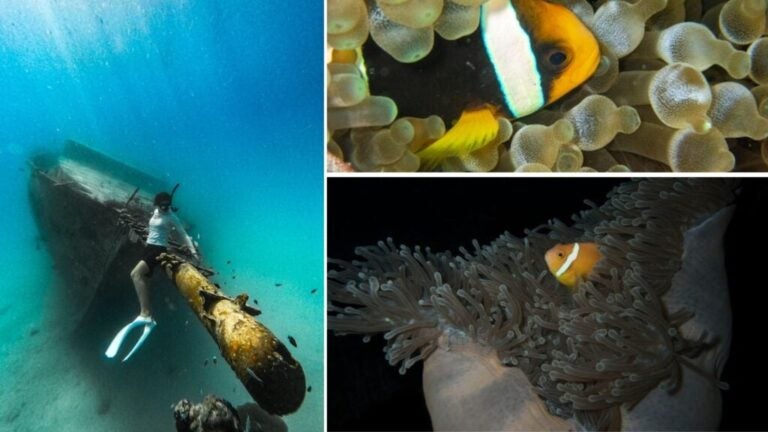
Banana Reef was one of the first dive sites discovered in the Maldives and still retains its charm. Its curved shape, resembling a banana, offers coral walls teeming with clownfish, parrotfish, anemones, moray eels, and rays.
Visibility is excellent, and the currents are mild, making it a perfect spot for beginners or training dives. Additionally, due to its close proximity to Malé, it’s often the first experience for many travellers diving in the archipelago.
Manta Point – North Ari Atoll
Depth: 10 to 25 metres
Recommended level: All levels
During manta season (June to November), this site is a must-visit. At Manta Point, manta rays come to cleaning stations where small fish remove parasites from their bodies.
Diving here is like attending a natural ballet: dozens of manta rays spinning around divers while corals and anemones complete the scene. The current is mild, and visibility can reach up to 30 metres, making it a dive suitable for all levels, especially photographers and lovers of large marine life.
Hanifaru Bay – Baa Atoll (UNESCO Biosphere Reserve)
Depth: 5 to 18 metres (mainly snorkelling)
Recommended level: All levels
Although better known for snorkelling, Hanifaru Bay is one of the most impactful marine experiences in the world. Between June and November, currents bring an abundance of plankton, attracting dozens of mantas and occasionally whale sharks.
Tank diving is restricted within the bay to protect the ecosystem, but diving is allowed in nearby reefs, which offer impressive marine life and visibility exceeding 30 metres.
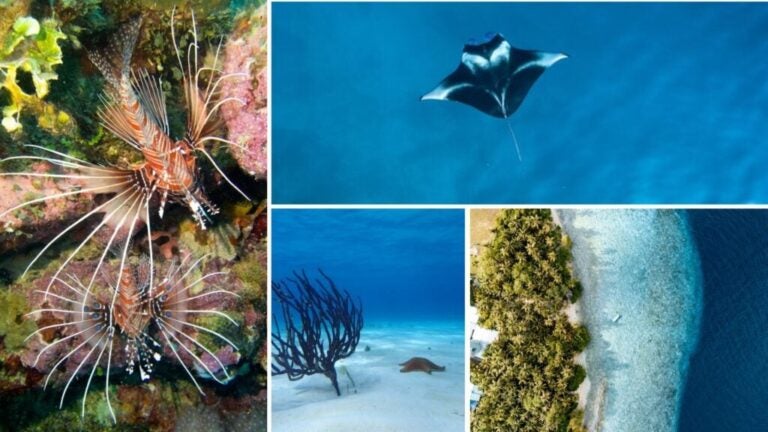
Kudarah Thila – South Ari Atoll
Depth: 5 to 25 metres
Recommended level: Intermediate to advanced
Designated as a protected marine area, Kudarah Thila is an underwater mountain covered in soft corals, fans, and anemones, home to reef sharks, moray eels, Napoleon wrasse, and turtles.
The currents can be intense, but this is exactly what gives the site its life. It ‘s one of the favourite spots for underwater photographers due to its vibrant colours and the opportunities to spot large marine life.
Alimatha House Reef – Vaavu Atoll
Depth: 5 to 20 metres
Recommended level: All levels
This reef, in front of Alimatha Resort, is famous for its night dives with nurse sharks. As the sun sets, dozens of them approach the pier, alongside rays and catfish, creating a safe yet awe-inspiring experience.
During the day, the reef is perfect for relaxed dives, with an abundance of soft corals and tropical fish. It’s undoubtedly a must-do experience for anyone visiting Vaavu Atoll.
Dhigurah Thila – South Ari Atoll
Depth: 8 to 25 metres
Recommended level: All levels
Located near the “whale shark island”, Dhigurah Thila combines lively reefs with the possibility of seeing the giant of the sea in its natural habitat.
Dives here usually include encounters with whale sharks, turtles, and schools of fusiliers, while the coral formations host a large variety of macro life. The current is mild and the sea calm, making it suitable even for beginner divers.
The large number of dive sites in the Maldives only reinforces the beauty for which this destination is known. From the channels with sharks in Vaavu to the coral gardens of Ari, each dive is a living postcard of the Indian Ocean. Whether you seek excitement or serenity, diving in the Maldives offers the best of the sea in its purest form.
How much does diving in the Maldives cost?
You need to know: diving in the Maldives is not exactly cheap, but it’s an experience that justifies every penny. The quality of the centres, safety, biodiversity, and water clarity are among the best in the world. However, prices vary considerably depending on the type of accommodation and the format you choose for diving.
On local islands such as Maafushi, Thulusdhoo, or Fulidhoo, prices are more affordable than at private resorts or liveaboards (diving cruises). Individual dives usually cost between $70 and $110 ($65 – 100), while PADI courses range from $550 to $950 (€510 – 890), depending on the level and area.
Most centres include in the price the complete equipment, guide, boat, snacks, and environmental fees, although some schools apply a small surcharge for Nitrox usage or long transfers to remote sites.
Below is an updated reference with average prices, depending on the experience:
| Type of Experience or Course | Centre or area | Approx. price (USD/EUR) | Includes | Recommended Level |
| Discover Scuba Diving | Maafushi Dive & Water Sports (South Malé) | $90 – 110 (€85 – 100) | Shallow water practice, one dive on a local reef, instructor and full gear | Beginners |
| PADI Open Water Diver Course | Sea Star Diving, Thulusdhoo | $550 – 650 (€510 – 605) | Theory, pool sessions, four open water dives, PADI certification | Beginners |
| Advanced Open Water Diver course | Fulidhoo Dive (Vaavu) | $600 – 700 (€560 – 655) | Five themed dives (deep, navigation, buoyancy, drift, night), equipment and materials | Intermediate |
| Single dive for certified divers | Rasdhoo Dive Centre (North Ari) | $75 – 90 (€70 – 85) | Guided trip, full gear and boat transfer | Certified divers |
| Double Dive (2 tanks) | Dive Ukulhas (North Ari) | $130 – 160 (€120 – 150) | Two dives, snack, guide, and environmental fees | Certified divers |
| Whale Shark Dive | Island Divers Dhigurah (South Ari) | $150 – 180 (€140 – 170) | Two guided dives in the protected area + whale shark search | All levels |
| Night dive with nurse sharks | Fulidhoo Dive (Vaavu) | $110 – 130 (€105 – 120) | One guided night dive + briefing + full gear | Certified divers |
| Full day manta ray excursion (Hanifaru Bay) | Dharavandhoo Divers (Baa) | $140 – 180 (€130 – 170) | Boat transfer, two dives or snorkelling, lunch and drinks | All levels |
| Rescue Diver + EFR Course | Coral Point Malé / Maafushi | $800 – 950 (€745 – 890) | PADI material, theory and practical classes, international certification | Advanced |
| PADI Divemaster Course (Professional) | Fulidhoo Dive or Rasdhoo Dive Centre | $1,000 – 1,500 (€935 – 1,405) | Professional training, unlimited dives, job counselling | Advanced / Professional |
Diving costs in the Maldives
Traveller’s tip: If you plan to do multiple dives, most centres offer discounted packages (e.g., 10 dives for around $600–700 (€560 – 655)). You can also reduce costs by diving from local islands and staying in guesthouses, without sacrificing the quality of the dives.
By the way, if you want to learn more about accommodations, we recommend reading this complete guide on where to stay in the Maldives for a long stay.
Another tip to help you save money is to dive in the low season (May to September), when some centres offer special promotions and combined courses at a lower price.
Connectivity in the Maldives: Between Atolls and Reefs
Travelling to the Maldives is literally a dive into disconnection. Local islands usually have modern infrastructure, but in the middle of the Indian Ocean, the internet signal can vary depending on the atoll.
On more touristy islands (such as Maafushi, Thulusdhoo, Rasdhoo, or Fulidhoo), 4G coverage is good, although during boat excursions or on more remote islands, the connection tends to weaken or disappear entirely.
That’s why many travellers prefer to arrive with a Holafly eSIM for the Maldives, which offers unlimited data from the moment you land in Malé. For longer stays or multi-destination trips, Holafly Plans is a better alternative. With your monthly plan, you’ll get access to a global eSIM that gives you limited or unlimited data in more than 160 countries worldwide, including the Maldives.
So, with Holafly, you can coordinate boat transfers, check maps without depending on hotel Wi-Fi, or upload your photos after a dive without worrying about data usage.
Important: If you are a frequent traveler and want to stay connected without worrying about expensive roaming or looking for a new SIM at every destination, Holafly’s subscription plans are for you. With a single eSIM, enjoy internet in more than 160 countries for a fixed price and no surprises on your bill. Travel without limits and connect easily and securely! 🚀🌍

Frequently Asked Questions about Diving in the Maldives
Yes. The Maldives has a stable tropical climate and water temperatures between 27°C and 30°C year-round. However, the best conditions usually occur from November to April during the dry season, when visibility is at its best, and the sea is calmer.
The most popular atolls are Ari (North and South), Vaavu, South Malé, and Baa, each with its unique charm. In Ari, you can see whale sharks and mantas, in Vaavu, grey and nurse sharks, and in Baa, the famous manta ray aggregations in Hanifaru Bay.
No. If you have never dived before, you can take a Discover Scuba Diving course at any PADI centre in the country. This includes a brief theory class, shallow water practice, and a guided reef dive. If you fall in love with diving (as most people do), the next step would be to do an Open Water Diver course.
The Maldives is one of the richest destinations in the world for marine life. In its waters, you can find manta rays, whale sharks, turtles, reef sharks, Napoleon wrasse, eagle rays, and schools of fusiliers, in addition to countless tropical fish and perfectly healthy corals.
For diving in channels with currents (kandus) or deep dives, it is recommended to have an Advanced Open Water certification and some prior drift dive experience. However, there are plenty of calm sites suitable for beginners, especially in the northern and southern atolls of Malé.
Yes. The centres operate under PADI and SSI standards, have modern equipment, fast boats, and staff trained in first aid and rescue. Additionally, the main hospitals in Malé have hyperbaric chambers, ensuring safety even in the rare case of emergencies.
If you’re looking for good infrastructure and quality diving, Maafushi is the most convenient. For large marine life, Dhigurah and Ukulhas are ideal, while Fulidhoo is perfect for those who prefer a peaceful and natural setting.