Language


 No results found
Scuba diving in Galapagos Islands: Best spots and prices
We’ve gathered the best dive centres for scuba diving courses in Galapagos, along with the top dive spots to explore and discover marine life.

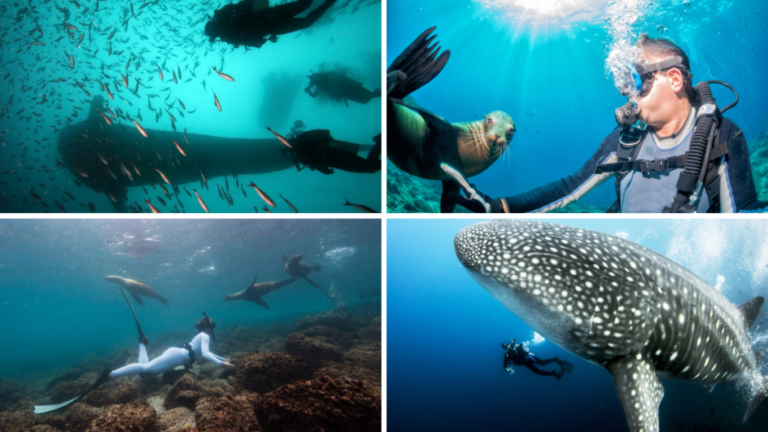
The experience of diving around the Galápagos Islands stays with you forever. Here, you find places filled with marine life found only in this region and calm currents that help you enjoy it.
Here, we’ve gathered information about 3 centres that offer courses for all levels so you can dive with confidence. We also add 3 places where you can dive near large animals that you really can’t miss.
In the end, you’ll discover the costs you’ll assume to swim with sharks, rays, turtles, and a huge variety of tropical fish. Let’s start this dive into the Galápagos Islands!
Diving centres and courses in the Galápagos
Several agencies operate in the Galápagos Islands and help you take that first step to become a diver or improve your underwater technique with the courses they offer. This time, we’ve gathered three agencies with everything you need to enjoy diving on the Islands.
Planet Ocean Galapagos
You’ll find this agency on the Galápagos Island itself, between Teodoro Wolf and Ignacio Hernández streets in San Cristóbal. With them, you can join a diving tour with or without certification, and you can also take a course to earn a PADI certification or specialise in a diving technique.
Planet Ocean includes all tools and equipment necessary for learning and practising diving, so you won’t worry about bringing your own gear. They also use boats to take divers to the best diving spots.
Courses offered:
- Introductory diving: For non-certified divers, you’ll descend up to 12 metres after a short induction.
- Refresher dive: Ideal for divers with experience who stopped diving for 1 year or longer.
- Open Water Course: This course takes up to 4 days and includes theory lessons, pool practice, 2 dives up to 5 metres, and 2 dives up to 18 metres.
- Advanced Open Water Course: You’ll need 3 days to complete it, with theory classes and 5 open-water sessions: drift, navigation, 34-metre depth, night, and buoyancy.
- Rescue diver course: Includes 1 theory class and 4 water sessions. You’ll learn to use essential tools to assist yourself or others during emergencies. It also includes first-aid lessons.
Eagleray Tours
This agency sits on Santa Cruz Island and helps you with everything you need to dive, from the amazing experience of entering the sea without a licence to completing any of their courses with all tools and gear included.
You’ll also rely on their diving boat specially equipped for this sport, so the experience becomes even more interesting. With it, you’ll reach the best diving spots and always carry all tools you need for any situation.
Courses offered:
- Diving introduction: Enjoy diving at shallow depths and decide if you want a certification course. You’ll do two dives in small groups with PADI instructors.
- PADI Open Water Diver Course: Ideal for beginners who want certification. You’ll take theory online and practise in a pool or shallow waters. You’ll learn all diving tools and test them during 4 dives with PADI instructors.
- PADI Advanced Open Water Course: If you already dive in open water and want advanced techniques, take this 5-session course. Two sessions are mandatory: Deep diving and underwater navigation. Choose the other three: Night diving, fish ID, peak performance buoyancy, or drift.
- Rescue Diver Course: Gain confidence to solve problems you or another diver may face underwater.
- Divemaster Course: Learn to lead any type of diving trip for beginners or experts. You’ll study essential techniques to guide other divers.
Aquaventures Dive Center
Their main base sits on San Cristóbal Island, although their work gives them presence across the Galápagos Islands, as they offer tours, ferry transport between islands, and diving courses.
Aquaventures has more than ten years of experience and you can rent technological gear like cameras or computers. You can also rent fins, masks, and diving suits.
Courses offered:
- Beginner open-water diving: This course certifies you as a diver and lets you dive worldwide. It lasts three days and ends with a descent to 18 metres carrying enough knowledge to handle complex underwater situations.
- Advanced open-water diving: In three days, you’ll enjoy five experiences: deep, navigation, buoyancy, drift, and night. This gives you an experienced diver certification.
- Rescue diving: You’ll learn how to manage your own problems or those of other divers underwater, including emergency tools.
- Divemaster course: Ideal if you want to join instructors during group dives and turn diving into your profession. You’ll study all theory required to lead underwater.
The best places to dive in the Galápagos
After completing one of the courses offered by these specialised diving centres, you can enjoy some of the most important places around the islands. Up next, we show you three places you can’t miss during your diving adventure in Ecuador.
Cerro Tijeretas in San Cristóbal
You can reach Cerro Tijeretas through Puerto Baquerizo Moreno and enter the sea from the pier. You’ll find facilities for snorkelling, and they also work as an access point for diving.
Its calm currents make it ideal for beginner divers. You can descend between 5 and 10 metres with up to 20 metres’ visibility in the best conditions.
If you’re an intermediate diver, you can enjoy a descent of up to 25 metres by swimming further out. You’ll discover the variety of tropical fish that colour the seafloor and swim near rays, sharks, turtles, moray eels, and sea lions.
This spot works perfectly for beginners because it offers calm dives near the coast and immediate contact with many marine animals, helping you adapt quickly.
Tortuga Islets on Isabela Island
To enjoy the depths of Tortuga Islets, you must take a boat from Puerto Villamil on Isabela to reach the spot and start your dive.
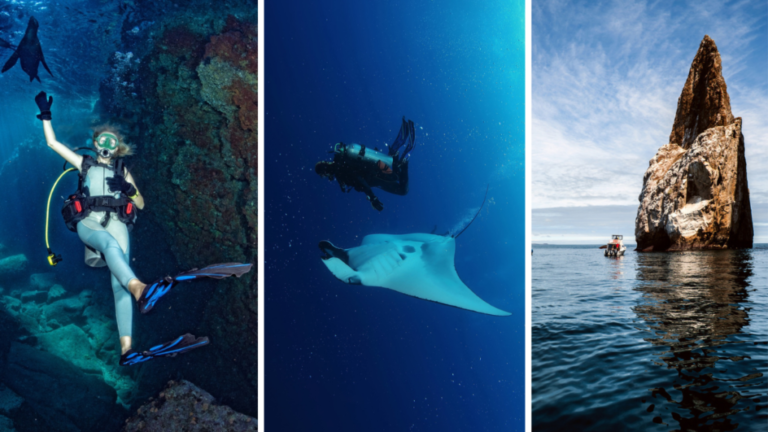
As a small volcanic islet, many animals enjoy a peaceful place to live there. You’ll see hammerhead sharks, mantas, sea turtles, and countless tropical fish and rays.
Bring a camera if you can. This location suits intermediate or advanced divers, as depths can reach over 15 metres. Depth changes appear gradually depending on the area.
This place stands out because few divers visit it. Because of that, more animals show up and conditions usually offer good visibility.
Kicker Rock or León Dormido
This place ranks among the busiest diving spots in the Galápagos, attracting beginners and intermediate divers because it sits near San Cristóbal Island. You reach it by taking a boat that arrives in 45 minutes and gives you a calm-water dive.
This site remains uninhabited by humans and offers crystal-clear waters showing every contrast in the rocky and marine landscape. Underwater, you’ll enjoy visibility of up to 30 metres if currents stay moderate.
This rocky islet guarantees encounters with large animals such as hammerhead sharks, Galápagos sharks, turtles, rays, and mantas. You’ll definitely take some photos.
It’s one of the best diving spots because it sits near San Cristóbal Island, offers an attractive landscape, and suits every diver profile. Its moderate currents give confidence to beginners and greater manoeuvrability for experienced divers.
Connectivity while you dive in the Galápagos
Connectivity matters while you dive because it lets you stay in touch with family and friends. Besides sharing your diving plans, you’ll have internet to upload photos and videos to your social networks without issues.
We recommend choosing one of Holafly’s monthly subscription plans. This gives you internet from the moment you reach Ecuador. You can choose 25 GB or unlimited data. You can share them with other devices and the best part is their global coverage.
If you’ll spend only a few days in the Galápagos Islands, it’s best to install the Ecuador eSIM. You’ll get unlimited data during your stay. Everything works without roaming fees and without replacing your physical SIM.
Important: If you are a frequent traveler and want to stay connected without worrying about expensive roaming or looking for a new SIM at every destination, Holafly’s subscription plans are for you. With a single eSIM, enjoy internet in more than 160 countries for a fixed price and no surprises on your bill. Travel without limits and connect easily and securely! 🚀🌍

How much does diving cost in the Galápagos?
Diving costs in the Galápagos depend on the activity you choose. For example, if you take a course, you’ll also cover food and accommodation during the training days. But if you only take a one-day tour, your expenses change.
Here, we first show you the costs for a course:
- Beginner diving course: Cost €198–212 ($215–230).
- Advanced diving course: Cost €460–598 ($500–650).
- Specialty course: Cost €276–€368 ($300–400).
- Accommodation per day: Cost €37–73 ($40–80).
- Food per day: Mid-range cost €18–36 ($20–40).
Scuba Diving tours
If you choose a diving tour in the Galápagos, several plans offer the full experience, including snacks, meals, equipment, and transport to the diving spots. These are the approximate tour costs:
- One-day tour: Includes diving gear, instructor and guide support, transport, and one meal. Cost €230–257 ($250–280).
- Night dive in San Cristóbal: Includes gear and transport from the pier.
- Cost €184–230 ($200–250). Beginner diving tour: You’ll go at your own pace, with all necessary gear, instructor support, and brief lessons to understand basic techniques. Cost €202–230 ($220–250).
Frequently Asked Questions
Several places offer great experiences, but Darwin Island gives advanced divers the best option. Its strong currents challenge divers and bring exciting encounters with sharks and other species.
You first fly to Quito or Guayaquil in Ecuador. From there, you take a flight that reaches the Galápagos in two and a half hours.
You don’t need to bring your own gear because agencies provide all necessary equipment. However, you can bring yours if you prefer.
Insurance isn’t mandatory, but it helps a lot because diving always involves risks. It prevents unexpected medical or logistical expenses during an emergency.
A diving course usually lasts four or five days, depending on level and content. Beginner and specialty courses often take four days, including theory, practice, and certification tests.