







 Language


 No results found
Scuba diving in Brazil: Best spots and prices
Discover scuba diving in Brazil: prices, courses, and the best spots to dive in reefs, shipwrecks, and crystal-clear waters.

Brazil stands out as one of the most attractive diving destinations in Latin America, thanks to its diverse coasts, reefs and marine parks. In this article, you’ll find a complete guide to organising your scuba diving in Brazil: From the top diving centres and courses to the must-see places for every dive.
Besides, we’ll review the approximate prices, specialised boats and liveaboard options, as well as practical details about connectivity and services. This structured overview helps you plan your trip safely and enjoy every dive in Brazil.
Which are the main diving centres and courses in Brazil?
Brazil offers a wide range of diving centres along its coast, from north to south, many of them affiliated with international organisations like PADI:
- Búzios Divers (Búzios, Rio de Janeiro): This PADI 5-star centre ranks among the region’s most recognised. It organises daily trips to sites like Ilha de Âncora, with trained instructors and full rental gear available. It’s ideal for recreational dives and for beginners starting their Open Water Diver course.
- Oceano Sub: More than a centre, it’s a resort-style diving school. It operates with PADI 5-star standards and stands out for its advanced courses and instructor-training programmes. It’s an excellent choice for divers who want to turn a hobby into a professional path.
- Mares del Sur (MdS Brasil): It offers complete training that combines theory, pool practice and open-water dives. Its programmes cover basic to professional levels, and it also provides equipment maintenance services. Divers value its personalised and comprehensive approach.
- Água Viva Mergulho (Florianópolis): This centre suits beginners perfectly. It offers open-water try dives and basic courses in unique settings such as Ilha do Arvoredo, a marine reserve with rich biodiversity. It gives you an excellent gateway into the Brazilian underwater world.
- Aicá Diving (Recife): Recife is known as the “shipwreck capital”, and this centre makes full use of that. It organises dives in wrecks like Virgo and Taurus, resting around 25 metres deep, plus other vessels that now form artificial reefs. It’s an unmissable experience for lovers of underwater history.
- Other local operators: Besides these well-known names, you’ll find many certified schools listed in international diving guides across the whole Brazilian coast. This ensures that you always have reliable options regardless of your chosen destination.
Diving courses you can find
In Brazil, you can join a full range of courses designed for every diver’s level and interest.
| Course | Level / Purpose | What’s included | Estimated duration | Estimated price in USD* |
|---|---|---|---|---|
| Open Water Diver / Basic | For people who’ve never dived | Theory + pool work / confined water + 4 open-water dives | 3 to 5 days | €446 ($490) Offer from Búzios Divers for PADI course. Some centres also offer an “initial course” at €146–164 ($160–180). |
| Advanced Open Water / Intermediate | For certified divers seeking depth and specialities | Deep dives, navigation, and specialities like deep diving or search & rescue | 2 to 3 extra days | At Água Viva Mergulho: Advanced course with 5 dives and study material. €473–€546 ($520–600). |
| Rescue Diver / Rescue skills | Safety, emergencies and rescue | Rescue techniques, incident management and practical exercises | Varies (extra days) | At Scuba Point: Rescue / first aid listed at €100–118 ($110–130). |
| Wreck Diver / Shipwreck speciality | Speciality focused on wreck exploration | Specific planning, wreck techniques and safety procedures | Speciality course | At Scuba Point: Wreck Diver course listed at €100–118 ($110–130). |
There are also speciality courses such as:
- Nitrox diving (enriched air mixes)
- Deep diving
- Wreck diving
- Night diving
- Underwater photography
- Cold-water or cave diving (where available)
Some centres also offer “residential” programmes or long stays for instructor training. They combine theory, open-water practice and on-site accommodation, as offered by Mares del Sur.
The best places to dive in Brazil If you plan to dive in Brazil, these destinations must appear on your list.
Each one offers unique landscapes, amazing marine life and great diving experiences for every level.
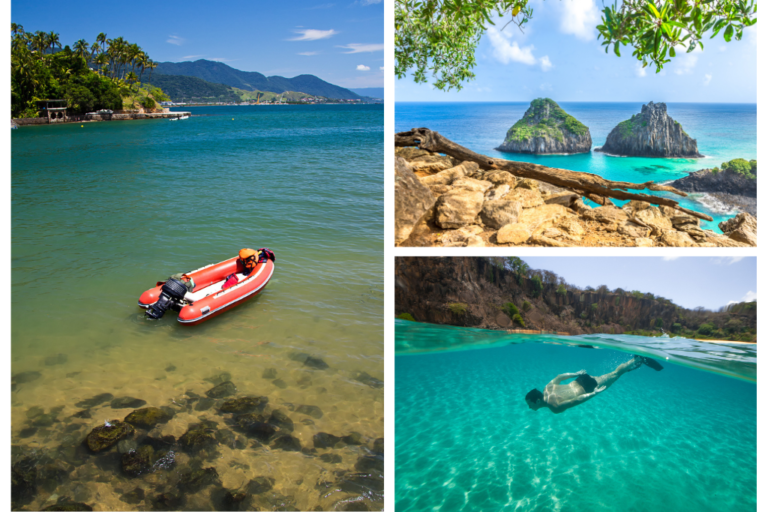
Fernando de Noronha (Pernambuco)
This protected archipelago, located about 340 km off Pernambuco’s coast, ranks as Brazil’s top diving treasure. Its warm and clear waters often offer visibility up to 50 metres, which creates unforgettable diving moments.
You can meet green turtles, reef sharks, rays and huge schools of tropical fish. Fernando de Noronha also hosts resident spinner dolphins, visible on the surface and underwater. Because of its biodiversity and preservation, it suits divers of every level.
Abrolhos (Bahia)
Off the coast of Caravelas lies the Abrolhos Marine National Park, a group of islands and reefs featuring unique mushroom-shaped corals called “chapeirões”.
This place combines colourful reefs with large marine life. Between July and October, thousands of humpback whales arrive to breed, offering incredible sightings even during dives. Moreover, it features historical wrecks and diverse fish species, which makes Abrolhos one of Brazil’s most complete diving destinations.
Recife (Pernambuco)
Known as the “shipwreck capital”, Recife offers more than 20 sunken vessels along its coast, many of them now forming artificial reefs. Well-known wrecks like Virgo and Taurus rest between 20 and 30 metres. The marine life around them includes turtles, groupers and barracudas. This destination suits certified divers wanting to explore the Atlantic’s submerged history.
Arraial do Cabo (Rio de Janeiro)
Only a few hours from Rio, Arraial do Cabo is famous for its clear turquoise waters. The upwelling phenomenon brings cold, nutrient-rich water that attracts many species, from turtles and seahorses to angelfish and moray eels.
Its many dive sites allow try dives and advanced dives, and you can also explore wrecks. This popular destination offers excellent infrastructure, easy access and rich marine life.
Ilha Grande and Angra dos Reis (Rio de Janeiro)
The Costa Verde region features sheltered bays, tunnels and wrecks that attract beginners and experienced divers. One of the most visited wrecks is the Pinguino cargo ship, lying around 18 metres deep and now covered in corals.
The natural beauty of Ilha Grande and Angra dos Reis above the water adds extra charm, which creates a perfect mix of diving and beach tourism.
Laje de Santos (São Paulo)
Located about 40 km offshore, Laje de Santos is a rocky formation shaped like a whale from above. It’s one of Brazil’s best places to see large marine life: Giant manta rays, sharks and big schools often appear during warm months. Visibility usually reaches 20 to 30 metres, and it also features tunnels and an artificial wreck.
Bonito – Lagoa Misteriosa and rivers (Mato Grosso do Sul)
Although far from the coast, Bonito ranks among the world’s top freshwater diving destinations. Lagoa Misteriosa, a flooded cavern with blue and transparent water, offers almost infinite visibility and deep descents in a magical setting. Rivers like the Rio da Prata allow snorkelling and light diving among freshwater fish in crystal-clear water. It’s perfect for divers seeking something different from marine environments.
Arvoredo Biological Reserve (Santa Catarina)
In southern Brazil, off Bombinhas and Florianópolis, lies the Arvoredo Marine Biological Reserve. Its temperate waters host turtles, rays, seahorses and many reef fish. This region’s main diving spot suits beginners and advanced divers. Although visibility is often lower than in the northeast, the biodiversity and rocky scenery make it worth including.
Connectivity while diving in Brazil
Reliable internet during your diving trip in Brazil helps you stay connected, check maps, coordinate with your diving centre, and share underwater moments. A practical choice involves using a Brazil eSIM from Holafly, which lets you connect without physical SIM cards or expensive roaming.
Holafly currently offers monthly plans that work in Brazil, all with unlimited coverage.
- Unlimited Plan: Unlimited data, unrestricted hotspot, global connection and a European number included. From €59.06 ($64.90) per month.
- Light Plan: Includes 25 GB of data with hotspot available, valid in multiple countries. From €45.41 ($49.90) per month.
Important: If you are a frequent traveler and want to stay connected without worrying about expensive roaming or looking for a new SIM at every destination, Holafly’s subscription plans are for you. With a single eSIM, enjoy internet in more than 170 countries for a fixed price and no surprises on your bill. Travel without limits and connect easily and securely! 🚀🌍

How much does diving cost in Brazil?
Diving prices in Brazil vary depending on location, experience type and certification. Here’s a clear summary to guide you.
Try dives or Discover Scuba (if you’ve never dived)
If you want to try diving without certification, try dives offer the perfect start. In Arraial do Cabo, for example, experiences start at €50.96 ($56) with everything included (boat, instructor and gear). In Florianópolis, a try dive around Ilha do Arvoredo costs about €86.45 ($95). In exclusive places like Fernando de Noronha, trips reach €172.90–182 S$190–200). The difference comes from logistics and the richness of the environment.
Guided dives for certified divers
If you already hold certification, a typical two-tank trip in Arraial do Cabo costs around €47 ($52). In remote destinations like Laje de Santos, the price rises to €118.30–122.85 ($130–135) because of longer navigation and park permits. In Fernando de Noronha, trips usually cost €172.90–182.00 ($190–200). In Recife, known for its wrecks, prices range between €100.10–136.50 ($110–150) depending on the centre and personal gear.
Diving courses (PADI)
If you want certification, you’ll find competitive prices. An Open Water Diver in Arraial do Cabo costs about €350.35 ($385). The Advanced Open Water usually costs €355.00–364 ($390–400). In the south, around Florianópolis, advanced courses like Rescue Diver cost about €477.75 ($525), and the first-aid course (EFR) costs about €204.75 ($225). These prices include theory, pool practice, open-water dives and study materials.
Liveaboards and multi-day trips
If you want a full experience, Abrolhos offers catamaran trips for several days. Packages for 2 days / 1 night cost about €509.60 ($560). Packages for 3 days / 2 nights reach €655.20 ($720). Longer trips like 4 days / 3 nights cost around €764.40 ($840). They include cabin, meals, guides and air refills, while personal gear usually costs extra.
Extra costs to consider
Besides the course or dive, you must consider extra costs. Full gear rental usually costs €13.65–18.20 ($15–20) per day when not included. There are also environmental and park fees. In Fernando de Noronha, entry to the National Park costs about €63.70 ($70) for ten days. The daily environmental preservation fee costs €17.29–18.20 ($19–20) per person. In Laje de Santos, you must also buy a marine-park permit valid for one year.
Frequently asked questions about diving in Brazil
Not always. If you’ve never dived, you can join a try dive or Discover Scuba, which doesn’t require certification. However, you’ll need the Open Water Diver course for deeper or regular dives.
Prices vary by city and centre. An Open Water course usually costs between €345.80–364.00 ($380–400), while advanced levels like Rescue Diver cost around €473.20 ($520).
It depends on the region. In Noronha you’ll often see turtles, sharks and dolphins. In Abrolhos, you may spot whales. In Recife, you’ll find groupers and barracudas around wrecks. In Bonito, freshwater fish swim in crystal-clear rivers.
You can dive year-round. However, whale sightings in Abrolhos are best between July and October. The northeast usually has stable weather, while winter in the south requires careful checking.
Yes. In Bonito (Mato Grosso do Sul) you’ll find the famous Lagoa Misteriosa and rivers like the Rio da Prata, perfect for snorkelling and freshwater diving with impressive visibility.


