




 Language
Planning your first trip to Japan? Here’s what no one tells you before you go
Learn exactly how to plan your first trip to Japan in the right order. From flights and hotels to trains and IC cards, here’s what to do and when.

Japan feels like the kind of trip you can’t just book on a whim. From transport and accommodation to language barriers and cultural etiquette, there’s the assumption that Japan requires months of careful preparation.
The truth? Yes, a trip to Japan requires some planning, but it’s not actually as complex as you may think.
All you need is a clear understanding of what to do and in what order. And we’re here to help.
Read on for a simple, step-by-step framework for planning your first trip to Japan in the right order. We’re covering everything from booking flights and choosing where to base yourself, to understanding transport and getting online the moment you land.
How far in advance should you book a trip to Japan?
Depending on the time of year you’re visiting Japan, you should book your international flight and accommodation between 2 and 6 months ahead of your trip.
Peak seasons, such as cherry blossom and autumn foliage, are among the best times to visit Japan, but they also attract the largest crowds. Therefore, it’s recommended to book accommodation around 6 months in advance if traveling during this period. Meanwhile, in the summer and winter, you can generally book around 3 months out.
| Season | When it peaks | Book flights by |
|---|---|---|
| Cherry blossom | Late March to mid April | 5 to 6 months ahead |
| Summer | July to August | 3 to 4 months ahead |
| Autumn foliage | Mid November | 5 to 6 months ahead |
| Winter | December to February | 2 to 3 months ahead |
Most international visitors from the USA, Canada, and Europe fly into Tokyo Narita (NRT) or Tokyo Haneda (HND) and begin their trip there. However, you can also fly into Kansai (KIX), the main international hub for the Osaka/Kyoto/Kobe regions.
Do you need a visa to visit Japan?
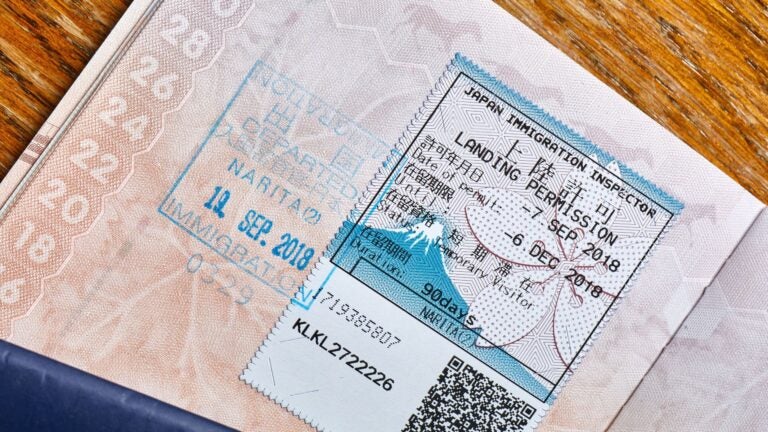
Before booking your trip, it’s a smart idea to run through an international travel checklist to check things like entry requirements.
Most Western passport holders, including those from the USA, UK, EU, Australia, and Canada, can enter Japan visa-free for up to 90 days. This applies to 74 countries and means you don’t need to apply for a visa before your trip; you’ll be granted “temporary visitor” status upon arrival.
Of course, when you are planning a trip to Japan, it’s always a good idea to check your government’s specific travel portal to verify this is the case for you.
Aside from a visa, you should be aware of the following:
- Passport validity: Your passport must be valid for the duration of your stay. Unlike many other countries, Japan does NOT require travelers’ passports to be valid for 6 months beyond their stay.
- Tourist tax: Japan charges departing international travelers a small exit tax of 1,000 yen (about $7 USD). However, you don’t actively pay it at the airport; instead, it’s automatically included in the cost of your airfare. From July 2026, this tax is set to triple to ¥3,000 ( $20).
- Local accommodation taxes: Some Japanese cities, including Tokyo, Kyoto, and Osaka, charge small nightly accommodation taxes. Usually, this is around $1–5 per night, and is either included in the room rate or payable at the hotel.
What to book before you leave (and what’s flexible)

Your international flights and accommodation in major cities like Tokyo and Kyoto are the two main things you should book a few months in advance.
If you’re visiting multiple cities, another thing to get before leaving is the Japan Rail Pass. The pass gives you unlimited travel throughout the country, and you can buy it on the official website or on authorized third-party sites like Klook.
Most attractions, activities, and temples are generally very flexible and don’t require advance booking. Many first-timers assume they have to book all their activities in advance and end up overplanning every hour. But the reality is, Japan is extremely easy to navigate once you’re there, and things can be booked spontaneously.
Another thing that requires careful planning is your luggage. Japan is a four-season country, so what to pack for Japan will depend heavily on when you go.
How to get around Japan as a first-timer

Japan has one of the fastest, most modern, and most reliable railway networks in the world, so taking a train in Japan is a whole experience in itself. The network is incredibly extensive, consisting of local and regional trains, which together cover all four major islands: Honshu, Hokkaido, Kyushu, and Shikoku.
The most common long-distance train network is the Shinkansen (bullet train), which travels up to 320 km/h (200 mph). It connects Tokyo, Kyoto, Osaka, and most major cities. As an example, it takes just over 2 hours to travel between Tokyo and Kyoto by bullet train.
The Japan Rail Pass covers most long-distance trains across Japan, including most Shinkansen. But it does not cover local city metro systems.
For in-city transport, you will need an IC card (Suica or Pasmo). This rechargeable travel card works on trains, subways, and buses in most cities by tapping in and out of stations. You can buy one at any train station or the airport, or get a digital IC card on your phone.
Google Maps works very well for Japan transit navigation as it gives real-time train and bus departure times.
Beyond public transport, taxis are clean and reliable but expensive. Ride-hailing apps are less commonly used than in other Asian countries, but they do exist.
- Uber is the most tourist-friendly ride-hailing app, and it is a very handy Japan travel app to have on your phone. But it is quite expensive and only works in the major cities.
- GO Taxi is another option, which is cheaper than Uber and popular among both locals and tourists.
What first-timers always get wrong about staying connected in Japan
In the past, mobile internet connection for tourists in Japan was a bit tricky. Most physical SIM cards were only available to locals, so most tourists would buy a Pocket WiFi (a small, portable device) at the airport to connect their devices. However, this meant carrying the device everywhere you went.
Thankfully, the situation has changed, and staying connected in Japan is now far easier. eSIM technology is now widespread in Japan, and getting a travel eSIM is the easiest and quickest way to get a mobile connection.
You can install the eSIM before you leave, and then activate data the moment you land. It has completely eliminated the need to queue for a rental WiFi device or hunt down a kiosk that sells SIM cards to tourists.
With instant data from an eSIM, you can use Google Maps, book an Uber to your hotel, and use translation tools with the driver immediately. This is a game-changer considering how much we rely on our phones for travel logistics in a new country, especially in those first hours after landing.
Staying connected as soon as you land with Holafly
A Holafly eSIM not only gives you instant connectivity the moment you land, but also unlimited data throughout your trip for just a few dollars a day. What’s more, as Holalfy connects with the best local mobile networks, you get excellent coverage across all of Japan’s cities and towns.
Plus, Holafly offers a special perk with every eSIM: Always On. You get 1 GB of backup data with every eSIM purchase. Simply keep the Holafly eSIM installed on your device to stay connected whenever travel gets difficult.
Get your Holafly eSIM for Japan here.

Unlimited data. Peace of mind.
Make sure you have travel data that's there when you need it most.
Plans that may interest you


Hi, I'm Mika, a South Korean writer living in the US. I cover travel and live events, focusing on the practical stuff that makes your trip smoother, whether you're navigating a new city or heading to a major international event.I'm also the founder of Search SEOul, South Korea's leading SEO conference, bringing together search marketing experts and speakers from around the world.