Language


 No results found
How to become a flight attendant: Tips & tricks
Thinking about becoming a flight attendant? This guide covers requirements, steps, and tips to help you start your cabin crew career with confidence.

Ever looked out of an airplane window and thought, “I could do this for a living”? You’re not alone. For many, this curiosity is the first step towards a real profession, in a career that offers non-monotony, purpose, and human connection. Becoming a flight attendant isn’t just about travel perks and uniforms. It’s about people, responsibility, adaptability, and building a career that rarely feels routine.
For many, this role offers something traditional office jobs don’t; you’re not tied to one desk or one city. One day you’re helping a nervous flyer feel calm, the next you’re landing in a country you’ve never visited before.
That said, becoming a flight attendant isn’t accidental, or by luck. Airlines look for specific skills, physical requirements, and personality traits. In this guide, we’ll walk through how to become a flight attendant, what airlines actually look for, the requirements to become a flight attendant, and the step-by-step process to get hired.
If you’re serious about this career path, you’re in the right place.
Requirements to become a flight attendant
Before applying, it’s important to understand what airlines expect. While requirements vary slightly by airline and country, most follow similar standards.
Age requirements
Most airlines require flight attendants to be at least 18 or 21 years old at the time of application, depending on the airline and local labor laws. While there is usually no official maximum age limit, some airlines set upper limits around 27 or 30 for entry-level candidates. These limits are often relaxed for experienced cabin crew, because airlines give more importance to fitness, skills, and the ability to perform safety procedures. Many U.S. and European airlines focus on capability rather than age, making career switchers and second-career applicants common in this field.
Height and reach requirements
Rather than listing a specific height, most airlines focus on reach.
- You must be able to reach overhead safety equipment without assistance.
- Typical reach requirements range from 208 to 220 cm (81-86 inches) while standing on tiptoes.
- Having said that, some airlines do mention height minimums like 158 cm for women & 165 cm for men.
Weight is not usually listed, but airlines expect proportional height and weight within a healthy Body Mass Index (BMI) range.
Medical and health certifications
Yes, medical fitness matters. And most airlines require:
- A medical examination after you pass interviews.
- Good vision (correctable with glasses or contact lenses).
- Normal hearing.
- No conditions that would interfere with emergency duties.
Also note that tattoos, scars, or piercings may be restricted, especially if they are visible while wearing the uniform. Each airline has its own policy, so always check before applying.
Language requirements
For international airlines:
- English fluency is required.
- Additional languages are a major advantage.
- Speaking two or more languages can significantly boost your profile.
For domestic airlines:
- English is almost always mandatory.
- Spoken fluency in the local language is expected.
- And speaking two or more languages can significantly boost your profile.
Languages like Spanish, French, German, Arabic, Mandarin, and Japanese are especially valued.
Passport requirements
You must:
- Hold a valid passport.
- Have at least 6 to 12 months of validity remaining.
- Be eligible to travel freely to all destinations served by the airline.
Most airlines help you with the required visas. And they also help you with getting the legal right to work in specific countries.
Swimming
When looking into what you need to become a flight attendant, the ability to swim is a standard requirement. Flight attendants must typically swim at least 25-50 meters unassisted, tread water for a short time, and perform basic water survival tasks. This is usually assessed during training, not at the interview stage.
Customer service experience
While not always mandatory, customer-facing experience is strongly preferred. Examples include:
- Hospitality
- Retail
- Tourism
- Call centers
- Healthcare
- Teaching
Airlines care less about the job title and more about how well you handle people, pressure, and problem-solving.
Steps to become a flight attendant
Now let’s break down how to become a flight attendant, step by step.
Step 1: Research airlines and requirements
Start by identifying airlines you’d realistically like to work for. Look at base locations, route networks, language requirements, and lifestyle and schedules. Every airline publishes its cabin crew requirements online. Read them carefully. This avoids wasted applications and frustration later.
Step 2: Prepare your CV and application
Your CV should be clean, one or two pages long, and focused on people skills, not technical jargon. Highlight customer service roles, safety-related responsibilities, and teamwork and leadership examples. When answering application questions, use real examples. Airlines value authenticity more than scripted answers.
Step 3: Apply online
Most airlines use online portals. Be patient. Hiring cycles can take months. If you’re rejected, don’t take it personally. Many successful flight attendants applied multiple times before getting hired.
Step 4: Improve your language skills
If English isn’t your first language, focus on fluency. You don’t need perfection, but you do need clear communication, and have the confidence to speak to groups. You also need the ability to understand instructions quickly. If you speak only one language, adding a second can set you apart. Online courses, language apps, and speaking practice help a lot with this.
Step 5: If possible, build or improve customer service experience
If you don’t already have customer service experience, start now. This doesn’t mean waiting years. Even 6-12 months in a customer-facing role can make a difference. While studying or preparing, look for roles that involve conflict resolution, teamwork, and direct interaction with customers. Airlines love candidates who already know how to stay calm under pressure.
Step 6: Prepare for interviews and assessment days
Assessment days often include:
- Group exercises.
- Role-playing scenarios.
- One-on-one interviews.
- Reach and appearance checks.
Airlines are evaluating how you communicate, work in teams, handle stress, and follow instructions. Be friendly, attentive, and professional. You don’t need to be loud or extroverted. Calm confidence goes a long way.
Step 7: Complete training
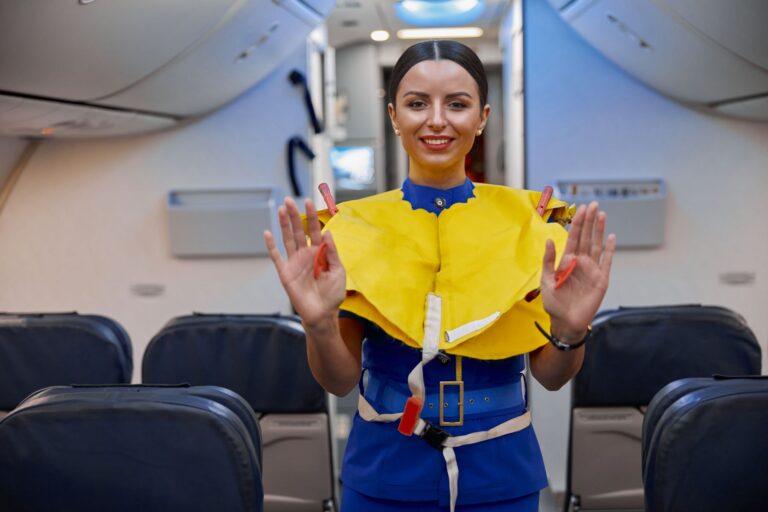
If you’re selected, airline training follows. This training includes safety procedures, emergency drills, first aid demonstrations and hands-on practice, service standards, and most importantly, aircraft familiarization. This training is intense, but it’s designed to prepare you fully. Passing it means you’re officially ready to fly.
Extra courses that can help
You don’t need expensive certifications to get hired, but some courses can strengthen your profile. While these are not official requirements to become a flight attendant, they can help you stand out during the selection process. Helpful options include:
- First aid and CPR.
- Hospitality or tourism diplomas.
- Language courses.
Tip: Be cautious of flight attendant schools that promise guaranteed jobs.
Perks of becoming a flight attendant
Let’s talk about the benefits, both obvious and less talked about. You get:
- Free or discounted flights, along with standby travel benefits for family members.
- Access to destinations most people only dream about, plus the confidence that comes with navigating different cultures and countries.
- No 9 to 5 schedules!
- Clear career growth opportunities, including roles such as purser or lead cabin crew, trainer, recruiter, or management.
- Options to transition into corporate aviation or international positions later in your career.
- A strong sense of community, with cabin crew often describing their colleagues as a second family.
- Daily exposure to people from different backgrounds, perspectives, and life stories.
- Long-term personal growth, including emotional intelligence, crisis management, and confident communication under pressure.
Important: If you are a frequent traveler and want to stay connected without worrying about expensive roaming or looking for a new SIM at every destination, Holafly’s subscription plans are for you. With a single eSIM, enjoy internet in more than 160 countries for a fixed price and no surprises on your bill. Travel without limits and connect easily and securely! 🚀🌍
Is this the right career for you?
If the idea of combining responsibility with travel excites you, then yes, this path is worth pursuing. And the first step starts right where you are. Becoming a flight attendant isn’t about fitting into a mold. It’s about showing airlines that you’re reliable, adaptable, and genuinely enjoy working with people. If you’re wondering what you need to become a flight attendant, the answer is simpler than it seems: Strong communication skills, a service mindset, and the willingness to learn. The rest can be built step by step.