Language


 No results found
Discover the best flight schools in the USA
A detailed guide to the best flight schools in the USA, covering locations, programs, costs, and whether they accept international students.

Choosing a flight school isn’t like choosing a regular college. You’re not just picking a campus. You’re also choosing where you’ll spend hundreds of hours in the air, who’ll sit next to you in the cockpit, and how confidently you’ll step into your first pilot role.
And if you’re searching for the best flight schools, the options can feel overwhelming. Should you opt for big universities? Or specialized academies? Accelerated programs or traditional paths? And every school claims to be “the best.” So how do you actually compare them?
For this list of the best flight schools in the USA, we focused on factors that truly matter to aspiring pilots: Quality of training, fleet and facilities, program structure, location, and overall reputation in the aviation industry. These aren’t random picks. Each school here has a proven track record of producing well-trained, job-ready pilots.
1. Embry-Riddle Aeronautical University (ERAU)
Embry-Riddle is often the first name that comes up when people ask about the best flight schools in the U.S. And for good reason! This is one of the most recognized aviation universities in the world. What sets Embry-Riddle apart is how deeply aviation is built into everything they do. Flight training here isn’t an add-on. It’s the core. Students can pursue degree programs such as Aeronautical Science while completing their flight training at the same time. This structured approach works especially well for students who want both academic depth and professional flight experience.
Location
Embry-Riddle has 2 campuses in the United States:
- Daytona Beach, Florida – East Coast campus near an international airport.
- Prescott, Arizona – Western campus set in a region with diverse flying conditions.
How long is the course?
Embry-Riddle doesn’t offer a single, standalone flight course. Instead, flight training is built directly into its undergraduate degree programs, including options like the Bachelor of Science in Aeronautical Science (Professional Pilot). These programs take around 4 years to complete and offer a mix of core academic coursework with structured flight training leading up to instrument and commercial pilot ratings.
Does it accept foreign students?
Yes. Applications are reviewed on an individual basis, and international students must meet the university’s academic requirements. This typically includes submitting credential evaluations and proof of English proficiency such as TOEFL or IELTS scores if English isn’t your first language.
Do applicants have to pass an entrance test?
Admission follows standard university criteria, including completion of high school (or an equivalent qualification) and proof of English proficiency. Flight training readiness is evaluated after enrollment, and many students begin the program without any prior flight certifications.
Cost
Program fees at ERAU are made up of these components:
- University tuition and fees (billed per credit or per block of coursework). For U.S. undergraduate students, this is typically around $45,000-47,000 per year, excluding flight training costs.
- Flight training costs are charged separately on a pay-as-you-go basis and vary based on aircraft type and hours flown. Students often budget roughly $20,000-30,000 per year for this.
2. CAE Phoenix Aviation Academy
CAE Phoenix Aviation Academy is a highly respected, airline-focused flight school designed for students who want a way into commercial aviation. As a primary training hub in Arizona, the academy runs multiple airline cadet programs in partnership with carriers from around the world. In fact, CAE trains more pilots for more airlines each year than any other organization globally. Training here is structured, professional, and closely aligned with real airline operations. Students train on a modern fleet of aircraft and simulators, following standardized procedures that mirror what airlines expect from day one.
Location
Based at Falcon Field Airport in Mesa, Arizona, a well-known training-friendly airport with favorable flying conditions year-round.
How long is the course?
The length of training at CAE Phoenix depends on the cadet program a student is enrolled in, as each airline follows its own structure.
- American Airlines Cadet Academy:
This program includes FAA ground school and flight training. The full course can take up to 56 weeks, depending on training pace and progression.
- JetBlue Gateway Select Program:
A multi-phase program that spans approximately three to four years, covering everything from private pilot training to airline preparation and instructor training.
- Southwest Airlines Destination 225° Cadet Pathway:
Divided into phases, this one includes flight training, commercial and instrument ratings, followed by instructor training. Timelines vary by phase and student progression.
Does it accept foreign students?
Yes. CAE Phoenix Aviation Academy accepts international students, though eligibility requirements vary depending on the specific airline cadet program. Some programs may have nationality, visa, or right-to-work restrictions tied to airline partnerships.
Do applicants have to pass an entrance test?
Yes. Admission is selective and program-specific. Applicants are typically assessed through a combination of academic review, English proficiency, medical certification, and aptitude or assessment testing required by the airline cadet program they are applying to. Final acceptance depends on meeting both CAE and airline partner criteria.
Cost
Costs vary depending on the airline cadet program selected:
- American Airlines Cadet Academy (CPL Program): Approximately $97,468.
- JetBlue Gateway Select: Around $110,000.
3. ATP Flight School
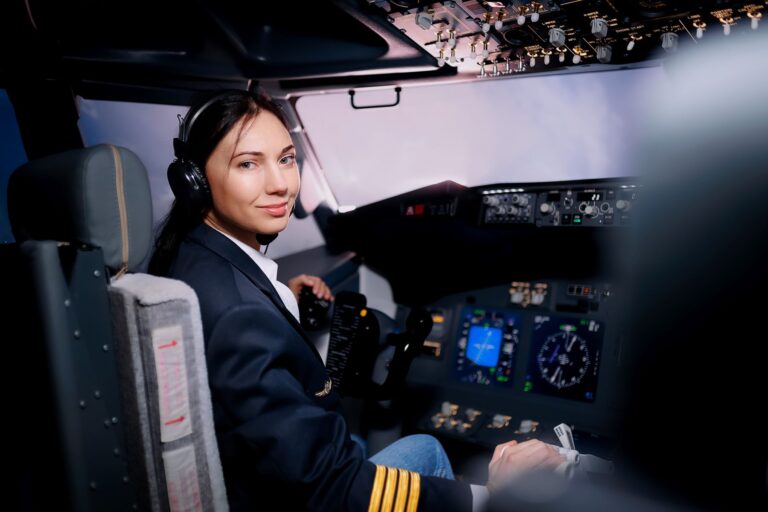
ATP Flight School is an accelerated, airline-focused training academy built for students who want the fastest possible path from zero flight time to an airline cockpit. Its flagship Airline Career Pilot Program is designed as a single, all-inclusive training solution that covers every required certification, along with structured airline-oriented procedures and long-term career support. ATP is widely known for its strong airline relationships and standardized training model, and it has helped thousands of pilots transition into airline careers since its founding in 1984.
Location
ATP operates 85 flight training centers across the United States, making it one of the most geographically accessible flight schools in the country. Training locations are based at major and regional airports, including cities such as Atlanta, Chicago, Jacksonville, Las Vegas, Raleigh-Durham, Richmond, San Diego, and Albuquerque, among many others.
How long is the course?
The duration of ATP’s Airline Career Pilot Program depends on a student’s prior flight experience:
- 12 months for students starting from zero flight time.
- 11 months for students with solo flight credit.
- 9 months for students who already hold a Private Pilot Certificate.
After completing the program, many graduates build additional flight time by working as ATP flight instructors before transitioning to airline roles.
Does it accept foreign students?
Yes. ATP Flight School accepts international students, although eligibility may vary by training location and visa availability. International applicants must meet FAA medical and licensing requirements and comply with U.S. visa regulations.
Do applicants have to pass an entrance test?
Admission to ATP is selective: Applicants are evaluated based on medical eligibility, academic background, English proficiency, and overall readiness for an accelerated training environment. The program is fast-paced, so students must demonstrate the ability to commit to full-time, immersive training.
Cost
ATP offers fixed-cost pricing based on a student’s starting experience level:
- $116,995 for students starting from zero flight time.
- $96,995 for students with credit for solo flight.
- $86,995 for students with a Private Pilot Certificate.
The program cost includes flight training, simulator time, ground school, training materials, and career support. Financing options and airline-sponsored tuition assistance is available to eligible students.
4. University of North Dakota’s John D. Odegard School of Aerospace Sciences
The University of North Dakota’s John D. Odegard School of Aerospace Sciences is considered to be one of the best flight schools in the USA. It’s home to the largest and most respected collegiate aviation programs in the world. But for this list, we are focusing only on their Bachelor of Science in Aeronautics with a major in Commercial Aviation, a degree designed for students who want a strong academic foundation paired with professional flight training. The program includes aviation-focused coursework, flight training, and liberal arts, preparing graduates for a wide range of aviation careers.
Location
The University of North Dakota is located in Grand Forks, North Dakota, USA.
How long is the course?
The Commercial Aviation degree is a full-time, on-campus program that typically takes 4 to 5 years to complete and requires 120 credit hours. Students get to choose between two primary training tracks:
- Airplane track: Leads to FAA commercial pilot certification in single-engine and multi-engine aircraft, an instrument rating, a jet transition course modeled after airline training programs, and a flight instructor certificate.
- Helicopter track: Focuses on rotorcraft training and includes private, commercial, instrument, and flight instructor certifications using high-performance training helicopters.
Does it accept foreign students?
Yes. The University of North Dakota accepts international students into its Commercial Aviation program. International applicants must meet university admission standards, visa requirements, and any applicable FAA regulations for flight training.
Do applicants have to pass an entrance test?
Admission follows standard university criteria rather than a standalone flight-school entrance exam. Applicants must meet academic requirements, including:
- A minimum 3.25 unweighted high school GPA for first-year students.
- A minimum 2.60 GPA for transfer students.
- Submission of official academic transcripts.
Cost
UND is widely regarded as one of the better-value options among U.S. collegiate aviation programs. For the Bachelor’s degree in Commercial Aviation, on-campus tuition and fees are approximately $13,477.92 per academic year. Financial aid is available, with a significant percentage of undergraduate students receiving assistance each year.
5. Purdue University
Purdue University’s Professional Flight undergraduate major is designed for students who want a structured, hands-on path into professional aviation. Offered through the School of Aviation and Transportation Technology, the program combines flight training with in-depth aviation coursework, leadership development, and industry exposure. Students build strong foundations in flight operations, aircraft systems, safety management, meteorology, and aviation law, while training in Purdue’s modern aircraft fleet and advanced simulators. The program emphasizes professionalism and industry standards, preparing graduates for careers as commercial pilots, and flight instructors.
Location
The Professional Flight program is based in West Lafayette, Indiana, USA.
How long is the course?
The Professional Flight major is a full-time, on-campus undergraduate program requiring 120 credit hours. Standard completion time for this is 4 years, but eligible students can graduate in 3 years through Purdue’s Degree in 3 option with careful course planning.
Does it accept foreign students?
Yes. Purdue University accepts international students into the Professional Flight program. International applicants must meet university admission requirements, English proficiency standards, visa regulations, and FAA-related requirements for flight training.
Do applicants have to pass an entrance test?
There is no standalone flight-school entrance exam. Admission is based on standard university criteria, including academic performance and required documentation. Once enrolled, students must maintain a minimum “C” grade in aviation-related courses, and a 2.0 cumulative GPA to graduate.
Cost
Purdue bills undergraduate tuition and mandatory fees separately from flight costs. For a typical full-time undergraduate student, annual tuition ranges roughly around $9,600 per year for a resident, and $13,500 per year for a non-resident. Purdue’s flight training courses are charged per flight course or simulator lab.
Important: If you are a frequent traveler and want to stay connected without worrying about expensive roaming or looking for a new SIM at every destination, Holafly’s subscription plans are for you. With a single eSIM, enjoy internet in more than 160 countries for a fixed price and no surprises on your bill. Travel without limits and connect easily and securely! 🚀🌍

Ready to take flight?
These are some of the best flight schools in the USA. And while all of them offer something slightly different, they share a few critical strengths such as providing structured, professional training environments, having experience working with international students, and most importantly, producing pilots who are employable, confident, and well-trained. If your goal is to become a pilot and train in the United States, starting with one of these schools puts you on a strong footing from day one. And on a path that actually takes off.