Language


 No results found
The best flight schools: Check our worldwide top 5
A guide to the best flight schools for pilots, covering locations, costs, entry requirements, and international student options.

Choosing one of the best flight schools to become a commercial pilot isn’t just an academic decision; for many, it’s the first real step into a global aviation career. And for this, some students prefer to train close to home. Others pack a bag and cross continents to log flight hours under different skies, get better infrastructure, or sign up for airline-aligned programs.
In this guide, we’re looking at the best flight schools in the world, not just based on reputation, but on factors that matter when you’re investing serious time and money. We’ve looked at the quality of training and aircraft, airline partnerships and graduate outcomes, location and flying conditions, acceptance of international students, and most importantly transparency, and credibility. It’s designed to help you compare your options globally, and make the right choice for yourself.
1. CAE Civil Aviation – Integrated CPL – Melbourne Pilot Training Program
Why it made our top 5
CAE Civil Aviation is a globally respected name in airline pilot training, and its Melbourne programme stands out for its structure, depth, and regulatory alignment. The Integrated Commercial Pilot Licence with Multi-Engine Command Instrument Rating (CPL MECIR) is designed to meet the minimum licensing requirements for employment with commercial airlines. What sets this programme apart is how comprehensive it is, from classroom-based aeronautical knowledge to extensive flight and simulator training. The course fully complies with CASA Part 61 standards and prepares students for both licensing exams and real-world airline operations.
Upon successful completion of the programme and all required assessments, students are awarded:
- Private Pilot Licence (PPL).
- Multi-Engine Class Rating.
- Multi-Engine Instrument Rating.
- Commercial Pilot Licence with Multi-Engine Command Instrument Rating.
Location
Melbourne, Australia.
How long is the course?
This is a full-time, integrated programme with a duration of 15 months.
The course leads to a Commercial Pilot Licence with a Multi-Engine Command Instrument Rating (CPL MECIR) and includes both theoretical and practical training. While CAE offers multiple pilot training pathways globally, this specific programme in Melbourne follows a single, structured training route.
Does it accept foreign students?
Yes. International students are accepted. Applicants must meet English language requirements based on their visa type. For international applicants, an IELTS score of 5.5 or higher is recommended.
Do applicants have to pass an entrance test?
There is no standalone entrance exam listed, but applicants must meet several eligibility and competency requirements. You must:
- Be 18 years or older at the start of training.
- Be eligible to hold an Australian Security Identification Card (ASIC).
- Be able to obtain a CASA Class 1 Medical Certificate.
- Meet English language requirements relevant to their visa (international students).
Cost
Approx. $68,520 (AUD 101,350), inclusive of GST.
2. FlightSafety International
Why it made our top 5
FlightSafety International is one of the most respected names in global aviation training, known for setting industry benchmarks in simulator-based instruction. Unlike traditional ab initio flight schools, FlightSafety focuses heavily on advanced, professional-grade training using some of the most sophisticated flight simulation technology in the world. What earns FlightSafety a spot in our top 5 is its uncompromising emphasis on safety, precision, and real-world preparedness. Training here goes beyond ticking regulatory boxes. It’s about developing calm decision-making, situational awareness, and confidence. With FAA-, EASA-, and internationally approved programs, FlightSafety is trusted by airlines, corporate operators, and government agencies worldwide.
Location
FlightSafety International operates multiple training centers worldwide, with major locations in:
- United States: Vero Beach (Florida), Dallas, Wichita, and several other cities.
- Europe: United Kingdom, France.
- Asia: Singapore, Tokyo.
- Africa: Kenya, South Africa.
And even in Brazil and Australia. Its global footprint allows students to train close to where they plan to operate.
How long is the course?
FlightSafety offers multiple training programs, rather than a single, fixed-duration course. And the program length varies depending on the training path, aircraft type, and certification level. Options include professional pilot training programs, aircraft-specific type ratings, advanced and recurrent training, and customized, master-level instruction. Courses can range from a few weeks to several months, depending on the objective and regulatory requirements.
Does it accept foreign students?
Yes. FlightSafety International accepts international students across many of its training centers. International applicants must meet visa, medical, and regulatory requirements based on the country and certification authority under which they plan to train.
Do applicants have to pass an entrance test?
Admission depends on the type of program selected. Applicants are typically evaluated based on:
- Medical certification eligibility.
- Regulatory and licensing prerequisites.
- Program-specific assessments or interviews.
- Previous flight experience (for advanced programs).
Cost
Costs vary significantly depending on the type of program, aircraft and simulator used, duration of training, and location. As a result, pricing is custom-quoted, and applicants are encouraged to contact FlightSafety directly for accurate estimates based on their training goals.
3. Singapore Flying College
Why it made our top 5
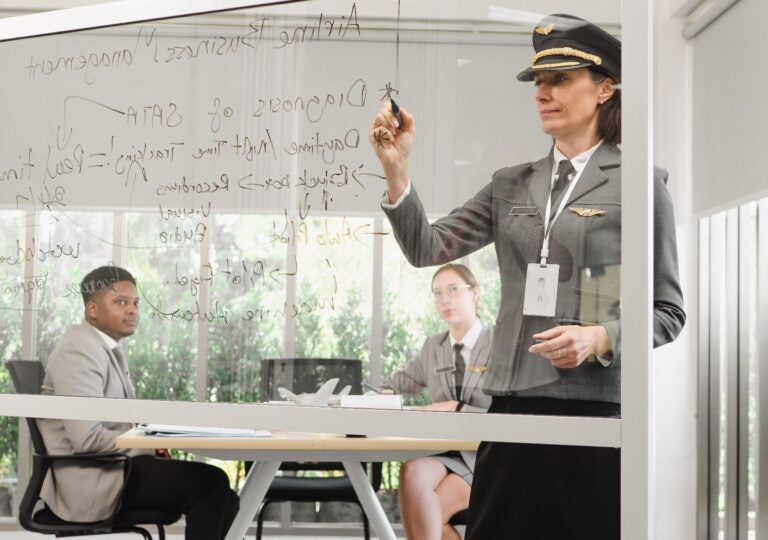
Singapore Flying College (SFC) is the training arm behind one of the world’s most respected aviation ecosystems. As an Airline Training Organisation, SFC is known for its disciplined approach, high training standards, and strong regulatory oversight. Their CAAS Commercial Pilot Licence (CPL) with Multi-Engine Instrument Rating (MEIR) programme is designed as a structured, end-to-end pathway for aspiring commercial pilots. What sets SFC apart is its balance of rigorous ground school, advanced simulator sessions, and extensive real-flight experience, all delivered by seasoned aviation professionals. Its reputation for producing airline-ready pilots earns it a solid place in our global top 5 best flight training schools.
Location
- Ground School: Singapore.
- Flight Training: Jandakot Airport, Western Australia, Australia.
This dual-location structure allows students to complete theory training in Singapore and benefit from Australia’s ideal flying conditions for practical instruction.
How long is the course?
The CAAS CPL MEIR programme follows a two-phase structure:
- Phase A – ATPL Ground Studies (Singapore):
Approximately 6 to 8 months, covering all 14 CAAS ATPL theory subjects along with internal examinations. - Phase B – Flight Training (Western Australia):
Includes a minimum of 200 flight hours, with at least 35 hours on multi-engine aircraft, plus simulator training and Upset Prevention and Recovery Training (UPRT).
Does it accept foreign students?
No. This programme is primarily open to Singapore citizens and Singapore permanent residents.
Do applicants have to pass an entrance test?
While there is no listed standalone entrance exam, applicants must meet strict selection and medical criteria. Candidates are expected to demonstrate academic readiness, suitability for flight training, and must meet the medical standards set by the Civil Aviation Authority of Singapore (CAAS).
Cost
Estimated program fees range between $108,753 and $124,289 (SGD 140,000 and SGD 160,000). Final costs may vary, and applicants are advised to confirm updated fees directly with Singapore Flying College.
4. Embry-Riddle Aeronautical University (ERAU)
Embry-Riddle Aeronautical University (ERAU) is widely regarded as one of the top aviation universities in the world and is frequently part of the conversation around what the best flight schools are for future pilots. By mixing rigorous academic degree programs with professional-level flight training, Embry-Riddle offers more than a traditional standalone flight school experience. Students can earn a Bachelor’s degree in Aeronautical Science or related aviation fields while completing the flight hours and certifications required to become a commercial pilot. Graduates leave with a strong mix of theory, hands-on flight experience, and aerospace industry credibility.
Location
Embry-Riddle operates major campuses in the United States:
- Daytona Beach, Florida: East Coast campus near an international airport.
- Prescott, Arizona: Western campus set in a region with diverse flying conditions.
How long is the course?
Embry-Riddle does not offer just a single flight course. Instead, flight training is integrated into its undergraduate degree programmes, such as the Bachelor of Science in Aeronautical Science (Professional Pilot). These degrees typically take 4 years to complete, combining core academics with required flight training towards commercial pilot and instrument ratings.
Does it accept foreign students?
Yes. Admissions are evaluated individually, and international applicants must meet academic standards and provide required documentation such as credential evaluations and English proficiency evidence (e.g., TOEFL/IELTS) if English is not their first language.
Do applicants have to pass an entrance test?
Admission depends on the standard university admissions criteria, which include academic qualifications (high school completion or equivalent) and proof of English proficiency. Flight training readiness is assessed once enrolled; many students start their degree without prior certifications.
Cost
Costs at Embry-Riddle are made up of several components:
- University tuition and fees (billed per credit or per block of coursework). For U.S. undergraduate students, this is typically around $45,000-$47,000 per year, excluding flight training costs.
- Flight training costs are charged separately on a pay-as-you-go basis and vary based on aircraft type and hours flown. Students often budget roughly $20,000-$30,000 per year for this.
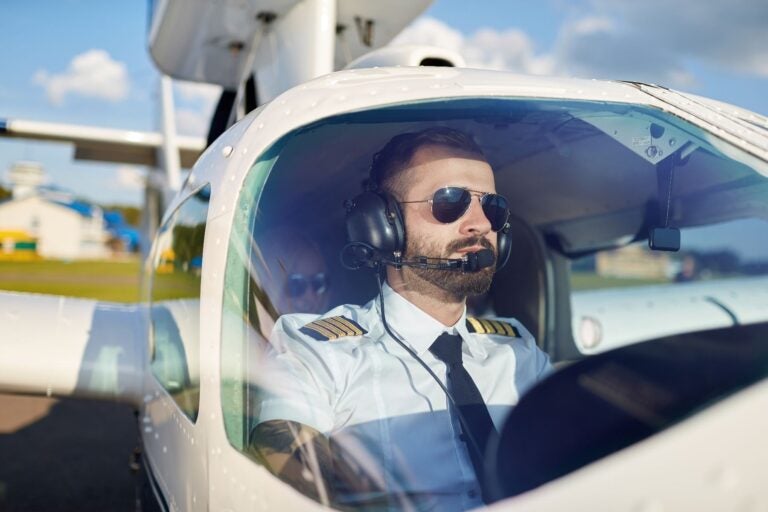
5. British Columbia Institute of Technology (BCIT)
British Columbia Institute of Technology (BCIT), in partnership with the Pacific Flying Club (PFC), offers one of the most industry-focused and fast-tracked commercial pilot programs in Canada. What makes this programme stand out is its fully integrated structure that combines hands-on flight training with aviation-specific academic education and a recognized post-secondary diploma. BCIT is one of Canada’s largest aviation training institutions, while Pacific Flying Club brings decades of real-world flight training experience, modern aircraft, and strong industry accreditation. Together, they deliver a program designed to produce airline-ready pilots with both technical flying skills and a solid understanding of the aviation business.
Location
BCIT operates major campuses in Canada:
- Academic training: BCIT Aerospace and Technology Campus, British Columbia.
- Flight Training: Boundary Bay Airport, Delta (near Vancouver), British Columbia.
How long is the course?
The Airline and Flight Operations Commercial Pilot Diploma is a 64-week, full-time program delivered over four terms. It is a single, integrated pathway designed to take students from zero or minimal flight experience through to commercial pilot qualifications while earning a post-secondary diploma.
Does it accept foreign students?
Yes. This program accepts international applicants. International students must hold a valid BCIT study permit before beginning the programme.
Do applicants have to pass an entrance test?
Yes. Admission is competitive and follows a two-step selection process.
Step 1: Entrance requirements
Applicants must meet academic and assessment criteria, including:
- English language proficiency.
- Mathematics requirements.
- BCIT Abstract Reasoning and Mechanical Reasoning assessments.
- A Transport Canada Category 1 Aviation Medical Certificate.
- Completion of a mandatory applicant questionnaire.
Step 2: Selection process
Shortlisted applicants are required to complete a Multiple Mini Interview (MMI), which assesses overall suitability for a professional aviation career.
Cost
Estimated full-program costs (subject to change) are approx. $63,014 (CAD 87,047) for domestic students, and approx. $84,645 (CAD 116,929) for international students. Additional costs include examination and licensing fees which cost approx. $1,364 (CAD 1,885). There’s also a commitment fee (non-refundable) of $723 (CAD 1,000) for domestic students and $4,343 (CAD 6,000) for international students.
Important: If you are a frequent traveler and want to stay connected without worrying about expensive roaming or looking for a new SIM at every destination, Holafly’s subscription plans are for you. With a single eSIM, enjoy internet in more than 160 countries for a fixed price and no surprises on your bill. Travel without limits and connect easily and securely! 🚀🌍

Choosing the best flight school for yourself
There is no single “best” option for everyone. Some students want airline-backed training programs. Others want flexibility, faster timelines, or global exposure. What matters is choosing a school that fits your budget, accepts international students smoothly, trains you in real-world aviation environments, and aligns with where you want to fly geographically and professionally. The best flight schools in the world don’t just teach you how to fly. They prepare you to operate in an industry where standards, communication, and adaptability matter every day.