







 Language


 No results found
Cost of living in Indonesia: Food, transport, and more
Cost of living in Indonesia in 2026: rent, food, transportation, internet, and leisure to see if it fits your budget.

Living in Indonesia can be both an exciting and surprisingly affordable experience, especially when you look closely at the cost of living and how flexible it is for different lifestyles. In this article, you’ll find a clear, practical overview of what it actually costs to live in Indonesia in 2026, covering key expenses like housing, food, transportation, utilities, and entertainment.
Indonesia is known for its sharp contrasts: you can live comfortably on a modest budget in smaller cities or less touristy areas, while popular hubs like Bali or Jakarta can significantly increase your monthly expenses if you’re aiming for a more international or upscale lifestyle. Eating out is generally very affordable, but rental prices can vary widely depending on the neighborhood and type of property. In the following sections, we break down these essential costs to give you a realistic picture, help you plan ahead, and decide whether Indonesia fits your plans for a temporary move.
Average cost of accommodation in Indonesia
Accommodation plays a major role in the cost of living in Indonesia, and prices can vary greatly depending on where you choose to live. What you pay will depend on the city, the neighborhood, and the type of property you prefer. Below, you will find an overview of the most common options, focused on comfortable mid range housing rather than luxury properties or very basic rentals.
Furnished apartments
If you’re planning to stay for several months, this is usually the most practical and well rounded choice. A furnished apartment gives you the freedom to cook your own meals, work from home, and enjoy your own space without relying on outside services.
In major cities like Jakarta, or in urban areas outside the main tourist hotspots, a well located one bedroom apartment with basic amenities typically ranges from $170 to $360 per month. In Bali, particularly in areas with strong international demand, prices are noticeably higher, usually between $680 and $1,050 per month, especially in central or highly sought after neighborhoods. Moving slightly away from the main tourist zones can make a significant difference to your monthly budget.
Mid-range hotels
Mid range hotels are a common choice during your first few weeks, especially while you are getting to know the city or searching for a long term place to live. They may not be luxurious, but they provide comfortable rooms, daily housekeeping, and convenient locations.
In cities like Jakarta, the average cost of a three star hotel is around $20–30 per night. This makes it a convenient and affordable option for short stays, but over time it usually ends up being more expensive than renting an apartment.
Colivings
Coliving has become very popular in Indonesia, especially in Bali. It’s perfect for remote workers looking for a sense of community. These spaces typically include a private room, shared common areas, reliable Wi-Fi, and often cleaning services and social events.
While convenient and a great way to settle in, coliving is usually more expensive than a traditional rental. Prices can vary widely depending on the location and season, and are typically charged by night or month. The focus is more on the experience and social connections than on saving money.
If you are considering this option, here you can find a clear and up-to-date guide to the best colivings in Bali and how to choose the one that best suits you.
Airbnb for monthly stays
Airbnb can be a great choice if you want flexibility and a place that’s ready to move into from day one. There are plenty of listings designed for month long stays or longer, both in major cities and popular tourist areas.
Keep in mind that monthly rates are usually higher than renting directly from a local landlord. Still, if you want to skip the initial paperwork and enjoy immediate comfort, Airbnb can fit well into your budget for the first few months.
Overall, housing plays a key role in the cost of living in Indonesia and can accommodate a wide range of lifestyles and budgets. Choosing the right city and type of accommodation makes all the difference between keeping expenses low or paying more for location and amenities.
Cost of food in Indonesia
Food is one of the most enjoyable aspects of living in Indonesia. By shopping for everyday items and eating at local warungs or regular restaurants instead of touristy places, you can enjoy good meals at very affordable prices.
To give a clear idea, a well known international chain with a strong presence in Indonesia, AEON (RAISA AEON Indonesia), was used as a reference, with prices taken from their online store.
Food prices at the supermarket (AEON)
| Product | Price in USD |
| Pasta (San Remo spaghetti 500 g) | $1.24 |
| Eggs (Kip telur ayam negeri 10 units) | $2.06 |
| UHT milk (Ultra Milk 1 L) | $1.17 |
| Chicken (skinless breast ~280–300 g) | $1.29 |
| Beef (~280-300 g) | $3.52 |
| Chocolate (Coklat Monggo Dark 58% 40 g) | $2.07 |
| Ground coffee (JJ Royal Toraja Blend 200 g) | $5.30 |
Basic groceries in Indonesia are usually very affordable, but items like specialty coffee or imported products can be much more expensive. How much you spend on these extras can have a big effect on your overall cost of living in Indonesia.
Eating out as a resident: Breakfast, lunch, and dinner
Indonesia really shines when it comes to dining out, as meals at local restaurants can be very budget friendly.
- Breakfast (warung/simple local food): Around $1.18.
- Lunch (inexpensive restaurant, designed for residents): Average $1.78.
- Dinner (inexpensive restaurant): Typically around $1.78–3.55.
Transportation prices in Indonesia
Transportation is one of the more affordable parts of the cost of living in Indonesia if you plan it well. How much you spend depends on the city and how you get around. Most locals combine public transport, motorbike taxis, and ride hailing apps, which is much cheaper than relying on a car every day.
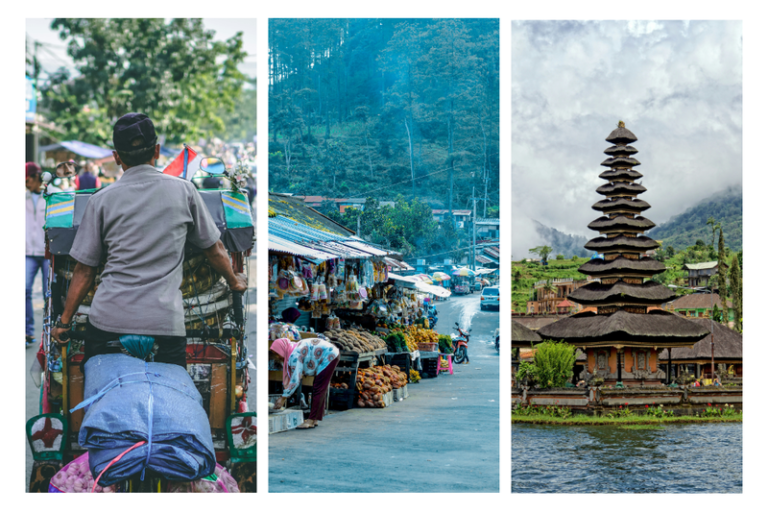
Public transportation: Cheap and functional (especially in Jakarta)
Not all cities in Indonesia have a metro system, but Jakarta is a good example of how many people get around every day. The TransJakarta bus rapid transit costs about $0.21 per trip, while the MRT (metro) fares range from $0.30 to $0.89 depending on the distance. Commuter trains (KRL) are also very affordable, starting around $0.18 and increasing gradually with longer routes.
In Jakarta, careful planning can make daily transportation cheaper than a cup of coffee. In smaller cities, there might not be a metro, but local buses and minibuses still make getting around easy and affordable.
Taxis and apps
It’s worth noting that Uber isn’t available in Indonesia. Instead, Grab and Gojek dominate the market and are widely used for everyday travel.
Motorbike taxis are by far the most common way to get around, thanks to their speed and ability to navigate traffic. Short trips typically run from $0.60 to $3, depending on distance and demand, while car rides are a bit pricier but still reasonable.
For many residents, these apps completely replace owning a car, especially in congested urban areas.
Gasoline and electricity
If you choose to have a car or motorbike, fuel usually isn’t a major expense. Gasoline costs around $0.59 to $0.73 per liter, depending on the type, which is quite affordable compared with many Western countries.
For electric cars, electricity costs about $0.09 per kWh. Energy expenses are low, but charging infrastructure is still more developed in major cities than in rural areas.
Bicycles
Bicycles are used, but they aren’t a primary way to get around in most cities. Hourly rentals are available for about $0.60 to $2.40, and bike sharing is offered in select areas, particularly in Jakarta.
This is a practical option for short trips or rides, rather than for traveling long distances on a daily basis.
Vehicle insurance
In Indonesia, vehicle insurance is usually based on a percentage of the car’s value. Comprehensive coverage typically ranges from 1% to 4% of the vehicle’s value per year. For a popular car, that works out to roughly $150 to $580 annually, depending on the level of coverage.
How much does a new vehicle cost?
If you’re considering buying a car, the Toyota Avanza is one of the most popular models in Indonesia and beyond. A new one typically costs between $14,400 and $16,700.
Transportation can be surprisingly affordable in Indonesia if you follow the local approach. Using public transit, ride hailing apps, and motorbike taxis lets you get around efficiently without stretching your budget.
Healthcare costs in Indonesia
When it comes to the cost of living in Indonesia, healthcare is something worth understanding early on. It’s not necessarily expensive, but the system works differently from many other countries, so it’s important to know what services are available to foreigners and what you might need to arrange on your own.
Can foreigners access public healthcare?
Indonesia has a public healthcare system called BPJS Kesehatan. Foreigners can access it, but usually only if they have legal residency (KITAS or KITAP) and stay in the country for more than six months, typically for work or investment purposes. In many cases, enrollment is handled directly by the employer.
In practice, BPJS can significantly cut healthcare costs, but it works through assigned clinics and referrals. This means you don’t always have the freedom to choose your hospital or doctor, and waiting times can be longer than in private healthcare.
Cost of the public system (BPJS)
If you meet the requirements, the monthly premiums are very low compared to other countries:
- Class 1: Around $9 per month.
- Class 2: Around $6 per month.
- Class 3: Around $2.50 per month.
The difference between classes is mainly related to the type of hospital room, rather than the quality of medical care.
Private health insurance
Many expats go for private health insurance, either alongside the public system or on its own. The appeal lies in quicker access to care, the ability to choose your clinic, and sometimes coverage that extends internationally.
- Basic private insurance for one person usually costs around $90–100 per month.
- There are both basic and more comprehensive plans, but the cost largely depends on factors like age, coverage options, and whether hospitalization or medical evacuation is included.
How much do medical consultations and treatments cost?
In private clinics (the ones most commonly used by foreigners), prices are usually quite reasonable:
- General medical consultation: Between $20 and $50.
- Consultation with a specialist: Between $50 and $100.
- Basic tests or exams: Between $10 and $50
For a common procedure like an appendectomy, costs can vary depending on the hospital and type of surgery, but they generally range from around $475 to $2,650. Even at the higher end, it’s still cheaper than having the same procedure in many Western countries without insurance.
Over-the-counter medications
Basic medications in Indonesia are inexpensive and easy to find in pharmacies:
- Paracetamol: Around $0.25.
- Ibuprofen: Around $0.22.
- Antiallergics (cetirizine): Around $0.40.
- Common antacids: Between $0.15 and $0.70.
Prices for internet and calling plans
Internet and connectivity are a key part of the cost of living in Indonesia, especially if you work remotely or rely on your phone for getting around, ordering rides, or staying in touch. The good news is that reliable internet is generally affordable, but it’s worth understanding your options to avoid overpaying or running into limitations.
Fixed internet at home
If you rent an apartment or stay in one place for several months, the usual choice is a fiber optic internet connection. It’s stable, fast enough for video calls and online work, and generally reliable in larger cities and urban areas.
Most common plans offer speeds between 50 and 200 Mbps, typically costing around $14 to $29 per month. With a mid range plan of 75–100 Mbps, you can work smoothly, stream content, and connect multiple devices at the same time. There’s usually a one time installation fee at the start, but it’s a minor expense.
Local mobile plans
In Indonesia, most people use prepaid mobile plans or short term packages that cover a few days or weeks. Data is usually purchased on its own, with call or text packages added as needed.
There are budget friendly options, with call packages costing less than a dollar and monthly plans around $10 that include both data and minutes to other networks. For everyday use like messaging, occasional calls, and apps, these plans are generally sufficient and fit well within the cost of living in Indonesia.
Holafly Plans
Holafly’s monthly plans are especially useful if Indonesia is part of a longer trip or if you want to avoid the hassle of local SIM cards. A single eSIM gives unlimited data, lets you share your connection, and works in over 160 countries without needing to swap cards or adjust any settings.
The plans are billed monthly, starting at $49.90, while the unlimited data plan is around $64.90. This makes them very convenient for remote work, frequent video calls, or traveling between countries in Southeast Asia.
Important: If you are a frequent traveler and want to stay connected without worrying about expensive roaming or looking for a new SIM at every destination, Holafly’s subscription plans are for you. With a single eSIM, enjoy internet in more than 160 countries for a fixed price and no surprises on your bill. Travel without limits and connect easily and securely! 🚀🌍
Cost of leisure activities in Indonesia
It wouldn’t be complete to talk about the cost of living in Indonesia without looking at how you spend your free time. Here’s a simple, practical overview of what you might spend on activities that many locals and travelers enjoy, like going to the movies, visiting parks or temples, subscriptions, and more.
Going to the movies is a simple and common outing in Indonesia. At popular chains like XXI or CGV, a standard ticket usually costs between $3 and $5, depending on the city and showtime. It’s an affordable option for a relaxed afternoon.
For theater, shows, or cultural events, prices vary depending on the type of performance and the venue. Many local events are priced similarly to a movie ticket or just a bit higher, especially at cultural centers in larger cities.
For family outings or outdoor activities, zoos and amusement parks are generally very reasonably priced. A standard zoo ticket usually starts around $8, while larger parks or those with full experiences can cost up to $35–40, depending on what’s included.
For home entertainment, streaming services are priced similarly to other countries. A monthly subscription to platforms like Netflix, Disney+, or Amazon Prime usually ranges from $8 to $15, depending on the plan, making it a common expense for those who spend a lot of time at home.
Entrance fees to tourist sites
Indonesia stands out for how affordable many of its tourist and cultural sites are. Admission to temples, national parks, and iconic landmarks is often surprisingly cheap.
For example, visiting famous temples in Bali, like Uluwatu, costs about $2. Other popular spots, such as the Sacred Monkey Forest in Ubud, charge around $5–6 for entry.
Even in heavily visited destinations, most entry fees for temples, waterfalls, or national parks rarely exceed $7–8, as long as you’re sticking to the basic admission without extra activities.
How much does it cost to live in Indonesia?
Looking at housing, food, transport, internet, and leisure together, the cost of living in Indonesia can fit different lifestyles. For a single person living comfortably without luxury, with a modest apartment, a mix of local meals and supermarket groceries, public transport or ride apps, and reliable internet, monthly expenses usually fall between $700 and $1,000, depending on the city and area.
For a couple, sharing housing and expenses makes a big difference. Monthly costs usually range from $1,200 to $1,600, allowing for a comfortable life, occasional outings, and good connectivity. For a family of four, with a larger apartment, extra groceries, and school or family leisure expenses, monthly costs typically fall between $2,000 and $2,500. In all cases, living in highly touristy areas like Bali can raise these numbers, while other cities tend to be more affordable.
Frequently asked questions about the cost of living in Indonesia
Yes, for many foreigners, the cost of living in Indonesia is lower than in Europe or North America. The key is to adjust your lifestyle by eating local, choosing the right neighborhood, and avoiding areas that are purely tourist focused.
The most expensive areas are usually Bali, especially Canggu, Seminyak, and Ubud, and some central parts of Jakarta. However, you can still keep your budget under control by choosing areas just outside the most popular neighborhoods.
Someone who mixes supermarket shopping with meals at local restaurants usually spends between $150 and $250 per month. Eating out at spots frequented by locals is affordable and helps keep the monthly budget low.
No. Fixed internet and local mobile plans are quite affordable. Plus, if you travel between countries or work remotely, options like Holafly’s monthly plans make staying connected much easier.
Absolutely. Many people get around daily using public transport, motorbike taxis, and apps like Grab or Gojek, which keeps costs low. Owning a car is not necessary for a comfortable lifestyle.
Plans that may interest you


Hi! I'm a Spanish-English translator working with Holafly, helping bring travel content to life for curious travelers. As a digital nomad with a passion for exploring, I'm always adding new spots to my bucket list. If you love to travel like me, stick around because you're in the right place to find inspiration for your next trip! ✈️🌍
