Language


 No results found
Living in Greenland as a foreigner: What is it really like?
Find out what living in Greenland is like: quality of life, pros, cons, and what to expect if you’re planning to move there.

Living in Greenland is a completely different experience from relocating anywhere else. Daily life takes place in an incredibly isolated corner of the world, where icy landscapes, months of darkness, and towering glaciers become the norm. For many outsiders, the thought of living there is both intriguing and captivating. It is a place where nature sets the pace and people live in a way that feels completely unlike life in the bustling cities most are used to.
However, settling on this Arctic island involves much more than enjoying the northern lights or ice-covered landscapes. Life in Greenland comes with real challenges, from extreme weather and geographic isolation to high living costs and limited access to services. At the same time, it offers unique benefits: pristine natural surroundings, small and safe communities, and a closeness to nature that few places in the world can match.
In this article, we explore what it’s like to live in Greenland as a foreigner, the kind of quality of life you can expect, its main advantages, and the key factors to consider before deciding to spend some time there or even make a permanent move to this unique northern land.
Quality of life in Greenland
Talking about quality of life in Greenland requires a very realistic perspective. It is not a place that can compete with the world’s major capitals in terms of services, urban connectivity, or convenience. Its appeal comes from strong institutions, reliable public services with a Nordic approach, daily contact with nature, and a slower, more secluded way of living. At the same time, its remoteness, harsh climate, and vast distances make everyday life more expensive and limit access to education, healthcare, and job opportunities.
Education
Greenland offers ten years of mandatory primary and lower secondary education. The challenge comes later, as many students from small settlements must move to another town to attend the higher grades or continue their studies. Only one in eight students goes straight to upper secondary school, which shows that education is available, but it is not always easy or continuous for everyone.
For anyone moving to Greenland from abroad, this is an important point. If you’re staying long-term with children or planning to continue your studies, the town you choose matters a lot. Nuuk has the widest range of options, while smaller communities often mean longer travel, fewer resources, and a more restricted learning environment. Still, the education system is strong, public, and firmly based on the Nordic approach.
Safety
Greenland has a stable institutional framework and a very small population, which usually results in peaceful communities with strong social bonds.
However, official statistics show that significant social challenges exist, especially in small communities where isolation and social issues impact daily life. For this reason, the sense of safety can vary widely between Nuuk, other mid-sized towns, and remote settlements.
In general, day-to-day safety is more influenced by the size of the community and its social environment than by the typical urban problems found in large cities.
Economy and wages
Greenland’s economy is largely based on fishing, the public sector, and increasingly on tourism and natural resources. The region also receives substantial annual funding from Denmark, which supports a significant portion of public spending.
When it comes to income, salaries can be competitive compared to many countries, but the high cost of living offsets much of that advantage. For instance, recent estimates suggest that a single person may need over $1,700 a month to cover basic expenses, not including rent, while a family of four could easily spend more than $6,000 per month.
This is because Greenland relies heavily on imported goods and has a small local market, which drives up the cost of food, transportation, and housing. In fact, international comparisons show that living expenses can be more than 80% higher than in some European countries.
Healthcare system
Greenland has a government-funded public healthcare system that covers doctor visits, hospital care, and many treatments for residents. Healthcare is organized around regional hospitals and local health centers, while the national hospital in Nuuk provides specialized services.
The main challenge is usually not access to healthcare itself, but the distance between communities, which can require long trips to receive specialized treatment.
Internet and digital connectivity
Digital connectivity in Greenland has improved in recent years, but it remains uneven. The national provider, Tusass, manages most of the telecom infrastructure and provides mobile networks and broadband in the main towns.
In towns like Nuuk, Sisimiut, or Ilulissat, reliable connections make it possible to work or study online. However, many remote communities rely on satellite infrastructure, which can mean slower speeds and occasional service interruptions. In fact, in 2025, some remote areas temporarily lost phone and internet service due to a satellite network outage. Despite this, e-commerce and digital services continue to grow, especially in the larger towns.
Connectivity and eSIM for Greenland
If you’re planning to visit or stay in Greenland for a while, having a reliable internet connection from day one can make a big difference. In such a vast and remote territory, connectivity options vary by town or region, so arriving with active mobile data can make those first days much easier.
Holafly provides two practical ways to stay online while in Greenland. One option is a daily-plan eSIM, ideal for short visits or quick trips. The other is their international monthly plan, perfect for remote work or frequent travelers who need constant connectivity across different countries without changing SIM cards. Both can be set up digitally before your trip, so you’re ready to use the internet as soon as you arrive.
Important: If you are a frequent traveler and want to stay connected without worrying about expensive roaming or looking for a new SIM at every destination, Holafly’s subscription plans are for you. With a single eSIM, enjoy internet in more than 160 countries for a fixed price and no surprises on your bill. Travel without limits and connect easily and securely! 🚀🌍

Advantages of living in Greenland
Deciding to live in Greenland is a different choice from moving to a big European city or a tropical destination. Life here is unlike anywhere else, defined by its natural surroundings, tight-knit communities, and a social rhythm that feels very different from most places. For many foreigners, it’s precisely this unique lifestyle that draws them in.
Below, we’ll tell you about some of the main advantages you’ll find if you decide to settle in Greenland.
A natural environment unlike any other on the planet
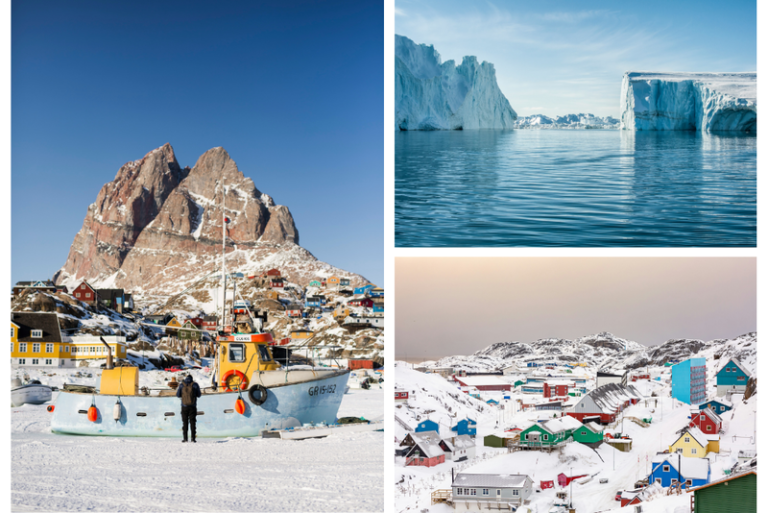
Few places offer such a close connection with nature as Greenland. Over 80% of the land is covered by ice, and the towns are surrounded by glaciers, fjords, mountains, and nearly untouched Arctic landscapes.
If you’re looking for a slower pace of life or want to be closer to nature, this daily connection with the environment is one of Greenland’s biggest draws. Activities like hiking, kayaking, fishing, and Arctic expeditions are part of the local lifestyle, especially in the summer months.
Small communities and a strong sense of community
Greenland has a very small population, just over 50,000 people living in small towns and coastal settlements. This makes for a close-knit social environment, where people often know each other and daily life moves at a slower, more relaxed pace.
For many foreigners, living in small communities makes it easier to build direct connections with neighbors and coworkers. Greenlandic culture also tends to emphasize cooperation and mutual support, which is especially noticeable in the smaller towns.
Job opportunities in specific sectors
While the job market is smaller than in larger countries, Greenland still offers interesting opportunities in certain fields. Sectors such as education, healthcare, scientific research, public administration, tourism, and natural resource management often rely on foreign professionals.
In some cases, salaries can be quite competitive compared to other countries, especially for skilled professionals. The small size of the job market also means that certain specialized roles tend to be in steady demand.
High environmental quality and low pollution
One of the most valued aspects of living in Greenland is the quality of its natural environment. Pollution levels are very low compared to many urbanized regions, and the air remains clean thanks to limited industrial activity.
This translates into a very high standard of environmental quality, which directly influences daily well-being and the perception of a peaceful environment.
A unique cultural experience
Living in Greenland also means experiencing a very distinct culture, shaped by both Inuit traditions and the territory’s Danish history. Local customs, cuisine, the Greenlandic language, and traditional celebrations all reflect a strong and unique cultural identity.
For many foreigners, this cultural blend makes living in Greenland a deeply enriching experience, especially if you’re interested in discovering ways of life that differ from those in more urbanized Western societies.
Drawbacks of living in Greenland as a foreigner
While living in Greenland can be a unique experience, it also comes with certain challenges that are important to understand before deciding to move. The extreme climate, geographic isolation, and small market all have a direct impact on daily life. For many foreigners, adjusting to these conditions can take time.
Below, we review some of the main drawbacks commonly reported by those living in this Arctic region.
- Extreme weather is a reality for much of the year. Winters are long and intensely cold, with subzero temperatures lasting for months and periods of polar night in some regions.
- Isolation and limited transport are part of daily life. There are no roads connecting towns, so travel is done by plane, helicopter, or boat, and it often depends heavily on weather conditions.
- High living costs are a key factor. Many goods have to be imported from abroad, which makes essentials like food, clothing, and everyday items more expensive. As a result, living in Greenland is generally costlier than in many other places.
- Limited leisure options and services are another factor to consider. Greenlandic towns cover basic needs, but the range of cultural activities, shopping, and entertainment is quite small compared to larger cities, especially outside the capital, Nuuk.
- Language can be a barrier in some communities. While Danish and English are used professionally, Greenlandic is the main language. In smaller towns, it can be challenging to integrate without some knowledge of kalaallisut.
- The job market is small and specialized. Employment opportunities are mostly focused on sectors like fishing, public services, education, healthcare, research, and tourism. For certain professionals, finding work can be challenging.
Frequently asked questions about living in Greenland
Yes, the cost of living is generally high. Many goods need to be imported, which drives up the prices of food, clothing, transportation, and certain services. While some salaries can be competitive, housing and everyday expenses mean that monthly costs are higher than in many other places.
It largely depends on your field. Greenland’s job market is small, with opportunities mostly in areas like education, healthcare, research, tourism, public administration, and natural resources. Skilled professionals tend to have the best chances of finding work.
The official language is Greenlandic, or kalaallisut. Danish is also widely used in government and schools, and English is commonly spoken in professional and tourist settings, especially in towns like Nuuk.
The climate is one of the toughest aspects of living in Greenland. Winters are long and bitterly cold, with subzero temperatures lasting for months. Some areas also experience polar night in winter and the midnight sun in summer, which can significantly alter daily routines.
It’s a great fit for anyone looking for a peaceful lifestyle surrounded by nature and far from the hustle of major cities. However, it also means adapting to extreme weather, remote living, and fewer options for services and leisure than you might find elsewhere.
Plans that may interest you


Hi! I'm a Spanish-English translator working with Holafly, helping bring travel content to life for curious travelers. As a digital nomad with a passion for exploring, I'm always adding new spots to my bucket list. If you love to travel like me, stick around because you're in the right place to find inspiration for your next trip! ✈️🌍