Language
When is the Great Migration in Africa? Month-by-month guide (2026)
When is the Great Migration in Africa? See a 2026 month-by-month guide, where to go in Kenya or Tanzania, a migration map, and planning tips.
The Great Migration happens year-round, and the best time to go depends on what you want to see, from newborn calves on open plains to dramatic river crossings. Each year, roughly 1.5 million wildebeest, plus hundreds of thousands of zebras and gazelles, move in a looping circuit across northern Tanzania and southwestern Kenya.
Unlike a one-week event, the herds are always somewhere on the route. What changes is where they concentrate and what’s happening on the ground, which is shaped by rainfall and fresh grass. This guide shows you all the essential info you need to know about the Great Migration, including where to go each month and what to expect.

An eSIM you can rely on
Join over 10 million Holafly customers and get connected with our trusted, global services.
What is the Great Migration in Africa?
The Great Migration in Africa is the annual movement of wildebeest, zebra, and gazelle between Tanzania’s Serengeti ecosystem and Kenya’s Masai Mara. It’s driven by survival basics: the herds follow seasonal rains that trigger new grass growth, then keep moving as conditions change.
It’s considered one of the world’s biggest wildlife spectacles because it combines huge herd numbers, constant motion, and predator-prey dynamics. Depending on the month, you might see calving, large predator activity, long-distance trekking, and river crossings.
When and where is the great migration in Africa? (Month-by-month guide)
The Great Migration is a year-round loop, but what you see changes by month: calving in the south, a northward push through the central and western corridor, the Mara River crossings, and then the return south as rains shift again. Because rainfall patterns vary each year, the herds can arrive earlier or later than expected, especially around season transitions.
Use this month-by-month guide to match your travel dates to the stage you most want to see.
| Month | Typical location (best base) | Key event | What you’re most likely to see |
|---|---|---|---|
| January | Ndutu and Salei Plains (Southern Serengeti + northern Ngorongoro Conservation Area) | Early calving | Mega-herds gathering on nutrient-rich plains; a few early births; predators positioning for calving season |
| February | Ndutu, Salei, and Kusini Plains (Southern Serengeti + Ngorongoro Conservation Area) | Peak calving | Highest chance of newborns; frequent predator action; dense herds on lush grazing |
| March | Ndutu and surrounding southern plains (including Maswa area) | Calving tail-end | Herds dispersing across the southern Serengeti; last calves born; start of long rains can bring storms |
| April | Central Serengeti (Seronera and Moru Kopjes) | Grazing + early rutting | Bulk of herds moving north through central areas; steady grazing; early breeding behavior; wet-season conditions |
| May | Western Corridor toward Grumeti (via Seronera/Moru Kopjes) | Rutting + northbound push | Herds trekking north in earnest, peak rutting behavior, and large concentrations moving toward the west |
| June | Western Serengeti (Grumeti River and Grumeti Reserve) | Grumeti River crossings | Crocodile encounters at Grumeti; rewarding longer game drives as herds spread out; start of dry season |
| July | Northern Serengeti (Kogatende/Mara River area) | Mara River crossings begin | Front-runners arrive in early July; crossings often start late July into August; peak-season crowds build |
| August | Mara River corridor (Northern Serengeti) and Masai Mara (Kenya) | Peak Mara River crossings | Best odds for dramatic crossings; main herds move into Masai Mara; busy safari conditions |
| September | Masai Mara (Kenya) + Northern Serengeti (Kogatende) | Late crossings + high herd density | Main herds lingering in the Mara; some crossings continue; strong predator activity; early mornings can be cold |
| October | Northern Serengeti (Kogatende/Mara River), spreading into Loliondo and Lobo | Return movement + late crossings | Herds crossing back toward Tanzania; still possible to see crossings; animals spread south within the north |
| November | Eastern and Central Serengeti (via Loliondo, toward central plains) | Moving + grazing (short rains) | Herds traveling south along the eastern edge; shifting concentrations; occasional late crossings until mid-November |
| December | Ndutu and Salei Plains (Southern Serengeti + northern Ngorongoro Conservation Area) | Prep for calving | Herds arrive back on the southern plains; lush grazing for nursing mothers; short rains and regional storms are possible |
January – March: Calving season in the Southern Serengeti
January through March, the herds typically concentrate around the Ndutu and Salei Plains, between the southern Serengeti and the northern Ngorongoro Conservation Area. This is the core calving phase, driven by nutrient-rich short grass after the short rains.
January: The mega-herds gather on Ndutu and Salei, and you can often catch early calvings. Predators are active as they anticipate the upcoming surge of vulnerable prey. Conditions are usually warm and dry, but thunderstorms can happen, so pack a light rain layer.
February: This is usually the peak calving month, and the best bet if your goal is newborns and predator activity. Large numbers of calves are born in a short window, and lions, cheetahs, leopards, and hyenas take advantage of the easy opportunities.
March: The herds begin to disperse across the southern plains as calves strengthen and the long rains start to build. You can still see late calving, but movement increases, and some groups may linger in the Ndutu region, including the Maswa area, into early April if grazing stays good.
April – June: The westward journey and Grumeti River crossing
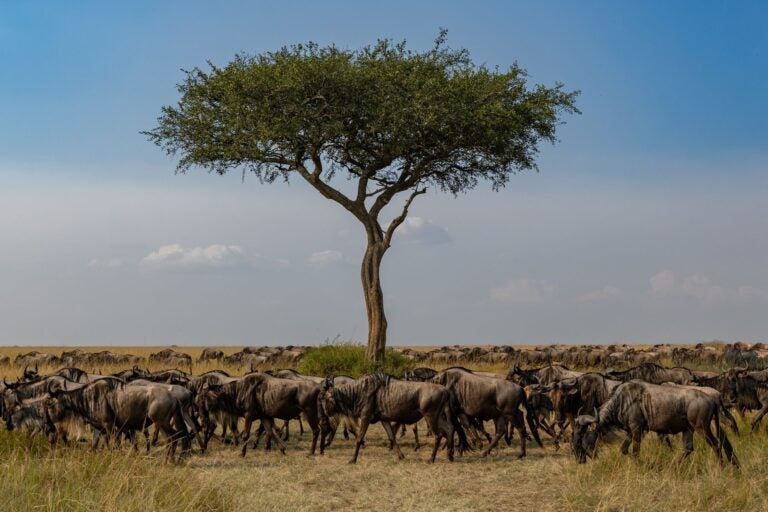
April to June is the on-the-move phase, when the herds transition northward through Tanzania, feeding as they go and preparing for the first major river obstacle.
April: By this point, the bulk of the herd has typically left the Ndutu area and is moving through Central Serengeti, especially the Seronera region and Moru Kopjes. They are not rushing, expect steady grazing and wide, shifting concentrations. April to May also overlaps with the start of breeding (rutting) in central and western zones.
May: The herds push north more decisively, moving toward the Western Corridor and toward Grumeti. Rutting behavior can still be noticeable while the animals travel, and this is a strong month if you want classic migration scenes without the peak-season crowds.
June: The herds enter the Grumeti River area in the western Serengeti and may need to make Grumeti crossings to continue. These crossings can be impressive, including crocodile encounters, even if they’re typically less dramatic than the Mara River later in the season. June also marks the start of the dry season in the Serengeti, with warm days and cooler nights.
July – October: The Mara River crossings (Peak season)
July through October is the peak-demand window because it offers the best chance of seeing the famous Mara River crossings. Timing is never guaranteed, and the herds can be spread across multiple northern areas at once, so it helps to plan with buffer days.
July: Front-runners typically reach Kogatende in the Northern Serengeti early in the month, while other groups may still be in the western corridor. Crossing attempts often build through July, with many crossings starting late July into August.
August: This is often the best month for dramatic crossing action, with major herd concentrations around the Mara River and movement into Kenya’s Masai Mara. It’s also peak dry-season safari weather, which means the busiest camps and the most vehicles at popular viewing points.
September: The main herds often remain in the Masai Mara, with some crossings still happening, and high wildlife density across the plains. In northern Serengeti, you may start seeing early return crossings back from Kenya in mid to late September in some years.
October: Herds continue shifting back toward Tanzania, often crossing from the Masai Mara into the Northern Serengeti, then spreading south into the Loliondo and Lobo regions. Late September into October can still deliver strong crossing opportunities, but the movement is more dispersed than in peak August.
November – December: The return to the South
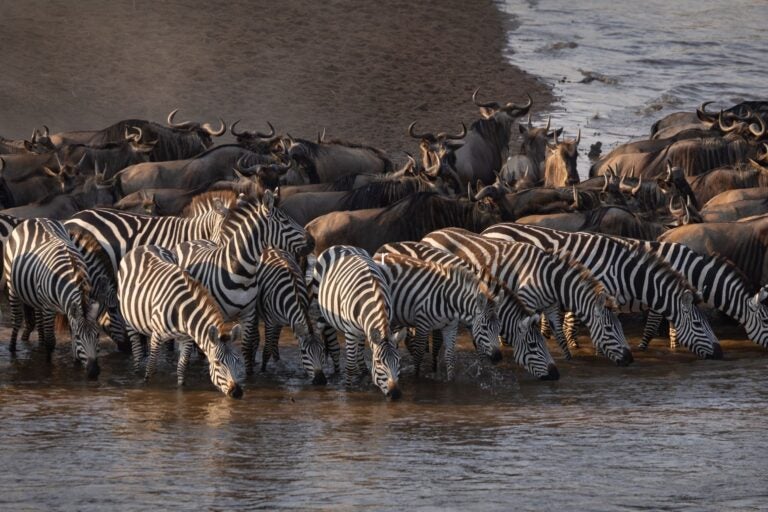
November and December are the green-up and reset months, when the herds move south toward the next calving cycle as the short rains return. This can be a great time for travelers who want to see the migration with fewer crowds and better value.
November: You can sometimes still find late crossings back into northern Serengeti until mid-November, but the larger movement is south through Loliondo and along the eastern edge of the Serengeti, with herds passing into central areas where grazing improves.
December: By December, the main herds typically reach the Ndutu and Salei Plains again, such as the southern Serengeti and the northern Ngorongoro Conservation Area. They spread out to feed on nutrient-rich short grass in preparation for calving, and you should expect some regional showers and storms as the short rains taper off.
The great migration map: Where does it take place?
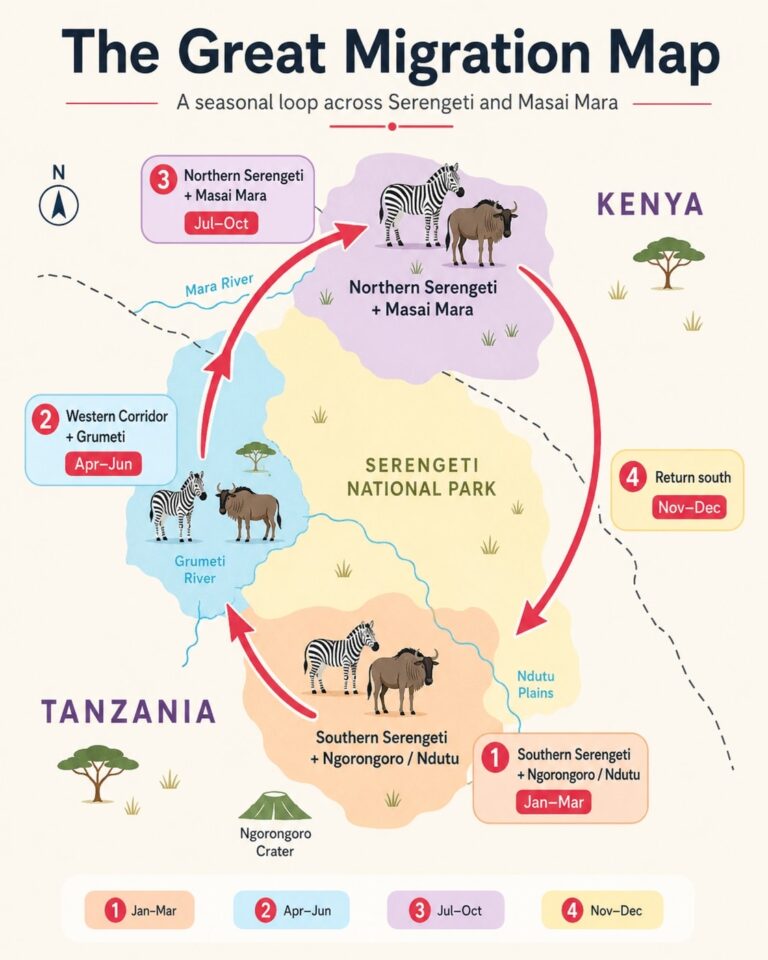
This Great Migration map shows the seasonal movement of wildebeest, zebras, and other herds across Tanzania’s Serengeti and Kenya’s Masai Mara. The route is not fixed by exact dates, as the animals follow rainfall and fresh grazing.
Typically, the cycle begins in the Southern Serengeti and Ndutu area from January to March, then moves northwest through the Western Corridor and Grumeti River from April to June. From July to October, many herds reach the Northern Serengeti and Masai Mara, where river crossings often occur. By November and December, the migration turns south again, restarting the cycle.
Best time to see the great migration: Quick summary
Migration timing shifts with rainfall, but these are the most reliable planning windows for each goal.
- Best time for calving season: February + Ndutu and Salei Plains (Southern Serengeti + Ngorongoro area)
- Best time for river crossings: Late July–September + Northern Serengeti (Kogatende/Mara River) and/or Masai Mara
- Best time for the Grumeti River crossing: June + Western Serengeti (Grumeti River / Western Corridor)
- Best time for smaller crowds: April–June or November–early December + mostly Serengeti, Tanzania, away from peak crossing hotspots
- Best time for budget travel: November–December + Central/Eastern Serengeti moving south to Ndutu
- Best time for migration with less pressure: Year-round + choose the region that matches your month, not a fixed date
Tips for planning your great migration in Africa
Planning is easiest when you pick a phase first, then choose the right base camp region for that time of year. Because the herds follow rainfall, plan around month ranges and build in flexibility, especially for river crossings.
- Choose your priority, then choose your base.
- Calving: Ndutu/Salei.
- Grumeti: Western Corridor.
- Mara crossings: Northern Serengeti (Kogatende/Mara River) and/or Masai Mara.
- Return south: Loliondo/eastern route into central Serengeti, then back to Ndutu.
- Book early for July–September. This is peak demand, and the best-located camps can sell out far ahead.
- Add buffer days for crossings. Crossings are never guaranteed. Staying longer in one well-placed area usually beats constant chasing.
- Expect longer drives in June. Herds can be spread out around Grumeti, so full-day game drives are common.
- Pack for dust, sun, and cool mornings. Use an international travel packing list as a baseline, and adapt safari clothing tips for what to wear on safari.
- Plan for patchy connectivity in parks. Lodges may have Wi-Fi, but speeds and coverage vary between camps and on the road.
- Prioritize safety and budget? Tanzania is often considered one of the safest African countries for safari travel, as well as one of the cheapest African countries to visit. Take these into consideration while planning your Great Migration trip.
If you’re comparing options for staying online, this Africa SIM card guide is a quick way to weigh local SIMs vs. eSIM setups for multi-stop trips.
Stay connected during the great migration with Holafly
Safari days often involve early starts, long drives, and travel between towns, airstrips, and camps, where signal and Wi-Fi quality can be inconsistent. Having reliable data helps with practical tasks like confirming transfers, messaging your guide or camp, accessing e-tickets, and using maps in transit.
If you want to set up connectivity before you land, Holafly lets you install a travel eSIM ahead of time. For most itineraries, a country-specific option like an eSIM for Kenya or an eSIM for Tanzania is the simplest fit.
If your trip combines multiple African destinations, an eSIM for Africa can be a practical alternative, and you can compare plans by destination and trip length in the Holafly eSIM shop.

Get an unlimited data eSIM
Use code MYESIMNOW5 for 5% off at checkout
Plans that may interest you


哈囉我是來自台灣的 Wen,平常最喜歡旅遊,也喜歡將旅遊的種種化成文字跟大家分享,希望大家能在我的文章中找到有用的資訊,加上 Holafly 的 eSIM,讓你的旅程更美好!✈️✈️✈️ Hi! I'm Wen, a passionate content writer and travel enthusiast from Taiwan. I transform my wanderlust adventures into engaging stories and practical guides, helping fellow travelers make the most of their journeys.Through my articles, I strive to provide travel tips while introducing how our eSIM technology can enhance your travel experience - keeping you connected wherever your adventures take you!