Language


 No results found
How to get into the Boston Marathon: Qualification times, entry process, and how hard it really is
To qualify for the Boston Marathon, you have to run a qualifying time based on age and gender on a certified course. Fastest qualifiers are accepted first.
To qualify for the Boston Marathon, you have to run a qualifying time based on both your age group and gender on a course sanctioned by the Boston Athletic Association (B.A.A.). This then gives you the opportunity to submit your application and officially qualify. Fastest qualifiers are accepted first as demand exceeds available spots.
This guide breaks down everything you need to know: current qualification times for 2026 and 2027, how the application process works, alternative ways to enter without qualifying, and what it really takes to secure a spot in this major sporting event.

An eSIM you can rely on
Join over 10 million Holafly customers and get connected with our trusted, global services.
How to qualify for the Boston Marathon
Qualifying for the Boston Marathon requires running a full marathon within a set time standard determined by your age group and gender. The race must be held on a certified course and completed within the official qualifying window.
Because meeting the standard doesn’t guarantee entry, most runners aim to beat their qualifying time by several minutes to improve their chances of being accepted.
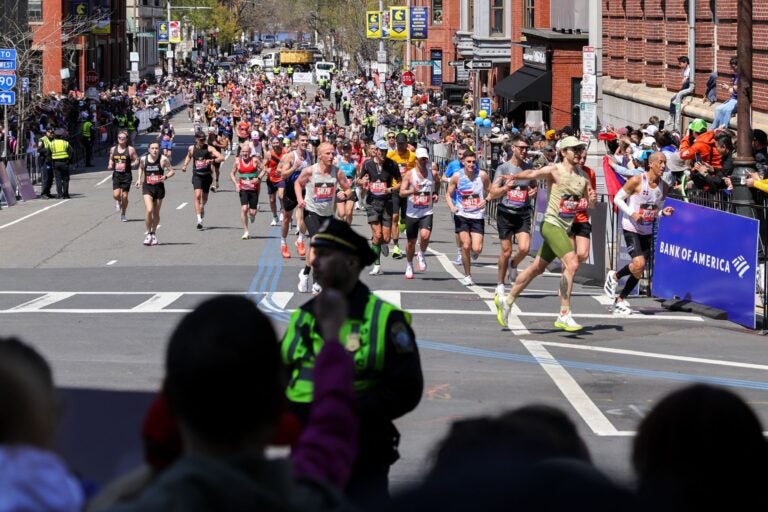
Boston Marathon qualifying times by age group
Boston Marathon qualifying standards vary by age group and gender. Keep this in mind so you know which category you fall into when setting your goal. Below are the qualifying times for 2026 and 2027.
| Age group | Men’s standard | Women’s standard | Nonbinary standard |
|---|---|---|---|
| 18–34 | 2:55:00 | 3:25:00 | 3:25:00 |
| 35–39 | 3:00:00 | 3:30:00 | 3:30:00 |
| 40–44 | 3:05:00 | 3:35:00 | 3:35:00 |
| 45–49 | 3:15:00 | 3:45:00 | 3:45:00 |
| 50–54 | 3:20:00 | 3:50:00 | 3:50:00 |
| 55–59 | 3:30:00 | 4:00:00 | 4:00:00 |
| 60–64 | 3:50:00 | 4:20:00 | 4:20:00 |
| 65–69 | 4:05:00 | 4:35:00 | 4:35:00 |
| 70–74 | 4:20:00 | 4:50:00 | 4:50:00 |
| 75–79 | 4:35:00 | 5:05:00 | 5:05:00 |
| 80 and older | 4:50:00 | 5:20:00 | 5:20:00 |
What is the Boston Marathon cutoff time?
The Boston Marathon cutoff time is the amount of time you need to run faster than the qualifying standard to actually get accepted into the race. Because more runners meet the qualifying times than there are available spots, the B.A.A. sets a cutoff each year based on demand.
For the 130th Boston Marathon, the cutoff time was four minutes and 34 seconds (4:34) or faster to be accepted into the marathon. This is calculated by comparing the total number of applicants to the number of available spots, and then ranking runners based on how far under their qualifying time they ran (their “buffer”).
The cutoff is set at the point where only the top applicants — up to the maximum number of accepted runners — remain.
What races count as Boston qualifiers?
Only full marathon races (26.2 miles) are accepted as Boston qualifiers. The course must be certified by organizations such as USA Track & Field (USATF), the Association of International Marathons and Distance Races (AIMS), or the official governing body for distance running in the country where the race is held.
The race must also be run outdoors, as indoor and virtual marathons are not eligible. It’s best to check with the event organizer in advance to confirm that the course is officially certified.
Best Boston Marathon qualifying races for 2026
Below are some of the best races for earning a Boston Marathon qualifying time, based on recent BQ percentages, course profile, and race conditions.
BQ% (Boston Qualifier percentage) shows the share of runners who meet qualifying standards. For example, a 30% BQ rate means about 3 in 10 runners qualified.
📌 Ventura Marathon
2025 BQ%: 24.74%
When: February 22, 2026
Where: Ojai, California
Outlook: A net downhill course that starts inland and finishes along the coast. Expect a gradual descent that helps with pacing, along with cool morning temperatures. The point-to-point setup requires some logistics, but it is known as a fast and beginner-friendly qualifier.
📌 Revel Mt. Charleston
2025 BQ%: 42.53%
When: March 28, 2026
Where: Las Vegas, Nevada
Outlook: One of the fastest courses in the US, with a sustained downhill profile from the mountains into the valley. Runners can expect thin air at the start and a long descent that favors experienced racers who can manage quad fatigue.
📌 Jack and Jill’s Downhill Marathon
2025 BQ%: 25.93%
When: July 25–26, 2026
Where: North Bend, Washington
Outlook: A smooth downhill course on packed gravel trails, ideal for runners comfortable on nonpaved surfaces. The shaded route and steady grade support fast times, but the tunnel section requires a headlamp and some preparation.
📌 Tunnel Vision Marathon
2025 BQ%: 36.06%
When: August 9, 2026
Where: Hyak, Washington
Outlook: A gentle downhill rail-trail course with a consistent grade that makes pacing easier. The race includes a long tunnel early on, so lighting is required. Cooler conditions and smooth terrain make it a strong option for a personal best.
📌 Erie Marathon
2025 BQ%: 34.73%
When: September 13, 2026
Where: Erie, Pennsylvania
Outlook: A flat, looped course with minimal elevation change, making it one of the most reliable qualifiers. Held on a paved path near Lake Erie, it offers predictable conditions, although wind can be a factor.
📌 California International Marathon
2025 BQ%: 30.06%
When: December 6, 2026
Where: Sacramento, California
Outlook: A net downhill course with rolling hills early and a flat finish. Known for ideal race-day weather and strong competition, it attracts serious runners aiming to secure a qualifying time or improve their buffer.
How hard is it to get into the Boston Marathon?
Getting into the Boston Marathon is extremely difficult, especially when meeting the qualifying time is only the first step, as more runners apply with qualifying times than there are available spots. As a result, runners often need to beat their qualifying standard by several minutes to secure entry.

The acceptance rate
For the 2025 Boston Marathon, the B.A.A. accepted 24,069 qualified applicants, while 12,324 were not accepted. This puts the acceptance rate at about 66%, meaning roughly 1 in 3 qualified runners did not get in.
Why Boston is considered one of the hardest marathons to enter
The Boston Marathon is one of the most difficult races to get into because it does not offer a general lottery. Entry is primarily based on strict qualifying times that vary by age and gender, and even meeting those standards is not enough by itself.
Due to high global demand, runners must often exceed the qualifying time by several minutes to secure a spot. With limited entries and thousands of competitive applicants each year, Boston remains one of the most selective marathons in the world.
How to get into the Boston Marathon once you qualify?
Because thousands of runners meet the standards each year, the B.A.A. follows a competitive selection process. Here’s how it works step by step:
- Run a qualifying time (Anytime before registration)
Complete a certified marathon and meet your age- and gender-specific Boston-qualifying standard. Aim to beat the standard by a few minutes to stay competitive.
- Wait for registration to open (Typically early–mid September)
The B.A.A. announces the official registration dates for next year’s race.
- Submit your application (Registration week)
Apply online through the B.A.A. portal. You’ll need to provide proof of your qualifying race and time.
- Applications are reviewed in waves (About 1–2 weeks)
Runners are accepted based on how much faster they ran than their qualifying time and not on a first-come, first-served basis. Faster runners get priority.
- Cutoff time is announced (Shortly after registration closes)
The B.A.A. sets a cutoff time based on demand. Only runners who beat their qualifying time by at least this margin are accepted.
- Receive your confirmation (Same period as cutoff announcement)
If your time is within the cutoff, your spot is secured. If not, you’ll need a faster time for the next cycle.
How to get into the Boston Marathon without qualifying?
Not hitting a qualifying time doesn’t mean you’re out of options. A portion of Boston Marathon entries is reserved for alternative pathways, although they’re limited and often competitive or costly.

Charity entries
Running for an official Boston Marathon charity is likely the easiest route without a qualifying time. Each year, the B.A.A. partners with selected nonprofits that offer race bibs in exchange for fundraising commitments.
Most runners are expected to raise at least $5,000, with some charities requiring more. In return, you’ll get a guaranteed entry, along with team support, training resources, and a structured fundraising plan.
Special invitations and elite entry
A small number of entries are reserved for elite athletes, past champions, and individuals invited directly by the B.A.A. This includes professional runners who meet elite performance standards, as well as occasional special guests. These spots are highly exclusive and not open to the general public.
International tour operator packages
If you’re traveling from outside the US, you can book a marathon package through an official international tour operator. These packages typically bundle race entry with hotel accommodations and sometimes flights or local transport.
While convenient, they are significantly more expensive than standard registration, and availability depends on your country of residence.
Tip! If you plan on just watching the event, here’s where you can watch the Boston Marathon.
Practical tips for getting into the Boston Marathon
The tips below can help you improve your chances, avoid common mistakes, and choose the best entry route for your situation:
- Pick a fast, flat marathon with good weather conditions to maximize your qualifying chances.
- Beat your qualifying time by at least 5–7 minutes to stay competitive for the cutoff.
- Submit your application as soon as registration opens to be included in early review waves.
- Choose between a lower-cost but uncertain qualifying route or a higher-cost, guaranteed charity/tour entry.
- Book flights and accommodations early, as Boston hotels fill up quickly during race week.
- Arrive a few days early to adjust to jet lag, weather, and course conditions.
- Use a travel eSIM or US SIM card to stay connected for maps, updates, and race communication.
Stay connected during the Boston Marathon with Holafly
Make your racing preparations easier with Holafly’s eSIM for Boston, and get unlimited data at 4G/5G speeds, 24/7 customer support, hotspot sharing, and instant connection. If you’re traveling beyond the city, you can try Holafly’s eSIM for the USA and keep the same benefits with nationwide coverage.

Get an unlimited data eSIM
Use code MYESIMNOW5 for 5% off at checkout
Plans that may interest you

哈囉我是來自台灣的 Wen,平常最喜歡旅遊,也喜歡將旅遊的種種化成文字跟大家分享,希望大家能在我的文章中找到有用的資訊,加上 Holafly 的 eSIM,讓你的旅程更美好!✈️✈️✈️ Hi! I'm Wen, a passionate content writer and travel enthusiast from Taiwan. I transform my wanderlust adventures into engaging stories and practical guides, helping fellow travelers make the most of their journeys.Through my articles, I strive to provide travel tips while introducing how our eSIM technology can enhance your travel experience - keeping you connected wherever your adventures take you!