Language
How to get around Las Vegas: A complete guide for tourists
Learn how to get around Las Vegas with various transport options, including the monorail, rideshare, shuttles, and the Vegas Loop. Find out which option suits you best.

Las Vegas is a spread-out city centered around the Las Vegas Strip, a 4.2-mile corridor of high-density resorts and casinos.
This guide covers all you need to know about getting around Las Vegas, including walking, rideshares, buses, and the Las Vegas Monorail, with the best choice depending on budget, distance, and convenience.
To explore Las Vegas effectively, it’s also important to stay connected throughout the day. So, consider Holafly’s travel eSIM, with unlimited data and a reliable connection.

Limitless data, endless adventures
Stream, scroll, and share as you please. With Holafly, your data is always unlimited.
How to get around Las Vegas without a car
There are several car rental companies in the USA where you can rent a car to get around Las Vegas. However, it is not the perfect option for most tourists because of expensive daily parking at major resorts, usually between $20 to $40 per day, significant traffic jams on the Strip, and the difficulty of maneuvering through large parking garages.
What are the options if you don’t have a car?
- The Las Vegas Strip is walkable. So, you can get around without a car easily. But it is often more physically demanding than visitors anticipate due to the scale of the resorts and the environmental conditions.
- For longer trips, such as traveling from the Strip to Downtown, Uber and Lyft are great choices.
- Deuce bus offers a cost-effective 24/7 transit option.
- The Las Vegas Monorail provides a faster route along the east side of the corridor by bypassing street-level traffic.
- Hotels’ shuttles are also great options if you want to get around properties. They do not provide comprehensive city-wide coverage.
How to get around the Las Vegas Strip
The Las Vegas Strip is divided into three main sections:
- North Strip: The quiet part, home to resorts like SAHARA Las Vegas.
- Mid Strip: The bust part, where major attractions and hotels such as Bellagio and Caesars Palace are concentrated.
- South Strip: The more relaxed part, near the airport, with large properties like Mandalay Bay Resort and Casino.
Although hotels may look close on a map, walking between Strip resorts can take 10-30+ minutes because they are large and the Strip is long.
Here are the options to get around the Las Vegas Strip:
Walking the Strip
Walking is ideal for sightseeing and exploring clusters of nearby hotels. It allows you to visit Las Vegas iconic landmarks, like the Bellagio Fountains or the Linq Promenade, at your own pace without worrying about traffic or parking.
While the Strip is only 4.2 miles long, walking it end-to-end is not practical for most tourists. A continuous walk from South to North takes approximately 90 minutes to 2 hours of non-stop walking.
Monorail system
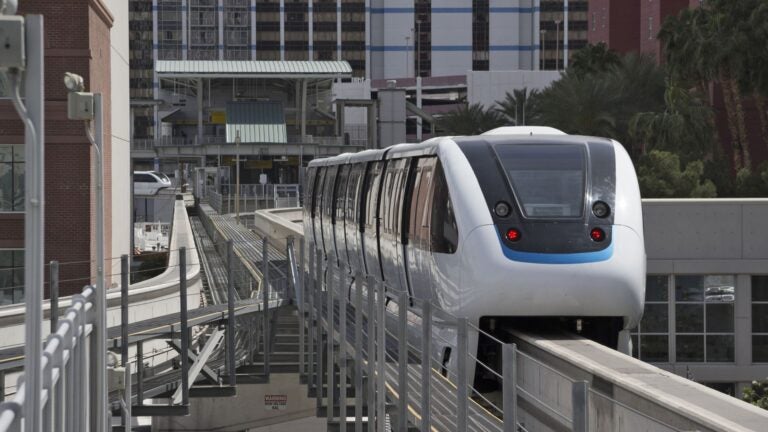
The other great option to get around Las Vegas is the Monorail, which is a 3.9-mile automated system running along the east side of the Strip, making it efficient for reaching destinations like the Convention Center or major resorts from the MGM Grand to the Sahara.
But the Las Vegas Monorail is not a door-to-door service. The stations are positioned at the rear of hotel properties, often requiring a 10-minute walk to reach the Strip sidewalk or the hotel lobby.
How to use it:
- Passengers can scan mobile QR codes or paper tickets at station fare gates.
- Trains arrive every 4 to 8 minutes.
Rideshare for Strip hopping (Uber/Lyft)
If you want a point-to-point convenience and climate-controlled travel, rideshares are the primary option, especially at night or for longer trips between the Strip and Downtown.
How to use it:
- Since street hailing is prohibited, you must request a vehicle via a mobile app.
- You can also request a rideshare from your Hotel.
- Every resort features a designated rideshare pickup zone, typically located in parking garages or side entrances.
- Users must follow interior hotel signage to these specific zones, as drivers are restricted to these areas for all pickups and drop-offs.
- Pricing is dynamic and often increases during peak hours or major events.
Vegas Loop
The Vegas Loop is an underground public transportation system in Las Vegas, developed by Elon Musk. As of 2026, it is a rapidly expanding network that primarily serves the North Strip and the Convention Center area.
Vegas Loop has four stations (South, Central, North, and West Halls) that turn a 25-minute walk across the campus into a 2-minute ride.
How to use it:
- Head to one of the active stations at Resorts World, Encore, Westgate, Fontainebleau, or the Las Vegas Convention Center (LVCC). Most stations are subterranean and accessible via escalators or elevators.
- Scan the QR codes located on signage at the station entrance.
- Show your digital ticket (QR code) to the attendant at the gate or scan it at the digital reader.
- Tell the driver your destination. Unlike a bus or train, the ride is point-to-point—you won’t stop at other stations along the way.
Notes:
- You may share the car with up to three other passengers heading to the same location.
- If you are traveling strictly between halls at the LVCC, rides are typically free.
- Short hops between resorts typically cost $4.25 to $5.00.
- Trips to the airport or further distances range from $10 to $12.
Vegas Loop vs. Monorail
While both are efficient, they serve different needs:
- Vegas Loop: Best for the North Strip and Convention Center. It is point-to-point, without stops at every station, and uses cars.
- Monorail: Best for the Mid and South Strip. It is a traditional train that stops at every station along the east side of the Strip.

Cheap ways to get around Las Vegas
Las Vegas is one of the best tourist destinations in the USA, which some consider expensive. But it can be an affordable destination if you plan your trip right. Here are the cheapest options you have to get around this city.
- Walking is definitely the cheapest method to get around the Las Vegas Strip. It’s free, and you can enjoy your time by exploring or shopping.
- The Deuce is the next option if you want to get around Las Vegas at night or for longer distances. This 24/7 double-decker bus is the most economical paid option. It stops at nearly every major resort and connects the Strip to Fremont Street in Downtown Las Vegas.
- Some resorts and third-party apps offer occasional shared shuttles, though these are typically limited to specific routes or major convention events. Shared shuttles are a very affordable option for group travel.
- Monorail is a mid-cost, automated system that bypasses street traffic entirely along the east side of the corridor.
- The Vegas Loop serves as a modern, low-to-mid-cost alternative for the North Strip and Convention Center areas.
Note: Las Vegas is home to special events, like Las Vegas EDC. During these events, traffic is often heavier, which can increase the cost of rides. If you want a cheaper option, walking is always a better choice.
How to get around Las Vegas efficiently
If you want to know how to get around Las Vegas efficiently, consider your trip length and primary interests. The following frameworks prioritize time-saving and cost-efficiency.
- For a 1–2 day trip, stick to walking within one zone (North, Mid, or South Strip) and use rideshares for longer jumps. This saves time and energy.
- For 3–4 days, combine the Las Vegas Monorail with buses and occasional rideshares to cover more ground without overspending.
For longer stays:
- Spend each day focusing on one area (North, Mid, or South Strip) to avoid wasting time going back and forth. You will have more time walking the Strip since there is no rush.
- Use the Las Vegas Monorail for longer north–south movement and buses like the Deuce on the Strip for budget-friendly travel.
- With more time, you can also explore beyond the Strip, like Downtown or nearby attractions, without rushing.
To keep your Las Vegas trip budget-friendly, regardless of its length:
- Budget travelers should rely mostly on buses like the Deuce on the Strip, plus strategic walking.
- To improve efficiency, it’s better to group attractions by Strip zones rather than moving back and forth.
- Plan your routes ahead of time, and avoid peak rideshare surge hours, which are typically evenings and weekends.
- Even short distances can take 10–30+ minutes on foot, so moving with a plan makes a big difference.
Best way to get around Las Vegas (by situation)
Your transportation options in Las Vegas can vary depending on your specific needs, destination, or other situations.
- Airport to Strip hotel: If you are at the airport, you can use the Las Vegas airport Wi-Fi to connect and request Uber or Lyft. It’s fast, direct, and usually worth it after a flight.
- Strip hopping: Combine walking with the Las Vegas Monorail to move efficiently along the Las Vegas Strip without wasting time.
- Strip to Downtown: Uber or Lyft is the most convenient way to reach Downtown Las Vegas quickly. If you prioritize affordability over speed, the Deuce is also a popular and affordable option.
- Budget travel: Use buses like the Deuce on the Strip, plus strategic walking to save money. Vegas Loop is also a free option if you’re on the North Strip and wish to explore the area.
- Night travel: Rideshare is the safest and most convenient choice, especially late at night when distances feel longer, and public transport is slower.
Staying connected while getting around Las Vegas
Exploring Las Vegas and nearby areas requires you to have a good internet connection. You need a stable connection to use navigation apps like Google Maps or request a rideshare, like Uber or Lyft, especially late at night.
To stay connected in Las Vegas without the concerns about roaming charges and also to reduce the costs of your trip, you can consider Holafly Las Vegas eSIM, with unlimited data, reliable coverage, 24/7 customer support, and a flexible plan duration.
Holafly eSIM for the USA offers daily plansfrom 1 day to 90 days, ranging from $3.90 to $1.55 per day. It is one of the most cost-effective ways to stay connected during your trip to Las Vegas, as you can purchase an eSIM based on your travel duration.
Peace of mind before you fly
Set up your eSIM before travel and get unlimited data on arrival.
Plans that may interest you

Formerly a travel journalist turned marketing copywriter, I found my way back to the travel world with Holafly—my dream company that made remote work possible. My motto? “Dream big and make it happen.” I’m passionate about writing, exploring the world, and staying active through walking, running, swimming, and hiking. I also love learning, reflecting, and connecting with inspiring minds.