Language


 No results found
Proton VPN vs Mullvad: Which is better?
We compare Proton VPN vs. Mullvad VPN and help you choose the best one based on the security, privacy and performance offered by each.

When you look for a VPN that truly protects your privacy, two names appear fast: Proton VPN vs. MullVad VPN. Both lead in digital security, and they focus on anonymity, transparency, and user protection over marketing. Yet, although they share a philosophy, they deliver different experiences and suit different needs.
Proton VPN, built by the team behind Proton Mail, combines advanced privacy with modern infrastructure, extra features, and very solid performance for streaming, travel, and remote work. Mullvad VPN, however, focuses on extreme simplicity and absolute anonymity. It doesn’t require an email address, it stores no personal data, and its payment model aims to stop anyone linking your identity to your connection.
In this comparison, we’ll analyse differences in security, privacy, performance, advanced tools, pricing, and recommended uses, so you can choose the best fit for your digital lifestyle.
General comparison: Proton VPN vs. MullVad VPN
Although Proton VPN and Mullvad VPN share a privacy-first philosophy, their offers feel very different. Proton VPN delivers a full service with advanced features, polished apps, a strong security focus, and performance that suits streaming and remote work. Mullvad, on the other hand, prioritises maximum simplicity and strict anonymity. It even drops popular features to keep its minimal, transparent model.
The table below summarises the most important differences between both VPNs, so you can spot which one matches your needs.
| Feature | Proton VPN | MullVad VPN |
| Jurisdiction | Switzerland (outside surveillance alliances; strong privacy laws) | Sweden (14 Eyes member; more intrusive legal environment) |
| No-logs policy | Strict, externally audited; open-source apps | Strict and minimalist; it doesn’t require email or personal data |
| Servers | More than 16800 server in 127 countries | More than 650 server in 50 countries |
| Speed | Very fast with WireGuard and the Stealth protocol | Very fast with WireGuard, especially over short distances |
| Streaming | Excellent for Netflix, Disney+, HBO, Prime Video; optimised servers | It doesn’t prioritise streaming; compatibility can feel inconsistent |
| Advanced security | Secure Core, Stealth, Tor over VPN, NetShield, RAM-only servers | Total simplicity; no Secure Core or add-ons |
| External audits | Yes, by third parties (SEC Consult, Cure53) | Yes, audits of software and infrastructure |
| Code transparency | Open-source apps | Open-source apps |
| Malware / ad blocking | Yes (NetShield) | Yes (via DNS filters) |
| Split tunnelling | Yes | Yes (depending on platform) |
| Tor over VPN | Yes | No |
| Extra features | Auto profiles, smart connections, Secure Core, Stealth | No “extras” by minimalist design |
| Payment methods | Card, PayPal, crypto, and cash by post (in some countries) | Card, PayPal, crypto, and postal cash without linking identity |
| Price | From €2.69 ($2.99) per month on a two-year plan | One fixed price: €5 ($5.56) per month (always the same) |
| Ease of use | Modern, intuitive, and very complete apps | A simple, minimalist interface, aimed at technical users |
| Support | Very good support and an extensive knowledge base | Limited to email support; sparse technical documentation |
| Simultaneous connections | 10 devices | 5 devices |
Broadly speaking, the table shows that Proton VPN is the more complete and versatile option. It suits users who want balanced privacy, advanced tools, excellent global performance, and strong support for streaming or remote work. Its infrastructure is larger, it adds more security tools (like Secure Core and Stealth), and it delivers a more robust experience for travel and everyday use.
Mullvad VPN, in contrast, excels in one very specific area: Extreme anonymity. It requires no registration details, so it becomes one of the hardest VPNs to trace. However, that simplicity also means fewer modern features, such as streaming-optimised servers, advanced security tools, or broad support.
That said, we’ll now move into a deeper analysis of the differences and similarities between Proton VPN vs Mullvad VPN. The goal is to give you enough information to choose with confidence.
Important: If you are a frequent traveler and want to stay connected without worrying about expensive roaming or looking for a new SIM at every destination, Holafly’s subscription plans are for you. With a single eSIM, enjoy internet in more than 170 countries for a fixed price and no surprises on your bill. Travel without limits and connect easily and securely! 🚀🌍

No-logs policy, jurisdiction, and audits: Proton VPN vs. MullVad VPN
When we talk about real privacy, three factors determine how much trust you can place in a VPN: Where the company registers, what information it keeps, and how verifiable those promises are. Here, both Proton VPN and Mullvad VPN stand out, yet they do so with very different approaches.
Proton VPN: Swiss privacy with recurring external audits
Proton VPN operates under Swiss jurisdiction, one of the world’s strongest data-protection environments, and it stays outside surveillance alliances like 5/9/14 Eyes. So, even if a foreign authority requests information, Swiss law blocks data disclosure without a very strict court process.
Its no-logs policy is strong, detailed, and backed by external audits from firms like SEC Consult and Cure53. These firms have reviewed both software and critical infrastructure elements. Also, all its apps are open source, so experts can inspect the code and confirm there’s no hidden data collection.
In practice, Proton VPN is built to protect journalists, activists, remote professionals, and users who need verifiable guarantees, not just promises.
Mullvad VPN: Absolute anonymity, but a less favourable jurisdiction
Mullvad takes a unique approach: It maximises anonymity even before you use the VPN. It doesn’t ask for an email address, it doesn’t record names, and it stores no personal data. Its no-logs policy ranks among the strictest on the market. Also, you don’t need to trust a “no-logs” promise, because it aims to hold nothing meaningful in the first place.
However, it’s based in Sweden, a 14 Eyes member, which shares intelligence across countries. Even so, Mullvad has shown through external audits that its infrastructure doesn’t log activity. Yet, Swedish jurisdiction isn’t as privacy-friendly as Switzerland. In theory, authorities could demand cooperation. In practice, Mullvad can only hand over… nothing, because it stores no identifiable data.
Mullvad has also passed external audits, and its apps are open source, which strengthens transparency.
So, what do we conclude? In privacy terms, both VPNs rank among the best available, but their approach differs. Proton VPN blends advanced security, strong laws, and regular audits. Mullvad VPN focuses on absolute anonymity from minute one, and it trades convenience and extra tools to keep a minimalist, hard-to-trace model.
Security features: Proton VPN vs. MullVad VPN
Although Proton VPN and Mullvad VPN rank among the most respected privacy options, their security features aren’t identical. Proton VPN builds a fuller ecosystem with advanced tools. Mullvad, however, keeps a minimalist philosophy, where simplicity and low traceability form the core of protection.
Let’s review the main security features of both VPNs, and then we’ll summarise the key points:
| Security feature | Proton VPN | MullVad VPN |
| Encrypted | AES-256: | AES-256: |
| Protocols | WireGuard, OpenVPN, IKEv2, Stealth | WireGuard, OpenVPN |
| Kill Switch | Yes | Yes |
| DNS / IPv6 leak protection | Yes | Yes |
| RAM-only servers | Yes | Yes |
| Ad and malware blocking | Yes (NetShield) | Yes (DNS-based blocking) |
| Secure Core (double-hop via hardened servers) | Yes | No |
| Tor over VPN | Yes | No |
| Obfuscation / censorship bypass | Yes (Stealth) | Limited |
| Split tunnelling | Yes | Yes (depending on OS) |
| Independent software verification | Yes (external audits) | Yes (external audits) |
| Anonymous key authentication | No (it requires an account) | Yes (a random number without personal data) |
If you evaluate security by available tools, Proton VPN offers a far more complete suite. Its Secure Core, Stealth, and Tor over VPN features suit users who need extra protection layers. This helps if you travel to censored countries, handle sensitive data, or rely on public WiFi daily. Also, NetShield and broader protocol choice make it more flexible and adaptable.
Mullvad, however, delivers security through simplicity. It avoids advanced tools because it removes potential weak points. Less complexity often means less risk. WireGuard-first design, strict no-logs, and minimalism make it extremely safe for browsing, downloads, and general use. Yet, it can fall short for specific needs, such as bypassing censorship, using Tor through the VPN, or protecting critical connections during travel.
Performance and speed: Which VPN is faster?
In pure speed terms, both Proton VPN and Mullvad VPN rank among the fastest VPNs on the market because they use WireGuard, today’s most efficient protocol. However, when we review performance across scenarios (international links, public WiFi, remote work, streaming, and overall stability) important differences appear.
Proton VPN runs very fast on WireGuard, and it stays even more stable thanks to its Stealth protocol. It’s designed to keep connections alive on congested networks and restrictive environments. Also, its larger infrastructure (more countries and servers) lets you choose less crowded routes. That boosts speed when you travel or work across continents. So, it performs brilliantly for video calls, downloads, and cloud-based remote work.
Mullvad VPN also offers outstanding speeds with WireGuard, especially on nearby servers, and has very stable performance over short and medium distances.
But with no optimised servers or specific acceleration features, performance may vary more on international connections or from poorly covered regions. So, it feels less consistent for global mobility than Proton VPN.
Streaming and gaming
People who stream often, or enjoy online gaming, care about a VPN that won’t harm the experience. Again, you’ll see clear differences between Proton VPN and Mullvad VPN.
With Proton VPN, you’ll get strong performance on Netflix, Disney+, Prime Video, and other services. This happens because it offers streaming-optimised servers, so it suits travel viewing and regions where platforms block access. Also, it maintains strong speed for HD and 4K playback.
As you already know, Mullvad VPN doesn’t prioritise streaming. Although it can work with some catalogues, it won’t guarantee consistent unblocking, so you may face blocks or VPN detection errors.
So, Proton VPN is clearly the stronger streaming option than Mullvad. What about gaming? The picture stays similar.
Mullvad offers very good latency on nearby connections, which suits users staying in one region. Yet, it doesn’t optimise for international gaming. Proton VPN, in contrast, delivers solid speed and stable latency even on distant connections.
Conclusion: Mullvad works great if you only play within your region. Proton VPN works better if you travel, switch countries, or play on distant servers.

Server network comparison: Proton VPN vs. MullVad VPN
Although both VPNs prioritise privacy, their infrastructures differ a lot. Proton VPN builds a wide, distributed network with specialised servers. Mullvad prefers a smaller, simpler network that it manages carefully to maximise safety without extra features.
| Feature | Proton VPN | MullVad VPN |
| Total number of servers | Over 11,000 | 696 |
| Available countries | 127 countries | 50 countries |
| Broad global coverage (Americas, Europe, Asia, Africa, Oceania) | Yes, very wide coverage | Limited; mainly Europe and North America |
| Physical plus virtual servers | Yes | Yes (it prefers physical where possible) |
| Specialised servers – Secure Core | Yes (double routing via safer countries like Switzerland and Iceland) | No |
| Specialised servers – Tor over VPN | Yes | No |
| Specialised servers – Streaming | Yes (optimised for Netflix, Disney+, Prime Video, and more) | No |
| Specialised servers – P2P/torrents | Yes | Yes (generally allowed) |
| Obfuscated servers / censorship bypass | Yes (Stealth protocol) | It doesn’t target censorship |
| RAM-only infrastructure | Yes | Yes |
| Server ownership | A mix: Owned plus verified rented servers | A high share of owned servers |
| International performance | Very good | Good, but limited by fewer locations |
Just by looking at server and country counts, you can see Proton VPN offers a much larger, more diverse, and more functional network. For frequent travellers, remote workers, and users who need access to blocked services, this scale means more stable connections, less congestion, better long-distance speed, and more flexibility when choosing strategic countries.
Also, its specialised servers (such as Secure Core, Stealth, and Tor over VPN) add security layers that Mullvad doesn’t include by design.
Mullvad VPN’s network, in contrast, is smaller and deliberately simple. Its servers are fast and very secure, but limited geographic variety and missing specialised servers make it less suitable for people who need international unblocking, censorship bypass, or stable access from regions with weaker coverage.
Its infrastructure is extremely reliable, yet it targets users who prioritise anonymity and simplicity over versatility.
So, if you want global flexibility, specialised servers, and consistent travel performance, Proton VPN clearly leads.
Price comparison: Proton VPN vs. MullVad VPN
On pricing, Proton VPN and Mullvad VPN follow completely different philosophies. Proton VPN offers several subscription tiers (including a genuine free plan), while Mullvad sticks to one simple, transparent model. So, your choice depends on what kind of user you are, and how much you want to invest in privacy.
| VPN | Free plan | VPN Plus monthly plan | Long-term VPN Plus plan | Other details |
| Proton VPN | Yes — unlimited data, servers in 10 countries, full security, and no ads | From about €8.99 ($9.99) per month | From about €4.49 ($4.99) per month (1 year)From €2.69 ($2.99) per month (2 years) | Multiple tiers (Free, Plus, Unlimited); higher plans add more features |
| MullVad VPN | No | €5 ($5.56) per month (fixed price) | It doesn’t offer annual discounts | One plan, always the same price; paying longer won’t reduce the cost |
One of Proton VPN’s biggest differentiators is its free plan. It includes unlimited data and no ads, which is rare in this market. Unlike many other free VPNs:
- It doesn’t keep logs,
- It doesn’t cap speed artificially,
- It doesn’t sell data,
- It lets you browse securely with the same technical foundations as the paid plan.
This plan won’t suit streaming or premium servers, but it’s perfect for users who need security while they work or travel, and don’t want to pay immediately. Mullvad doesn’t offer anything similar, because its model relies on simplicity and one fixed payment approach.
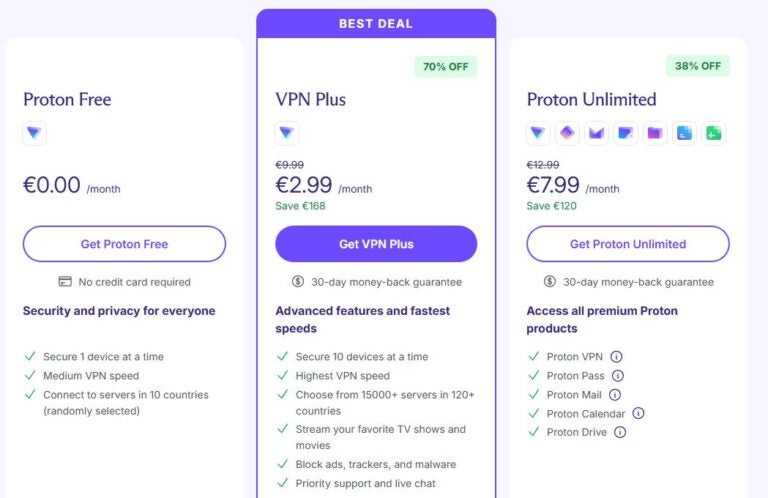
If you want flexibility, several service tiers, or a free starting point, Proton VPN clearly leads. Its free plan ranks among the market’s best, and paid plans add advanced tools like Secure Core, Stealth, and optimised servers.
If you prefer a simple, transparent model with no pricing swings, Mullvad VPN fits perfectly. There are no offers, promotions, or tiers: You pay €5 ($5.56) per month and that’s it. However, it doesn’t include advanced tools or the service variety that Proton offers.
Proton VPN vs. Mullvad VPN, which is better for remote work worldwide?
Although Proton VPN and Mullvad VPN share a deep commitment to privacy, they deliver very different experiences. For digital nomads, remote workers, international students, frequent travellers, and people who need to protect connections worldwide, Proton VPN is the best choice.
Proton VPN is one of the market’s most complete, versatile, and balanced brands. Why? It’s built for users who need advanced security, stable travel performance, specialised servers, streaming compatibility, and a wide infrastructure for working or connecting from anywhere.
Its mix of Secure Core, Stealth, Tor over VPN, and a global network makes it ideal for digital nomads, remote workers, and users who want a reliable service in every scenario.
Mullvad VPN, in contrast, shines in one very specific area: Absolute anonymity. Its minimalist design, extremely strict no-logs policy, and anonymous payment model make it perfect for people who put pure privacy above everything else.
However, its smaller network, missing specialised servers, and lack of focus on streaming or global mobility make it less convenient for people who travel, work remotely, or need a VPN that adapts across contexts.

So, Proton VPN is the best option for most users, especially if you travel, work remotely, or want a complete and consistent service. Alongside your Holafly monthly plan, you can move worldwide while keeping a stable and secure connection.