Language


 No results found
Proton VPN vs ExpressVPN: Which is better?
Discover, through this comparison between Proton VPN vs. ExpressVPN, which is the best option for working remotely while travelling the world.

Comparing Proton VPN vs. ExpressVPN is a common practice among travellers and remote workers looking for a reliable Virtual Private Network outside their home country. Both brands hold strong positions in the market and share a focus on security and privacy. However, they differ in philosophy, infrastructure, and the user experience they deliver.
In this article, we’ll review key similarities and differences, plus performance, server network, security, no-logs policy, and travel-focused features. The goal is to help you understand what each one offers. Then, you can choose what fits your travel, work, and connectivity style abroad.


 +1M
+1M
 Unlimited data
Limitless data plans in more than 170 destinations
Unlimited data
Limitless data plans in more than 170 destinations

With Holafly, you save +30% compared to roaming fees
Plans that may interest you


General comparison: Proton VPN vs. ExpressVPN
Before we analyse each service in detail, it helps to get an overview of what each VPN offers. Proton VPN and ExpressVPN are premium solutions for travellers and demanding users, yet they take different approaches. One prioritises privacy and transparency. The other stands out for performance and ease of use.
The table below summarises key similarities and differences, so you can compare them at a glance.
| Attribute | Proton VPN | ExpressVPN |
| Servers | 16,000+ | Over 3,000 |
| Countries | Over 120 | 105 |
| Protocols | WireGuard, OpenVPN, IKEv2 | Lightway, OpenVPN, IKEv2 |
| Encryption | AES-256: | AES-256: |
| Customer Support | Email and online support | 24/7 live chat |
| Available plans: | 3 plans (includes a free plan) | 3 plans |
| Free trial | Yes (free plan with no time limit) | No |
| Estimated speed impact | 5% to 20% | 5% to 10% |
| Monthly price | Approximately €8.39 ($9.99) | Approximately €10.39 ($12.49) |
| Streaming support | Yes (on paid plans) | Yes |
| Ad / malware blocker | Yes (NetShield) | Not built in |
| Dedicated IP | No | Yes, as an add-on |
| Kill switch | Yes | Yes |
| Compatible devices | Windows, macOS, iOS, Android, Linux | Windows, macOS, iOS, Android, Linux |
| Simultaneous connections | 10 devices | 8 devices |
| No-logs policy | Yes (independently audited) | Yes (independently audited) |
| Independent audits | Yes | Yes |
As you can see, the focus differs clearly. ExpressVPN delivers stronger performance, so it suits users who prioritise speed and ease of use. Proton VPN, instead, stands out for transparency and privacy policy. It also offers a free plan, which is rare at this level.
Both options work well for travel, yet they meet different needs. We’ll explore that more in the next sections.
Before that, here’s one tip. Using a VPN won’t help if you don’t secure your internet connection first. Luckily, one effective solution exists, especially for digital nomads, remote workers, international students, airline staff, and frequent travellers: Holafly Plans.
With monthly plans, you’ll get unlimited data in 170+ countries. Alongside a VPN, they act as key tools every digital nomad should keep close. With Holafly, your VPN will run smoothly, and it won’t leave you exposed at any point.
Important: If you are a frequent traveler and want to stay connected without worrying about expensive roaming or looking for a new SIM at every destination, Holafly’s subscription plans are for you. With a single eSIM, enjoy internet in more than 170 countries for a fixed price and no surprises on your bill. Travel without limits and connect easily and securely! 🚀🌍

Customer support: Proton VPN vs. ExpressVPN
Your VPN’s support team plays a key role, especially when you travel abroad and rely on it for secure work. It’s not only about fixes. It’s also about speed and clarity.
Proton VPN offers customer support mainly through email support and an online help centre. Documentation feels clear, detailed, and well organised, so users can solve most issues on their own.
On paid plans, email replies usually feel accurate and well explained, although they aren’t always immediate. This can suit patient users or those with technical experience. However, it feels less practical when you need urgent help.
ExpressVPN, in contrast, stands out with 24/7 live chat, plus email support. Chat often replies within minutes and offers direct solutions, which helps during trips or critical connections. Its knowledge base is also extensive. Even so, real-time support remains the key advantage.
Streaming and content unblocking: Proton VPN ExpressVPN
One of the most common VPN uses while travelling is accessing streaming platforms abroad. After all, downtime matters for digital nomads too. In that sense, series and films help you reset after work. Whether you want home content or international catalogues, the key is consistent access and stable speeds.
Proton VPN delivers good streaming performance, yet it comes with a few caveats. Access to Netflix, Amazon Prime Video, and Disney+ is available only on paid plans, via optimised servers. Under normal conditions, it runs steadily and supports HD playback. However, some countries or catalogues may require server switching. Proton VPN doesn’t focus only on streaming. Instead, it balances streaming with privacy and security.
ExpressVPN, in contrast, ranks among the most consistent VPNs for streaming. It works reliably with Netflix, Amazon Prime Video, Disney+, BBC iPlayer, HBO, and more, without hunting for specific servers. Access usually feels instant, and speeds stay stable over long distances. Therefore, you can watch high-definition content without drops.
If streaming matters most during your trip, ExpressVPN has the edge. If streaming is secondary, within a privacy-first setup, Proton VPN still works well.

Countries and servers: Which VPN has the wider network?
The server network matters when you travel abroad. It affects speed, connection stability, and your ability to pick locations. That helps based on your country or the content you need.
Proton VPN offers one of the widest geographic coverages on the market. It operates in 120+ countries, with strong presence in Europe and North America. One standout feature is security-tier routing, such as Secure Core servers. They route traffic through privacy-friendly countries before it reaches the open internet. This strengthens data protection, although it can slightly reduce speed.
Its network suits users who prioritise privacy and control over pure coverage. For common destinations, it performs well. However, it can fall short when you need very specific or uncommon locations.
ExpressVPN, on the other hand, also covers 100+ countries, so you can find nearby servers almost anywhere. As a result, you’ll often get stable connections and stronger speeds when you move between regions.
In addition, ExpressVPN runs its infrastructure on RAM-based servers. This enables frequent reboots and strengthens privacy without sacrificing performance. It doesn’t segment servers by use case, yet it optimises the network for browsing, remote work, and streaming overall.
Performance and speed: Proton VPN vs. ExpressVPN Which is better for remote work?
Speed and stability matter when you travel, work remotely, run video calls, or use cloud services. Here, Proton VPN and ExpressVPN show clear differences in approach.
Proton VPN delivers solid performance, yet results vary by server type. On standard servers, browsing feels smooth and works for daily use. However, when you enable advanced features like Secure Core, speeds can drop. That happens because traffic passes through two server layers to strengthen privacy. This won’t usually hurt browsing or light work, yet you may notice it during heavy downloads or high-resolution streaming.
Overall, Proton VPN prioritises security over maximum performance. For many travellers, that’s fine, but keep it in mind when speed matters most.
ExpressVPN, in contrast, uses its Lightway protocol to deliver fast, stable connections, even on distant servers. Therefore, you get lower latency, quicker loading, and consistent video calls, streaming, and remote work.

Dedicated IP for digital nomads
For some digital nomads and remote workers, a dedicated IP can matter. It helps prevent security blocks and reduces repeated checks. It also makes access easier for banks, corporate platforms, and work tools that distrust shared IPs. In general, VPNs that offer this benefit sell it as an add-on, and none include it in standard plans.
With Proton VPN, it doesn’t offer a dedicated IP as an extra feature. Its approach centres on privacy and anonymity, so it prioritises shared, dynamic IPs. This strengthens identity protection, yet it can create friction with services that expect a fixed, recognisable IP.
ExpressVPN, in contrast, offers a dedicated IP as a paid add-on. This gives you an exclusive IP address, not shared with other users, which reduces automated blocks and security alerts. It suits remote workers who need a more stable online identity while travelling.
ExpressVPN integrates its dedicated IP simply within the service. It targets users who want steady access to sensitive services, while keeping premium VPN protection.
So, ExpressVPN takes the lead by offering a dedicated IP as an add-on, which helps digital nomads using banking and corporate systems. Proton VPN, instead, stays closer to anonymity and privacy, so it trades away fixed-IP stability.
The choice depends on the need: Constant IP for remote work with ExpressVPN or greater anonymity with Proton VPN.
No-logs policy: Proton VPN vs ExpressVPN
A no-logs policy ranks among the most important VPN factors. It not only defines what data is collected, but also how protected your online activity is from third parties.
Proton VPN applies a strict no-logs policy. It doesn’t log IP addresses, browsing history, DNS queries or connection timestamps. Moreover, it’s based in Switzerland, a country with very favourable privacy laws and outside of international surveillance alliances. This legal framework, coupled with the use of RAM-based servers and independent external audits, reinforces its commitment to transparency and data protection.
Proton VPN also stands out for publishing clear disclosures about its privacy policy and for keeping some of its infrastructure and applications open source, which is appreciated by more technical and security-conscious users.
ExpressVPN also maintains a strong no-logging policy. It declares that it doesn’t store browsing activity, IP addresses or data that allow the user to be identified. It operates under the jurisdiction of theBritish Virgin Islands, a territory with privacy-friendly laws and no data retention obligations. Like Proton VPN, it uses RAM-onlyservers, which ensures that data is automatically deleted with every reboot.
Its no-logs policy was verified by independent audits and backed up by actual cases where it was unable to hand over user data, which reinforces its credibility.
Conclusion: Rest assured that both Proton VPN and ExpressVPN don’t log data on your online activity (and deliver what they promise).
Which VPN offers the best value for money?
Price is an important factor when choosing a VPN for travel, but it is worth considering this alongside what each plan offers. Proton VPN and Express VPN are positioned as premium services, albeit with different subscription models.
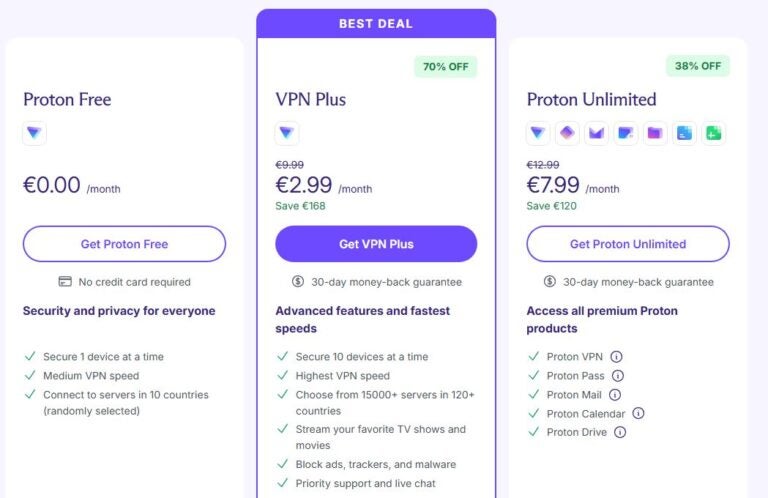
Proton VPN offers a more flexible plan structure. But its great differential is that it has a free plan that allows you to browse without data limits, something unusual in VPNs of this level, although with limited access to servers (10 countries) and advanced functions. It is a useful option for basic uses or for those who want to try the service before paying.
On paid plans, Proton VPN improves significantly. Includes full server access, faster speeds, streaming support and up to 10 simultaneous connections. Their long-term plans are competitively priced, especially if contracted for one or two years, and offer a good balance between cost, privacy and benefits.
ExpressVPN, on the other hand, does not have a free plan. Its proposal is more straightforward: A premium service with all functions active from the start. The monthly price is higher, and although annual and biennial plans reduce the cost per month, it’s still one of the most expensive VPNs on the market.

Reputation and reviews: Proton VPN vs. ExpressVPN
Proton VPN and ExpressVPN are two well-known brands in the industry and both have good reputations, but they tend to attract different user profiles.
Proton VPN is born out of the Proton ecosystem, known for privacy-focused services such as Proton Mail and Proton Drive. This gave it a very strong image in terms of data protection and transparency from the outset. It‘s a VPN that is especially valued in technical environments, privacy communities and among users who prioritise control over their personal information. Its open source policy, independent audits and Swiss headquarters reinforce this perception of trust.
On review platforms and specialised forums, Proton VPN receives positive reviews for its ethical approach, its free plan with no data limits and its clarity in explaining what data it does and does not collect. Criticisms often focus on speed, which, while good, is not always up to the level of more purely performance-oriented VPNs.
Express VPN, meanwhile, is one of the most award-winning brands on the market. For years, it has been praised by international technology media for its performance, stability and ease of use. It’s often recommended as an “all-rounder” VPN, designed for users who want to set it up and forget about configurations.
User reviews highlight its constant speed, its good streaming performance and the quality of its customer service. On the downside, the higher price is often the main negative point mentioned, although many users feel that this is justified by the overall experience.
Proton VPN vs. Express VPN: Which one should you choose for travelling abroad?
Both Proton VPN and Express VPN are reliable options for travelling and securing your connection abroad, but they serve different needs. So, the final choice will depend on which aspects you prioritise during your trip and the type of use you make of the VPN.
Express VPN is ideal for those looking for maximum performance, stability and ease of use. Its wide country coverage, constant speed and 24/7 support make it a very practical choice for frequent travellers and remote workers who need everything to work without additional configuration.
Proton VPN, on the other hand, stands out for its focus on privacy, transparency and the advantage of having one of the best free plans on the market. Its jurisdiction in Switzerland, its audited no-logs policy and the possibility of using a free plan make it especially attractive for users who value control of their data and a balance between security and cost.
Both work well when abroad. The difference is whether you need premium power and comfort or privacy and transparency at a better price.