Language


 No results found
Opening a bank account in Spain: Requirements, prices and steps
Do you need to open a bank account in Spain and are you a foreign national? We explain the requirements, types of banks and fees.

One of the first things you’ll need to do if you’ve moved to this country is to open a bank account in Spain. If you’re planning to stay for an extended period – whether as a tourist, digital nomad or student – this is a requirement you’ll need to meet in order to make local payments, set up direct debits for your salary and utilities such as water or electricity bills, and also to rent a flat.
In this article, you’ll find all the information you need to know about how to open a bank account as a foreigner, whether online or in person, including the requirements, processing times, maintenance fees and whether there is an account opening fee. Don’t miss this handy guide to help you sort out this banking procedure in Spain.
Do you need to open a bank account in Spain and are you a foreign national?
Whether you’ve just arrived in this country or are planning to do so soon – perhaps thanks to the Spanish digital nomad visa, because you’re studying on a scholarship, or simply because you’re staying for a while to enjoy the sunshine and the local cuisine – you’ll need to open a bank account in Spain to carry out various administrative tasks, such as paying taxes. Firstly, any foreign national can open an account online, but the requirements will depend on whether you are legally resident or not.
What are the steps involved in opening an online account?
The first thing you need to be clear about is that a 100% online account does not necessarily mean it is with a Spanish bank, as it may be an account held in Europe that is valid in Spain. The process for registering as a customer on an online banking platform involves:
- Filling in your details remotely as a customer on a digital financial platform (fintech or neobank). This includes uploading a copy of your ID card or passport.
- Digital identity verification.
- Review and approval.
- Obtaining a European IBAN, which may be from another EU country.
- Activating the bank account (from a few minutes to around two days)
- Applying for a card (between 5 and 15 days)
Find out the requirements for opening an online account
As you don’t have to visit a physical branch, the requirements are simpler than with traditional banking, and so are the waiting times. To open an online bank account in Spain as a foreign national, you will be asked to provide your passport, a residential address (which may be outside Spain) and proof of identity via a selfie or video call.
The difference between a fintech company and a bank in Spain
Have you heard of the term “fintech”? Also known as a neobank, it is a banking platform that is managed entirely online from outside Spain, so there is no need to be a resident of the country. It’s a perfect temporary solution until you can travel to Spain and open an account with a Spanish bank, if you need one urgently for any administrative procedures where it’s required. With a fintech account, you get a European IBAN number, which you can use to carry out transactions in Spain and across the rest of the continent.
In contrast, a traditional Spanish bank is a regulated institution based in Spain, where you can open an account in person and, in some cases, online. The difference is that with this bank, you get a Spanish IBAN (ES), which is more suitable for employment, tax and administrative procedures.
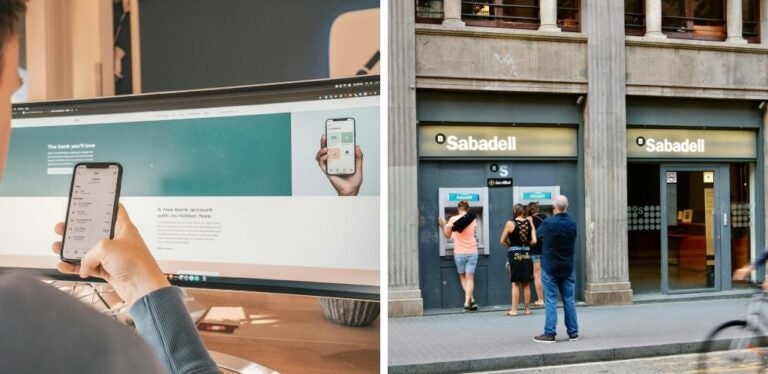
Platforms that allow 100% online account opening from abroad
| Bank | IBAN | Mandatory requirements | Non-residents | Digital identification |
|---|---|---|---|---|
| Santander | spanish | + 18 years old, passport. | ✅ | ✅ |
| N26 | german | +18 years old, passport. | ✅ | ✅ |
| Revolut | lithuanian | +18 years old, passport. | ✅ | ✅ |
| Monvenience | european | +18 years old, passport. | ✅ | ✅ |
| Wise | european | +18 years old, passport. | ✅ | ✅ |
| MisterTango | lithuanian | +18 years old, passport. | ✅ | ✅ |
Important: If you are a frequent traveler and want to stay connected without worrying about expensive roaming or looking for a new SIM at every destination, Holafly’s subscription plans are for you. With a single eSIM, enjoy internet in more than 170 countries for a fixed price and no surprises on your bill. Travel without limits and connect easily and securely! 🚀🌍
Do you need to open a bank account in Spain and are you a foreign national?
In banking terms, a non-resident is someone who does not habitually live in the country and is domiciled outside Spain. Faced with a massive influx of non-resident foreigners – drawn by the Mediterranean climate and a moderate cost of living compared to other European countries, and who need to open a bank account – some banks in Spain have created a special option for this type of customer:
- Santander, online account for non-residents: With this account, you’ll receive a Spanish IBAN and can open it online via video identity verification or in person.
- BBVA: You must visit a branch in person with a valid passport. They also provide you with a Spanish IBAN that you can use for transactions both within Spain and abroad.
- CaixaBank, HolaBank account for non-residents: Requires in-person registration, with a Spanish IBAN and access to ATMs in Spain and online banking.
- Banco Sabadell: You’ll need to visit a branch to complete the account opening process; you can open an account without needing a certificate of residence and use a Spanish IBAN.
Documents required to open a non-resident account
Although each bank has its own terms and conditions, one of the general mandatory requirements is the presentation of a valid passport or national identity card, if you are an EU citizen. They may also ask you to provide proof of your address abroad, such as a recent utility bill or a bank statement.
In addition, some banks require a certificate of non-residence issued by the Spanish police. This document confirms that you’re not a tax resident in Spain and, although it is not mandatory, it speeds up the process and reduces queries regarding your tax status in the country.
Steps required to open a non-resident account
- Book an appointment: With the institution you have chosen to open a non-resident account. The estimated time is one to two weeks.
- Visit the branch: Bring your passport, proof of address abroad, bank statements and a certificate of non-residence.
- Sign the forms: Read the small print and sign the account opening agreement.
- Verification: The bank verifies your identity and tax status.
- Account activation: If everything is in order, your account will be activated immediately and you’ll be issued with a bank card if you’ve requested one. If any documents are missing, the process may take a few extra days.

How much does it cost to open and maintain a bank account in Spain?
When opening a bank account in Spain, it is important to bear in mind the associated fees that the bank may charge you. We explain the main categories involved in this type of procedure and provide a table detailing the approximate costs:
- Account opening fee: This is a charge payable for the service of opening the account.
- Monthly or annual maintenance fees: Charges for keeping the account active.
- Initial deposit or minimum balance: The amount required to activate the account without incurring penalties.
- Card fees: Debit or credit cards linked to the account.
- Usage fees: Charges for transfers, ATM withdrawals or additional services.
| Account | Opening | Maintenance fee/month | Card | International transfers |
|---|---|---|---|---|
| Traditional bank (non-resident) | Free | €15–30 ($17–35) | €12-20 ($14–23) per year | High €10–50 ($11–58) |
| Traditional bank (non-resident) | Free | €6.00–8.00 ($7.00-35) | €12 -20 ($14–23) per year | High €10–50 ($11–58) |
| N26 standard digital | Free | Free | Free | Low (SEPA free) |
| Revolut Standard | Free | Free | Free | Down, according to the plan |
| Wise | Free | Free | Not always a physical card | Margin + per-transaction fee |
In addition to these standard charges, additional fees may also apply in various situations, such as withdrawing cash from an ATM at a different bank, making an urgent transfer, or the high fees you may be charged if you do not meet a minimum monthly spending requirement.
Opening a bank account online or in person – which is best for you?
It all depends on how you intend to use the account. Generally speaking, if you don’t need a Spanish IBAN because you won’t be setting up direct debits for taxes or utility bills and only intend to make SEPA transfers, online payments or other transactions, an online bank account will suffice. In fact, many digital nomads in Spain use a fintech platform for practical purposes within Europe.
However, if your bank account absolutely must have a Spanish IBAN – perhaps because it is required for the payment of an administrative fee, to set up a direct debit for your rent, or because you wish to apply for loans or mortgages – it is advisable to visit a Spanish bank in person. Here are a few points to help you understand this more clearly:
| Aspect | Online account | In-person account |
|---|---|---|
| Opening times | Quick and immediate | Slower, taking days or weeks |
| Requirements | Passport and digital verification | NIE, TIE, proof of address and bank statements |
| IBAN | Not always Spanish, it depends on the provider | Spanish |
| Costs | Low and even free | Monthly fees |
| Limitations | If you have a foreign IBAN, your application for utilities or a tenancy may be rejected | Greater flexibility and administrative acceptance |
| Physical presence required | No | Yes |
In any case, you can opt for a hybrid approach and first open a 100% online account to start trading quickly, and later, if you need a Spanish IBAN or additional services, you can visit a branch and open a bank account in Spain. So, don’t worry if you’re not sure which one to choose!
How to stay connected in Spain as a foreigner
To open a bank account in Spain, it’s important to have a good internet connection that allows you to access the online banking platform and complete your registration without the risk of being disconnected. What’s more, once your account is active, you’ll be able to carry out transactions via the app and check your account activity or international transfers. If you’re only in the country for a few days or a couple of weeks, you can get unlimited data just for the days you need it via Holafy’s eSIM for Spain, from €3.79 ($3.90) a day.
On the other hand, if you’re planning a longer stay, Holafly’s monthly plans are the best option, offering stable and reliable 5G coverage nationwide, with plans starting from 25 GB or unlimited data from $50.50 a month, and no minimum contract period. Plus,you can travel to your home country and over 170 destinations with the same eSIM and rate!
Frequently asked questions about opening a bank account in Spain
Some banks offer special accounts for non-residents, so you’ll only need your passport.
No, some digital banking platforms allow you to complete the process online, such as Banco Santander, Revolut or N26.
A non-resident account is for people who do not live in Spain, so it usually has higher fees. In contrast, a resident account offers better terms if you can prove your residence in the country and set up direct debits for utility bills or your salary.
Yes, many banks accept non-EU customers, depending on their profile, the source of their funds and the intended use of the account.
Check the costs for international transfers, cards, currency exchange and specific fees for non-residents, which vary from bank to bank.