Language


 No results found
Best supermarkets in Istanbul: Where to go grocery shopping?
Guide to the best supermarkets in Istanbul: discover where to shop in Turkey's vibrant capital.

Moving to the capital of Turkey can be as exciting as it is challenging. Before settling into this beautiful city, whether for a few weeks, several months, or indefinitely, you have a checklist of tasks to complete. In addition to finding accommodation for long stays, you’ll need to figure out which are the best supermarkets in Istanbul for your shopping, whether it’s for small items or to last the entire month.
Today, we’ll focus on the latter. We’ll explain the differences between supermarkets and traditional markets, something key if you’re moving to or staying in Istanbul for a while. Some places stand out for their low prices, others for convenience or the quality of their fresh products. In any case, shopping here can be as everyday as it is fascinating.
What types of stores and supermarkets can you find in Istanbul?
Supermarkets in Istanbul reflect the unique energy of the city: A blend of the modern and the traditional, where you can find everything from international products to spices, olives, and typical Turkish sweets.
The city, divided between Europe and Asia, offers a wide variety of options for your shopping needs. On the European side, large chains like Migros, CarrefourSA, and Şok dominate, while on the Asian side, there are many bazaars, greengrocers, and local shops, where the experience is more local, and the prices are usually better. In any case, you should know that the cost of living in Istanbul (and Turkey in general) is lower than in many other European capitals, and this is reflected in the shopping prices.
That being said, let’s take a look at the types of stores and supermarkets in Istanbul:
Major Supermarket Chains in Istanbul
The large chains dominate the urban landscape. Migros, CarrefourSA, and A101 are the most widespread throughout the city.
- Migros, of Swiss origin, is one of the most reliable and comprehensive, with branches in almost every neighborhood. Its MigrosJet version offers small convenience stores, while 5M Migros are hypermarkets with a wide range of products and competitive prices.
- CarrefourSA, operated in Turkey by Sabancı Holding, has stores of various sizes (from CarrefourSA Mini to CarrefourSA Hyper), with a good selection of international products.
- A101, for its part, is a local favourite for basic shopping: It offers very low prices and a line of private-label products. It’s common to find it in residential areas or side streets of Beyoğlu, Ümraniye, or Bahçelievler.
Discount Supermarkets
The discount model is deeply rooted in Turkey, especially in residential neighbourhoods. The chains Bim and Şok are the main players, though we could also include A101 in this group.
- Bim is probably the cheapest in the country: It has a limited selection but offers prices that are hard to match, ideal for those looking to save money.
- Şok, on the other hand, offers a balance between price and variety and is usually present in almost every neighbourhood, from Kadıköy to Sarıyer.
These stores are small, with few brands per product, but perfect for daily or weekly shopping.
Gourmet Supermarkets and International Stores
In more touristy or middle-to-high-income residential areas, such as Nişantaşı, Bebek, or Etiler, there are supermarkets catering to an international clientele. Macrocenter, part of the Migros group, is the most well-known option: It offers gourmet products, wines, European cheeses, and imported foods. There are also stores specialising in organic products, like Ekopazar or City Farm.
Traditional Markets (Pazarlar)
No supermarket can compete with Istanbul’s historic bazaars. Every neighbourhood has at least one or two pazarlar weekly, where locals buy fresh fruits, vegetables, spices, and bread at very low prices.
The Kadıköy Market, on the Asian side, and the Beşiktaş Pazar, on the European side, are the most popular. Also, the legendary Grand Bazaar remains a symbol of the city, with thousands of stalls selling everything from spices to ceramics and textiles.
Local Shops (Bakkal)
Bakkals are small family-run stores that survive on every corner in Istanbul. They act as a meeting point for the neighbourhood: Selling bread, milk, fruits, cigarettes, and basic items, often on credit. Their main advantage is their proximity and personalised service, although prices tend to be a little higher than in large supermarkets.

What Are the Best Supermarkets in Istanbul?
Finding the ideal supermarket in Istanbul largely depends on your neighbourhood and lifestyle. On the European side, where the more modern and touristy areas are concentrated, large chains like Migros, CarrefourSA, and Macrocenter dominate, offering a varied selection that includes international products. Meanwhile, on the Asian side (more residential and family-oriented), Bim and Şok are more common, with lower prices and smaller stores.
The good news is that all major supermarkets have online shopping apps and home delivery services, which is very useful in a city as large and with unpredictable traffic. Additionally, most accept card payments and digital wallets, and some, like Migros or CarrefourSA, even have loyalty programs and personalised discounts.
Next, we’ll tell you how the main supermarkets in Istanbul work, their advantages, prices, and what makes them stand out.
1- Migros
Migros is the most complete and reliable supermarket in Istanbul. Founded in Switzerland and operating in Turkey for decades, it combines moderate prices with excellent organisation and a wide range of products. It has different formats: MigrosJet (small stores), Migros (standard supermarkets), and 5M Migros (hypermarkets), adapting to the size and pace of each neighbourhood.
Its branches are spread across almost the entire city, especially in Beşiktaş, Şişli, Kadıköy, and Ataşehir. Prices include around 30 TRY (€1.00 ($0.90)) for a litre of milk, 20 TRY (€0.67 ($0.60)) for a kilo of fresh bread, and about 60 TRY (€2.00 ($1.80)) for a dozen eggs.
Its advantages include its consistent quality, its Money Club loyalty programme, and the ability to shop online via the Migros Sanal Market app. The downside is that some imported products are more expensive than in other discount chains.
| Pros | Cons |
|---|---|
| Wide coverage throughout the city | Higher prices for imported products |
| Good quality and product variety | Large stores, sometimes very crowded |
| App with home delivery and discounts | |
| Ideal for weekly or monthly shopping |
Advantages and disadvantages of Migros supermarkets in Istanbul
2- CarrefourSA
CarrefourSA is one of the most recognised and comprehensive options for shopping in Istanbul, especially if you’re looking for international brands or a modern shopping experience. It’s the result of a partnership between the French Carrefour group and the Turkish conglomerate Sabancı Holding, allowing it to adapt well to the local market.
It has a strong presence in central European neighbourhoods, such as Beşiktaş, Şişli, Fatih, and Taksim, as well as residential areas on the Asian side, such as Kadıköy and Ümraniye. Its formats range from small CarrefourSA Mini stores, ideal for quick shopping, to large CarrefourSA Hyper stores, located in shopping malls like Cevahir AVM or Akasya Mall.
Prices are moderate, with a good balance of quality and value. A litre of milk costs about 32 TRY (€0.73 ($1.00)). A kilo of fresh bread costs around 22 TRY (€1.25 ($0.70)). A dozen eggs usually comes to about 65 TRY (€2.49 ($2.00)). There are also organic, international, and delicatessen sections, as well as frequent promotions on fresh products.
The main advantage of CarrefourSA is its balance between variety and accessibility: you’ll find everything you need without paying excessive prices. Plus, its online platform CarrefourSA Online Market works well, with fast delivery to most districts. The downside is that some smaller stores may have less selection and slightly higher prices compared to the larger stores.
| Pros | Cons |
|---|---|
| Wide range of products, including imports | Slightly higher prices in small stores |
| Presence in central and residential areas | Smaller stores have less variety |
| Good online service and frequent promotions | |
| Ideal for weekly and convenience shopping |
Advantages and disadvantages of CarrefourSA
Important: If you are a frequent traveler and want to stay connected without worrying about expensive roaming or looking for a new SIM at every destination, Holafly’s subscription plans are for you. With a single eSIM, enjoy internet in more than 170 countries for a fixed price and no surprises on your bill. Travel without limits and connect easily and securely! 🚀🌍

3- Bim
Bim is, without exaggeration, the most popular and affordable supermarket in Turkey. Its name comes from “Birleşik Mağazalar A.Ş.” and its model is inspired by European discount chains. There’s a Bim in every neighbourhood in Istanbul, from the oldest alleys in Fatih and Eyüpsultan to the modern complexes in Kadıköy, Beşiktaş, and Ümraniye.
The secret to its success lies in simplicity: Few products, many private-label brands, and unbeatable prices. Bim doesn’t aim to offer a shopping experience but rather practicality and savings. There’s no music, wide aisles, or gourmet sections; just low prices and a constant supply of essential items.
A litre of milk costs about 28 TRY (€0.73 ($0.85)). A kilo of fresh bread costs around 18 TRY (€1.25 ($0.55)). A dozen eggs usually comes to about 55 TRY (€2.49 ($1.70)). Private-label products, such as Dost (dairy) or Filiz (pasta), are so popular that many Turkish households prefer them over traditional brands.
Its advantages include real savings and proximity: There’s always a Bim just a few minutes’ walk away, even in non-touristy areas. Also, its quality has improved significantly in recent years, while maintaining low prices. The downside is its limited variety: If you’re looking for something specific or imported, you probably won’t find it here.
| Pros | Cons |
|---|---|
| The lowest prices in Istanbul | Limited product variety |
| Presence in all neighbourhoods | Small, basic stores |
| Good-quality private-label products | No international or gourmet products |
| Ideal for daily shopping and saving |
Advantages and disadvantages of Bim
4- Şok
Şok is another major name in daily consumption in Turkey and a direct competitor to Bim. Its slogan, “Şok ucuz!” (“Super cheap!”), perfectly reflects its proposal: Low prices, essential products, and a network of stores covering the entire city. Unlike Bim, it offers a slightly more modern experience, with greater variety and some digital services to facilitate shopping.
Şok stores are also spread across almost every neighbourhood in the city, from the European side (Beşiktaş, Şişli, Fatih) to the Asian side (Kadıköy, Üsküdar, Maltepe). The stores are small but well organised, and every week they launch catalogues with discounts on food, cleaning products, and home goods.
Prices are highly competitive: A litre of milk costs around 29 TRY (€0.97 ($0.90)), a kilo of fresh bread around 19 TRY (€0.63 ($0.60)), and a dozen eggs costs about 58 TRY (€1.93 ($1.75)). Its private-label brand, Mis, offers good-quality basic food items and is very popular among locals.
Its advantages include strategic locations (always near residential areas), clean stores, and its mobile app, which allows you to see offers and add discounts. Its main downside is the limited space: Stores can get crowded during peak hours, and the selection varies depending on the neighbourhood.
| Pros | Cons |
|---|---|
| Low prices and weekly offers | Small and crowded spaces |
| Clean, well-located stores | Limited variety in fresh produce |
| Mobile app with discounts and catalogues | No international products |
| Excellent price-quality ratio |
Advantages and disadvantages of Şok
5- Macrocenter
Macrocenter is the premium supermarket par excellence in Turkey. Part of the Migros group, it’s designed for those seeking high-quality products, international brands, and a more peaceful and elegant shopping atmosphere. It’s the absolute opposite of Bim or Şok: Here, the focus is not on price, but on the experience.
Its branches are mainly concentrated in Istanbul’s more modern and affluent neighbourhoods, such as Nişantaşı, Etiler, Bebek, Levent, and Moda, as well as some tourist areas like Galata. The stores are bright, tidy, and have gourmet sections where you can find European cheeses, wines, cured meats, organic products, and high-quality ready-made meals.
Prices are high but in line with the type of products offered. A litre of milk costs about 35 TRY (€0.73 ($1.10)). A kilo of fresh bread costs around 25 TRY (€1.25 ($0.80)). A dozen eggs usually comes to about 75 TRY (€2.49 ($2.30)). They also sell imported products that are hard to find in other chains, such as Italian pastas, French sauces, and Asian snacks.
Its advantages include the exceptional quality of fresh products, personalised service, and pleasant atmosphere. Additionally, it offers delivery service and app orders, something highly valued by foreign residents. The downside, however, is clear: The prices are the highest on the market, and the branches are limited to specific areas of the city.
| Pros | Cons |
|---|---|
| Wide variety of gourmet and imported products | Highest prices on the market |
| Elegant, clean, and well-located stores | Limited presence in premium neighbourhoods |
| Excellent quality and personalised service | Not ideal for daily shopping |
| Delivery and online ordering options |
Advantages and disadvantages of Macrocenter in Istanbul
What Other Types of Stores Are Popular in Istanbul Besides Supermarkets?
Istanbul preserves a vibrant and deeply rooted shopping culture. In a single afternoon, you can go from a modern shopping mall with luxury stores to a centuries-old market where everything is bargained for out loud. This coexistence between the new and the old makes shopping in the city much more than just a routine: It’s part of its identity. If you want to know more, we recommend reading our article on what to buy in Istanbul.
If you want to know where to shop beyond the supermarkets in Istanbul we’ve mentioned, keep reading.
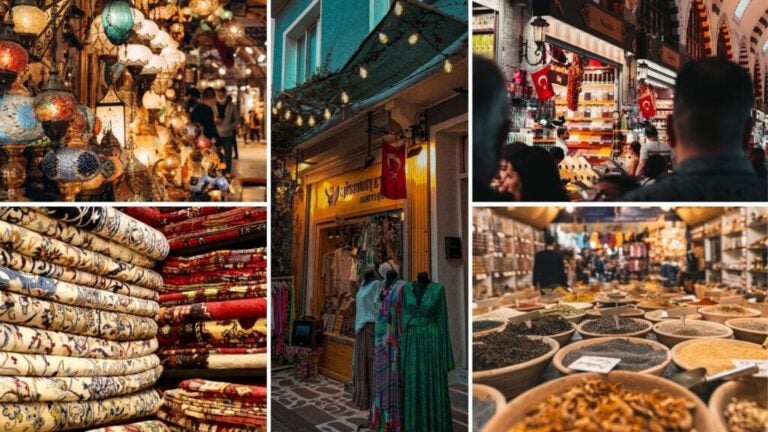
Grand Bazaar (Kapalıçarşı)
The Grand Bazaar is one of the oldest and largest covered markets in the world, with over 4,000 shops and stalls spread across a labyrinth of corridors. Located in the heart of the Fatih district, it’s an ideal place to buy spices, jewellery, ceramics, textiles, Turkish sweets, and souvenirs.
The great advantage of the Grand Bazaar is its unique and cultural atmosphere. Walking through it is a sensory experience that immerses you in Ottoman history. Also, if you know how to negotiate, you’ll find that getting reasonable prices is totally possible. Its downside is that initial prices are often inflated, especially for tourists, and it can be overwhelming because of the crowds.
Spice Market (Mısır Çarşısı or Spice Bazaar)
Located in the Eminönü district, the Spice Market is another iconic spot in Istanbul. Here, the air is filled with the scents of cinnamon, saffron, cumin, and Turkish coffee. It’s the perfect place to buy nuts, teas, honey, sweets, and fresh spices.
The main advantage is the quality of natural and local products, as well as its traditional atmosphere. It’s an ideal spot for those who love cooking and are looking for authentic ingredients. The downside is that many stalls cater to tourists, so it’s a good idea to compare prices or ask locals before buying.
Kadıköy Pazarı
Located on the Asian side of the city, Kadıköy Pazarı is one of the most beloved markets by locals. It’s less touristy than the markets on the European side and retains a very local essence. Here, you can find fresh fish, fruits, vegetables, olives, artisanal cheeses, and high-quality spices, as well as small traditional cafés.
The main advantage is its authenticity: Prices are fair, the products are fresh, and the service is personal. Its only downside is that not all vendors speak English, though this also adds to the local charm.
Beşiktaş Pazarı
Beşiktaş Pazarı is another favourite among Istanbulites, especially young people. It sets up on Saturdays and combines the best of a local market with a modern atmosphere. You’ll find clothes, accessories, household items, and fresh food at great prices.
The advantage is its variety and local vibe: It’s an ideal market for discovering different products and mingling with the everyday life of the neighbourhood. The downside is that it’s usually very crowded on weekends, so it’s best to go early.
Watsons and Gratis
For personal care, cosmetics, and cleaning products, Watsons and Gratis are the most popular chains in Istanbul. They’re present in all shopping malls and main avenues, with stores in Taksim, Nişantaşı, Kadıköy, and Üsküdar.
The advantage is the wide variety of international brands, competitive prices, and frequent promotions. Additionally, both offer apps with exclusive discounts and loyalty programs. The downside is that, during peak hours, the stores can get very crowded, especially in the centre.
Frequently Asked Questions About Supermarkets in Istanbul
It depends on your lifestyle and neighbourhood. If you’re looking for convenience and quality, Migros is the most balanced option. If you prefer to save money, Bim and Şok are local favourites. However, if you live in more modern areas like Nişantaşı or Levent, Macrocenter and CarrefourSA offer international products and a more complete shopping experience.
Yes. Almost all major chains have online shopping apps with home delivery or store pickup, which is very useful in a city this large. Migros Sanal Market, CarrefourSA Online Market, and Getir are the most used platforms. In central districts, even some small stores offer delivery via WhatsApp.
Definitely yes. The pazarlar and bazaars offer fresher products, better quality, and lower prices than supermarkets. They’re also an essential part of Istanbul’s culture. Buying fruits or spices at Kadıköy Pazarı or the Spice Bazaar isn’t just a way to save money, but also a way to experience the city like a local.
In major supermarkets like Migros or CarrefourSA, yes: They accept credit cards, debit cards, and digital payments like Masterpass or Papara. In bazaars and local markets, however, many vendors still prefer cash, although more and more are accepting QR payments or mobile wallets. That said, it’s still practical to carry some cash (Turkish lira).