


 Language


 No results found
Best supermarkets in Argentina: Where to go grocery shopping?
Shopping in supermarkets in Argentina can be tricky at first, but knowing the best options will help you make the most of your budget.

Moving to Argentina or spending a long stay there means adapting to a very particular shopping routine. In a context where prices change often, you need to know where to buy food and daily essentials. This knowledge helps you balance your budget and maintain a good quality of life. In this sense, the best supermarkets in Argentina range from big international chains to local neighbourhood shops. These smaller businesses still play a leading role in everyday life.
In large cities such as Buenos Aires, Córdoba or Rosario, the range is wide. You’ll find traditional supermarkets, discount stores, Chinese corner shops open until late and neighbourhood markets with fresh products. However, in small towns or rural areas, local self-service shops and family-run minimarkets dominate. Understanding the differences between each format helps you save money and adapt to the Argentinian lifestyle, where comparing prices and using promotions almost becomes a national art.
What Types Of Shops And Supermarkets Exist In Argentina?
Doing the food shop in Argentina almost becomes a cultural experience. This happens not only because prices change very often, but because every type of shop has its own audience and way of operating. From big chains with national presence to the classic corner “Chinese shops”, supermarkets and grocery stores in Argentina adapt to every lifestyle, budget and routine.
Traditional Supermarkets
These are the big chains that everyone in Argentina knows. Carrefour, Coto, Jumbo and Disco dominate the market in the main cities. They usually offer a wide variety of national and imported products, in addition to bakery, butcher and even household items.
In the Argentinian capital, Buenos Aires, there’s a branch in almost every neighbourhood. Prices can vary by area and even from one day to the next. Promotions with credit cards or bank discounts appear constantly in this type of store.
Wholesale Supermarkets
In recent years, wholesalers such as Makro, Vital, Diarco or Yaguar became a very popular option, even for families. Although people originally designed them for businesses, many individuals now use their volume prices for the monthly shop. These shops sit in areas further from the centre and offer the lowest prices on the market. However, they sell large formats that require some planning.
Here’s a useful tip if you’re a student or digital nomad. You can organise with your coliving flatmates or residence friends to shop in bulk and split costs. In a country like Argentina, this practice really helps you protect your budget.
Neighbourhood Self-Service Shops
People commonly call them “Chinese grocery shops”, and these small supermarkets appear in every neighbourhood in the country. They open from early until late, even on Sundays and bank holidays, and sell almost everything. You’ll find food, drinks, cleaning products and basic household items. Their big advantage lies in convenience and extended opening hours, although prices are usually slightly higher than in the big chains.
Discount Supermarkets
Chains such as Día or Carrefour Express represent the discount format in Argentina. Their shops are small or medium sized, with competitive prices and constant promotions. They’re ideal for people who live alone or need to buy small amounts frequently. Día, in particular, has its own private label line, which helps keep prices low while it still maintains quality.
Neighbourhood Markets And Street Fairs
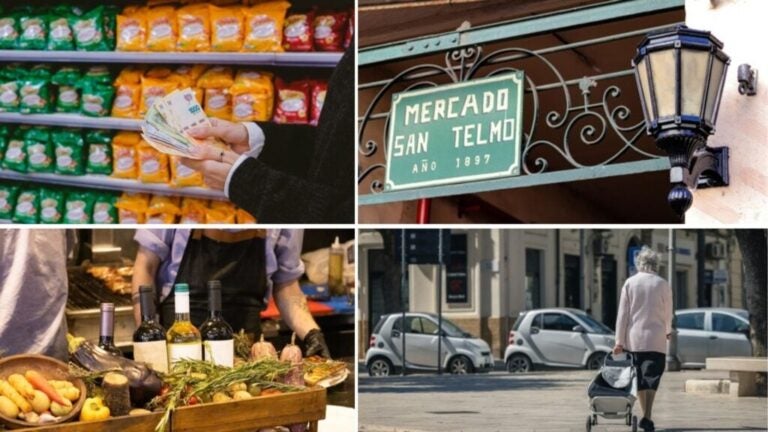
Almost every Argentinian city has municipal markets and fairs where people sell fruit, vegetables, meat and baked goods directly from local producers. In Buenos Aires, the San Telmo Market, the Belgrano Market and the City Government’s travelling fairs offer fresh products at lower prices than supermarkets. This becomes the favourite option for those who prioritise quality and direct contact with the seller.
Convenience Stores And Kioscos
Finally, kioscos are an Argentinian classic. They open until very late at night and sell snacks, drinks, cigarettes and basic products. At petrol stations you’ll also find 24-hour convenience stores such as Axion Shop or YPF Full, where you can grab something quickly or have a coffee. They cost more than a supermarket, but they’re perfect for urgent situations.
Which Are The Best Supermarkets In Argentina?
Supermarkets in Argentina aren’t just places to do the shopping. They also act as a price thermometer, meeting point and part of everyday life. Every chain has its own style, audience and strategy to survive in a country where prices change weekly and promotions almost become a science.
The range is wide, from international giants such as Carrefour to national brands like Coto or Chango Más. Some chains focus on variety and convenience, and others prioritise savings and discounts, while a few combine the best of both worlds. There’s also room for wholesalers, which gained importance among families who want to stretch their budgets.
Below, we explain which supermarkets are the most popular and recommended in Argentina. You’ll see what to expect from each one, where most branches sit and how to use their promotions so every shop goes further.
1- Carrefour: The Supermarket With The Biggest Presence And Range Of Products In Argentina
Carrefour is one of the most recognised supermarket chains in Argentina and the one with the broadest coverage across the country. With more than 600 branches across Buenos Aires, Córdoba, Rosario, Mendoza and other major cities, it’s almost impossible not to have one nearby.
What sets Carrefour apart is its variety of formats. Carrefour Hiper stores, located on major avenues or in shopping centres, sell everything. You’ll find food, appliances, clothing and household goods. Meanwhile, Carrefour Market and Express focus on quick, local top-up shops.
In terms of prices, Carrefour sits in the mid-range, with an excellent balance between variety and promotions. For example, one litre of milk costs around $1,200 ARS ($870 US, €820), one kilo of rice about $1,000 ARS ($725 US, €680) and a dozen eggs around $3,000 ARS ($2,170 US, €2,050). The key lies in using bank promotions and discounts through the Mi Carrefour app, which change every week and offer significant savings with certain cards or special days.
Carrefour also stands out for its private label line, Carrefour Selection, which offers good quality at more accessible prices than traditional brands. It also provides online shopping and home delivery services in the main cities of the country.
| Pros | Cons |
|---|---|
| Presence in almost the whole country, with multiple formats | Prices change a lot between shops and provinces |
| Wide variety of products, including appliances and home goods | Express stores can be more expensive due to convenience |
| Constant bank promotions and discounts | Queues in hypermarkets are often long |
| Private label with a good price–quality ratio | Some stores differ a lot in maintenance and stock |
Advantages and disadvantages of Carrefour supermarkets in Argentina
Important: If you are a frequent traveler and want to stay connected without worrying about expensive roaming or looking for a new SIM at every destination, Holafly’s subscription plans are for you. With a single eSIM, enjoy internet in more than 170 countries for a fixed price and no surprises on your bill. Travel without limits and connect easily and securely! 🚀🌍

2- Coto: The Quintessential Supermarket Of Buenos Aires
If one supermarket forms part of the identity of Buenos Aires, it’s Coto. Founded in Argentina, it’s one of the country’s biggest chains and has a strong presence in the City of Buenos Aires and Greater Buenos Aires, although it also has branches in other provinces. Its slogan “Yo te conozco” became part of everyday speech and reflects the closeness many Argentinians feel towards this brand.
Coto shops are usually large, with full butcher, bakery, greengrocer, appliance and home sections. One of their great attractions is the quality of their meat, which historically marked a strong point for the chain. In terms of prices, it sits in the mid to mid-low range, with constant weekly bank promotions and discounts. For example, one kilo of minced meat costs around $6,000 ARS ($4,340 US, €4,100), a bottle of sunflower oil about $2,500 ARS ($1,800 US, €1,700) and a packet of pasta around $800 ARS ($580 US, €550).
In addition, Coto offers online shopping and a mobile app, although its home delivery service still doesn’t cover the entire country. It also has its own Coto private label, which includes everything from basic foods to cleaning products.
| Pros | Cons |
|---|---|
| Wide range and large stores with complete sections | Higher concentration in Buenos Aires, lower national presence |
| Very good quality meat and fresh products | Large stores often become very crowded |
| Weekly bank promotions with significant discounts | App and online system can be unstable |
| Good price–quality ratio in private label products | Some branches differ a lot in cleanliness and service |
Advantages and disadvantages of Coto
3- Jumbo: The Supermarket Chain In Argentina For A Premium Shopping Experience
Jumbo belongs to the Chilean group Cencosud, which also owns Easy and Disco, and positions itself as Argentina’s leading premium supermarket. Its shops are large, bright and located in strategic areas of big cities, especially in Buenos Aires, Córdoba, Mendoza and Rosario. In the capital, there are very complete branches in Palermo, Recoleta and Caballito, plus others inside shopping centres.
Jumbo stands out because of the quality of its fresh products and the variety of imported brands you won’t easily find in other chains. Its shelves combine local items with gourmet products, international drinks and a carefully prepared bakery and patisserie section. However, quality comes at a price. One litre of milk can cost around $1,500 ARS ($1,085 US, €1,030), one kilo of rice about $1,300 ARS ($940 US, €890) and a bottle of olive oil around $4,000 ARS ($2,880 US, €2,730).
Many customers value the shopping experience itself. You’ll find well organised shops, exclusive products and weekly bank promotions that let you access significant discounts. Jumbo also offers online shopping, with home delivery or click and collect service, ideal for people in urban areas with little free time.
| Pros | Cons |
|---|---|
| Excellent quality fresh and gourmet products | Higher prices than the average |
| Wide variety of local and imported brands | Lower presence outside the biggest cities |
| Spacious, clean and well organised stores | Promotional products sometimes go out of stock |
| Offers online shopping and click and collect | Not the best option for tight budgets |
Advantages and disadvantages of Jumbo-@Shutterstock

4- Día, The Most Popular Discount Chain In Argentina
Día, previously known as Día%, is Argentina’s leading discount chain and one of the favourite options for people who seek low prices without losing quality. With more than 700 shops across the country, it appears in both large cities and medium-sized towns. Its branches are usually smaller than Carrefour or Coto, but very practical for daily or weekly shopping.
Día’s model focuses on offering private label products at lower prices than traditional brands. This makes it ideal for saving on everyday essentials. For example, a packet of pasta costs around $700 ARS ($510 US, €480), one litre of milk about $1,000 ARS ($725 US, €680) and a bottle of standard cooking oil around $2,300 ARS ($1,670 US, €1,580). In addition, Día has an app and the Club Día loyalty card. This system lets you collect points and access exclusive discounts, which regular customers appreciate a lot.
Most shops sit in residential and central areas, so you can easily walk there. Although it doesn’t offer a huge range of premium products or sections as complete as other supermarkets, it covers basic needs very well and provides good quality in its Día private label line.
| Pros | Cons |
|---|---|
| Very low prices and constant promotions | Smaller shops, with less product variety |
| Nationwide presence, even in medium-sized cities | Fresh sections aren’t as extensive as Coto or Jumbo |
| Affordable private label with good quality | Not ideal for large or monthly shops |
| Loyalty programme with personalised discounts | Online shopping doesn’t cover the entire country |
Advantages and disadvantages of Día supermarkets in Argentina
5- Supermarkets In Argentina: Chango Más
Chango Más is one of the most popular and fastest growing supermarket chains in Argentina. It started as part of the Walmart group, but after its sale to Grupo De Narváez, it adopted a more local identity. It now focuses on Argentinian customers and offers competitive prices without losing the experience of an international format.
Today, Chango Más combines the best of two worlds: Wholesale prices with the convenience of a retail supermarket. It has branches across much of the country, with strong presence in Buenos Aires, Córdoba, Mendoza, Tucumán and Santa Fe. Its stores are large, with tidy aisles, good cleanliness and a strong range of national products and private label lines. It also developed different shop sizes, such as Mini Más, created for quick shopping in central areas.
Its prices sit in the mid-low range of the market. One kilo of sugar costs around $1,200 ARS ($870 US, €820), one litre of milk approximately $1,100 ARS ($795 US, €750) and one kilo of rice starts at $950 ARS ($685 US, €650). It also offers frequent discounts with bank cards and weekly promotions. Many customers value that, after the change of ownership, the chain clearly improved its service and stock and started to prioritise Argentinian products.
| Pros | Cons |
|---|---|
| Good prices, especially for large shops | Lower presence in some northern and southern provinces |
| Comfortable, well organised stores | Product range can change a lot by branch |
| Mixes wholesale prices with retail experience | Some branches are still undergoing refurbishment |
| Private label and Argentinian products are growing |
Advantages and disadvantages of Chango Más, formerly Walmart, in Argentina
6- Makro, The Wholesale Supermarket Most Popular With Families And Small Businesses
Among all supermarkets in Argentina, Makro is the largest and best-known wholesaler. Although people originally designed it for shop owners and restaurants, in recent years it has become a very popular option for families who buy in bulk to save. It has branches across much of the country, in cities such as Buenos Aires, Córdoba, Rosario, Mendoza, Salta and Neuquén, usually in industrial zones or on the outskirts.
Makro’s model focuses on offering lower prices when you buy higher volumes. Products come in large formats or cases, so you can achieve clear savings compared with retail supermarkets. For example, a box of twelve litres of milk costs around $12,000 ARS ($8,670 US, €8,150), a pack of ten pasta packets about $6,500 ARS ($4,720 US, €4,460) and a pack of six bottles of oil around $12,000 ARS ($8,670 US, €8,150). The advantage is clear: The more you buy, the more you save.
Makro sells national and imported brands, plus its own Aro and M&K private labels. It usually offers very good quality in dry foods, drinks and cleaning items. Not all branches have fresh sections as complete as Coto or Carrefour, but its prices on non-perishable products are very hard to match. Another advantage is that, although you once needed a customer card, now anyone can shop there without special requirements.
| Pros | Cons |
|---|---|
| Very low prices when you buy in bulk | Branches sit far from city centres |
| Ideal for families or small businesses | Not practical for daily or small shops |
| Good quality in national and private label products | Less choice in fresh and gourmet items |
| No registration needed to shop | You usually need a car to carry large volumes |
Advantages and disadvantages of Makro
Other Popular Shops And Stores In Argentina
Besides the big supermarket chains, Argentina has a huge network of shops, local stores and specialist chains that shape daily life. Some of them provide smaller options for everyday shopping, while others focus on specific categories such as clothing or home decor.

1- Carrefour Market And Día Express
Carrefour Market and Día Express are the most common local formats in large cities. With smaller shops than hypermarkets, they’re perfect for daily or emergency shopping. In Buenos Aires, Carrefour Market appears in neighbourhoods such as Palermo, Belgrano and San Telmo, while Día Express sits in both residential and central areas.
Their prices are slightly higher than in larger stores, but they make up for it with long opening hours and convenient locations.
2- La Anónima
La Anónima is the most important chain in southern Argentina, with a strong presence in Patagonia, La Pampa and rural Buenos Aires province. It offers reasonable prices, a good range of fresh produce and national brands and more personalised service than the big national chains.
In many towns where other brands don’t operate, La Anónima is almost synonymous with “supermarket”.
3- Chinese Grocery Shops
Chinese grocery shops form an inseparable part of urban life in Argentina. They appear in every neighbourhood and open until late, even on Sundays and bank holidays, and stock everything from food to cleaning products and drinks.
Although prices are slightly higher, their main advantage lies in convenience and proximity. If you run out of bread or yerba (mate) at ten at night, your local Chinese shop almost always remains open.
4- Other Popular Shops In Argentina
Falabella, although it now has fewer physical stores, and Sodimac still act as key references for home products, decor and tools. You’ll also find national chains such as Sommier Center or Musimundo, where you can buy appliances, furniture or tech with local finance options. If you’re looking for affordable, modern clothing, C&A and Zara remain two of the best-known chains, especially in Buenos Aires, Rosario and Córdoba.
Tips For Shopping In Supermarkets In Argentina
Shopping in supermarkets in Argentina requires a clear strategy. In a country where prices constantly move, comparing, using promotions and planning almost become survival skills. The good news is that, with some organisation, you can save a lot.
The first tip is to keep an eye on bank discounts. Every week, the main banks in the country offer 20%, 30% or even 40% discounts in chains such as Coto, Carrefour and Día. There are also special days for certain cards or digital wallets such as MODO or Mercado Pago, which let you stack extra benefits.
Another very Argentinian trick consists of combining different shopping channels. People often do their big monthly shop in wholesalers such as Makro or Chango Más and then buy fresh products in neighbourhood shops or street fairs. It also helps to sign up for supermarket apps, such as Mi Carrefour or Club Día, where you can activate personalised promotions based on your shopping history. If you live in a central area, Express or Market branches are useful for urgent needs, although prices are slightly higher.
Supermarkets In Argentina: Frequently Asked Questions
It depends on the area, but Día, Chango Más and Makro are usually the cheapest options. Día stands out for low prices on private label products, Chango Más for its bundles and weekly offers and Makro for big discounts on bulk purchases. In smaller cities, neighbourhood grocery shops can also offer good prices if you choose local products.
Bank promotions form an essential part of saving in Argentina. Every bank has specific days with 20% to 40% discounts or cashback in chains like Carrefour, Coto or Jumbo. Some benefits also apply when you pay through digital wallets such as MODO or Mercado Pago.
These shops are great for buying non-perishable foods, cleaning products, drinks and personal care items. Bulk prices are much lower than in traditional supermarkets. However, fresh products are often more limited, so many Argentinians combine wholesalers with fairs or supermarkets to complete their shopping.
Yes, although they’re less common. Jumbo and Carrefour Hiper offer the best selection of imported products, international wines and gourmet foods. There are also specialist shops in neighbourhoods such as Palermo, Recoleta or Puerto Madero, but their prices are considerably higher than in traditional supermarkets.