



 Language


 No results found
The world’s most connected cities
We analyzed 100 destinations to find the world's most connected cities. From Milan to Doha, find out which cities make the top 10.

Whether you’re working remotely, streaming a movie or managing your banking on the go, reliable internet has become an important part of everyday life. For travelers especially, a city’s connectivity can make or break the experience.
Staying online isn’t just convenient, it’s essential when it comes to being able to check in with family, or work remotely without interruptions. The more connected a city is, the easier it is to explore and make the most of your time there.
What makes a city connected?
To uncover the world’s most connected cities, the Holafly research team has analyzed a mix of factors from wi-fi availability and hotel connectivity, to mobile data prices, internet speeds, mobile network operators, and active mobile connections. Each city then received a connectivity score, revealing where travelers can expect the best online experience.
Below are some of the most connected cities in the world, followed by a breakdown of the leading cities across the USA and Europe.
Key takeaways from the findings:
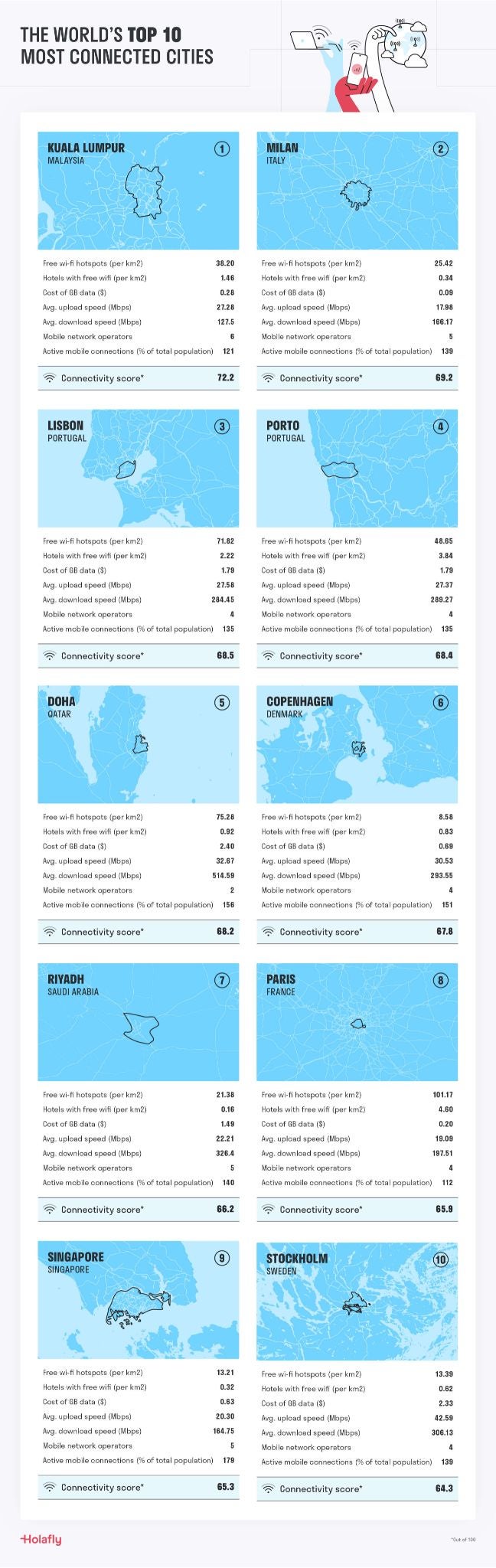
- Kuala Lumpur ranks #1 as the world’s most connected city, with ultra cheap mobile data ($0.28/GB), and mobile penetration of 121% (meaning there are more active mobile connections than people)
- Asia and Europe dominate the top 10, with four Asian cities and five European cities leading global connectivity
- Milan offers the cheapest data in the top 10 at just $0.09/GB
- Doha has the fastest internet in the top 10, averaging 514 Mbps downloads, but higher data costs ($2.40/GB) keep it from the top spot
- Both Lisbon and Porto rank in the top 5, with excellent wi-fi speeds and wi-fi availability
The top global cities to stay connected
1. Kuala Lumpur, Malaysia
Kuala Lumpur leads with a connectivity score of 72.2 thanks to some of the cheapest mobile data and strong internet speeds. The city offers 38.2 free wi-fi spots per km², and mobile data costs just $0.28 per GB. Kuala Lumpur also scores highly on hotel connectivity, with 1.46 hotels per km² offering free wi-fi, ensuring visitors have reliable internet access wherever they stay.
2. Milan, Italy
Milan ranks #2 with a connectivity score of 69.2, standing out for the cheapest mobile data at just $0.09 per GB. Speeds are also good, with downloads averaging 166.17 Mbps and uploads at 17.98 Mbps. With five mobile operators and a penetration rate of 139%, meaning there’s more active mobile connections than people, Milan combines affordability with widespread access when it comes to staying connected.
3. Lisbon, Portugal
Lisbon ranks in third position with a connectivity score of 68.5. With 71.82 wi-fi hotspots per km² and 2.22 hotels with free wi-fi per km², the city provides excellent public access when it comes to staying online. With mobile data costs at $1.79 per GB, it’s significantly higher than Milan and Kuala Lumpur, but speeds make up for it, with downloads averaging 284.45 Mbps.
4. Porto, Portugal
Porto ranks #4 with a connectivity score of 68.4. The city boasts 48.65 hotspots per km² and 3.84 hotels per km² offering free wi-fi, which is the highest density among the top 5. Data costs $1.79 per GB, with fast download speeds of 289.27 Mbps. Porto has four network operators and a mobile penetration rate of 135%, making it a high-performing yet compact city for travelers who want to stay connected.
5. Doha, Qatar
Rounding out the top 5, Doha scores 68.2. It leads in speed, with average downloads of a staggering 514.59 Mbps and uploads of 32.67 Mbps. The city also offers 75.28 wi-fi hotspots per km². While mobile data is pricier at $2.40 per GB, connectivity remains strong thanks to a mobile penetration rate of 156%, one of the highest in the world.
But it doesn’t stop there. Explore the full list of the world’s most connected cities below.
Top US cities
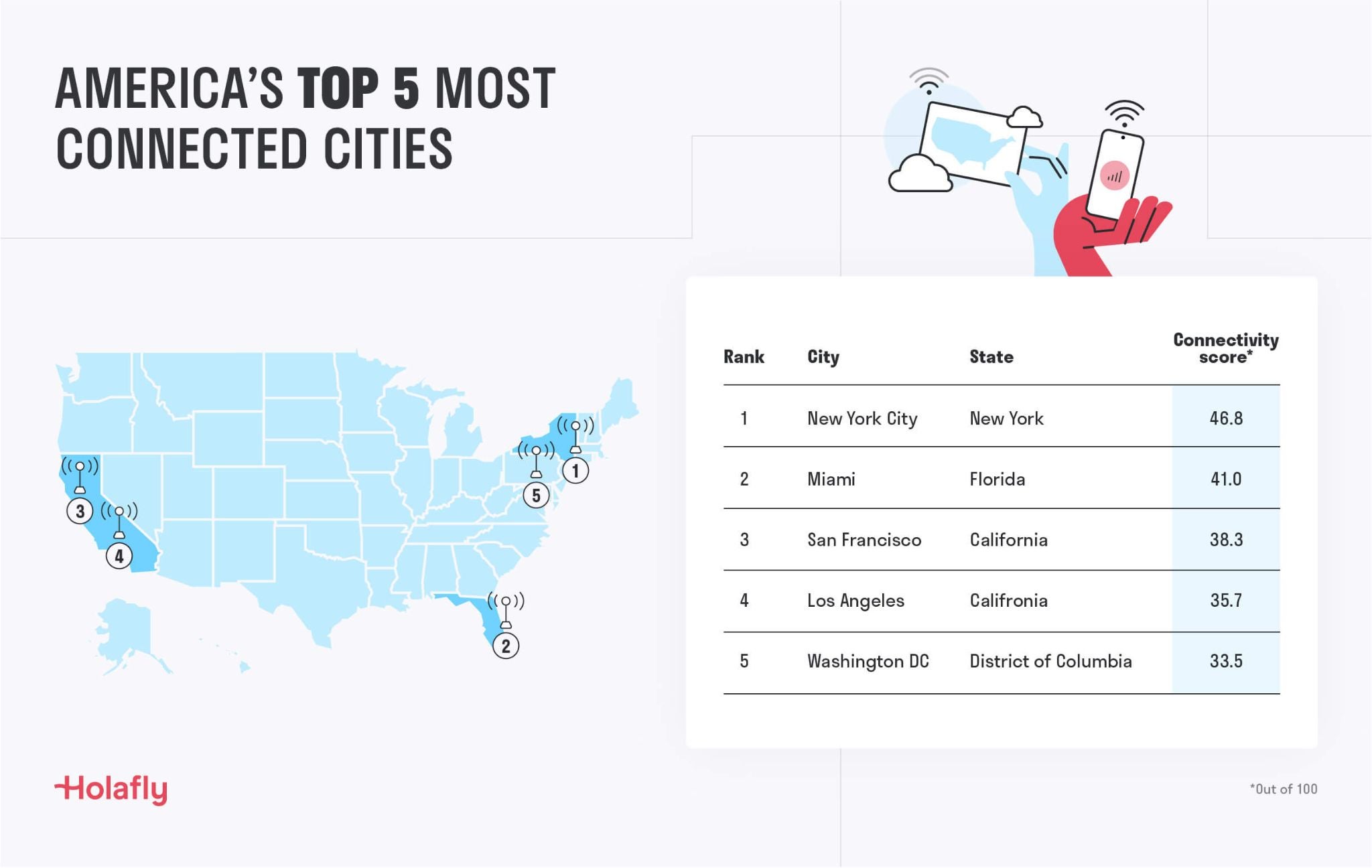
While none of the cities in the US made the global top 10, several of them do stand out for their connectivity. New York City leads with a connectivity score of 46.8, making it the most connected city in America. Other major US cities to make the list include Miami (41.0), San Francisco (38.3), Los Angeles (35.7), and Washington D.C. (33.5). These scores are noticeably lower than many European and Asian cities, however this is largely due to higher mobile data costs and fewer free wi-fi hotspots per km². Even so, US cities remain competitive thanks to robust infrastructure, multiple mobile operators, and widespread coverage, keeping the USA solidly connected, even if not at the top of the global rankings.
Top European cities
Europe dominates the global rankings, with five European cities making the world’s top 10 most connected destinations. Milan, Italy leads, with a connectivity score of 69.2. With cheap mobile data at just $0.09 per GB, and good download speeds of 166Mps, Milan is not only Europe’s most connected city but also one of the most affordable globally when it comes to staying online. Other European cities in the ranking include Lisbon (68.5), Porto (68.4), Copenhagen (67.8) and Paris (65.9). Lisbon and Porto both have super fast download speeds above 280 Mbps, Copenhagen stands out download speeds of 294 Mbps and Paris leads in wi-fi density, with over 101 hotspots per km².

Tips for staying connected when traveling
Staying connected while traveling has never been easier. However even in the most connected cities, wi-fi can cut out and roaming costs can add up. Whether you are a digital nomad or just on your travels, here are a few tips to help you stay connected.
1. Use an eSIM for instant connectivity
An eSIM is one of the easiest ways to get connected as soon as you land. They’re perfect for travelers because you can purchase a plan online before you even leave. Many also offer unlimited data options and multi-country plans, so you can travel between countries without paying roaming fees or losing connection.
2. Download essentials offline
Even in well connected cities, there will always be moments when signal drops and wi-fi becomes patchy. Before you set off for a day exploring, make sure you download and save useful things like maps and travel guides to your phone.
3. Be safe with public WiFi
Free wi-fi is available in most cafes, hotels and airports but they’re not always secure. When connecting to public wi-fi, make sure you’re using a trusted network and if possible, try to avoid logging in to personal accounts like online banking. Stick to trusted networks and use a VPN to protect your data when logging on.
4. Manage your data usage
When traveling abroad, remember to limit your background app refresh, stream lower quality videos and disable automatic updates as these can burn through your data faster than you think. Turning on your device’s data saver mode can help stretch your plan further, which is perfect for longer trips.
5. Be prepared
When traveling, remember to take a portable power bank and universal travel adapter so your phone, laptop and any other devices can stay charged wherever you are. A lightweight power bank can be a lifesaver during a long day sightseeing, whereas a universal adapter ensures you can plug in and recharge no matter what country you’re in.
The future of global connectivity
From Kuala Lumpur and Milan to Lisbon and Doha, the cities that top the global connectivity ranking show that strong infrastructure, widespread coverage, and affordable data make all the difference for travelers. Cities that invest in fast, accessible, and reliable internet will remain among the most attractive destinations, not just for visitors, but for the people who live there too.
Methodology
To determine the world’s most connected cities, we analyzed destinations from the Euromonitor Top 100 City Destination Index. Connectivity was measured using multiple indicators, including the density of Wi-Fi hotspots (WiFi Map), the availability of hotels with free WiFi (Booking.com), the cost of 1GB of mobile data (Best Broadband Deals), and average download and upload speeds (Speedtest Global Index). In addition, the number of mobile network operators (Wikipedia) and mobile penetration rates (DataReportal) were included. Each factor was standardized and weighted to produce a Connectivity Score.
Plans that may interest you


Born and raised in the UK, I discovered content creation as a journalist while studying at the University of Manchester. I've since covered a range of roles, both editorial and SEO, across the travel, hospitality, and professional services industries. I spend my weeks ensuring Holafly's content is relevant, insightful, and helpful, and my weekends exploring new destinations to satisfy my ever-growing travel bug.