Language


 No results found
Scuba diving in Costa Rica: Best spots and prices
Discover this guide to scuba diving in Costa Rica: prices, courses, recommended centres, and the best dive spots.

Diving in Costa Rica is an experience mixing adventure, nature and pura vida under the sea. Among colourful reefs, hammerhead sharks and giant turtles, each dive is a story worth living. In this guide to scuba diving in Costa Rica you’ll find everything you need to plan your trip: the most recommended centres and courses, the best diving spots and approximate prices for each kind of experience. If you’re ready to discover why this country ranks among the most fascinating diving destinations worldwide, keep reading and get ready to dive into an ocean full of life.
Dive centres and courses in Costa Rica
If there’s one thing Costa Rica does well, it’s diving. The country brims with schools led by passionate instructors, boats ready to sail every morning, and a diving community that welcomes you. Whether you come for your first dive or to certify as a professional, here’s a zone-by-zone guide with the top recommended centres and the courses available at each.
Rich Coast Diving
One of the country’s most complete centres. It’s accredited by SSI and PADI, and its strength lies in professional training. They offer everything from Discover Scuba Diving (a first guided dive for beginners) to advanced programmes like Divemaster or Instructor. They also offer speciality courses in Nitrox, underwater photography or rescue. It’s ideal if you want to take diving seriously or spend several weeks learning at your own pace.
Deep Blue Diving
This centre is perfect if you want to learn with experienced instructors and small groups. They use the PADI system and offer all official courses: Open Water Diver, Advanced Open Water, Rescue Diver and Emergency First Response. Additionally, they provide speciality courses to improve buoyancy, navigation or identify marine species.
Summer-Salt Dive Center
With a very international, relaxed vibe, this centre also works with PADI certifications. Their approach offers students patient and close support — a big plus for beginners. They offer beginner dives, Open Water, Advanced and personalised recreational diving programmes.
Oceans Unlimited
This is one of the most renowned centres in Costa Rica and it’s certified as a PADI 5★ IDC Center. That means you can complete the full training pathway, from Open Water to full Dive Instructor certification. They also include marine conservation workshops and practical programmes if you seek a full professional-level experience.
Costa Rica Dive & Surf
With a strong reputation among travellers, this centre offers PADI courses for every level. From Discover Scuba Diving to Rescue Diver. They also organise certification packages including several dives, digital materials and personalised support.
Costa Rica Divers
This modern centre has instructors certified by PADI, ideal if you want flexibility and more individual attention. They offer courses from Open Water to Divemaster, plus technical options (TecRec) and first aid training (Emergency First Response).
Sea Hunter / Argo (Undersea Hunter Group)
If you’re already an advanced diver and dream of a professional-level experience, this operator runs expeditions to legendary Cocos Island. They don’t offer proper courses, yet their crews include PADI and NAUI instructors guiding high-level technical dives.
Punta Uva Dive Center
Located on the Caribbean coast, this centre is an excellent choice if you want friendly and personalised treatment. They offer PADI courses from Discover Scuba Diving to Advanced Open Water. They also run guided dives and buoyancy-improvement workshops.
The best places to dive in Costa Rica
Now that you know where to learn and with whom, here comes the best part: discovering the places that make diving in Costa Rica magical. From calm waters and colourful reefs to hammerhead encounters in the Pacific, these are the sites every diver should experience at least once.
Cocos Island (Remote Pacific, liveaboard only)
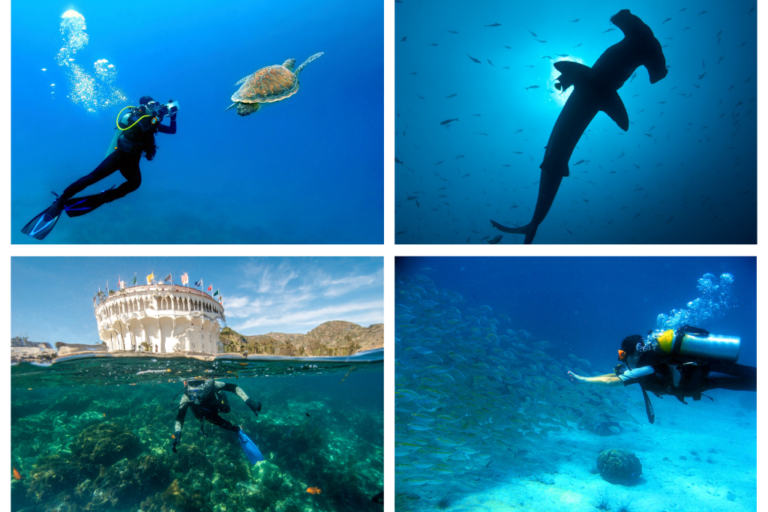
Cocos Island is every diver’s dream. Over 500 kilometres from the mainland, you only reach it by boat after almost 36 hours at sea, yet every minute feels worth it. Beneath its waters swim huge schools of hammerheads, whitetips, giant mantas and even whale sharks during some seasons. It feels remote, wild and perfectly preserved. However: It suits advanced divers only, and the journey takes place on liveaboards like Sea Hunter or Argo, which already hold legendary status among global divers.
Bat Islands (Islas Murciélago)
Bat Islands, in the northern Pacific, deliver pure adrenaline. Trips depart from Playas del Coco toward this area, located opposite Santa Rosa National Park, where bull sharks take the spotlight.
Diving here won’t suit beginners because currents can get strong. However, these currents bring intense marine life. The best season runs from May to November, when warmer waters increase your chances of seeing large species.
Catalina Islands
If you want to see oceanic mantas gliding metres from you, Catalina Islands become a must-visit. Near Flamingo and Tamarindo, these rocky formations offer abundant marine life and excellent visibility. Here you can also spot turtles, reef sharks and eagle rays, especially from November to April, when currents bring more nutrients.
Caño Island
Caño Island, in the southern Pacific, offers a classic choice if you prefer calm diving surrounded by pure nature. From Uvita and Drake Bay, small boats reach this underwater paradise in under an hour. The area holds turtles, rays and reef sharks, and visibility usually remains very good. The protected environment guarantees a healthy ecosystem. It’s also ideal if you’re certified or want to improve your level, because conditions stay safe and the dives feel almost therapeutic.
South Caribbean
The Costa Rican South Caribbean has a distinct, calmer energy, and you’ll feel it even underwater. In Cahuita, Punta Uva and Manzanillo you’ll find colourful reefs, nurse sharks, lobsters and turtles swimming among corals. The rhythm feels slower here, perfect for beginners or anyone who enjoys observing without rushing. Local communities care deeply about the sea, and that love shows in the way they protect their marine parks.
Connectivity while diving in Costa Rica
Staying connected while diving in Costa Rica feels very easy thanks to Holafly’s eSIMs, which give you internet as soon as you land, without swapping your physical SIM or paying roaming fees. With the Costa Rica eSIM, you enjoy unlimited data and a stable 4G/5G connection in most regions, ideal for planning your dives, checking maps or sharing photos without relying on hotel Wi-Fi.
If you travel through several destinations in the region, Holafly’s monthly plans offer stronger options: they offer unlimited data and wide coverage, perfect if you continue your diving route after Costa Rica. You install it within minutes with a QR code and stay connected everywhere.
Important: If you are a frequent traveler and want to stay connected without worrying about expensive roaming or looking for a new SIM at every destination, Holafly’s subscription plans are for you. With a single eSIM, enjoy internet in more than 160 countries for a fixed price and no surprises on your bill. Travel without limits and connect easily and securely! 🚀🌍

How much does diving in Costa Rica cost?
If you plan to enjoy diving in Costa Rica, here are the approximate prices for the main activities and courses available:
- Local dive (2 tanks, Playas del Coco or Papagayo): Between €73–116 ($85–135). It includes guide, equipment and boat transport. Perfect for certified divers.
- Day trip to Catalina Islands: Around €116 ($135). A popular experience to see oceanic mantas; some centres offer a 3-tank option for about €172 ($200).
- Diving at Caño Island (Uvita or Drake Bay): Between €151–198 ($175–230). Price includes two dives, lunch and full gear.
- Discover Scuba Diving (beginner experience): From €172–198 ($200–230). It includes theory, pool practice and an open-water dive with an instructor.
- PADI Open Water Diver course: Between €345–474 ($400–550). This basic international certification includes digital materials and four dives.
- PADI Advanced Open Water course: Between €293–431 ($340–500). It includes five adventure dives (deep, navigation, buoyancy and more).
- Night dive (1 tank, Gulf of Papagayo): About €65 ($75). Guided experience for certified divers.
- Liveaboard to Cocos Island (10–11 nights): Between €5,692–6,210 ($6,600–7,200). This advanced trip includes accommodation, meals and many dives; park fees (around €431 ($500)) require separate payment.
Frequently asked questions about diving in Costa Rica
The dry season, from November to April, offers better visibility and more stable conditions. However, during the green season (from May to October) the sea feels livelier and you can see more large species, including sharks or mantas.
You only need one for deep dives or advanced routes. If you’ve never dived, you can take a PADI Open Water course or try Discover Scuba Diving, where an instructor stays with you at all times.
The most recommended places for beginners include Uvita, Drake Bay and the South Caribbean (Punta Uva and Cahuita), thanks to their calm waters and good visibility.
Yes, as long as you dive with certified centres. Instructors hold international accreditations, equipment usually stays modern and sea conditions remain stable most of the year.
The PADI Open Water course lasts three to four days, with theory lessons, pool exercises and four open-water dives.