Language
10 best things to do in Rio de Janeiro, according to a local
Rio de Janeiro is one of the world's most spectacular cities — from the iconic Christ the Redeemer to the samba heartbeat of Lapa. Here are the top 10 things to do, from our local expert.

Rio de Janeiro is nicknamed Cidade Maravilhosa — the Marvelous City — and it earns it. Few places on Earth combine natural spectacle, cultural depth, and sheer energy the way Rio does. From the outstretched arms of Christ the Redeemer high above the city to the sound of live samba drifting out of a Lapa backstreet on a Monday night, Rio is a city that leaves an impression on everyone who visits.
To bring you the inside track on the best things to do in Rio de Janeiro, we teamed up with Pedro Correia Guedes, a Rio-based Holafly team member who knows the city in a way no guidebook can match. From the beaches of the South Zone to the samba roots of Pedra do Sal, Pedro’s recommendations cover Rio’s iconic sights and a few places most tourists never find. Stay connected throughout your trip with a Holafly eSIM for Brazil — unlimited data from the moment you land.

Avoid excessive roaming fees
Don't get caught out by data roaming charges in Brazil. Use local networks at local rates.
1. Visit Christ the Redeemer

No trip to Rio is complete without seeing Christ the Redeemer (Cristo Redentor). Standing 30 metres tall with arms spanning 28 metres, the statue crowns the 710-metre Corcovado Mountain and looks out over the entire city — and it is one of the New Seven Wonders of the World. The view from the base of the statue, across Guanabara Bay, the Atlantic Ocean, and the mosaic of Rio’s neighbourhoods below, is extraordinary.
Pedro Correia Guedes on Rio’s must-sees: “The five places you absolutely shouldn’t miss are Christ the Redeemer, Sugarloaf Mountain, Maracanã Stadium, Copacabana Beach, and the Lapa neighbourhood. These cover the essence of what Rio is.”
The most atmospheric way to reach the statue is by the Corcovado Railway, a rack railway that winds up through the dense Tijuca National Park to the summit. The journey through the rainforest is part of the experience. Alternatively, minivans run from several points in the city for those who prefer not to take the train.
Tip: Book Corcovado Railway tickets online in advance — queues at the ticket office can be very long, especially at weekends. Arrive early morning for the clearest views and the fewest crowds at the statue itself.
2. Take the cable car up Sugarloaf Mountain

If Christ the Redeemer is Rio seen from the west, Sugarloaf Mountain (Pão de Açúcar) gives you Rio from the east — and the view is just as dramatic. The mountain rises 396 metres directly from the edge of Guanabara Bay, and getting there is an experience in itself: two stages of glass-walled cable car, the first from Praia Vermelha to Morro da Urca, and the second from there to the Sugarloaf peak.
As Pedro puts it: “Sugarloaf Mountain is one of those places where the journey matters as much as the destination. The cable car ride gives you views of the whole city, the bay, and the ocean — and the top gives you a perspective on Rio you can’t get anywhere else.”
The late afternoon is the prime time to visit. Pedro specifically recommends timing your ascent to catch the sunset over the bay from the summit — the light on the water and the skyline as the city begins to illuminate is one of the most celebrated sights in South America.
At the base of the cable car, Praia Vermelha is a small, sheltered beach popular with locals that is often overlooked by tourists. If you’re visiting in the late afternoon, it’s a pleasant spot to relax before the cable car ascent.
Tip: The cable car runs until around 9PM, making it one of the few major Rio attractions accessible after dark. A night visit gives you the city lights rather than the sunset — a completely different and equally spectacular experience.
3. Spend a day at Copacabana Beach

Copacabana is one of the most famous beaches in the world, and it fully justifies the reputation. The four-kilometre crescent of white sand runs between the rocky outcrops of Leme and Arpoador, backed by the distinctive black and white wave-patterned mosaic promenade — one of the most recognisable streetscapes in South America.
Pedro on Copacabana: “Copacabana is where Rio lives its life. Locals come here every day — to exercise in the morning, to swim in the afternoon, and to watch the sunset in the evening. You can do Copacabana for free and spend the whole day there without spending a cent.”
The beach is free to access and genuinely one of the best free things to do in Rio de Janeiro. Vendors walk the sand selling coconut water, caipirinhas, and snacks throughout the day — this is the most informal and authentic setting to experience Brazilian food at its most everyday, from freshly opened coconuts to beach-side cheese skewers grilled on the spot.
At the southern end of the beach, Forte de Copacabana is a well-preserved early 20th-century fort with a military museum and one of the best seafront cafés in the city. The view back along the full arc of Copacabana from its ramparts is worth a short detour.
Tip: Copacabana fills up quickly at weekends. If you want space to spread out, visit on a weekday morning. Keep valuables at your accommodation — beach theft is common, and locals travel light.
4. Watch the sunset at Ipanema Beach and Arpoador

Ipanema runs directly from where Copacabana ends, and while the two beaches look similar from a distance, they have very different personalities. Ipanema is younger in energy, more fashion-conscious, and has a noticeably more international crowd. The beach is divided into informal sections that have evolved over time — the area near Posto 9 is particularly vibrant and popular with locals on weekends.
Pedro told us:“Arpoador Rock is the most famous sunset spot in Rio. It sits right at the point between Copacabana and Ipanema, and every evening locals gather there to watch the sun go down over the ocean. When the sunset is good, people applaud. It’s one of those genuinely unique Rio moments.”
At the Copacabana end of Ipanema, the rocky outcrop of Arpoador is one of the most beloved spots in the city. Surfers use the break in front of it during the day, and in the evenings it transforms into the city’s most atmospheric sunset gathering point. Pedro’s description of the nightly applause is accurate — it is a peculiarly Rio tradition that captures the city’s celebratory spirit perfectly.
Nearby, Parque Garota de Ipanema (named after the famous bossa nova song) runs along the waterfront and is a popular spot for couples — Pedro recommends Arpoador and Parque Lage as the most romantic spots in the city for those visiting Rio as a couple.
Tip: Arrive at Arpoador 30 minutes before sunset and position yourself on the rocks facing west. The applause at the moment of sunset is a Rio institution — join in. The area is safe and well-populated at this time of evening.
5. Explore Tijuca National Park

Tijuca National Park is one of the most remarkable natural areas in any major city in the world. At over 30 square kilometres, it is one of the largest urban forests on Earth — a dense Atlantic rainforest that covers the mountains surrounding Rio’s northern and western zones and is home to over 200 species of birds, capuchin monkeys, and rare plants.
Pedro on Tijuca: “Tijuca National Park is something people don’t fully appreciate until they’re inside it. You’re in the middle of one of the world’s largest cities and you’re surrounded by rainforest, waterfalls, and wildlife. It’s an extraordinary place to spend a morning or a full day.”
The park has a network of well-marked trails ranging from short, accessible walks to more challenging full-day hikes. Mirante Dona Marta is one of Pedro’s recommended viewpoints — the view over Rio from here is one of the finest in the city and the point was made famous by Michael Jackson’s “They Don’t Care About Us” video. Cascatinha Taunay, a 35-metre waterfall deep in the forest, is another highlight accessible from the main park road.
For the adventurous, hang gliding from Pedra Bonita is one of Rio’s most exhilarating experiences. Tandem flights launch from a ramp in the park and land on the sands of São Conrado Beach — you fly over the forest, the coastline, and the city simultaneously. No experience is needed for a tandem flight.
Tip: For Tijuca, hire a guide or join a guided tour — the park is large and trail marking is inconsistent in places. Bring water, insect repellent, and sun protection. Hang gliding operators are based at Pedra Bonita; the descent to São Conrado takes approximately 10 to 15 minutes.
6. Walk the Escadaria Selarón
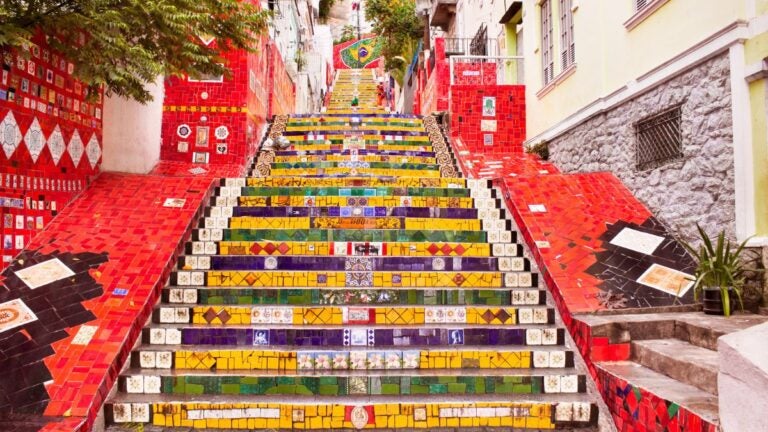
The Escadaria Selarón is one of the most visually striking public artworks in South America — a 250-step staircase connecting the neighbourhood of Lapa to Santa Teresa, entirely covered in over 2,000 colourful tiles collected from more than 60 countries. The staircase is the life’s work of Chilean artist Jorge Selarón, who began covering the steps in 1990 and continued working on them until his death in 2013.
What makes the Escadaria particularly compelling is not just its visual impact — it is the story behind it. Selarón devoted the last two decades of his life to the project, living in poverty in the house adjacent to the staircase and funding the tiles through the sale of his paintings. He called it “my tribute to the Brazilian people.” The tiles include portraits, abstract designs, and mosaics sent to Selarón from around the world.
The staircase connects two of Rio’s most characterful neighbourhoods. From the bottom, the Lapa end places you at the heart of the city’s nightlife district. From the top, you step directly into Santa Teresa.
Tip: The Escadaria is most photogenic in the morning before the crowds arrive. It is on a steep hill — wear shoes with grip. The staircase is free to visit at any time of day or night, though evening visits require standard urban caution.
7. Wander the Santa Teresa neighbourhood
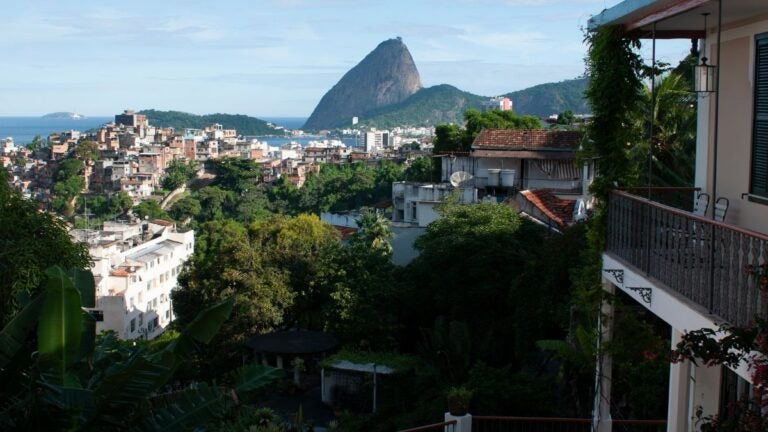
Santa Teresa is the most distinctive neighbourhood in Rio — a hilltop bohemian enclave of cobblestone streets, 19th-century villas, independent art galleries, and an atmosphere that feels entirely different from the beach-facing South Zone below. It sits above Lapa on a series of steep hillside streets and is one of the few parts of central Rio that has preserved its pre-20th-century architectural character.
Pedro on Santa Teresa: “Santa Teresa is Rio’s most unique neighbourhood. The cobblestone streets, the architecture, the views from the hilltop — it captures a version of Rio that most tourists don’t see. The bohemian vibe and the local art scene make it somewhere you want to spend an afternoon just exploring.”
The neighbourhood is best explored on foot. Rua Almirante Alexandrino is the main street, lined with independent boutiques, art studios, and restaurants. The Parque das Ruínas — a cultural space built within the ruins of a 19th-century mansion — has one of Pedro’s recommended sunset viewpoints, with views across the bay and towards Corcovado. Museu Chácara do Céu houses an impressive collection of European and Brazilian modern art within a 1950s house with terrace views.
Santa Teresa is also one of the best places in Rio to find Brazil souvenirs that feel genuinely local — handmade jewellery, original artwork, craft ceramics, and locally produced goods from the neighbourhood’s independent sellers carry a different quality from the beach-front tourist shops.
Tip: The traditional way to explore Santa Teresa is on the historic yellow tram (Bonde), though services have been intermittent. Check the current status before visiting. Alternatively, take an Uber up and walk down through the neighbourhood’s streets at your own pace.
8. Experience samba in Lapa and Pedra do Sal
Samba is not a tourist attraction in Rio — it is a living, breathing part of daily life, and nowhere is that truer than in Lapa and Pedra do Sal. These two locations represent Rio’s samba tradition at its most authentic: Lapa as the city’s established nightlife hub, and Pedra do Sal as the historic birthplace of the genre itself.
Pedro on Lapa:“Lapa is the soul of Rio’s nightlife. The Lapa Arches are one of Brazil’s great colonial landmarks, and the neighbourhood around them at night is electric. Bars, live music, restaurants — every type of experience in one area. Lapa and the South Zone together give you the full picture of what Rio’s nightlife offers.”
The Lapa Arches (Arcos da Lapa) — a colonial aqueduct built in 1724 — are the neighbourhood’s defining landmark. By night, the streets around them fill with vendors, musicians, and locals moving between the many samba venues. Rio Scenarium is the most famous of these — a three-storey antique warehouse converted into a live music space that has become one of the most iconic samba venues in the world.

Pedro on Pedra do Sal: “Pedra do Sal is my top recommendation for visitors who want to experience Rio beyond the postcard version. It’s considered the birthplace of samba, it has authentic gatherings with far fewer tourists than Lapa, and the atmosphere on a Monday night is unlike anything else in the city.”
Pedra do Sal is a historic stone square in the port district of Gamboa, a short distance from Lapa. It hosts open-air samba parties, particularly on Monday and Friday evenings, that draw a genuinely mixed crowd of locals and visitors. The setting — an ancient stone outcrop in a quiet neighbourhood — makes it one of the most atmospheric places in the city.
The botecos (local bars) of both Lapa and Copacabana are also where you’ll find some of the most authentic Brazilian food in the city — feijoada on a Saturday, traditional mortadella sandwiches, and cold chopps served with the kind of informality that only Rio’s neighbourhood bars do properly.
Tip: Lapa is at its most lively on Friday and Saturday nights from around 10PM. Pedra do Sal’s Monday samba circles typically start around 8PM. Both areas require standard nighttime precautions — use Uber rather than walking between districts, and avoid displaying phones or valuables in crowds.
9. Watch a match at Maracanã Stadium

Maracanã is one of the most celebrated football stadiums in the world and an essential Rio experience for any sports fan. Built for the 1950 FIFA World Cup, it once held over 200,000 people and remains one of the largest stadiums in the Americas. Today it hosts matches for Rio’s four main clubs — Flamengo, Fluminense, Vasco da Gama, and Botafogo — as well as international fixtures and concerts.
Pedro on Maracanã: “Going to a Maracanã match is one of the most intense experiences you can have in Rio. The atmosphere, the passion of the crowd, the noise — it’s unlike any other stadium in the world. If there’s a match during your visit, do not miss it.”
Even on non-match days, the stadium offers guided tours that take visitors through the players’ tunnel, onto the pitch, and into the museum of Brazilian football history. The museum covers the country’s World Cup victories, the careers of legends including Pelé and Zico, and the history of the stadium itself.
Rio’s football clubs each have their own passionate fanbase and distinct identity. Flamengo are by far the most supported club in the city and nationally — a home match at Maracanã when Flamengo are playing is one of the loudest sporting environments in the world.
Tip: Check the Maracanã fixture schedule at maracana.com.br before your trip and buy tickets online in advance for popular matches — Flamengo fixtures in particular sell out quickly. The stadium is in the North Zone, about 30 minutes from Ipanema by Uber.
10. Visit the Jardim Botânico and Rodrigo de Freitas Lagoon
For a more relaxed side of Rio, the Jardim Botânico (Botanical Garden) and the adjacent Rodrigo de Freitas Lagoon form one of the city’s most peaceful and beautiful natural spaces. Together they occupy a large area of the South Zone between Ipanema, Gávea, and the Corcovado mountain, and are a genuine favourite with locals.
Pedro on the South Zone’s nature spots: “Walking around Rodrigo de Freitas Lagoon or visiting Parque Lage are things locals do every weekend. They’re free, beautiful, and give you a completely different side of Rio — calm, green, and relaxed. Visiting Parque Lage and the Botanical Garden are genuinely great free options that most tourists skip.”
Jardim Botânico
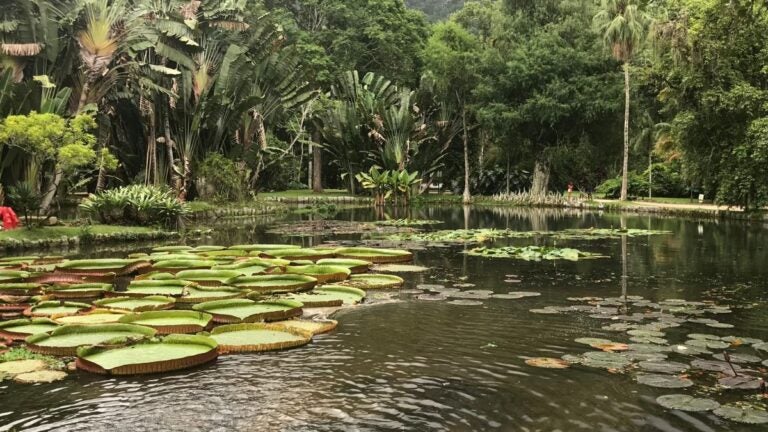
The Botanical Garden was established in 1808 by the Portuguese royal family and covers 54 hectares of Atlantic forest. Its most iconic feature is the Imperial Palm Avenue — a long corridor lined with 134 towering royal palms planted in the 19th century. The garden also houses the world’s largest Victoria amazonica water lily collection, a Japanese garden, orchid greenhouses, and a dedicated section for Amazonian species.
Rodrigo de Freitas Lagoon

The lagoon encircles an expanse of water in the heart of the South Zone, with a walkway running its full 7.5-kilometre perimeter. Locals cycle, run, and walk here throughout the week — it is one of Pedro’s recommendations for free activities that capture everyday Rio life. The view from the lagoon walkway across the water to Corcovado and Christ the Redeemer beyond is one of the most striking in the city.
Adjacent to the Botanical Garden, Parque Lage is a public park set within the grounds of a neo-classical mansion, with trails leading up into the Tijuca forest above. The café inside the mansion — set in an open courtyard with a pool — is one of the most beautiful in Rio and free to enter.
Tip: The Jardim Botânico is free to enter on Sundays — confirm current entry fees before visiting. Parque Lage is free at all times. Both are within walking distance of each other and make a natural half-day combination
How to spend 3 or 4 days in Rio de Janeiro
Pedro’s recommended approach is to divide Rio by area rather than trying to cross the city repeatedly: South Zone for beaches and iconic sights, Downtown for history and culture, and Santa Teresa and Lapa for art and nightlife. In 3 to 5 days, you can cover the main highlights at a comfortable pace.
3 days in Rio de Janeiro
Day 1 — South Zone beaches and sunsets: Morning at Copacabana Beach, then walk along to Ipanema. Late afternoon at Arpoador for the sunset — stay for the applause. Evening in Ipanema or Leblon for dinner.
Day 2 — Iconic landmarks: Early morning start for Christ the Redeemer on the Corcovado Railway before crowds arrive. Afternoon at Sugarloaf Mountain for the cable car and sunset views over Guanabara Bay.
Day 3 — Culture and nightlife: Morning walk at the Rodrigo de Freitas Lagoon and Jardim Botânico. Afternoon at Escadaria Selarón and Santa Teresa — explore the cobblestone streets and pick up Brazil souvenirs from the neighbourhood’s independent shops. Evening in Lapa for live samba, or head to Pedra do Sal if visiting on a Monday or Friday.
4 days in Rio de Janeiro
Add a fourth day for Tijuca National Park — a morning hiking the forest trails and afternoon hang gliding from Pedra Bonita, or visiting Maracanã Stadium for a guided tour or match, depending on your schedule.
With more time, Pedro recommends day trips from Rio de Janeiro to Petrópolis (imperial-era architecture, 1.5 hours by bus), Búzios (chic beaches, 2.5 hours — his top romantic recommendation), or Ilha Grande (unspoilt island with no cars, accessible by ferry). Each makes an excellent base for an overnight stay if you want to extend beyond the city.
For getting between Rio’s zones and out to day trip destinations, understanding Brazil transportation options helps significantly — from the metro and BRT bus network within the city to long-distance coaches and domestic flights to other Brazilian cities. Uber is the most practical option for short cross-city journeys.
Is Rio de Janeiro safe for tourists?
Rio’s reputation for crime is well-known, and it deserves honest acknowledgement. Pedro is direct on this point: certain neighbourhoods carry elevated risks, and visiting Rio without awareness of the local safety landscape is not advisable.
Pedro on Rio’s safety: “Rio de Janeiro presents real challenges — violence and some social problems that other Brazilian cities don’t have to the same degree. These concerns are justified. The important thing is to be well-informed and plan carefully. Most of the tourist areas are safe, but you need to know which areas to avoid and how to move around sensibly.”
The practical precautions Pedro and experienced Rio visitors consistently recommend:
- Use Uber or 99 for all transport: Never hail taxis from the street. Rideshare apps are significantly safer, give you a digital record of your journey, and pricing is transparent.
- Keep valuables out of sight at beaches: Do not take your phone, camera, or wallet to the beach unless you plan to keep them on your person at all times. Locals typically travel to the beach with only cash for vendors and their phone.
- Avoid certain areas at night: The North Zone and some parts of the port district carry higher risk after dark. Stick to Ipanema, Leblon, Copacabana, Botafogo, and the tourist areas of Lapa for evening activity.
- Check current travel advisories: The US State Department issues regularly updated Brazil travel advisories at travel.state.gov — check before departure for the most current assessment.
- Don’t resist if targeted: In the unlikely event of a robbery, give up your belongings without resistance. Most Rio incidents involving tourists are opportunistic and non-violent when met without confrontation.
Rio rewards those who go in prepared. Take the precautions above seriously — and then enjoy one of the most extraordinary cities in the world.

24/7 support, no matter what
When you're traveling, every question can be an urgent one. That's why we work around the clock.
Stay connected in Rio de Janeiro with Holafly
Rio de Janeiro is a sprawling city where reliable mobile data makes a genuine difference — for navigating between the South Zone, Santa Teresa, Lapa, and the North Zone, booking Uber rides, checking Maracanã fixture times, or finding the Pedra do Sal samba circle on a Monday night. A Holafly eSIM for Brazil gives you unlimited data from the moment you land, with no SIM swapping and no roaming fees.
Holafly offers travel eSIMs for 200+ destinations with unlimited data, 5G speeds, and 24/7 customer support included in every plan. If you’re extending your Brazil trip beyond Rio — to São Paulo, the Amazon, or the Northeast — Holafly Plans offers a pay-monthly eSIM covering 170+ destinations on a single eSIM. Cancel anytime.
And with Holafly’s Always On 1 GB backup data included with every eSIM purchase, you have instant connectivity for emergencies — whether that’s calling an Uber from Pedra do Sal at midnight, checking the Corcovado Railway schedule, or navigating back from Tijuca National Park. Simply keep the Holafly eSIM installed on your device and you’ll stay connected throughout your Rio trip.
Plans that may interest you


A senior SEO writer from Lithuania, combining my passion for writing and travel at Holafly. With years of experience in technical fields, I'm here to answer all of your questions about staying connected. I specialize in turning even the most complicated topics into something everyone can understand.