







 Language
Top 10 things to do in Morocco for an unforgettable first visit
The best things to do in Morocco span ancient medinas, Sahara desert camps, Atlas mountain treks, and blue-washed cities. Here's where to start.
Morocco is one of the world’s most varied travel destinations. Within a single trip, you can walk the labyrinthine alleyways of a medieval medina in the morning, ride a camel into the Sahara Desert by afternoon, and fall asleep under one of the clearest night skies on Earth.
Add the Atlas Mountains, the blue-washed streets of Chefchaouen, the Atlantic coast, and a culture that blends Berber, Arab, and European influences, and Morocco offers an extraordinary range of experiences in a country the size of California.
This guide covers the best things to do in Morocco across the country’s most compelling cities and landscapes. Each of Morocco’s most beautiful cities has its own distinct character — imperial Marrakech, ancient Fes, bohemian Chefchaouen, and cosmopolitan Tangier are four completely different versions of the same country. Stay connected throughout with a Morocco eSIM — unlimited data from the moment you land.
Peace of mind before you fly
Set up your eSIM before travel and get unlimited data on arrival.
1. Marrakech: the medina, the souks, and Jardin Majorelle
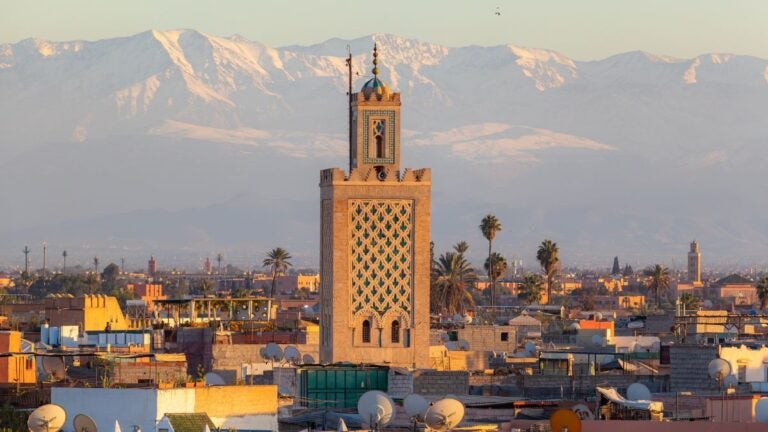
Marrakech is Morocco’s most iconic city and the destination most first-time visitors use as their entry point into the country. At its centre is Jemaa el-Fnaa — a vast open square and the social heart of the medina, which transforms throughout the day, and a must-visit on every Morocco travel guide.
In the morning it is relatively quiet. By late afternoon it fills with storytellers, musicians, acrobats, and snake charmers. By evening it is one of the most atmospheric outdoor spaces in the world. Open-air food stalls fill the square with smoke. Live music performances compete from every corner.
Jemaa el-Fnaa sits at the entrance to the Medina of Marrakesh — a UNESCO World Heritage Site and one of the most significant historic city centres in Africa. The medina spreads out from the square through a dense network of souks organised by trade: the leather souk, the spice souk, the textile souk, and the metalwork souk each occupy their own quarter.
The souks of Marrakech are among the best places in the world to find Morocco souvenirs — hand-stitched leather babouche slippers, handmade ceramic tagines, argan oil, and hand-woven Berber textiles sold directly by the makers.
Beyond the medina, Jardin Majorelle is Marrakech’s most celebrated garden. Its 12 acres were designed by French painter Jacques Majorelle in the 1920s. Yves Saint Laurent later purchased and restored it.
The Majorelle blue of the garden’s structures is one of the most recognisable design statements in Morocco. The Bahia Palace and Medersa Ben Youssef are the other essential stops within the historic city — both are exceptional examples of Moroccan decorative craftsmanship.
Tip: Jemaa el-Fnaa is at its most alive between 7PM and 10PM. Visit the souks in the morning when the light is better and traders are more relaxed. A licensed guide for the medina is useful for a first visit — the layout is deliberately disorienting.
2. Trek into the Sahara Desert
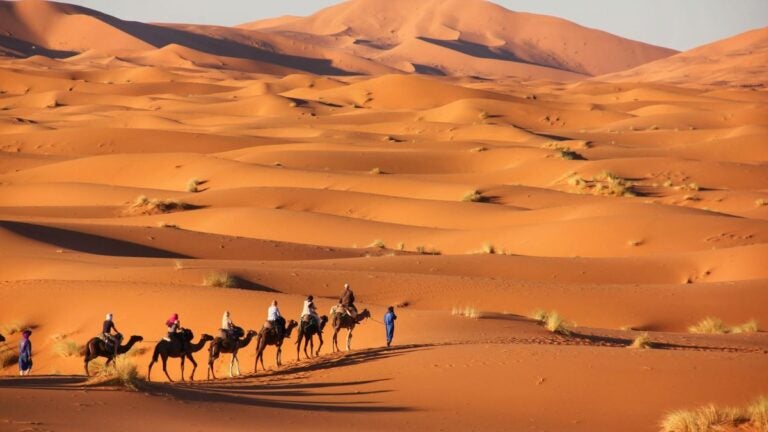
A night in the Sahara Desert is one of the most singular experiences Morocco offers. The main access point is Erg Chebbi — a sea of orange dunes near the town of Merzouga. The dunes reach heights of up to 150 metres. A second, more remote option is Erg Chigaga, further southwest. It sees fewer visitors and offers a more isolated desert experience.
The classic Sahara experience involves a camel trek into the dunes at sunset. The destination is a traditional Berber camp — a circle of nomadic-style tents in the desert. Expect a communal fire, local music, and an extraordinary silence once the wind drops.
The stargazing from Erg Chebbi on a clear, moonless night is among the best in the world. With no light pollution for hundreds of miles, the Milky Way is visible in full.
From Marrakech, the Sahara is a long day’s drive (around 9 to 10 hours) or an overnight journey by coach. Most visitors travel via the Dades and Draa valleys — the route itself, crossing the Atlas Mountains and passing ancient kasbahs and oasis towns, is one of the great scenic drives in Africa. Many tours stop at Aït Benhaddou en route.
Tip: Book a reputable Merzouga-based operator rather than a Marrakech agency to cut costs and ensure local knowledge. Carry cash — ATMs in Merzouga are unreliable. Bring warm layers for the night, regardless of how hot the day was.
3. Discover the medina of Fes
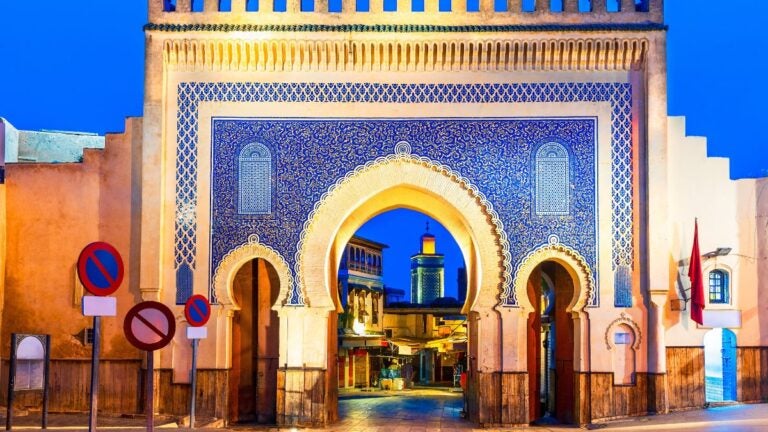
If Marrakech is Morocco’s most visited medina, Fes el-Bali is its most extraordinary. Founded in the 9th century, it is the world’s largest car-free urban area — a UNESCO World Heritage Site of over 9,000 streets and alleyways with no motorised vehicles, only foot traffic, donkeys, and the occasional moped squeezing between ancient walls.
The medina of Fes has barely changed in structure for centuries and is one of the most genuinely disorienting places on Earth to navigate.
The single most iconic sight in Fes is the Chouara Tannery (also spelled Chaouara) — one of the oldest leather tanneries in the world, visible from the viewing platforms of the surrounding leather shops. The circular stone vats filled with natural dyes create one of Morocco’s most photographed scenes. Vendors at the entrance typically hand visitors sprigs of fresh mint to hold under their nose against the smell of the tanning process.
Within the medina, the Medersa Bou Inania is the finest surviving example of 14th-century Marinid architecture in Morocco — its carved stucco, zellige tilework, and cedar wood details are exceptional. The Al-Qarawiyyin University, founded in 859 AD, is widely considered the oldest continuously operating university in the world.
Tip: Hire a licensed guide for at least half a day in Fes medina — getting genuinely lost here is almost guaranteed without one, and a good guide will take you to the tannery viewing platform and explain the medina’s organisation. Agree the price and itinerary before setting off.
4. Walk the blue streets of Chefchaouen
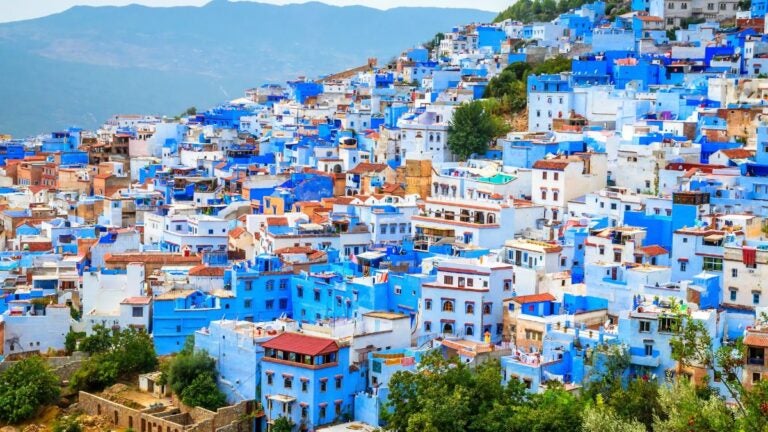
Chefchaouen is Morocco’s most visually distinctive town. Also known as Chaouen, it sits in the Rif Mountains on a compact hilltop medina. Streets, stairways, and buildings are painted in layered shades of blue — cobalt, powder blue, and violet.
The town was established in 1471. The blue-painting tradition is widely attributed to Jewish refugees who arrived in the 1930s. Its exact origins, however, remain debated by historians.
Chefchaouen is small and easily walkable. It rewards slow exploration rather than a structured tour. Plaza Uta el-Hammam is the main square, lined with cafés and a 15th-century kasbah. From here, streets lead through the blue quarter towards the hillside above the town. The Ras el-Maa waterfall sits at the medina’s edge — a popular local gathering spot and worth a short walk.
Chefchaouen is roughly 3.5 hours from Tangier and 4.5 hours from Fes. It sits naturally on a northern Morocco itinerary covering both cities. It is also popular as a day trip from Tangier. An overnight stay lets you experience the town in early morning light before the crowds arrive.
Tip: Arrive early morning for photography — the blue streets are at their most atmospheric in the first two hours after sunrise, before tour groups from Tangier and Fes appear. The upper quarters of the medina, away from Plaza Uta el-Hammam, are quieter and equally photogenic.
5. Visit Aït Benhaddou
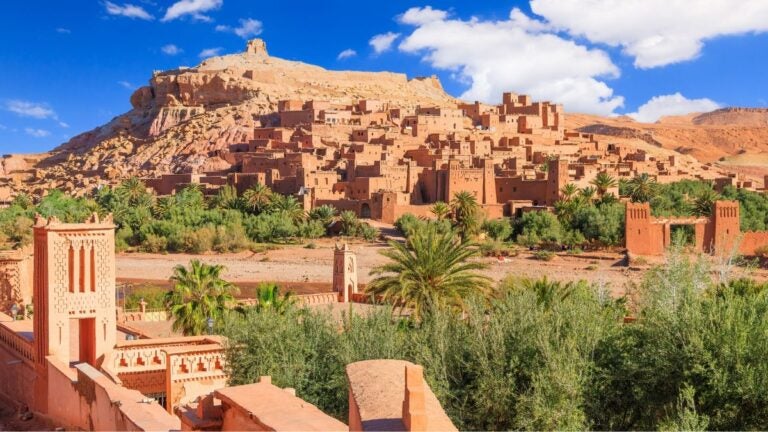
Aït Benhaddou is arguably Morocco’s most cinematic landscape. A fortified ksar of earthen towers and kasbahs, it rises from the Ounila River valley. The dramatic ridges of the southern Atlas form the backdrop. It has held UNESCO World Heritage status since 1987. It is one of the finest surviving examples of southern Moroccan earthen architecture.
For many visitors, the name Aït Benhaddou is already familiar from the screen. The ksar has appeared in Game of Thrones, Gladiator, Lawrence of Arabia, and The Mummy. Its dramatic silhouette and ochre palette have made it one of the most-used filming locations in history.
Aït Benhaddou sits 32 kilometres from Ouarzazate — Morocco’s so-called Hollywood of the desert. It lies on the main road between Marrakech and the Sahara Desert. Most visitors stop here on the drive southeast. Two to three hours is enough to explore the ksar on foot.
A few families still live within the walls and several have set up small shops and guesthouses inside. To enter the ksar, you cross the Ounila River on stepping stones or a small bridge at the base.
Tip: A local guide hired at the ksar entrance will explain the history and the specific filming locations in detail — well worth the small cost. Visit in the late afternoon when the earthen walls glow in the low light.
6. Hike in the Atlas Mountains
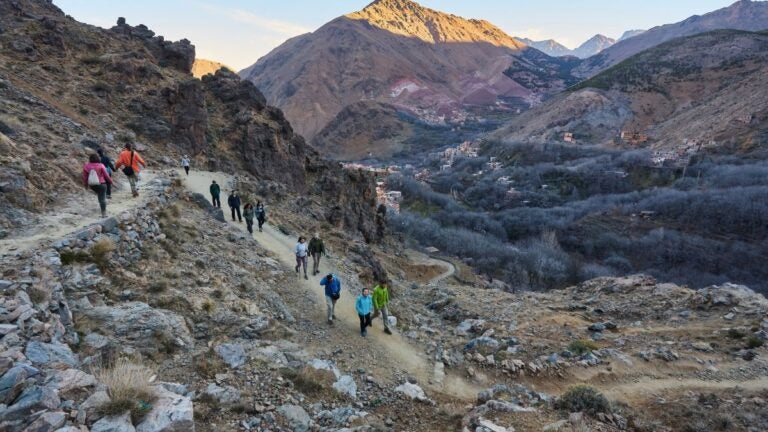
The High Atlas Mountains stretch northeast to southwest across Morocco. At their highest point stands Mount Toubkal at 4,167 metres — the highest peak in North Africa.
The mountains are also home to the Amazigh (Berber) people. Morocco’s indigenous population has lived in these terraced mountain valleys for thousands of years.
Travelling through the Atlas offers a completely different Morocco from the imperial cities: quieter, cooler, and with a pace of life that feels largely unchanged.
The standard route for ascending Toubkal begins in the village of Imlil, 60 kilometres south of Marrakech. From Imlil, the ascent is a two-day route via the Toubkal Refuge hut at 3,207 metres.
Day one takes around four to five hours of hiking. The summit push on day two adds a further three to four hours, depending on conditions.
The views from the summit across the Atlas range are exceptional. No technical climbing equipment is needed outside winter conditions, but the altitude is serious.
For visitors who want the Atlas experience without a multi-day trek, day hikes from Imlil through the Berber villages of Aroumd and Tacheddirt offer dramatic mountain scenery on well-marked trails. The valley floor around Imlil is also beautiful for straightforward walking between traditional stone-and-mud villages with walnut orchards and irrigation channels.
Tip: A licensed mountain guide is strongly recommended for the Toubkal ascent and can be arranged in Imlil on arrival. The best conditions are between May and October; winter ascents require crampons and ice axes. From Marrakech, Imlil is approximately 1.5 hours by taxi or local transport.
7. Experience a traditional hammam
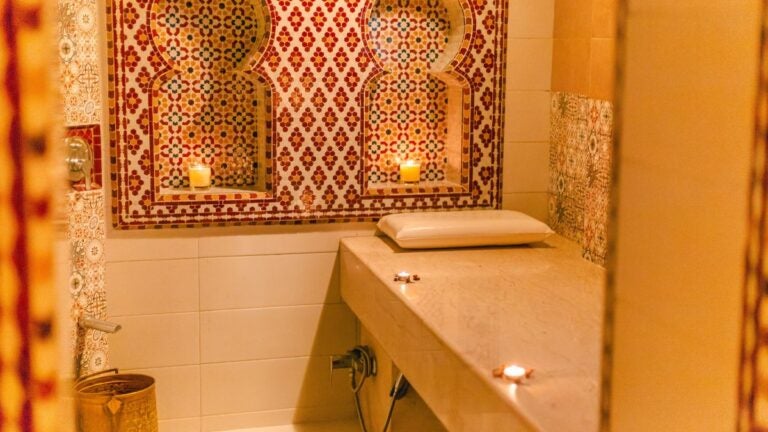
A hammam is a traditional Moroccan bathhouse — one of the most culturally embedded wellness rituals in North Africa, and a genuinely worthwhile experience for any visitor to Morocco.
The classic treatment involves a black soap scrub (using savon beldi, a soft olive oil-based soap), followed by a vigorous exfoliating massage using a kessa glove that removes dead skin, then a steam session and a rinse. The result is noticeably clean and smooth skin — locals visit weekly.
There are two main types of hammam available to visitors. Public hammams (hammam shaabi) are used by local residents, cost just a few dirhams, and offer the most authentic experience — though they are typically single-sex and expect visitors to know the basic etiquette.
Tourist hammams are found throughout the medinas of Marrakech and Fes, offer bilingual staff and a more comfortable environment, and typically include all products and a set treatment. They cost significantly more than public hammams but remain inexpensive by international standards.
Many traditional riads (guesthouses) in Marrakech and Fes have their own private hammam available for guests. Cooking classes are often combined with a hammam booking as part of a half-day cultural package — learning to make a slow-cooked tagine, Moroccan couscous, or traditional mint tea is one of the best ways to engage with Moroccan food culture beyond simply eating at a restaurant.
Tip: For a public hammam, bring your own towel and swimwear (or use the traditional option of wearing underwear), and a small tip for the attendant is expected. At tourist hammams, everything is typically provided. Book ahead in the medina — good tourist hammams fill up quickly.
8. See the Hassan II Mosque in Casablanca
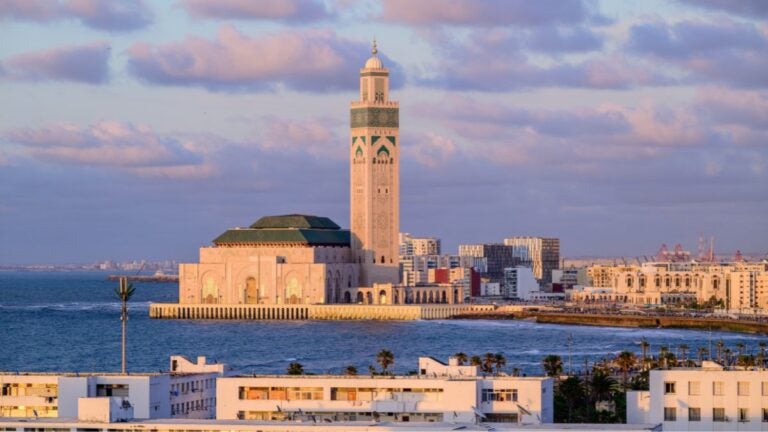
Casablanca is Morocco’s largest city and economic capital, and while it is often bypassed by tourists in favour of the imperial cities, it contains one of the most extraordinary buildings in Africa: the Hassan II Mosque.
Completed in 1993, it is one of the largest mosques in the world — with a capacity for 25,000 worshippers inside and a further 80,000 in the surrounding plaza. Its minaret stands 210 metres tall, making it the tallest religious structure in the world.
The entire complex is built partially over the Atlantic Ocean, with a retractable glass floor in the prayer hall that opens to reveal the water below.
Non-Muslims cannot enter most mosques in Morocco, but the Hassan II Mosque is one of the few exceptions — guided tours run several times daily and are the only way to see the interior. Hand-carved cedar ceilings, zellige tilework, and sculpted stucco cover every surface of a space large enough to hold an entire city block.
For those with an additional day based in or near the region, Volubilis — Morocco’s best-preserved Roman ruins, located near the city of Meknes — makes an excellent extension. The sprawling archaeological site includes remarkably intact mosaics and triumphal arches dating from the 3rd century AD, set against a backdrop of open Moroccan countryside.
Tip: Book Hassan II Mosque guided tours in advance at mosquehassanii.ma — tours run in the morning and early afternoon, and specific time slots sell out. The surrounding Corniche waterfront area is pleasant for a walk before or after the mosque visit.
9. Explore Tangier
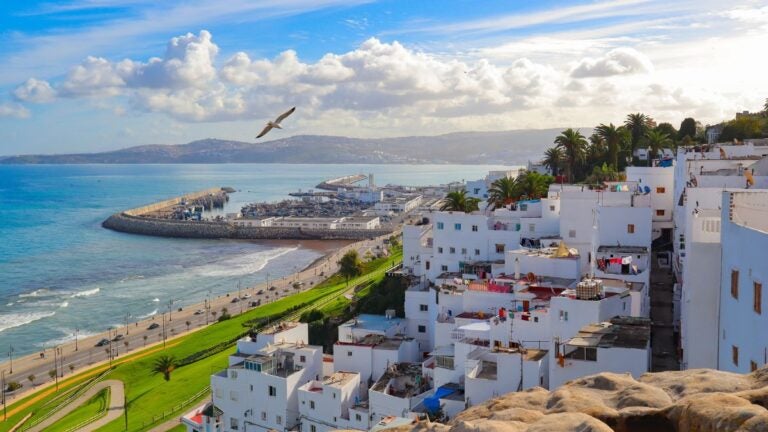
Tangier occupies a unique position — geographically, historically, and culturally. Perched at the northernmost tip of Africa, just 14 kilometres from the coast of Spain across the Strait of Gibraltar, it has spent centuries as a crossroads between continents, cultures, and civilisations. Arabic, Amazigh, Spanish, and French have all left their mark on the city, and the result is a place unlike anywhere else in Morocco: worldly, layered, and perpetually between identities.
The medina of Tangier clusters around the Grand Socco — the main market square — and the Kasbah, which occupies a promontory above the city with views across the Strait. The American Legation Museum in the medina is historically significant: it occupies the building that became the first American diplomatic property outside the United States, gifted by the Sultan of Morocco in 1821, and houses a collection of paintings, letters, and diplomatic correspondence spanning two centuries.
Beyond the city, Cap Spartel — the northwestern tip of Africa — is the point where the Atlantic Ocean meets the Mediterranean Sea, marked by a 19th-century lighthouse on a headland of windswept forest. Nearby, the Caves of Hercules are a network of sea caves connected to the Atlantic by an opening that, in silhouette, resembles the outline of the African continent.
Tip: Tangier works well as a gateway city arriving from Spain by ferry, or as a base for day trips to Chefchaouen and Asilah. The city centre has changed significantly in the last decade — the corniche and new waterfront development have transformed the bay area.
10. Essaouira: Morocco’s windswept Atlantic coast
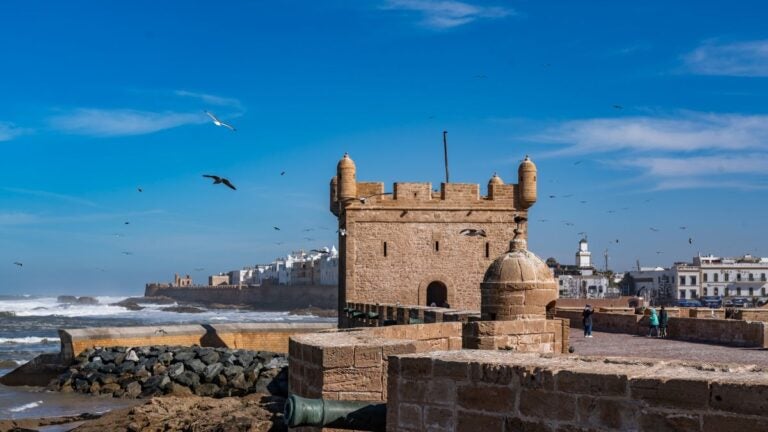
Essaouira is the antidote to the intensity of Marrakech — a fortified coastal medina on the Atlantic, built in the 18th century by French architect Théodore Cornut on the orders of Sultan Mohammed III.
The medina’s white-and-blue buildings, wide straight streets (unusual for a Moroccan medina), and sea ramparts are so well preserved that it has held UNESCO World Heritage status since 2001. The pace of life here is noticeably slower than inland.
Essaouira sits on a stretch of Atlantic coast consistently rated among the best beaches in Morocco for those who prefer wild, windswept shores over busy resort strips. The town is known as the “Wind City of Africa” — the constant Atlantic breeze that makes it a world-class destination for kitesurfing and windsurfing also keeps temperatures pleasant and crowds thinner than the beaches further south.
The ramparts running along the seafront are walkable and offer views across the Atlantic and along the coastline. The port at the southern end is still working — blue fishing boats unload their catch each morning at the harbour, and fresh seafood is sold directly on the quayside.
The medina itself is known for its craftsmen, particularly its thuya wood workshops — the area around Essaouira is the only place in the world where thuya wood is worked commercially, and the intricate carved pieces are among the most distinctive Morocco souvenirs available anywhere in the country.
Every June, Essaouira hosts the Gnaoua World Music Festival — a four-day celebration of Gnaoua music (a spiritual tradition rooted in West African and Moroccan Sufi culture) that draws artists from across Africa and the world. It is one of the most significant music events in North Africa and transforms the medina’s squares and ramparts into open-air stages.
Tip: Essaouira is 2.5 to 3 hours from Marrakech by bus or shared taxi and makes a very manageable two-night addition to a Marrakech itinerary. The wind drops in the evening — the hour before sunset on the ramparts is one of the best moments the city offers.
Practical tips before you visit Morocco
Here are the key practical points for first-time visitors — including answers to the most searched questions about travelling to Morocco:
- Connectivity: 4G coverage is strong in major cities and tourist routes. Remote areas including the Sahara and deep Atlas valleys have limited or no signal. Download offline maps before leaving the city for any desert or mountain itinerary.
- Dress code in medinas and near mosques: Both men and women should cover their shoulders and knees when walking through medinas and near mosques — lightweight trousers or a long skirt work well for both comfort and respect. Shorts are fine on Atlantic beaches but not in medinas or near religious sites.
- Should you bring toilet paper? Yes — carry your own supply, especially outside major hotels and established tourist restaurants. Public toilets in medinas, local cafés, and smaller guesthouses often do not provide it. A small amount of Moroccan Dirham coins is useful for toilet attendants, who are standard at most public facilities.
- Safety: Morocco is consistently ranked among the safest countries in Africa for tourists. Violent crime against visitors is rare. The main concerns are petty theft in crowded medinas (pickpocketing, bag snatching) and persistent touts near major tourist sites in Marrakech. Keep valuables secured and be firm but polite with unsolicited guides.
- Cash: Morocco is largely a cash-based economy, particularly in medinas and souks. Carry Moroccan Dirhams (MAD) — most vendors, street food stalls, and hammams do not accept cards. ATMs are widely available in city centres; avoid exchanging at airport kiosks where rates are poor.
- Bargaining: Expected in souks and with street vendors — start at around 40 to 50% of the asking price and negotiate upward from there. Always be polite and lighthearted; aggressive bargaining is considered rude. Once you agree a price, you are committed to the purchase.
- Getting between cities: Understanding how to get around Morocco is essential for multi-city planning. CTM buses are comfortable and reliable between major cities. Trains connect Casablanca, Rabat, Fes, Marrakech, and Tangier. Shared grands taxis cover shorter regional routes efficiently and cheaply.
- Packing: Morocco’s temperature swings between day and night can be dramatic — especially in the Sahara and the Atlas Mountains where nights are cold regardless of season. A detailed Morocco packing list should include lightweight layers, modest medina clothing, comfortable walking shoes for cobblestones, and a headscarf for women (useful near mosques and in conservative areas).
- Best time to visit: October to April offers the most comfortable temperatures across the country. Summer (July to August) is extremely hot in Marrakech and the Sahara — regularly exceeding 40°C. Winter in the Atlas Mountains is cold and snowy. Morocco in December is an excellent choice: mild temperatures in the cities, no crowds, and spectacular winter light.

Match your eSIM to your vacation
Choose a plan lasting between 1 and 90 days so you never pay for days or data you don't use.
Stay connected from souk to Sahara with Holafly
Navigating Morocco’s medinas, tracking down your riad in an unmarked alley, booking last-minute desert camp places, or calling ahead to a mountain guesthouse — reliable mobile data matters across a country where you are constantly moving between very different environments. A Morocco eSIM from Holafly gives you unlimited data from the moment you land, with no SIM swapping and no roaming charges on top of an already busy trip.
Holafly offers travel eSIMs for 200+ destinations with unlimited data, 5G speeds, and 24/7 customer support on every plan. If you’re extending your trip beyond Morocco to Spain, Portugal, or elsewhere in Europe or Africa, Holafly Plans offers a pay-monthly eSIM covering 170+ destinations — cancel anytime, no long-term commitment. If you prefer a physical card, all local Moroccan operator options are covered in the Morocco SIM card guide.
And with Holafly’s Always On 1 GB backup data included with every eSIM purchase, you have instant connectivity for emergencies — whether that’s finding your way out of the Fes medina, checking the Hassan II Mosque tour times, or navigating back to Merzouga from the dunes at dusk. Simply keep the Holafly eSIM installed on your device and you’ll stay connected from the first souk to the last sunset over the Sahara.
Plans that may interest you

I first started my content creation journey as a freelancer in 2019, before connecting with Holafly in 2021. At Holafly, my travel and tech interests come together in one place as I craft high-quality articles about the eSIM and related markets. My content aims to help travelers stay connected, wherever they are.

