







 Language
London packing list: What to pack and essentials
What to pack for London in every season, plus documents, electronics and what visitors get wrong, from a Holafly writer who lives in the city.

For a London packing list, pack layers, a waterproof outer layer and comfortable walking shoes in every season, plus a three-pin plug adapter and a contactless card. London weather shifts through the day year-round, so a packable rain layer beats a heavy coat for most of it.
What you add depends on the season. Below covers summer, winter and spring or fall, plus documents, toiletries and electronics. Mahnoor Bangush, a Holafly writer who lives in London, has added what visitors get wrong most often.

Match your eSIM to your vacation
Choose a plan lasting between 1 and 90 days so you never pay for days or data you don't use.
What should I wear in London?
Whatever else goes in the case, comfortable shoes are the thing visitors underestimate. Mahnoor Bangush, a Holafly writer who lives in London, describes the pace: “Walk fast, or move to the slower lanes to let the speed-walkers by. If not, you’ll be met with huffs, puffs, and looks of disdain.” Stand on the right on escalators for the same reason.

London has a reputation for always being cold and rainy, but that is not quite true. It is far from a tropical destination, but it does experience all four seasons, so your wardrobe should depend mostly on when you visit.
Annual rainfall at Greenwich averages 562.86 mm, which is lower than a lot of visitors expect. The issue is not how much rain falls, it is how little warning you get.
Summer clothes for London
Summer in London is mild rather than hot, with an average high of 23.75°C (74.8°F) in July and 23.31°C (73.9°F) in August. You can expect around 11 to 12 rainy days in any summer month, which isn’t much more than most cities in Europe. Pack light layers, because evenings cool off quickly.
Pack swimwear too, which is not advice most London lists give. Mahnoor points out something most visitors miss: “Not many people know the pools in Hampstead Heath are open for swimming during the summer. It’s such a peaceful place to relax, especially during the heatwaves.”
Here’s an example of what you might pack for a London trip in the summer:
- Several T-shirts;
- 1-2 pairs of shorts;
- 1-2 pairs of pants/jeans;
- 1-2 sweaters;
- A light jacket for colder days;
- A rain jacket for rainy days;
- A pair of comfortable shoes;
- A pair of shoes for going out;
- An outfit for going out;
- Several pairs of underwear;
- Several pairs of socks.
Winter clothes for London
Winter is colder than the old copy suggested. The average high sits around 8.47°C (47.2°F) in January and 9.21°C (48.6°F) in February, but the average low drops to 3.36°C (38.0°F) in January and 3.22°C (37.8°F) in February. That is a proper coat, not a jacket.
The cold is not really the problem, though. The wet is. As Mahnoor puts it, “Winters in the UK and London usually bring endless rain spells.” A waterproof outer layer earns its place in the case more than a heavy coat does. Snow and freezing temperatures are rare but not unheard of.
- Warm coat or warm jacket
- Several sweaters
- 1-2 sets of warm base layers
- 1-2 pairs of pants
- A scarf
- A winter hat
- A pair of warm gloves
- Warm waterproof boots
- A rain jacket
- Several pairs of warm socks
- Several pairs of underwear
Spring and fall clothes for London
The weather in November and March is not far from what you’d expect in the winter. That said, you can prepare for spring if you’re visiting in April or May, or for fall if your trip takes place in September or October.
With highs ranging from 20°C (68°F) to 12°C (53°F) and lows around 10°C (50°F), you’ll need to pack for both cold and warmer weather. Rain is always a possibility, so make sure you have means to stay dry and clothes to change into if you do get wet.
- A warm jacket
- A lightweight jacket
- A rain jacket
- Several sweaters
- Comfortable shoes
- Waterproof shoes
- Several T-shirts
- 1-2 pairs of pants
- A scarf
- Both warm and regular socks
- Several pairs of underwear
Hygiene and healthcare products
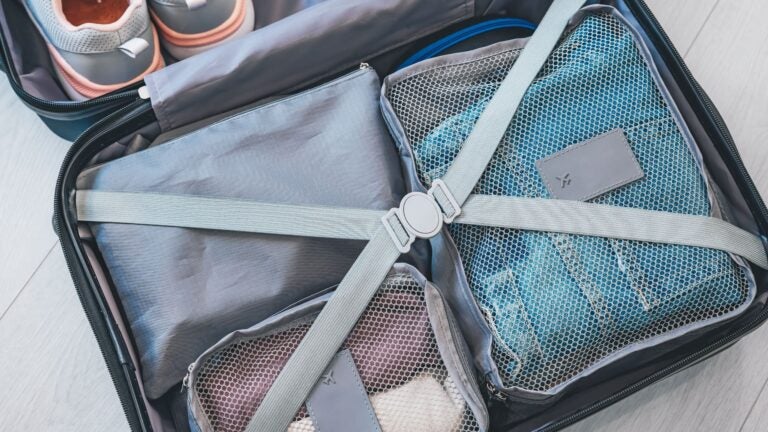
Clothes aren’t the only thing you need to pack for your London trip. You can probably purchase most healthcare and hygiene products when you arrive, but packing them from home means you don’t have to spend money and time buying new things when you already have what you need.
Just keep in mind that most airlines don’t allow liquids over 100 ml in carry-on luggage, so either buy travel-sized packages or have multi-use travel toiletry bottles ready, which you can fill with your own products.
- Toothbrush and toothpaste
- Lip balm
- Basic makeup and hair products
- Shampoo and conditioner
- Soap and/or shower gel
- Deodorant
- Feminine hygiene products
- Tissues and wet wipes
- Reusable water bottle
- Prescription medications, if needed
If you need to take prescription medication daily, make sure to take it with you. It’s a good idea to take the prescription itself with you if the airport security has any questions.
Electronics and internet connection
Gone are the days of using a paper map to navigate and tourist booklets to find somewhere to eat. All of it is on your phone now, so the job is keeping the phone charged and the data running.
UK power sockets deliver an average voltage of 230v, and UK appliances use a three-pin plug. If your device is dual voltage, which most phones, laptops and cameras are, you only need a plug adapter. Check the device for a 110-240v marking to be sure.
If it is not dual voltage, and many US hair dryers and straighteners are not, you need a converter as well as an adapter. Without one, the device will overheat. This catches out more US visitors than anything else on this list.
One more thing that surprises people: UK wall sockets have a switch. If a device is plugged in and nothing is happening, check the switch beside the socket is on before assuming the adapter has failed.
Download your apps before you fly, while you are still on home wifi. Mahnoor names “not planning your journey in advance or using apps like Google Maps or Citymapper” as one of the two biggest mistakes visitors make. Add Lime for electric bikes and scooters, or Santander Cycles if you would rather buy a pass. Trainline and Eurostar cover journeys out of the city.
For data, a london eSIM plan means you land connected rather than hunting for wifi. It is cheaper than paying data roaming charges or buying a SIM card in London, and you can buy, set up and activate it without leaving the house. If you forget, the London airport WiFi will get you as far as buying one. If London is one stop of a longer trip, an eSIM for Europe covers most of the continent on a single eSIM.
Every Holafly eSIM also includes Always On: 1 GB of monthly backup data, at no added cost, across 150+ destinations. That covers you between landing and getting online properly.
- Tour cell phone
- Cell phone charger
- Three-pin UK plug adapter
- A voltage converter, if any of your devices are not dual voltage
- Power bank for charging on the go
- An eSIM for your internet connection
Travel documents
The wonderful trip you’ve planned out for yourself may end at your home airport if you forget to pack the essential travel documents. Here are some of the main one’s that you should have with you whenever you travel to Europe.
- Passport
- Plane tickets
- Driver’s license
- Health and travel insurance
- Visa ,if applicable
None of these take up any space, so you don’t need an extra checked bag to fit everything. You won’t be able to board the plane without your passport and tickets, and a driver’s license matters if you want to explore the country by car.
Travel insurance isn’t mandatory for visitors to the UK, but having it means you can enjoy the trip rather than worry about what might happen. It covers lost or damaged luggage and helps with medical bills if anything goes wrong.
Visitors from most countries, including the US and all of the EU, don’t need a visa to enter the UK on holiday. Most non-British visitors do need to apply for a UK Electronic Travel Authorisation (ETA) before arrival. It’s an online process, costs £10, and is valid for multiple trips over two years.
You can skip the currency exchange. “Card! Contactless payment is what most people tend to use. I rarely see anyone with cash, unless they’re loading funds on to their Oyster card,” says Mahnoor.
You can pick up an Oyster card at any tube station, though it needs funds loaded before you travel. Tapping a bank card or your phone at the gate works just as well. Traveling with teenagers? Ask for the “young visitor” discount, which makes their travel half price.
What should I bring with me for a 7-day trip to London?
The list above should cover the bases. To summarize, here is what to bring for a hypothetical seven-day visit:
- 3-4 T-shirts
- 1-2 pairs of shorts
- 1-2 pairs of pants/jeans
- 2-3 sweaters
- A light jacket for colder days
- A rain jacket for rainy days
- A pair of comfortable shoes
- A pair of shoes for going out
- An outfit for going out
- 4-5 of underwear
- 4-5 pairs of socks
- A warm coat (depending on the season)
- Waterproof boots (depending on the season)
- A scarf, a pair of gloves, and a winter hat (depending on the season)
- Toothbrush and toothpaste
- Lip balm
- Basic makeup and hair products
- Shampoo and conditioner
- Soap and/or shower gel
- Deodorant
- Feminine hygiene products
- Tissues and wet wipes
- Reusable water bottle
- Prescription medications (if needed)
- Your cell phone
- Cell phone charger
- Universal travel adaptor
- Power bank for charging on the go
- eSIM for an internet connection
- Passport
- Plane tickets
- Driver’s license
- UK Electronic Travel Authorisation (ETA), if applicable
- Health and travel insurance
- Visa (if applicable)

That should prepare you for any activity in any weather. Use it as a base for your own checklist and add anything you can’t imagine traveling without, so you have everything ready to enjoy the things to do in London without missing a thing.
London study abroad packing list for international students
Packing for a term or a full academic year is a different exercise from packing for a holiday. You are not packing for the weather you will meet. You are packing for autumn, winter and spring at once, and doing your own laundry.
Mahnoor Bangush, who grew up in the US and now lives in London, has been through the adjustment. On getting around: “After living here for a while, I have to give credit to the TfL. Sure, we have our tube strikes here and there, but you can’t deny how well-connected London is.”
What to bring that a short-stay packing list leaves out:
- A proper winter coat. UK terms run from late September to June. You will be here for the cold months even if you arrive in sunshine.
- Layers you can wear indoors, because older student housing and university buildings are not always warm.
- A UK plug adapter for every device, plus a multi-socket extension lead from home. Student rooms are short on sockets, and one adapter running a UK extension lead is cheaper than buying four adapters.
- Documents in hard copy as well as on your phone. Your passport, your visa or share code and your CAS or acceptance letter. Also proof of address for opening a bank account, and vaccination records for registering with a GP.
- A contactless card that does not charge foreign transaction fees. Worth sorting before you fly.
- Space in the case. Bedding, kitchen equipment and a duvet cost less here than the excess baggage fee. Most student accommodation is within walking distance of somewhere that sells them.
For getting around once you arrive, london public transportation covers the Oyster, contactless and travelcard options in full, including the student discounts worth applying for.
One thing worth sorting before you land: arriving without a working connection. You will need maps, your accommodation’s address and your university’s app in the first hour. That is before you have a UK SIM or a bank account.
Enjoy your time in the Big Smoke
London is an easy city to spend a week in and a hard one to navigate without data. Maps, contactless gates, train times and restaurant bookings all assume you are online, and hotel wifi stops at the door.
A Holafly London eSIM plan gives you unlimited data, 5G speeds and 24/7 support, installed before you fly and active when you land. If your trip runs beyond the capital, the UK eSIM plan covers the same ground across the country.
If you travel often enough that a single-trip plan starts to feel like admin, Holafly Plans is a pay-monthly subscription. One eSIM covers 160+ destinations, with no long-term contract.
Either way, every Holafly eSIM includes Always On: 1 GB of monthly backup data, at no added cost, so you are never completely offline. That is the part that buys peace of mind.

Unlimited data. Peace of mind.
Make sure you have travel data that's there when you need it most.
FAQ
The things you should pack for a London trip depend heavily on when you’re going to visit. Summer weather is typically pleasant and warm with occasional rains, so you can pack fairly light. That said, cold weather is to be expected in the winter and you won’t be comfortable without a coat and a pair of gloves on.
Of course, you shouldn’t forget travel essentials such as your passport or flight tickets as well.
Comfortable everyday walking shoes most of the time. London gets enough rain that a waterproof pair is worth the space as well.
Not really. Contactless card and phone payments work almost everywhere, including on the tube and buses. Carry a small amount for markets and independent cafes.
A three-pin UK adapter. UK sockets run at an average of 230v, so a dual-voltage device needs only an adapter. A device that is not dual voltage needs a converter as well. Check for a 110-240v marking on the device.
Plans that may interest you

I am a Liverpool-based SEO content specialist with years of experience crafting content that connects. I combine my love for clear communication with a passion for travel and languages (currently diving into Japanese!). At Holafly, I'm here to help you understand everything about staying connected abroad, turning technical jargon into straightforward advice you can actually use.

